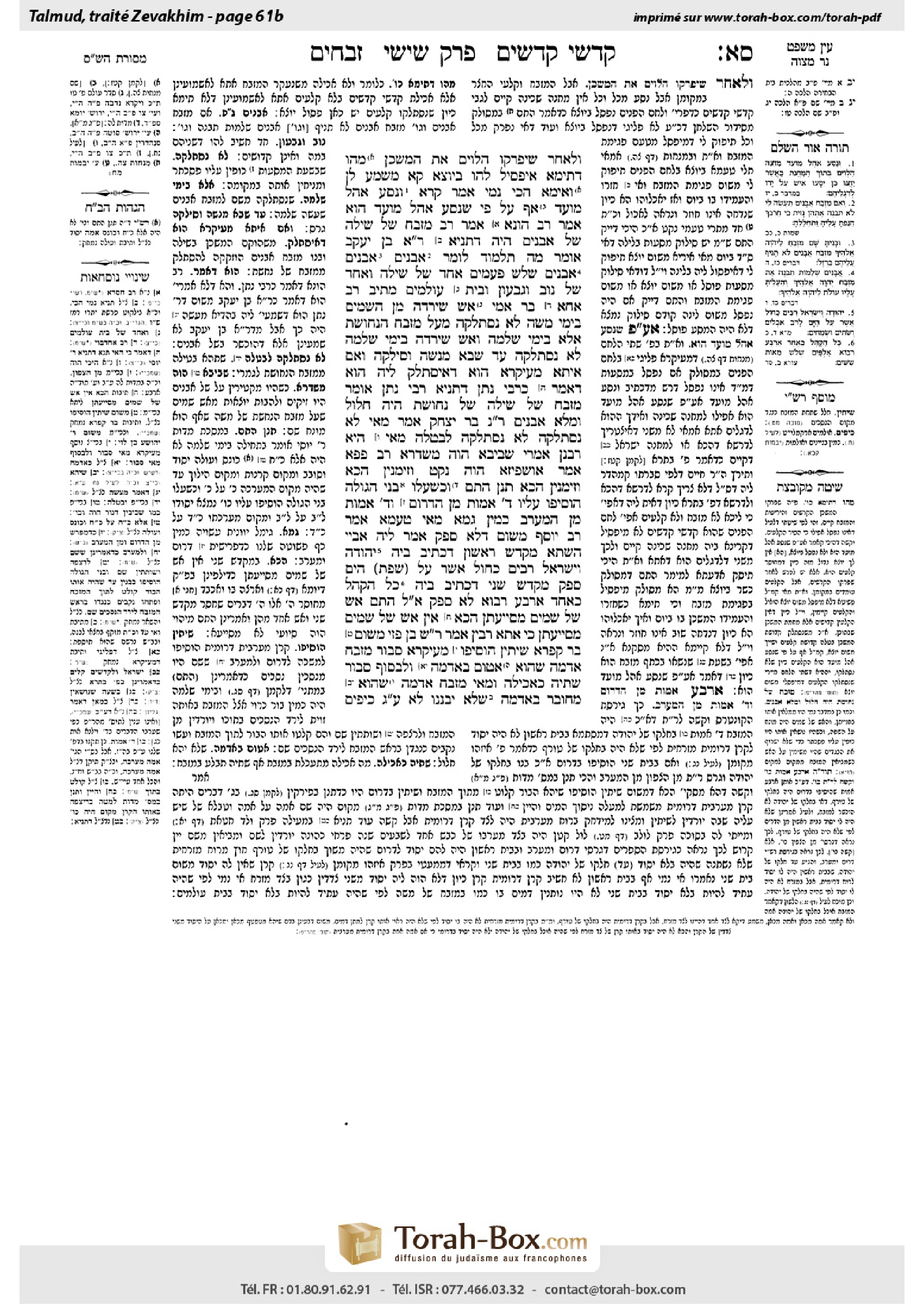
Zevachim 61b: Talmud study for Daf Yomi
Daf Yomi is the daily study of one Talmud folio. Explore 37 tractates with scans, Hebrew text, Sefaria English and AI-generated French translations where annotated.
Passage selection and English or AI-generated French translation are available where the scan has annotations. Daf Study is independent of Torah-Box and Sefaria.
Browse Zevachim · זבחים · All tractatesZevachim 61b text and translations
This page of Zevachim includes the Aramaic text, an English translation and an AI-generated French translation, alongside the scan above.
זבחים ס״א ב · Aramaic and Hebrew text
וּלְאַחַר שֶׁיְּפָרְקוּ הַלְוִיִּם אֶת הַמִּשְׁכָּן.
מַהוּ דְּתֵימָא: אִיפְּסִיל לְהוּ בְּיוֹצֵא; קָא מַשְׁמַע לַן.
וְאֵימָא הָכִי נָמֵי! אָמַר קְרָא: ״וְנָסַע אֹהֶל מוֹעֵד״ – אַף עַל פִּי שֶׁנָּסַע, אֹהֶל מוֹעֵד הוּא.
אָמַר רַב הוּנָא אָמַר רַב: מִזְבֵּחַ שֶׁל שִׁילֹה – שֶׁל אֲבָנִים הָיָה. דְּתַנְיָא, רַבִּי אֱלִיעֶזֶר בֶּן יַעֲקֹב אוֹמֵר: מָה תַּלְמוּד לוֹמַר ״אֲבָנִים״ ״אֲבָנִים״ ״אֲבָנִים״ שָׁלֹשׁ פְּעָמִים? אֶחָד שֶׁל שִׁילֹה, וְאֶחָד שֶׁל נוֹב וְגִבְעוֹן, וּבֵית עוֹלָמִים.
מֵתִיב רַב אַחָא בַּר אַמֵּי: אֵשׁ שֶׁיָּרְדָה מִן הַשָּׁמַיִם בִּימֵי מֹשֶׁה – לֹא נִסְתַּלְּקָה מֵעַל מִזְבַּח הַנְּחוֹשֶׁת אֶלָּא בִּימֵי שְׁלֹמֹה, וְאֵשׁ שֶׁיָּרְדָה בִּימֵי שְׁלֹמֹה – לֹא נִסְתַּלְּקָה עַד שֶׁבָּא מְנַשֶּׁה וְסִילְּקָהּ. וְאִם אִיתָא, מֵעִיקָּרָא הוּא דְּאִיסְתַּלַּק לֵיהּ!
הוּא דְּאָמַר – כְּרַבִּי נָתָן; דְּתַנְיָא, רַבִּי נָתָן אוֹמֵר: מִזְבֵּחַ שֶׁל שִׁילֹה – שֶׁל נְחוֹשֶׁת הָיָה, חָלוּל וּמָלֵא אֲבָנִים.
רַב נַחְמָן בַּר יִצְחָק אָמַר: מַאי לֹא נִסְתַּלְּקָה – לֹא נִסְתַּלְּקָה לְבַטָּלָה. מַאי הִיא? רַבָּנַן אָמְרִי: שְׁבִיבָא הֲוָה מְשַׁדְּרָא. רַב פָּפָּא אָמַר: אוּשְׁפִּיזָא הֲוָה נָקֵט, וְזִימְנִין הָכָא וְזִימְנִין הָכָא.
תְּנַן הָתָם: וּכְשֶׁעָלוּ בְּנֵי הַגּוֹלָה – הוֹסִיפוּ עָלָיו אַרְבַּע אַמּוֹת מִן הַדָּרוֹם וְאַרְבַּע אַמּוֹת מִן הַמַּעֲרָב, כְּמִין גַּמָּא. מַאי טַעְמָא? אָמַר רַב יוֹסֵף: מִשּׁוּם דְּלָא סָפַק.
אֲמַר לֵיהּ אַבָּיֵי: הַשְׁתָּא מִקְדָּשׁ רִאשׁוֹן, דִּכְתִיב בֵּיהּ: ״יְהוּדָה וְיִשְׂרָאֵל רַבִּים כַּחוֹל אֲשֶׁר עַל שְׂפַת הַיָּם״ – סְפֵק; מִקְדָּשׁ שֵׁנִי, דִּכְתִיב בֵּיהּ: ״כׇּל הַקָּהָל כְּאֶחָד אַרְבַּע רִבּוֹא״ – לֹא סָפֵק?! אֲמַר לֵיהּ: הָתָם אֵשׁ שֶׁל שָׁמַיִם מְסַיַּיעְתָּן, הָכָא אֵין אֵשׁ שֶׁל שָׁמַיִם מְסַיַּיעְתָּן.
כִּי אֲתָא רָבִין, אָמַר רַבִּי שִׁמְעוֹן בֶּן פַּזִּי מִשּׁוּם בַּר קַפָּרָא: שִׁיתִין הוֹסִיפוּ. מֵעִיקָּרָא סְבוּר: ״מִזְבַּח אֲדָמָה״ – שֶׁהוּא אָטוּם בָּאֲדָמָה.
וּלְבַסּוֹף סְבוּר: שְׁתִיָּה כַּאֲכִילָה, וּמַאי ״מִזְבַּח אֲדָמָה״ – שֶׁהוּא מְחוּבָּר בַּאֲדָמָה; שֶׁלֹּא יִבְנֶנּוּ לֹא עַל גַּבֵּי כִּיפִּים
Zevachim 61b · English translation
and, when they are leaving the camp, after the Levites dismantle the Tabernacle but before they remove the altar. Since the altar has not yet been moved, it is still permitted to consume the sacrificial food.
The Gemara continues: It was necessary to state this halakha lest you say that once the partitions surrounding the courtyard have been taken down, the sacrificial food has been disqualified because it is considered to have left the courtyard of the Tabernacle. Therefore, the baraita teaches us that the food is permitted for consumption as long as the altar remains in place.
The Gemara challenges: And say it is indeed so, that the sacrificial food should be disqualified because it is no longer within the partitions surrounding the courtyard. The Gemara explains: The verse states: “Then the Tent of Meeting shall travel” (Numbers 2:17). This verse indicates that even though it traveled it is still considered the Tent of Meeting. Therefore, the sacrificial food is not considered to have left its designated area.
§ The Gemara raises another discussion concerning the altar: Rav Huna says that Rav says: The altar in Shiloh was fashioned of stones, unlike the portable altar constructed in the time of Moses, which was fashioned from copper. This is as it is taught in a baraita: Rabbi Eliezer ben Yaakov says: Why must the verses state that the altar must be fashioned from stones (Exodus 20:22), and state again that the altar must be fashioned from stones (Deuteronomy 27:5), and mention yet again the word stones (Deuteronomy 27:6), with regard to the altar, for a total of three times? These allude to three different stone altars: One in Shiloh, and one in Nov and Gibeon, and one in the Eternal House, i.e., the Temple.
Rav Aḥa bar Ami raises an objection based on a baraita: The fire that descended from Heaven upon the altar in the days of Moses (see Leviticus 9:24) departed from atop the copper altar only in the days of Solomon, when he replaced the copper altar with a stone altar, and the fire that descended upon the altar in the days of Solomon did not depart until Manasseh came and removed it by destroying the altar. And if it is so that the altar in Shiloh was fashioned of stones, it emerges that the fire departed the copper altar earlier, when the stone altar in Shiloh replaced the copper altar of Moses, many years before King Solomon.
The Gemara explains: Rav Huna stated his opinion in accordance with the statement of Rabbi Natan, as it is taught in a baraita that Rabbi Natan says: The altar in Shiloh was fashioned of copper; it was hollow and full of stones.
Rav Naḥman bar Yitzḥak says there is an alternative answer: What is the meaning of the statement in the baraita that the fire did not depart until the days of Solomon? It means that it did not depart in a manner in which it was nullified; it was still somewhat present in Shiloh on the copper altar, which stood together with the stone altar. The Gemara asks: What is it, i.e., what does it mean that the fire did not depart in a manner in which it was nullified? The Gemara answers: The Rabbis say: The fire on the copper altar would emit sparks toward the stone altar when the priests would sacrifice offerings on the stone altar. Rav Pappa says: The fire was as a guest; sometimes it was here, on the copper altar, and sometimes it was there, on the stone altar.
§ The Gemara continues discussing the altar: We learned in a mishna there (Middot 35b): The altar in the First Temple was twenty-eight by twenty-eight cubits. When the members of the exile ascended to Jerusalem in the beginning of the Second Temple period, they added four cubits to it on the south and four cubits on the west sides of the altar, like the shape of the Greek letter gamma, i.e., the additions made a right angle. As a result, the altar in the Second Temple was thirty-two by thirty-two cubits. The Gemara asks: What was the reason for this expansion? Rav Yosef said: Because the size of the altar from the First Temple was not sufficient.
Abaye said to him: Now, if in the First Temple era, about which it is written: “Judah and Israel were many as the sand that is by the sea” (I Kings 4:20), the altar was sufficient, how could it be that in the Second Temple era, about which it is written: “The whole congregation together was forty and two thousand three hundred and sixty” (Ezra 2:64), the altar was not sufficient? Rav Yosef said to Abaye: There, in the First Temple, a heavenly fire would assist them and consume the offerings. Here, in the Second Temple, there was no heavenly fire that would assist them. Therefore, they needed a larger area in which to burn the offerings.
When Ravin came from Eretz Yisrael to Babylonia, he reported that which Rabbi Shimon ben Pazi says in the name of Bar Kappara with regard to the expansion of the altar: They expanded the altar to extend over the underground cavities into which the libations flowed. Initially, in the First Temple era, they held that when the verse states: “An altar of earth you shall make for Me” (Exodus 20:21), it means that it should be completely filled with earth.
But ultimately, in the Second Temple era, they maintained that the altar’s drinking is like its eating, i.e., just as the offerings are burned upon the altar, so too, the libations must be poured onto the altar itself and not down its side. Consequently, they expanded the altar to cover the underground cavities, and created holes in the altar so that the libations could be poured on top of the altar and flow into the underground cavities. And according to this, what is the meaning of the phrase “an altar of earth”? It teaches that the altar must be attached to the earth, so that one may not build it on top of arches
Zevachim 61b · Traduction française (IA)
et, lorsqu’ils quittent le camp, après que les Lévites ont démonté le Tabernacle, mais avant qu’ils ne déplacent l’autel. Puisque l’autel n’a pas encore été déplacé, il est toujours permis de consommer les aliments sacrificiels.
La Guemara poursuit : Il fallait énoncer cette halakha, de peur que tu ne dises qu’une fois les tentures entourant la cour démontées, les aliments sacrificiels sont invalidés, car ils sont considérés comme ayant quitté la cour du Tabernacle. La baraïta nous enseigne donc que ces aliments peuvent être consommés tant que l’autel reste en place.
La Guemara objecte : Pourquoi ne pas dire que c’est bien le cas, et que les aliments sacrificiels doivent être invalidés puisqu’ils ne se trouvent plus à l’intérieur des tentures entourant la cour ? La Guemara explique : Le verset dit : « Alors la Tente de la Rencontre se mettra en marche » (Nombres 2:17). Ce verset indique que, même lorsqu’elle se déplace, elle est toujours considérée comme la Tente de la Rencontre. Par conséquent, les aliments sacrificiels ne sont pas considérés comme ayant quitté l’endroit qui leur est assigné.
§ La Guemara soulève une autre question au sujet de l’autel : Rav Houna dit au nom de Rav : L’autel de Silo était fait de pierres, contrairement à l’autel portatif construit à l’époque de Moïse, qui était fait de cuivre. C’est ce qui est enseigné dans une baraïta : Rabbi Eliezer ben Yaakov dit : Pourquoi les versets indiquent-ils que l’autel doit être fait de pierres (Exode 20:22), le répètent-ils (Deutéronome 27:5), puis mentionnent-ils encore le mot « pierres » à propos de l’autel (Deutéronome 27:6), soit trois fois au total ? Ces mentions font allusion à trois autels de pierre différents : l’un à Silo, l’un à Nov et à Gabaon, et l’un dans la Maison éternelle, c’est-à-dire le Temple.
Rav Aḥa bar Ami objecte en s’appuyant sur une baraïta : Le feu descendu du Ciel sur l’autel à l’époque de Moïse (voir Lévitique 9:24) ne quitta le sommet de l’autel de cuivre qu’à l’époque de Salomon, lorsque celui-ci remplaça l’autel de cuivre par un autel de pierre ; et le feu descendu sur l’autel à l’époque de Salomon ne disparut qu’à l’arrivée de Manassé, qui le fit disparaître en détruisant l’autel. Or, s’il est vrai que l’autel de Silo était fait de pierres, il s’ensuit que le feu aurait quitté l’autel de cuivre plus tôt, lorsque l’autel de pierre de Silo remplaça l’autel de cuivre de Moïse, de nombreuses années avant le roi Salomon.
La Guemara explique : Rav Houna a exprimé son avis conformément à celui de Rabbi Natan, comme on l’enseigne dans une baraïta : Rabbi Natan dit : L’autel de Silo était fait de cuivre ; il était creux et rempli de pierres.
Rav Naḥman bar Yitzḥak propose une autre réponse : Que signifie, dans la baraïta, l’affirmation selon laquelle le feu ne disparut qu’à l’époque de Salomon ? Cela signifie qu’il ne disparut pas au point de s’éteindre complètement ; il était encore présent dans une certaine mesure à Silo, sur l’autel de cuivre, qui se dressait à côté de l’autel de pierre. La Guemara demande : Qu’est-ce que cela signifie, c’est-à-dire que veut-on dire en affirmant que le feu ne disparut pas au point de s’éteindre complètement ? La Guemara répond : Les Rabbins disent que le feu de l’autel de cuivre projetait des étincelles vers l’autel de pierre lorsque les prêtres y offraient des sacrifices. Rav Pappa dit que le feu était comme un invité : tantôt il se trouvait ici, sur l’autel de cuivre, tantôt là, sur l’autel de pierre.
§ La Guemara poursuit sa discussion sur l’autel : Nous avons appris dans une Michna, là-bas (Middot 35b) : L’autel du Premier Temple mesurait vingt-huit sur vingt-huit coudées. Lorsque les membres de l’exil montèrent à Jérusalem au début de la période du Second Temple, ils l’agrandirent de quatre coudées au sud et de quatre coudées à l’ouest, à la manière de la lettre grecque gamma, c’est-à-dire que les agrandissements formaient un angle droit. L’autel du Second Temple mesurait donc trente-deux sur trente-deux coudées. La Guemara demande : Pour quelle raison l’a-t-on agrandi ? Rav Yossef dit : Les dimensions de l’autel du Premier Temple ne suffisaient pas.
Abayé lui dit : Si, à l’époque du Premier Temple, dont il est écrit : « Juda et Israël étaient nombreux comme le sable qui est au bord de la mer » (I Rois 4:20), l’autel suffisait, comment se peut-il qu’à l’époque du Second Temple, dont il est écrit : « Toute l’assemblée réunie comptait quarante-deux mille trois cent soixante personnes » (Esdras 2:64), l’autel n’ait pas suffi ? Rav Yossef dit à Abayé : Là-bas, au Premier Temple, un feu céleste les aidait et consumait les offrandes. Ici, au Second Temple, aucun feu céleste ne les aidait. Ils avaient donc besoin d’une plus grande surface pour brûler les offrandes.
Lorsque Ravin arriva d’Eretz Yisrael en Babylonie, il rapporta ce que Rabbi Shimon ben Pazi dit au nom de Bar Kappara au sujet de l’agrandissement de l’autel : ils agrandirent l’autel de façon qu’il recouvre les cavités souterraines dans lesquelles s’écoulaient les libations. Au début, à l’époque du Premier Temple, ils estimaient que, lorsque le verset dit : « Tu me feras un autel de terre » (Exode 20:21), cela signifie qu’il doit être entièrement rempli de terre.
Mais, finalement, à l’époque du Second Temple, ils soutinrent que l’autel reçoit les libations comme il reçoit les offrandes, c’est-à-dire que, de même que les offrandes sont brûlées sur l’autel, les libations doivent elles aussi être versées sur l’autel lui-même, et non le long de son côté. Par conséquent, ils agrandirent l’autel pour qu’il recouvre les cavités souterraines et y percèrent des trous, afin que les libations puissent être versées sur l’autel et s’écouler dans les cavités souterraines. Et selon cette explication, que signifie l’expression « un autel de terre » ? Elle enseigne que l’autel doit être ancré dans la terre, de sorte qu’on ne peut pas le construire au-dessus d’arches
Traduction française générée par IA à partir de l’édition anglaise de Sefaria. Vérifie toujours un passage avec le texte source.
Text from Sefaria: William Davidson Edition - Vocalized Aramaic (CC BY NC); William Davidson Edition - English (CC BY NC).