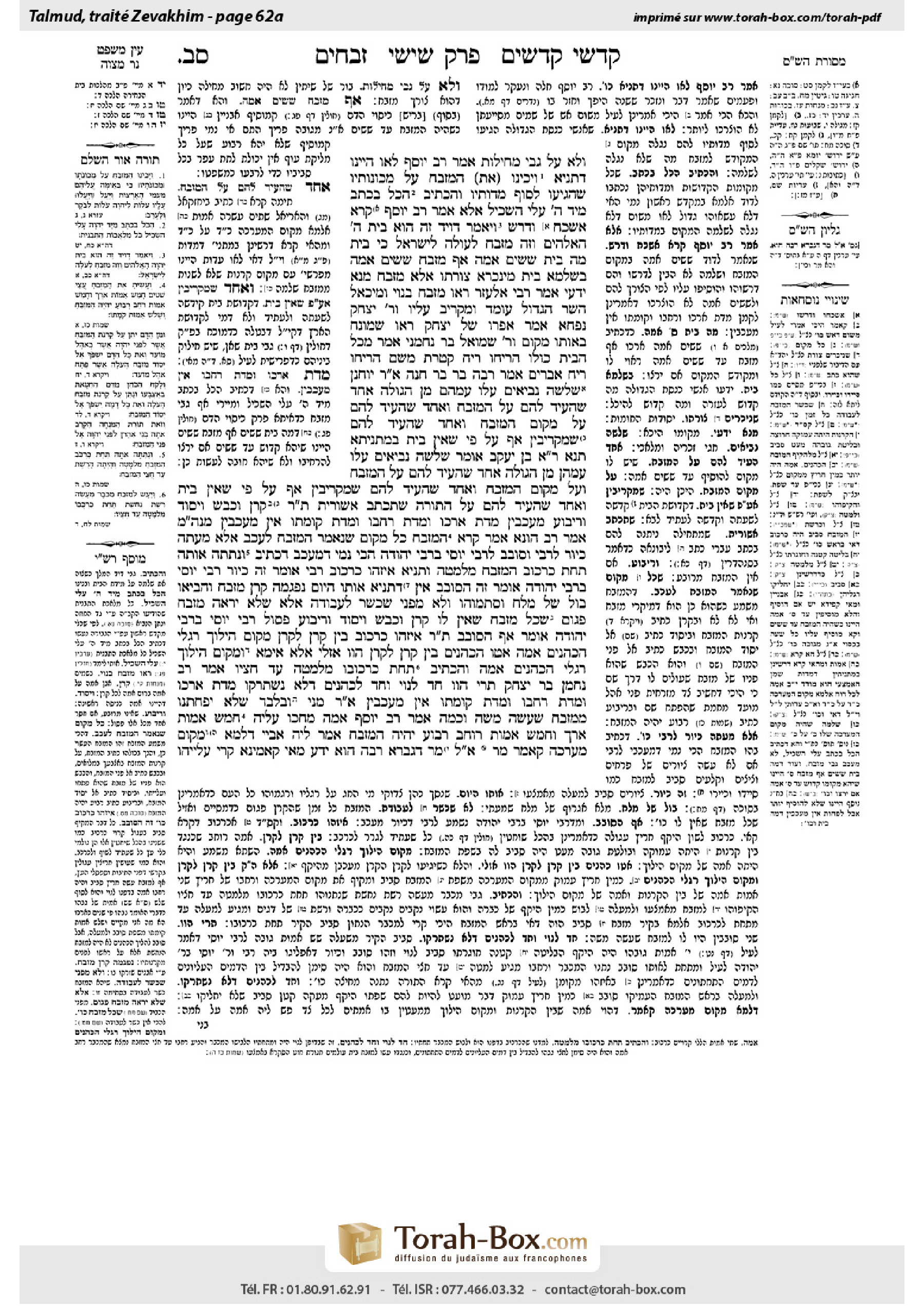
Zevachim 62a: Talmud study for Daf Yomi
Daf Yomi is the daily study of one Talmud folio. Explore 37 tractates with scans, Hebrew text, Sefaria English and AI-generated French translations where annotated.
Passage selection and English or AI-generated French translation are available where the scan has annotations. Daf Study is independent of Torah-Box and Sefaria.
Browse Zevachim · זבחים · All tractatesZevachim 62a text and translations
This page of Zevachim includes the Aramaic text, an English translation and an AI-generated French translation, alongside the scan above.
זבחים ס״ב א · Aramaic and Hebrew text
וְלֹא עַל גַּבֵּי מְחִילּוֹת.
אָמַר רַב יוֹסֵף, לָאו הַיְינוּ דְּתַנְיָא: ״וַיָּכִינוּ אֶת הַמִּזְבֵּחַ עַל מְכוֹנָתוֹ״ – שֶׁהִגִּיעוּ לְסוֹף מִדּוֹתָיו? וְהָכְתִיב: ״הַכֹּל בִּכְתָב מִיַּד ה׳ עָלַי הִשְׂכִּיל״!
אֶלָּא אָמַר רַב יוֹסֵף: קְרָא אַשְׁכַּח וּדְרַשׁ – ״וַיֹּאמֶר דָּוִיד: זֶה הוּא בֵּית ה׳ הָאֱלֹהִים, וְזֶה מִּזְבֵּחַ לְעֹלָה לְיִשְׂרָאֵל״ – כִּי בַּיִת; מָה בַּיִת שִׁשִּׁים אַמָּה, אַף מִזְבֵּחַ שִׁשִּׁים אַמָּה.
בִּשְׁלָמָא בַּיִת – מִינַּכְרָא צוּרָתוֹ; אֶלָּא מִזְבֵּחַ – מְנָא יָדְעִי?
אָמַר רַבִּי אֶלְעָזָר: רָאוּ מִזְבֵּחַ בָּנוּי, וּמִיכָאֵל הַשַּׂר הַגָּדוֹל עוֹמֵד וּמַקְרִיב עָלָיו. וְרַבִּי יִצְחָק נַפָּחָא אָמַר: אֶפְרוֹ שֶׁל יִצְחָק רָאוּ, שֶׁמּוּנָּח בְּאוֹתוֹ מָקוֹם. וְרַבִּי שְׁמוּאֵל בַּר נַחְמָנִי אָמַר: מִכׇּל הַבַּיִת כּוּלּוֹ הֵרִיחוּ רֵיחַ קְטֹרֶת, מִשָּׁם הֵרִיחוּ רֵיחַ אֵבָרִים.
אָמַר רַבָּה בַּר בַּר חָנָה אָמַר רַבִּי יוֹחָנָן: שְׁלֹשָׁה נְבִיאִים עָלוּ עִמָּהֶם מִן הַגּוֹלָה – אֶחָד שֶׁהֵעִיד לָהֶם עַל הַמִּזְבֵּחַ, וְאֶחָד שֶׁהֵעִיד לָהֶם עַל מְקוֹם הַמִּזְבֵּחַ, וְאֶחָד שֶׁהֵעִיד לָהֶם שֶׁמַּקְרִיבִין אַף עַל פִּי שֶׁאֵין בַּיִת.
בְּמַתְנִיתָא תָּנָא, רַבִּי אֱלִיעֶזֶר בֶּן יַעֲקֹב אוֹמֵר: שְׁלֹשָׁה נְבִיאִים עָלוּ עִמָּהֶן מִן הַגּוֹלָה – אֶחָד שֶׁהֵעִיד לָהֶם עַל הַמִּזְבֵּחַ וְעַל מְקוֹם הַמִּזְבֵּחַ, וְאֶחָד שֶׁהֵעִיד לָהֶם שֶׁמַּקְרִיבִין אַף עַל פִּי שֶׁאֵין בַּיִת, וְאֶחָד שֶׁהֵעִיד לָהֶם עַל הַתּוֹרָה – שֶׁתִּכָּתֵב אַשּׁוּרִית.
תָּנוּ רַבָּנַן: קֶרֶן וְכֶבֶשׁ וִיסוֹד וְרִיבּוּעַ – מְעַכְּבִין. מִדַּת אׇרְכּוֹ וּמִדַּת רׇחְבּוֹ וּמִדַּת קוֹמָתוֹ – אֵין מְעַכְּבִין. מְנָא הָנֵי מִילֵּי? אָמַר רַב הוּנָא, אָמַר קְרָא: ״הַמִּזְבֵּחַ״; כׇּל מָקוֹם שֶׁנֶּאֱמַר ״הַמִּזְבֵּחַ״ – לְעַכֵּב.
אֶלָּא מֵעַתָּה, כִּיּוֹר לְרַבִּי וְסוֹבֵב לְרַבִּי יוֹסֵי בְּרַבִּי יְהוּדָה – הָכִי נָמֵי דִּמְעַכֵּב?! דִּכְתִיב: ״וְנָתַתָּה אֹתָהּ תַּחַת כַּרְכֹּב הַמִּזְבֵּחַ מִלְּמָטָּה״, וְתַנְיָא: אֵיזֶהוּ כַּרְכּוֹב? רַבִּי אוֹמֵר: זֶה כִּיּוּר, רַבִּי יוֹסֵי בְּרַבִּי יְהוּדָה אוֹמֵר: זֶה הַסּוֹבֵב!
אִין; דְּתַנְיָא: אוֹתוֹ הַיּוֹם נִפְגְּמָה קֶרֶן מִזְבֵּחַ, וְהֵבִיאוּ בּוּל שֶׁל מֶלַח וּסְתָמוּהוּ; וְלֹא מִפְּנֵי שֶׁכָּשֵׁר לַעֲבוֹדָה, אֶלָּא שֶׁלֹּא יֵרָאֶה מִזְבֵּחַ פָּגוּם. שֶׁכׇּל מִזְבֵּחַ שֶׁאֵין לוֹ קֶרֶן וְכֶבֶשׁ וִיסוֹד וְרִיבּוּעַ – פָּסוּל. רַבִּי יוֹסֵי בְּרַבִּי יְהוּדָה אוֹמֵר: אַף הַסּוֹבֵב.
תָּנוּ רַבָּנַן: אֵיזֶהוּ כַּרְכּוֹב? בֵּין קֶרֶן לְקֶרֶן, מְקוֹם הִילּוּךְ רַגְלֵי הַכֹּהֲנִים אַמָּה. אַטּוּ (הכהנים) [כֹּהֲנִים] בֵּין קֶרֶן לְקֶרֶן הֲווֹ אָזְלִי?! אֶלָּא אֵימָא: וּמְקוֹם הִילּוּךְ רַגְלֵי הַכֹּהֲנִים – אַמָּה.
וְהָכְתִיב: ״תַּחַת כַּרְכֻּבּוֹ מִלְּמַטָּה עַד חֶצְיוֹ״! אָמַר רַב נַחְמָן בַּר יִצְחָק: תְּרֵי הֲווֹ; חַד לְנוֹי, וְחַד לְכֹהֲנִים דְּלָא נִשְׁתַּרְקוּ.
מִדַּת אׇרְכּוֹ וּמִדַּת רׇחְבּוֹ וּמִדַּת קוֹמָתוֹ – אֵין מְעַכְּבִין. אָמַר רַבִּי מָנִי: וּבִלְבַד שֶׁלֹּא יִפְחָתֶנּוּ מִמִּזְבֵּחַ שֶׁעָשָׂה מֹשֶׁה. וְכַמָּה? אָמַר רַב יוֹסֵף: אַמָּה. מַחֲכוּ עֲלֵיהּ: ״חָמֵשׁ אַמּוֹת אֹרֶךְ וְחָמֵשׁ אַמּוֹת רֹחַב רָבוּעַ יִהְיֶה הַמִּזְבֵּחַ״!
אֲמַר לֵיהּ אַבָּיֵי: דִּלְמָא מְקוֹם מַעֲרָכָה קָאָמַר מָר? אֲמַר לֵיהּ: מָר דְּגַבְרָא רַבָּה הוּא, יָדַע מַאי קָאָמֵינָא. קָרֵי עֲלַיְיהוּ
Zevachim 62a · English translation
and one may not build it on top of tunnels.
The Gemara relates that after reconsidering the reason for the expansion of the altar, Rav Yosef said: Is this not as it is taught in a baraita with regard to the verse: “And they set the altar upon its bases” (Ezra 3:3), which teaches that in the Second Temple the size of the altar reached its full measure, i.e., that it was the ideal size, whereas in the First Temple it was not the ideal size? The Gemara asks: But isn’t it written with regard to the instructions David gave Solomon about how to build the Temple: “All this in writing, as the Lord has made me wise by His hand upon me, even all the works of this pattern” (I Chronicles 28:19), indicating that the design of the First Temple was dictated by God?
Rather, Rav Yosef said: The size of the altar in the First Temple was ideal, but in the Second Temple era there was a need to expand the altar, and they found a verse and interpreted it as follows. The verse states: “Then David said: This is the House of the Lord God, and this is the altar of burnt offering for Israel” (I Chronicles 22:1). The verse juxtaposes the House, i.e., the Temple, with the altar, which indicates that the altar is like the Temple: Just as the House was sixty cubits (see I Kings 6:2), so too, the altar may be extended up to a length of sixty cubits.
§ The Gemara discusses the construction of the altar in the Second Temple. The Gemara asks: Granted, with regard to the location of the House, its shape was discernable from the vestiges of its foundations; but how did they know the proper location of the altar?
The Gemara answers that Rabbi Elazar says: They saw a vision of the altar already built and Michael the archangel standing and sacrificing offerings upon it. And Rabbi Yitzḥak Nappaḥa says: They saw a vision of the ashes of Isaac that were placed in that location. And Rabbi Shmuel bar Naḥmani says: From the entire House they smelled the scent of incense, yet from there, the location of the altar, they smelled a scent of burned animal limbs.
Rabba bar bar Ḥana says that Rabbi Yoḥanan says: Three prophets ascended with them from the exile: One who testified to them about the size and shape of the altar, and one who testified to them about the proper location of the altar, and one who testified to them that one sacrifices offerings even if there is no Temple, provided that there is a proper altar.
It was taught in a baraita that Rabbi Eliezer ben Yaakov says: Three prophets ascended with the Jewish people from the exile: One who testified to them about the size and shape of the altar and about the proper location of the altar, and one who testified to them that one sacrifices offerings even if there is no Temple, and one who testified to them about the Torah and instructed that it be written in Assyrian script [Ashurit] rather than the ancient Hebrew script used in the times of Moses.
§ The Sages taught in a baraita: The corner built at each point where the edges of the altar meet, the ramp upon which the priests ascended the altar, the base of the altar, and the requirement that the altar must be exactly square, are all indispensable in order for the altar to be fit for use. But the measurement of its length, and the measurement of its width, and the measurement of its height are not indispensable. The Gemara asks: From where are these matters derived? Rav Huna says: In reference to each of these characteristics the verse states the term “the altar,” and there is a principle that wherever the term “the altar” is stated, it serves to indicate that the halakhic detail mentioned is indispensable.
The Gemara asks: If that is so, then the engraving [kiyyur] that was on the altar according to Rabbi Yehuda HaNasi, or the surrounding ledge of the altar according to Rabbi Yosei, son of Rabbi Yehuda, should also be indispensable, as it is written: “And you shall put it under the karkov of the altar beneath” (Exodus 27:5). And it is taught in a baraita: What is the karkov? Rabbi Yehuda HaNasi says: This is the engraving on the altar. Rabbi Yosei, son of Rabbi Yehuda, says: This is the surrounding ledge.
The Gemara answers: Yes, the karkov is also indispensable, as it is taught in a baraita: On that day when etrogim were pelted at a Sadducee priest who poured the water libation of Sukkot on his feet rather than on the altar (see Sukka 48b), the corner of the altar was damaged as a result of the pelting and the ensuing chaos. They brought a fistful of salt and sealed the damaged section. They did this not because it rendered the altar fit for the Temple service, but in deference to the altar, so that the altar would not be seen in its damaged state. The reason the altar is disqualified is because any altar that does not have a corner, a ramp, and a base, and any altar that is not square, is disqualified. Rabbi Yosei, son of Rabbi Yehuda, says: Even the surrounding ledge is indispensable.
§ The Sages taught in a baraita: What is the karkov of the altar? It is the area between one corner and the next corner, which is the cubit-wide place on top of the altar where the priests would walk. The Gemara asks: Is that to say that the priests would walk between one corner and the next corner? The Gemara answers: Rather, say: The karkov is the cubit-wide area between one corner and the other, and there was an additional cubit that was the place where the priests would walk.
The Gemara asks: But isn’t it written: “And he made for the altar a grating of network of brass, under the karkov beneath, reaching halfway up” (Exodus 38:4), which indicates that the karkov was on the side of the altar and not on top of it? The Gemara answers: Rav Naḥman bar Yitzḥak said: There were two entities called karkov. One was a slight protrusion above the midway point of the altar for aesthetic purposes, and one was an indentation on top of the altar for the benefit of the priests, to ensure that they would not slip off the top of the altar.
It was taught in a baraita cited above that the measurement of the altar’s length, and the measurement of its width, and the measurement of its height are not indispensable. Rabbi Mani says: This is the halakha provided that one does not decrease its size so that it is smaller than the altar constructed by Moses. The Gemara asks: And how large was the altar constructed by Moses? Rav Yosef says: One cubit. Those in the study hall mocked Rav Yosef, as it is written explicitly: “Five cubits long and five cubits wide; the altar shall be square” (Exodus 27:1).
Abaye said to Rav Yosef: Perhaps the Master is speaking about the area of the arrangement of wood? Since the corners took up one cubit on each side and there was an additional cubit on each side for the priests to walk, only one cubit was left for the arrangement of wood. Rav Yosef said to Abaye: The Master, i.e., Abaye, who is a great man, knows what I mean to say. Rav Yosef read, i.e., applied, the following verse to those who mocked him:
Zevachim 62a · Traduction française (IA)
et on ne peut pas le construire au-dessus de tunnels.
La Guemara rapporte qu’après avoir réexaminé la raison de l’agrandissement de l’autel, Rav Yosef dit : N’est-ce pas ce qui est enseigné dans une baraïta à propos du verset : « Ils placèrent l’autel sur ses fondations » (Esdras 3:3), qui enseigne que, dans le Second Temple, l’autel atteignit ses dimensions maximales, c’est-à-dire ses dimensions idéales, alors que, dans le Premier Temple, il n’avait pas ses dimensions idéales ? La Guemara demande : Mais n’est-il pas écrit, au sujet des instructions que David donna à Salomon sur la construction du Temple : « Tout cela par écrit, comme le Seigneur m’a éclairé de Sa main, toutes les œuvres de ce modèle » (I Chroniques 28:19), ce qui indique que le plan du Premier Temple avait été dicté par Dieu ?
Rav Yosef dit plutôt : Les dimensions de l’autel du Premier Temple étaient idéales, mais, à l’époque du Second Temple, il fallut agrandir l’autel, et ils trouvèrent un verset qu’ils interprétèrent ainsi. Le verset dit : « David dit alors : C’est ici la Maison du Seigneur Dieu, et c’est ici l’autel des holocaustes pour Israël » (I Chroniques 22:1). Le verset juxtapose la Maison, c’est-à-dire le Temple, et l’autel, ce qui indique que l’autel est comparable au Temple : de même que la Maison avait soixante coudées (voir I Rois 6:2), de même l’autel peut être prolongé jusqu’à une longueur de soixante coudées.
§ La Guemara examine la construction de l’autel dans le Second Temple. La Guemara demande : Certes, quant à l’emplacement de la Maison, sa forme était discernable à partir des vestiges de ses fondations ; mais comment ont-ils déterminé l’emplacement exact de l’autel ?
La Guemara répond que Rabbi Elazar dit : Ils virent l’autel déjà construit dans une vision, avec l’archange Mikhaël debout et offrant des sacrifices dessus. Rabbi Yitzḥak Nappaḥa dit : Ils virent dans une vision les cendres d’Isaac, déposées à cet endroit. Et Rabbi Shmuel bar Naḥmani dit : Dans toute la Maison, ils sentaient le parfum de l’encens, tandis qu’à cet endroit, celui de l’autel, ils sentaient l’odeur de membres d’animaux brûlés.
Rabba bar bar Ḥana dit au nom de Rabbi Yoḥanan : Trois prophètes montèrent avec eux depuis l’exil : l’un leur attesta les dimensions et la forme de l’autel, un autre leur attesta l’emplacement exact de l’autel, et un troisième leur attesta qu’on offre des sacrifices même en l’absence du Temple, à condition qu’il y ait un autel conforme.
Il a été enseigné dans une baraïta que Rabbi Eliezer ben Yaakov dit : Trois prophètes montèrent avec le peuple juif depuis l’exil : l’un leur attesta les dimensions et la forme de l’autel ainsi que son emplacement exact ; un autre leur attesta qu’on offre des sacrifices même en l’absence du Temple ; et un troisième leur attesta ce qui concerne la Torah et ordonna qu’elle soit écrite en écriture assyrienne [Ashurit], plutôt que dans l’ancienne écriture hébraïque utilisée à l’époque de Moïse.
§ Les Sages enseignèrent dans une baraïta : La corne construite à chacun des points où se rencontrent les arêtes de l’autel, la rampe par laquelle les prêtres montaient sur l’autel, la base de l’autel et l’exigence que l’autel soit parfaitement carré sont toutes indispensables pour que l’autel soit apte au service. En revanche, la mesure de sa longueur, celle de sa largeur et celle de sa hauteur ne sont pas indispensables. La Guemara demande : D’où déduit-on ces règles ? Rav Huna dit : Pour chacune de ces caractéristiques, le verset emploie le terme « l’autel », et un principe veut que partout où figure le terme « l’autel », il indique que le détail halakhique mentionné est indispensable.
La Guemara demande : Si c’est ainsi, la gravure [kiyyur] qui se trouvait sur l’autel selon Rabbi Yehuda HaNasi, ou la corniche qui entourait l’autel selon Rabbi Yosei, fils de Rabbi Yehuda, devrait également être indispensable, puisqu’il est écrit : « Tu le placeras sous le karkov de l’autel, en bas » (Exode 27:5). Et il est enseigné dans une baraïta : Qu’est-ce que le karkov ? Rabbi Yehuda HaNasi dit : C’est la gravure de l’autel. Rabbi Yosei, fils de Rabbi Yehuda, dit : C’est la corniche qui l’entoure.
La Guemara répond : Oui, le karkov est également indispensable, comme l’enseigne une baraïta : Le jour où des étrogim furent lancés sur un prêtre sadducéen qui versa la libation d’eau de Souccot sur ses pieds au lieu de la verser sur l’autel (voir Soukka 48b), l’angle de l’autel fut endommagé par les projectiles et le désordre qui s’ensuivit. Ils apportèrent une poignée de sel et obturèrent la partie endommagée. Ils le firent non parce que cela rendait l’autel apte au service du Temple, mais par égard pour l’autel, afin qu’il ne soit pas vu dans cet état endommagé. L’autel est invalidé parce que tout autel dépourvu d’une corne, d’une rampe ou d’une base, ainsi que tout autel qui n’est pas carré, est invalide. Rabbi Yosei, fils de Rabbi Yehuda, dit : Même la corniche qui l’entoure est indispensable.
§ Les Sages enseignèrent dans une baraïta : Qu’est-ce que le karkov de l’autel ? C’est l’espace entre une corne et la suivante, c’est-à-dire la bande d’une coudée de large, au sommet de l’autel, où les prêtres circulaient. La Guemara demande : Faut-il donc comprendre que les prêtres circulaient entre une corne et la suivante ? La Guemara répond : Il faut plutôt dire que le karkov est la bande d’une coudée de large située entre une corne et l’autre, et qu’il y avait une coudée supplémentaire où les prêtres circulaient.
La Guemara demande : Mais n’est-il pas écrit : « Il fit pour l’autel une grille en treillis de cuivre, sous le karkov, en bas, jusqu’à la moitié de sa hauteur » (Exode 38:4), ce qui indique que le karkov se trouvait sur le côté de l’autel et non à son sommet ? La Guemara répond : Rav Naḥman bar Yitzḥak dit : Il y avait deux éléments appelés karkov. L’un était une légère saillie au-dessus du milieu de l’autel, à des fins esthétiques ; l’autre était une indentation au sommet de l’autel, destinée aux prêtres afin de les empêcher de glisser du haut de l’autel.
Il a été enseigné dans une baraïta citée plus haut que la mesure de la longueur de l’autel, celle de sa largeur et celle de sa hauteur ne sont pas indispensables. Rabbi Mani dit : Cette halakha vaut à condition de ne pas réduire ses dimensions au point qu’il soit plus petit que l’autel construit par Moïse. La Guemara demande : Et quelle était la taille de l’autel construit par Moïse ? Rav Yosef dit : Une coudée. Les membres de la salle d’étude se moquèrent de Rav Yosef, car il est écrit explicitement : « Cinq coudées de long et cinq coudées de large ; l’autel sera carré » (Exode 27:1).
Abaye dit à Rav Yosef : Peut-être le Maître parle-t-il de l’espace réservé à l’empilement du bois ? Puisque les cornes occupaient une coudée de chaque côté et qu’il y avait une coudée supplémentaire de chaque côté pour le passage des prêtres, il ne restait qu’une coudée pour l’empilement du bois. Rav Yosef dit à Abaye : Le Maître, c’est-à-dire Abaye, qui est un grand homme, sait ce que je veux dire. Rav Yosef appliqua alors le verset suivant à ceux qui s’étaient moqués de lui :
Traduction française générée par IA à partir de l’édition anglaise de Sefaria. Vérifie toujours un passage avec le texte source.
Text from Sefaria: William Davidson Edition - Vocalized Aramaic (CC BY NC); William Davidson Edition - English (CC BY NC).