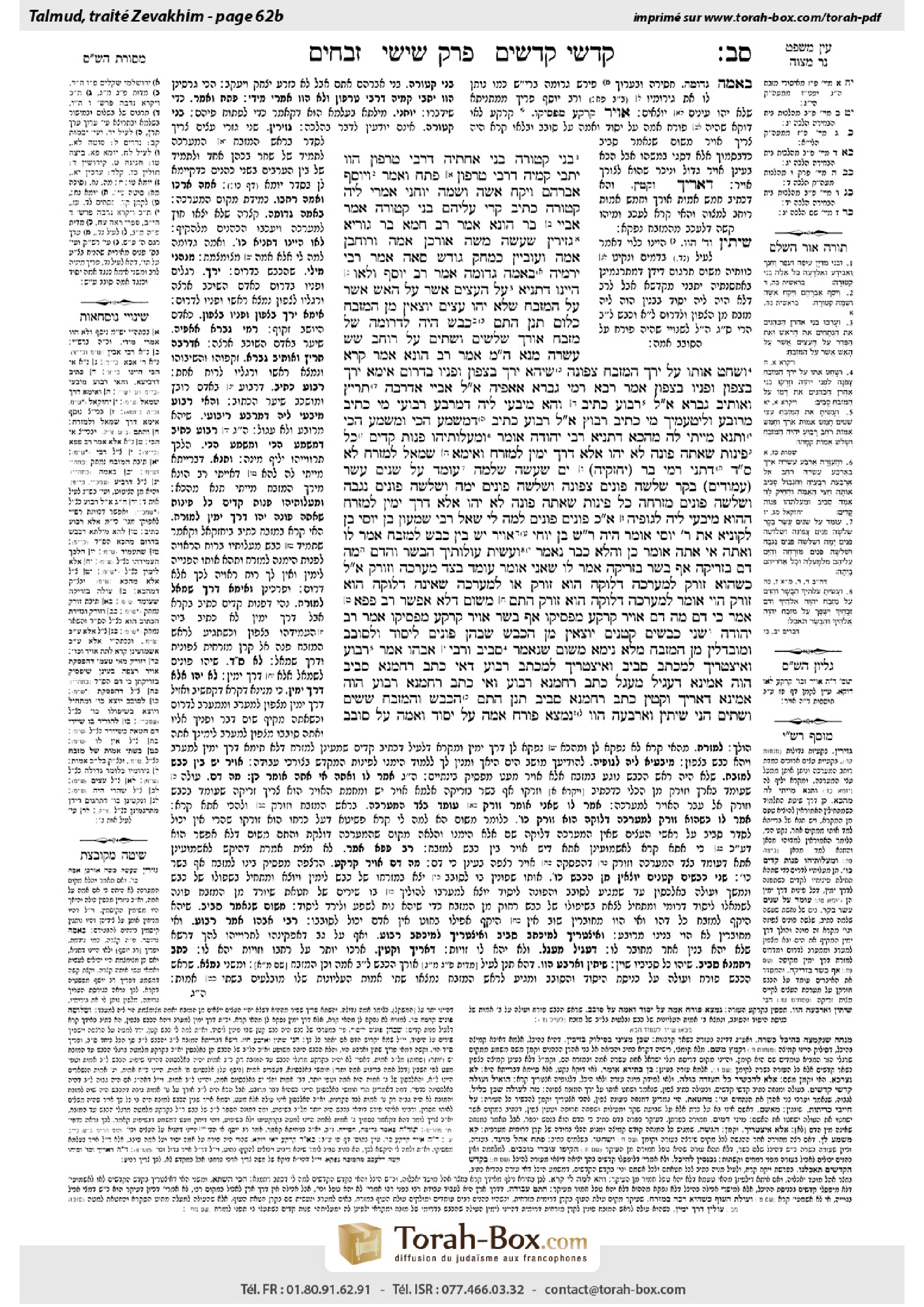
Zevachim 62b: Talmud study for Daf Yomi
Daf Yomi is the daily study of one Talmud folio. Explore 37 tractates with scans, Hebrew text, Sefaria English and AI-generated French translations where annotated.
Passage selection and English or AI-generated French translation are available where the scan has annotations. Daf Study is independent of Torah-Box and Sefaria.
Browse Zevachim · זבחים · All tractatesZevachim 62b text and translations
This page of Zevachim includes the Aramaic text, an English translation and an AI-generated French translation, alongside the scan above.
זבחים ס״ב ב · Aramaic and Hebrew text
״בְּנֵי קְטוּרָה״. בְּנֵי אֲחָתֵיהּ דְּרַבִּי טַרְפוֹן הָווּ יָתְבִי קַמֵּיהּ דְּרַבִּי טַרְפוֹן, פָּתַח וְאָמַר: ״וַיּוֹסֶף אַבְרָהָם וַיִּקַּח אִשָּׁה וּשְׁמָהּ יוֹחָנִי״. אָמְרִי לֵיהּ: ״קְטוּרָה״ כְּתִיב! קָרֵי (עֲלֵיהֶם) [עֲלַיְהוּ] ״בְּנֵי קְטוּרָה״.
אָמַר אַבָּיֵי בַּר הוּנָא אָמַר רַב חָמָא בַּר גּוּרְיָא: גְּזִירִין שֶׁעָשָׂה מֹשֶׁה – אוֹרְכָּן אַמָּה, וְרוֹחְבָּן אַמָּה, וְעוֹבְיָין כְּמַחַק גּוֹדֶשׁ סְאָה.
אָמַר רַבִּי יִרְמְיָה: בְּאַמָּה גְּדוּמָה. אָמַר רַב יוֹסֵף, וְלָאו הַיְינוּ דְּתַנְיָא: ״עַל הָעֵצִים אֲשֶׁר עַל הָאֵשׁ אֲשֶׁר עַל הַמִּזְבֵּחַ״ – שֶׁלֹּא יְהוּ עֵצִים יוֹצְאִין מִן הַמִּזְבֵּחַ כְּלוּם?!
תְּנַן הָתָם: כֶּבֶשׁ הָיָה לִדְרוֹמָהּ שֶׁל מִזְבֵּחַ – אוֹרֶךְ שְׁלֹשִׁים וּשְׁתַּיִם, עַל רוֹחַב שֵׁשׁ עֶשְׂרֵה. מְנָא הָנֵי מִילֵּי? אָמַר רַב הוּנָא, אָמַר קְרָא: ״וְשָׁחַט אוֹתוֹ עַל יֶרֶךְ הַמִּזְבֵּחַ צָפוֹנָה״ – שֶׁיְּהֵא יָרֵךְ בְּצָפוֹן, וּפָנָיו בַּדָּרוֹם.
אֵימָא: יָרֵךְ בַּצָּפוֹן וּפָנָיו בַּצָּפוֹן! אָמַר רָבָא: רָמֵי גַּבְרָא אַאַפֵּיהּ. אֲמַר לֵיהּ אַבָּיֵי: אַדְּרַבָּה – תָּרֵיץ וְאוֹתֵיב גַּבְרָא!
אֲמַר לֵיהּ: ״רָבוּעַ״ כְּתִיב. וְהָא מִיבְּעֵי לֵיהּ דִּמְרַבַּע רַבּוֹעֵי! מִי כְּתִיב ״מְרוּבָּע״?! וְלִיטַעְמָיךְ, מִי כְּתִיב ״רָבוּץ״?! אֲמַר לֵיהּ: ״רָבוּעַ״ כְּתִיב – דְּמַשְׁמַע הָכִי וּמַשְׁמַע הָכִי.
וְתַנָּא מַיְיתֵי לַהּ מֵהָכָא – דְּתַנְיָא, רַבִּי יְהוּדָה אוֹמֵר: ״וּמַעֲלֹתֵהוּ פְּנוֹת קָדִים״ – כׇּל פִּינּוֹת שֶׁאַתָּה פּוֹנֶה, לֹא יְהוּ אֶלָּא דֶּרֶךְ יָמִין לַמִּזְרָח.
וְאֵימָא שְׂמֹאל לַמִּזְרָח! לָא סָלְקָא דַּעְתָּךְ; דְּתָנֵי רָמֵי בַּר (יְחִזְקִיָּה) [יְחֶזְקֵאל]: יָם שֶׁעָשָׂה שְׁלֹמֹה – ״עֹמֵד עַל שְׁנֵים עָשָׂר בָּקָר; שְׁלֹשָׁה פֹנִים צָפוֹנָה, וּשְׁלֹשָׁה פֹנִים יָמָּה, וּשְׁלֹשָׁה פֹּנִים נֶגְבָּה, וּשְׁלֹשָׁה פֹּנִים מִזְרָחָה״ – כׇּל פִּינּוֹת שֶׁאַתָּה פּוֹנֶה, לֹא יְהוּ אֶלָּא דֶּרֶךְ יָמִין לַמִּזְרָח.
הָהוּא מִיבְּעֵי לֵיהּ לְגוּפֵיהּ! אִם כֵּן, ״פֹּנִים״ ״פֹּנִים״ לְמָה לִי?
שָׁאַל רַבִּי שִׁמְעוֹן בֶּן יוֹסֵי בֶּן לָקוֹנְיָא אֶת רַבִּי יוֹסֵי: אוֹמֵר הָיָה רַבִּי שִׁמְעוֹן בֶּן יוֹחַי, אֲוִיר יֵשׁ בֵּין כֶּבֶשׁ לַמִּזְבֵּחַ? אָמַר לוֹ: וְאַתָּה – אִי אַתָּה אוֹמֵר כֵּן?! וַהֲלֹא כְּבָר נֶאֱמַר: ״וְעָשִׂיתָ עֹלֹתֶיךָ הַבָּשָׂר וְהַדָּם״ – מָה דָּם בִּזְרִיקָה, אַף בָּשָׂר בִּזְרִיקָה!
אָמַר לוֹ: שֶׁאֲנִי אוֹמֵר, עוֹמֵד בְּצַד מַעֲרָכָה – וְזוֹרֵק.
אָמַר לוֹ: כְּשֶׁהוּא זוֹרֵק – לְמַעֲרָכָה דְּלוּקָה הוּא זוֹרֵק, אוֹ לְמַעֲרָכָה שֶׁאֵינָהּ דְּלוּקָה הוּא זוֹרֵק? הֱוֵי אוֹמֵר: לְמַעֲרָכָה דְּלוּקָה הוּא זוֹרֵק! הָתָם מִשּׁוּם דְּלָא אֶפְשָׁר.
רַב פָּפָּא אָמַר: כִּי דָּם; מָה דָּם – אֲוִיר קַרְקַע מַפְסִיקוֹ, אַף בָּשָׂר – אֲוִיר קַרְקַע מַפְסִיקוֹ.
אָמַר רַב יְהוּדָה: שְׁנֵי כְּבָשִׁים קְטַנִּים יוֹצְאִין מִן הַכֶּבֶשׁ, שֶׁבָּהֶן פּוֹנִים לַיְסוֹד וְלַסּוֹבֵב; וּמוּבְדָּלִין מִן הַמִּזְבֵּחַ מְלֹא נִימָא, מִשּׁוּם שֶׁנֶּאֱמַר ״סָבִיב״. וְרַבִּי אֲבָהוּ אָמַר: ״רָבוּעַ״.
וְאִיצְטְרִיךְ לְמִכְתַּב ״סָבִיב״, וְאִיצְטְרִיךְ לְמִכְתַּב ״רָבוּעַ״. דְּאִי כְּתַב רַחֲמָנָא ״סָבִיב״ – הֲוָה אָמֵינָא דְּעָגֵיל מִעְגָּל; כְּתַב רַחֲמָנָא ״רָבוּעַ״. וְאִי כְּתַב רַחֲמָנָא ״רָבוּעַ״ – הֲוָה אָמֵינָא דַּאֲרִיךְ וְקַטִּין; כְּתַב רַחֲמָנָא ״סָבִיב״.
תְּנַן הָתָם: הַכֶּבֶשׁ וְהַמִּזְבֵּחַ – שִׁשִּׁים וּשְׁתַּיִם. הָנֵי שִׁיתִּין וְאַרְבְּעָה הָווּ! נִמְצָא פּוֹרֵחַ אַמָּה עַל יְסוֹד וְאַמָּה עַל סוֹבֵב.
Zevachim 62b · English translation
“The children of Keturah” (Genesis 25:4). Although Keturah’s children were children of Abraham, they were not of the same caliber as Isaac. Similarly, Rav Yosef was saying that his other students were not of the caliber of Abaye. Having mentioned this term, the Gemara relates: The sons of Rabbi Tarfon’s sister were sitting silently before Rabbi Tarfon. In an attempt to encourage them to say something, he began and said: The verse states: And Abraham took another wife, and her name was Yoḥani. They said to Rabbi Tarfon: It is written: “Keturah” (Genesis 25:1), not Yoḥani. Rabbi Tarfon read, i.e., said, about them the phrase “the children of Keturah” as they were able to contribute only this small piece of information.
§ Abaye bar Huna says that Rav Ḥama bar Gurya says: With regard to the logs that Moses prepared for the mitzva of burning wood upon the altar, their length was a cubit and their width was a cubit, and their thickness was like that of a leveler, a kind of flat stick used to remove the excess grain heaped on top of a container that holds one se’a.
Rabbi Yirmeya says: The length and width of the logs mentioned were measured with a shortened cubit. Rav Yosef said: Is this not as it is taught in a baraita: The verse states: “Upon the wood that is on the fire that is upon the altar” (Leviticus 1:8). The seemingly superfluous phrase “that is upon the altar” teaches that the wood should not extend at all beyond the area of the altar designated for the arrangement of wood. Since this area was one square cubit, the logs were exactly one cubit as well.
§ The Gemara discusses the ramp of the altar: We learned in a mishna there (Middot 36a): There was a ramp that was located on the south side of the altar, whose size was a length of thirty-two cubits by a width of sixteen cubits. The Gemara asks: From where are these matters derived, i.e., from where is it derived that the ramp is on the south side of the altar? Rav Huna said: The verse states: “And he shall slaughter it on the side [yerekh] of the altar northward” (Leviticus 1:11), which teaches that the altar’s thigh [yarekh] should be located in the north, and its face, i.e., the front of the altar where the priests ascend to it, should be in the south. The verse likens the positioning of the altar to a person who is lying down flat, in which case if his legs are to the north, his face is to the south.
The Gemara asks: Why not say that its thigh should be in the north and its face should also be in the north? Perhaps the verse is referring to a person sitting with both his face and feet in the north. Rava said in response: Place the man on his face, i.e., the analogy is to a man who is lying down. Abaye said to him: On the contrary, sit the man straight up so that his face and his legs are facing the same direction.
Rava said back to him: It is written in a verse that the altar must be “square [ravua]” (Exodus 27:1), which indicates lying down or crouching, as it is similar to the term ravutz, meaning crouching. Abaye challenges Rava: But this word is necessary to teach that the altar must be square. Rava responds: Is it written in the verse that the altar must be square [merubba]? The verse specifically uses the form ravua in order to allude to the word ravutz, crouching. Abaye counters: According to your reasoning, is it written in the verse that the altar must be ravutz? Rava answers: It is written in the verse that the altar must be ravua, which is a term that indicates this, i.e., that the altar must be square, and indicates that, i.e., that its positioning is comparable to that of a person who is lying down.
The Gemara adds: And another tanna cites the source for the ramp’s positioning from here, as it is taught in a baraita that Rabbi Yehuda says: The verse states with regard to the future altar: “And its steps shall look [penot] toward the east” (Ezekiel 43:17), which indicates that all the turns [pinot] that you turn should be only to the right and you should turn to the east. Only if the ramp is in the south can one turn to the right and be facing eastward.
The Gemara challenges: The verse indicates only that after a person turns he is facing eastward. Why not say that the ramp was located in the north and the priest turns left and faces eastward? The Gemara answers: This possibility should not enter your mind, as Rami bar Yeḥizkiya teaches: A verse describes the sea, i.e., the Basin, that Solomon built, in the following terms: “It stood upon twelve oxen, three looking toward [ponim] the north, and three looking toward [ponim] the west, and three looking toward [ponim] the south, and three looking toward [ponim] the east” (II Chronicles 4:4). From the order of the directions in which the verse lists the groups of oxen under the Basin, it can be derived that all the turns that you turn should be only to the right and to the east.
The Gemara challenges: That verse is necessary to teach its own information describing the Basin. The Gemara explains: If so, why do I need the verse to repeat the term ponim, ponim? It must be in order to teach how one turns while performing the sacrificial rite upon the altar, which, in turn, teaches the location of the ramp.
§ Rabbi Shimon ben Yosei ben Lakonya asked Rabbi Yosei: Is it so that Rabbi Shimon ben Yoḥai used to say that there is airspace, i.e., a gap, between the ramp and the altar? Rabbi Yosei said to him: And you, don’t you say so as well? But isn’t it already stated: “And you shall offer your burnt offerings, the flesh and the blood” (Deuteronomy 12:27)? The verse juxtaposes the flesh of the burnt offering with its blood to teach that just as the blood is presented upon the altar via tossing while the priest stands on the ground next to the altar (see Leviticus 1:5), so too, the flesh of the burnt offering is presented via tossing. In order to fulfill this requirement, the priest stands on the ramp and tosses the flesh over the gap between the ramp and the altar, so that it lands on the arrangement of wood.
Rabbi Shimon ben Yosei ben Lakonya said to him: If the verse simply teaches that the flesh must be tossed onto the arrangement of wood, it does not prove that there must be a gap between the ramp and the altar, as I say that the priest should stand next to the arrangement of wood and toss the flesh onto it.
Rabbi Yosei said to him: When he tosses the flesh, does he toss it onto a part of the arrangement of wood that is burning or does he toss it onto a part of the arrangement of wood that is not burning? You must say that he tosses it onto a part of the arrangement of wood that is burning. And there, according to your suggestion that the priest is standing next to the arrangement of wood, he would have to toss the flesh, because it is impossible to place the flesh directly into the fire without the priest getting burned. It would be unnecessary for the verse to teach that the priest tosses the flesh while standing next to the arrangement. Consequently, when the verse juxtaposed the blood with the flesh, it must be teaching that the flesh must be tossed over a gap between the ramp and the altar.
Rav Pappa says: The requirement that there be a gap between the ramp and the altar can be derived from this verse, because the juxtaposition teaches that the flesh is like blood in the manner in which it is tossed: Just as with regard to the blood there is space on the ground that interposes between the priest and the altar, so too with regard to the flesh, there is space on the ground that interposes between the priest and the altar, i.e., he stands on the ground next to the altar and tosses the flesh onto the altar.
§ The Gemara continues discussing the ramp: Rav Yehuda says: There were two small ramps protruding from the main ramp that led to the altar, on which the priests could turn to the base of the altar and to the surrounding ledge of the altar. They were separated from the altar by a hairbreadth, because it is stated: “Roundabout” (Leviticus 1:5), with regard to the altar. This indicates that nothing is attached to the entire perimeter of the altar. And Rabbi Abbahu says there is a different source, as it states: “Square” (Exodus 27:1), and if the ramps would be connected to the altar it would no longer be square.
The Gemara continues: And it was necessary for the verse to write: “Roundabout,” and it was necessary for the verse to write: “Square,” as, had the Merciful One written only: “Roundabout,” I would say that the altar can be circular. Therefore, the Merciful One wrote that the altar must be “square.” And had the Merciful One written only that the altar must be “square [ravua],” I would say that the word ravua simply means rectangular and the altar can be long and narrow. Therefore, the Merciful One wrote the term “roundabout,” which teaches that the altar must not have some sides that are longer than others.
§ We learned in a mishna elsewhere (Middot 37b): The ramp and the altar together were sixty-two cubits long. The Gemara challenges: The dimensions of these are sixty-four cubits, as the altar and the ramp were each thirty-two cubits long (Middot 36a). The Gemara explains: The thirty-two-cubit measurement of the ramp is explained by a baraita that states: It is found that the ramp of the altar overhung the base of the altar by one cubit and the surrounding ledge by one cubit, resulting in an aggregate length of thirty-two cubits.
Zevachim 62b · Traduction française (IA)
« Les fils de Qetoura » (Genèse 25:4). Bien que les fils de Qetoura fussent les fils d’Abraham, ils n’étaient pas du même calibre qu’Isaac. De même, Rav Yossef disait que ses autres élèves n’étaient pas du calibre d’Abayé. Puisque cette expression a été mentionnée, la Guemara rapporte : Les fils de la sœur de Rabbi Tarfon étaient assis en silence devant lui. Pour les encourager à dire quelque chose, il prit la parole et dit : « Le verset déclare : “Abraham prit une autre femme, et son nom était Yoḥani.” » Ils dirent à Rabbi Tarfon : « Il est écrit “Qetoura” (Genèse 25:1), et non “Yoḥani”. » Rabbi Tarfon leur appliqua alors l’expression « les fils de Qetoura », car ils n’avaient pu apporter que cette petite information.
§ Abayé bar Houna dit au nom de Rav Ḥama bar Gourya : Les bûches que Moïse avait préparées pour la mitsva de brûler du bois sur l’autel mesuraient une coudée de long et une coudée de large, et leur épaisseur était celle d’une règle à araser, sorte de baguette plate servant à enlever l’excédent de grain entassé au-dessus d’un récipient contenant un séa.
Rabbi Yirmeya dit : La longueur et la largeur des bûches mentionnées étaient mesurées selon une coudée réduite. Rav Yossef dit : N’est-ce pas ce qui est enseigné dans une baraïta ? Le verset déclare : « Sur le bois qui est sur le feu, lequel est sur l’autel » (Lévitique 1:8). L’expression apparemment superflue « lequel est sur l’autel » enseigne que le bois ne doit pas dépasser, même d’un rien, la surface de l’autel réservée à l’arrangement du bois. Puisque cette surface était d’une coudée carrée, les bûches mesuraient elles aussi exactement une coudée.
§ La Guemara parle de la rampe de l’autel : Nous avons appris dans une Michna, là-bas (Middot 36a), qu’il y avait une rampe située du côté sud de l’autel, longue de trente-deux coudées et large de seize coudées. La Guemara demande : D’où tire-t-on ces éléments, c’est-à-dire d’où sait-on que la rampe se trouvait du côté sud de l’autel ? Rav Houna dit : Le verset déclare : « Il l’égorgera sur le côté [yerekh] nord de l’autel » (Lévitique 1:11). Cela enseigne que la cuisse [yarekh] de l’autel doit se trouver au nord, et sa face, c’est-à-dire l’avant de l’autel par où les prêtres y montent, au sud. Le verset compare la position de l’autel à celle d’une personne allongée à plat : si ses jambes sont au nord, son visage est au sud.
La Guemara demande : Pourquoi ne pas dire que sa cuisse doit être au nord et que sa face doit elle aussi être au nord ? Peut-être le verset parle-t-il d’une personne assise, le visage et les pieds tournés vers le nord. Rava répond : Place l’homme sur le ventre, c’est-à-dire que l’analogie porte sur un homme allongé. Abayé lui dit : Au contraire, redresse l’homme, afin que son visage et ses jambes soient tournés dans la même direction.
Rava lui réplique : Il est écrit dans un verset que l’autel doit être « carré [ravua] » (Exode 27:1), ce qui évoque une position allongée ou accroupie, puisque ce mot ressemble à ravoutz, qui signifie « accroupi ». Abayé objecte à Rava : Mais ce mot est nécessaire pour enseigner que l’autel doit être carré. Rava répond : Est-il écrit dans le verset que l’autel doit être carré [meroubba] ? Le verset emploie précisément la forme ravua afin de faire allusion au mot ravoutz, « accroupi ». Abayé rétorque : Selon ton raisonnement, est-il écrit dans le verset que l’autel doit être ravoutz ? Rava répond : Le verset dit que l’autel doit être ravua, terme qui indique ceci, c’est-à-dire que l’autel doit être carré, et cela, c’est-à-dire que sa position se compare à celle d’une personne allongée.
La Guemara ajoute : Un autre tanna cite aussi une source concernant l’emplacement de la rampe, comme il est enseigné dans une baraïta que Rabbi Yehouda dit : À propos de l’autel futur, le verset déclare : « Ses marches seront tournées [penot] vers l’est » (Ézéchiel 43:17). Cela indique que tous les virages [pinot] que l’on prend doivent se faire uniquement vers la droite et que l’on doit tourner vers l’est. Cela n’est possible que si la rampe se trouve au sud.
La Guemara objecte : Le verset indique seulement qu’après avoir tourné, on se trouve face à l’est. Pourquoi ne pas dire que la rampe était située au nord et que le prêtre tournait à gauche pour se retrouver face à l’est ? La Guemara répond : N’envisage pas cette possibilité, car Rami bar Yeḥizkiya enseigne qu’un verset décrit la mer, c’est-à-dire le bassin que Salomon avait construit, en ces termes : « Il se tenait sur douze bœufs, trois tournés [ponim] vers le nord, trois tournés [ponim] vers l’ouest, trois tournés [ponim] vers le sud et trois tournés [ponim] vers l’est » (II Chroniques 4:4). L’ordre dans lequel le verset énumère les directions vers lesquelles les groupes de bœufs sous le bassin étaient tournés permet de déduire que tous les virages que l’on prend doivent se faire uniquement vers la droite et vers l’est.
La Guemara objecte : Ce verset est nécessaire pour décrire le bassin lui-même. La Guemara explique : Si tel est le cas, pourquoi le verset répète-t-il le terme ponim, ponim ? C’est nécessairement pour enseigner comment on tourne lors de l’accomplissement du rite sacrificiel sur l’autel, ce qui, à son tour, enseigne où se trouvait la rampe.
§ Rabbi Shimon ben Yossei ben Lakonya demanda à Rabbi Yossei : Est-il vrai que Rabbi Shimon ben Yoḥai disait qu’il y avait un espace, c’est-à-dire un intervalle, entre la rampe et l’autel ? Rabbi Yossei lui dit : Et toi, ne dis-tu pas la même chose ? N’est-il pas déjà écrit : « Tu présenteras tes holocaustes, la chair et le sang » (Deutéronome 12:27) ? Le verset rapproche la chair de l’holocauste de son sang pour enseigner que, de même que le sang est présenté sur l’autel par aspersion, tandis que le prêtre se tient au sol à côté de l’autel (voir Lévitique 1:5), de même la chair de l’holocauste est présentée en la lançant. Pour satisfaire à cette exigence, le prêtre se tient sur la rampe et lance la chair par-dessus l’espace entre la rampe et l’autel, afin qu’elle tombe sur l’arrangement de bois.
Rabbi Shimon ben Yossei ben Lakonya lui dit : Si le verset enseigne simplement que la chair doit être lancée sur l’arrangement de bois, cela ne prouve pas qu’il doit y avoir un espace entre la rampe et l’autel, car, selon moi, le prêtre peut se tenir à côté de l’arrangement de bois et lancer la chair dessus.
Rabbi Yossei lui dit : Quand le prêtre lance la chair, la lance-t-il sur une partie de l’arrangement de bois qui brûle ou sur une partie qui ne brûle pas ? Tu dois dire qu’il la lance sur une partie de l’arrangement qui brûle. Or, selon ta proposition, si le prêtre se tenait à côté de l’arrangement de bois, il devrait lancer la chair, car il lui serait impossible de la placer directement dans le feu sans se brûler. Il serait donc inutile que le verset enseigne que le prêtre lance la chair tout en se tenant à côté de l’arrangement. Par conséquent, lorsque le verset rapproche le sang de la chair, il doit enseigner que la chair doit être lancée par-dessus un espace entre la rampe et l’autel.
Rav Pappa dit : L’exigence d’un espace entre la rampe et l’autel peut se déduire de ce verset, car le rapprochement enseigne que la chair est semblable au sang quant à la manière dont elle est lancée : de même que, pour le sang, un espace au sol s’interpose entre le prêtre et l’autel, de même, pour la chair, un espace au sol s’interpose entre le prêtre et l’autel ; autrement dit, le prêtre se tient au sol, à côté de l’autel, et lance la chair sur l’autel.
§ La Guemara poursuit son propos sur la rampe : Rav Yehouda dit : Deux petites rampes partaient de la rampe principale menant à l’autel ; les prêtres pouvaient y tourner vers la base de l’autel et vers sa corniche périphérique. Elles étaient séparées de l’autel par l’épaisseur d’un cheveu, car il est écrit, à propos de l’autel : « Tout autour » (Lévitique 1:5). Cela indique que rien n’est rattaché à l’ensemble du périmètre de l’autel. Rabbi Abbahou donne une autre source : il est écrit « carré » (Exode 27:1) ; si les rampes étaient reliées à l’autel, celui-ci ne serait plus carré.
La Guemara poursuit : Le verset devait nécessairement contenir à la fois « tout autour » et « carré ». En effet, si le Miséricordieux avait seulement écrit « tout autour », j’aurais dit que l’autel peut être circulaire. Le Miséricordieux a donc écrit que l’autel doit être « carré ». Et si le Miséricordieux avait seulement écrit que l’autel doit être « carré [ravua] », j’aurais dit que le mot ravua signifie simplement « rectangulaire » et que l’autel peut être long et étroit. Le Miséricordieux a donc écrit « tout autour », ce qui enseigne que l’autel ne doit pas avoir certains côtés plus longs que les autres.
§ Nous avons appris dans une Michna, ailleurs (Middot 37b), que la rampe et l’autel mesuraient ensemble soixante-deux coudées de long. La Guemara objecte : Leurs dimensions totalisent soixante-quatre coudées, puisque l’autel et la rampe mesuraient chacun trente-deux coudées de long (Middot 36a). La Guemara explique : La mesure de trente-deux coudées de la rampe est expliquée dans une baraïta, qui enseigne que la rampe de l’autel dépassait d’une coudée la base de l’autel et d’une autre coudée sa corniche périphérique, ce qui lui donnait une longueur totale de trente-deux coudées.
Traduction française générée par IA à partir de l’édition anglaise de Sefaria. Vérifie toujours un passage avec le texte source.
Text from Sefaria: William Davidson Edition - Vocalized Aramaic (CC BY NC); William Davidson Edition - English (CC BY NC).