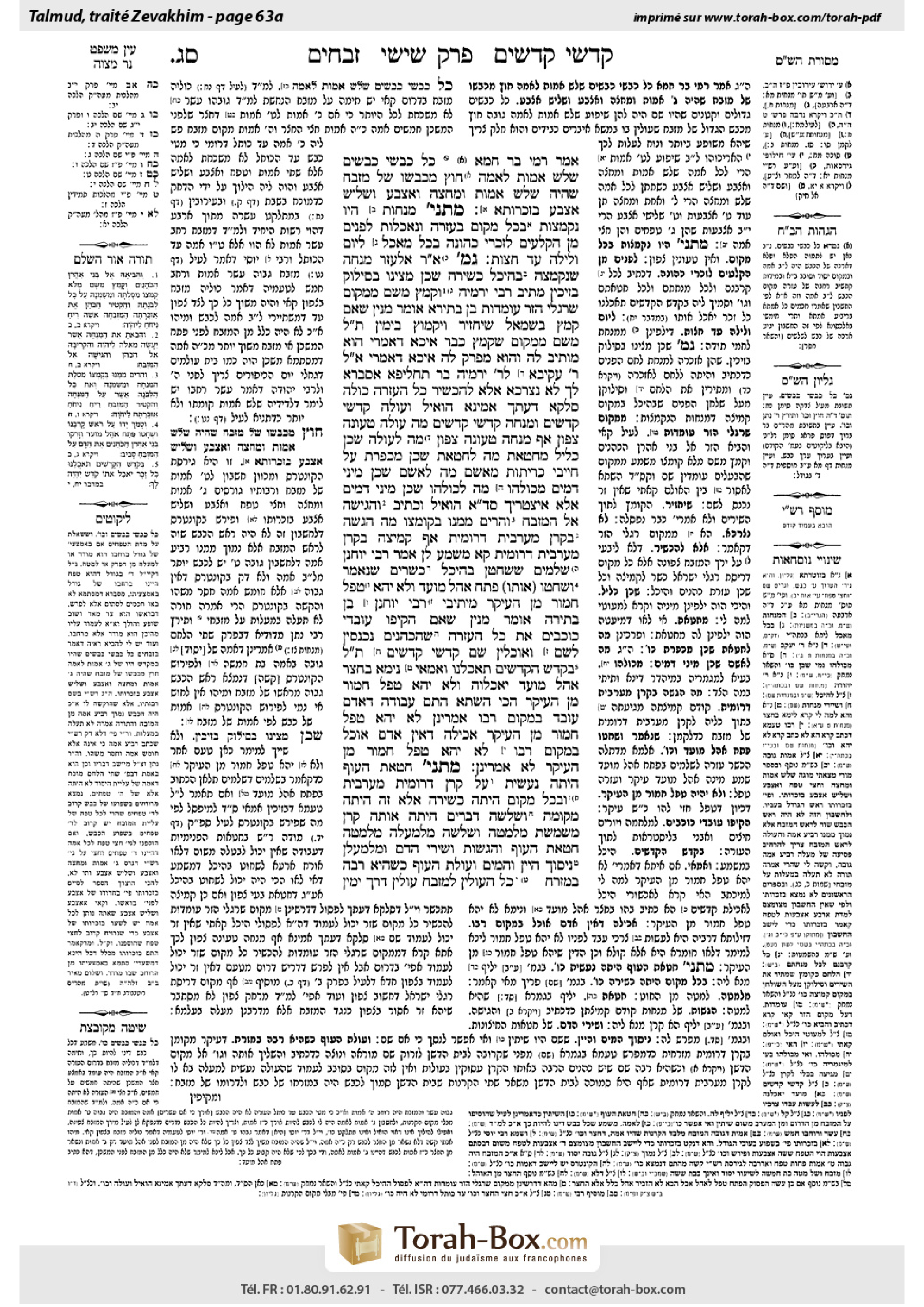
Zevachim 63a: Talmud study for Daf Yomi
Daf Yomi is the daily study of one Talmud folio. Explore 37 tractates with scans, Hebrew text, Sefaria English and AI-generated French translations where annotated.
Passage selection and English or AI-generated French translation are available where the scan has annotations. Daf Study is independent of Torah-Box and Sefaria.
Browse Zevachim · זבחים · All tractatesZevachim 63a text and translations
This page of Zevachim includes the Aramaic text, an English translation and an AI-generated French translation, alongside the scan above.
זבחים ס״ג א · Aramaic and Hebrew text
אָמַר רָמֵי בַּר חָמָא: כׇּל כִּבְשֵׁי כְּבָשִׁים – שָׁלֹשׁ אַמּוֹת לְאַמָּה, חוּץ מִכִּבְשׁוֹ שֶׁל מִזְבֵּחַ – שֶׁהָיָה שָׁלֹשׁ אַמּוֹת וּמֶחֱצָה וְאֶצְבַּע וּשְׁלִישׁ אֶצְבַּע בְּזַכְרוּתָא.
מַתְנִי׳ מְנָחוֹת הָיוּ נִקְמָצוֹת בְּכׇל מָקוֹם בָּעֲזָרָה, וְנֶאֱכָלוֹת לִפְנִים מִן הַקְּלָעִים – לְזִכְרֵי כְהוּנָּה, בְּכׇל מַאֲכָל, לְיוֹם וָלַיְלָה עַד חֲצוֹת.
גְּמָ׳ אָמַר רַבִּי אֶלְעָזָר: מִנְחָה שֶׁנִּקְמְצָה בַּהֵיכָל – כְּשֵׁירָה, שֶׁכֵּן מָצִינוּ בְּסִילּוּק בָּזִיכִין.
מֵתִיב רַבִּי יִרְמְיָה: ״וְקָמַץ מִשָּׁם״ – מִמָּקוֹם שֶׁרַגְלֵי הַזָּר עוֹמְדוֹת.
בֶּן בְּתִירָא אוֹמֵר: מִנַּיִן שֶׁאִם קָמַץ בִּשְׂמֹאל – שֶׁיַּחֲזִיר וְיִקְמוֹץ בְּיָמִין? תַּלְמוּד לוֹמַר: ״מִשָּׁם״ – מִמָּקוֹם שֶׁקָּמַץ כְּבָר.
אִיכָּא דְּאָמְרִי: הוּא מוֹתֵיב לַהּ וְהוּא מְפָרֵק לַהּ; אִיכָּא דְאָמְרִי: אֲמַר לֵיהּ רַבִּי עֲקִיבָא לְרַבִּי יִרְמְיָה בַּר תַּחְלִיפָא, אַסְבְּרַהּ לָךְ: לֹא נִצְרְכָא אֶלָּא לְהַכְשִׁיר כׇּל הָעֲזָרָה כּוּלָּהּ.
סָלְקָא דַּעְתָּךְ אָמֵינָא: הוֹאִיל וְעוֹלָה קׇדְשֵׁי קָדָשִׁים, וּמִנְחָה קׇדְשֵׁי קָדָשִׁים; מָה עוֹלָה טְעוּנָה צָפוֹן, אַף מִנְחָה טְעוּנָה צָפוֹן.
מָה לְעוֹלָה, שֶׁכֵּן כָּלִיל!
מֵחַטָּאת. מָה לְחַטָּאת, שֶׁכֵּן מְכַפֶּרֶת עַל חַיָּיבֵי כָרֵיתוֹת!
מֵאָשָׁם. מָה לְאָשָׁם, שֶׁכֵּן מִינֵי דָמִים!
מִכּוּלְּהוּ. מָה לְכוּלְּהוּ, שֶׁכֵּן מִינֵי דָמִים!
אֶלָּא אִיצְטְרִיךְ; סָלְקָא דַּעְתָּךְ אָמֵינָא, הוֹאִיל וּכְתִיב: ״וְהִגִּישָׁהּ אֶל הַמִּזְבֵּחַ״, ״וְהֵרִים מִמֶּנּוּ בְּקֻמְצוֹ״ –
מָה הַגָּשָׁה בְּקֶרֶן מַעֲרָבִית דְּרוֹמִית, אַף קְמִיצָה בְּקֶרֶן מַעֲרָבִית דְּרוֹמִית; קָא מַשְׁמַע לַן.
אָמַר רַבִּי יוֹחָנָן: שְׁלָמִים שֶׁשְּׁחָטָן בַּהֵיכָל – כְּשֵׁרִים, שֶׁנֶּאֱמַר: ״וּשְׁחָטוֹ (אוֹתוֹ) פֶּתַח אֹהֶל מוֹעֵד״ – וְלֹא יְהֵא טָפֵל חָמוּר מִן הָעִיקָּר.
מֵיתִיבִי: רַבִּי יוֹחָנָן בֶּן בְּתִירָה אוֹמֵר, מִנַּיִן שֶׁאִם הִקִּיפוּ גּוֹיִם אֶת כׇּל הָעֲזָרָה – שֶׁהַכֹּהֲנִים נִכְנָסִין לְשָׁם וְאוֹכְלִין שָׁם קׇדְשֵׁי קָדָשִׁים? תַּלְמוּד לוֹמַר: ״בְּקֹדֶשׁ הַקֳּדָשִׁים תֹּאכְלֶנּוּ״.
וְאַמַּאי? נֵימָא: ״בְּחָצֵר אֹהֶל מוֹעֵד יֹאכְלוּהָ״ – וְלֹא יְהֵא טָפֵל חָמוּר מִן הָעִיקָּר!
הָכִי הַשְׁתָּא?! הָתָם עֲבוֹדָה – דְּאָדָם עוֹבֵד בִּמְקוֹם רַבּוֹ, אָמְרִינַן: לֹא יְהֵא טָפֵל חָמוּר מִן הָעִיקָּר. אֲכִילָה – דְּאֵין אָדָם אוֹכֵל בִּמְקוֹם רַבּוֹ, לֹא יְהֵא טָפֵל חָמוּר מִן הָעִיקָּר – לָא אָמְרִינַן.
מַתְנִי׳ חַטַּאת הָעוֹף הָיְתָה נַעֲשֵׂית עַל קֶרֶן דְּרוֹמִית מַעֲרָבִית; וּבְכׇל מָקוֹם הָיְתָה כְּשֵׁירָה, אֶלָּא זֶה הָיְתָה מְקוֹמָהּ. וּשְׁלֹשָׁה דְּבָרִים הָיְתָה אוֹתָהּ קֶרֶן מְשַׁמֶּשֶׁת מִלְּמַטָּה, וּשְׁלֹשָׁה מִלְּמַעְלָה. מִלְּמַטָּה: חַטַּאת הָעוֹף, וְהַגָּשׁוֹת, וּשְׁיָרֵי הַדָּם.
וּמִלְּמַעְלָן: נִיסּוּךְ הַיַּיִן, וְהַמַּיִם, וְעוֹלַת הָעוֹף כְּשֶׁהִיא רַבָּה בַּמִּזְרָח.
כׇּל הָעוֹלִין לַמִּזְבֵּחַ – עוֹלִין דֶּרֶךְ יָמִין,
Zevachim 63a · English translation
Rami bar Ḥama says: The slope of each of the minor ramps, was one cubit of rise per three cubits of run; this was true aside from the main ramp of the altar, which rose one cubit in three and a half cubits and one fingerbreadth and one-third of a fingerbreadth, measured by the tip of the thumb. The slope of the main ramp of the altar was slightly less than that of the minor ramps in order to make it easier for the priests to ascend the ramp while holding the sacrificial portions.
MISHNA: Handfuls were removed from the meal offerings in any place in the Temple courtyard and were consumed within the area enclosed by the curtains by males of the priesthood, prepared in any form of food preparation that he chooses, e.g., roasted or boiled, for one day and night, until midnight.
GEMARA: Rabbi Elazar says: A meal offering that had its handful removed in the Sanctuary is valid, as we found with regard to the removal of the two bowls of frankincense that were placed beside the shewbread on the Table, which was located in the Sanctuary. On Shabbat, these bowls of frankincense were removed and burned on the altar, which allowed the shewbread to be eaten. Removal of the bowls of frankincense paralleled the process of removing a handful from a meal offering; just as the removal of the bowls took place in the Sanctuary, so could the removal of a handful of the meal offering be done in the Sanctuary.
Rabbi Yirmeya raises an objection from a baraita: The verse states with regard to the meal offerings: “And he shall bring it to Aaron’s sons, the priests; and he shall take from there his handful” (Leviticus 2:2). The term “from there” indicates that the handful must be taken from a place where the feet of the non-priest who brought the meal offering may stand, i.e., the Temple courtyard, but not the Sanctuary, in direct contradiction to the opinion of Rabbi Elazar.
The baraita continues: Ben Beteira says there is a different explanation of the verse. From where is it derived that if the priest removed a handful with his left hand, that he should return the handful to the vessel and then remove another handful with his right hand? The verse states: “And he shall take from there his handful,” indicating that he may take it from the place where he already removed a handful.
The Gemara answers: There are those who say that Rabbi Yirmeya raises the objection and he resolves it, and there are those who say that Rabbi Akiva said to Rabbi Yirmeya bar Taḥlifa: I will explain to you the solution. The verse that indicates that the handful is taken from a place where non-priests may stand is necessary only to render the entire Temple courtyard valid for removing the handful, but not to indicate that one may not take the handful in the Sanctuary.
This was necessary because it might enter your mind to say that since a burnt offering is one of the offerings of the most sacred order, and a meal offering is also one of the offerings of the most sacred order, just as a burnt offering requires slaughter specifically in the north side of the Temple courtyard, so too, a meal offering requires the taking of the handful specifically in the north side of the Temple courtyard.
The Gemara responds: What is notable about a burnt offering? It is notable in that it is completely burned upon the altar. Therefore, one would not have derived that just as a burnt offering must be slaughtered in the north side of the Temple courtyard, the handful must be taken from a meal offering in the north side of the Temple courtyard.
And if one would attempt to derive that the handful of a meal offering must be taken in the north side of the Temple courtyard from the halakha pertaining to a sin offering, which is an offering of the most sacred order whose slaughtering must take place in the north side, yet is not completely consumed upon the altar, this too can be refuted: What is notable about a sin offering? It is notable in that it atones for those liable to receive karet.
And if one would attempt to derive that the handful of a meal-offering must be taken in the north side of the Temple courtyard from the halakha pertaining to a guilt offering, which is an offering of the most sacred order that must be slaughtered in the north, and that does not share the unique characteristics of the burnt offering or sin offering, this too can be refuted: What is notable about a guilt offering? It is notable in that it is one of the types of offerings whose sacrificial rites are performed with their blood, which is not so with regard to a meal offering.
The Gemara adds: It also cannot be suggested to draw an analogy from the common element shared by all of the offerings mentioned above. What is notable about all of them? They are notable in that they are all types of offerings whose sacrificial rites are performed with their blood.
The Gemara presents a different answer: Rather, it was necessary for the baraita to teach that the handful may be taken from the meal offering anywhere in the Temple courtyard because it may enter your mind to say that since it is written: “And he shall bring it to the altar” (Leviticus 2:8), and then it states: “And he shall take up from there his handful” (Leviticus 6:8), indicating that the handful must be taken from the vessel in which the meal offering was brought near the altar, that the verses also indicate that the handful must be taken in the place where the vessel is brought near the altar.
Therefore, just as one must bring the meal offering to the southwest corner of the altar, so too, the removal of its handful must take place at the southwest corner of the altar. To counter this, the baraita teaches us that the removal of the handful may take place anywhere in the Temple courtyard.
§ Rabbi Yoḥanan says: Peace offerings that one slaughtered in the Sanctuary are valid, as it is stated: “And he shall slaughter it at the entrance of the Tent of Meeting” (Leviticus 3:2), i.e., in the courtyard; and the courtyard, which is of secondary sanctity, should not be weightier than the place of primary sanctity. Accordingly, as the offering is valid if it was slaughtered in the courtyard, it is certainly valid if it was slaughtered in the Sanctuary.
The Gemara raises an objection to Rabbi Yoḥanan’s statement from a baraita: Rabbi Yoḥanan ben Beteira says: From where is it derived that if gentiles surrounded the entire Temple courtyard and were attacking, making it impossible for the priests to remain there, the priests may enter that area, i.e., the Sanctuary, and eat the offerings of the most sacred order there? The verse states: “In a most holy place shall you eat it” (Numbers 18:10).
The Gemara asks: But why is there a need to derive the halakha from this source? Let us say that it can be derived from the verse: “In the court of the Tent of Meeting they shall eat it” (Leviticus 6:9), and the place of secondary sanctity should not be weightier than the place of primary sanctity. Therefore, similar to Rabbi Yoḥanan’s statement, if the sacrificial food can be eaten in the courtyard, it can certainly be eaten in the Sanctuary. The fact that the baraita requires another source indicates that Rabbi Yoḥanan’s method of derivation is not valid.
The Gemara answers: How can these cases be compared? There, with regard to slaughtering offerings, the act of slaughter is a sacrificial rite, and a person serves in the presence of his master. Therefore, we say that the place of secondary sanctity should not be weightier than the place of primary sanctity, and if one can slaughter an offering in the courtyard, he can certainly do so in the Sanctuary. By contrast, in the case of eating sacrificial food, which is different because a person does not eat in the presence of his master, we do not say the rationale that the place of secondary sanctity should not be weightier than the place of primary sanctity. Therefore, a verse was required to teach that the priest may partake of the offerings in the Sanctuary.
MISHNA: The sacrificial rite of a bird sin offering would be performed at the southwest corner of the altar. And if its sacrificial rite was performed in any place on the altar, the offering was deemed valid; but that corner was its designated place. And there were three matters for which the portion of that corner below the red line that served as the demarcation between the upper and lower portions of the altar served as the proper location, and there were three matters for which the portion of that corner above the red line served as their proper location. The following rites were performed below the red line: Sacrificing a bird sin offering, and bringing meal offerings near the altar before removal of the handful, and pouring out the remaining blood.
And the following rites were performed above the red line: The wine libation that is brought together with animal offerings or as an offering by itself, and the water libation on the festival of Sukkot, and sacrificing a bird burnt offering when they were numerous and it was impossible to perform the rite in the east, i.e., the southeastern corner where the bird burnt offering was sacrificed.
All those who ascend the ramp to the altar ascend via the right side of the ramp toward the southeast corner
Zevachim 63a · Traduction française (IA)
Rami bar Ḥama dit : La pente de chacune des petites rampes était d’une coudée de dénivelé pour trois coudées de longueur, à l’exception de la rampe principale de l’autel, dont la pente était d’une coudée pour trois coudées et demie, un doigt et un tiers de doigt, mesurés selon la largeur du bout du pouce. La pente de la rampe principale de l’autel était légèrement moins raide que celle des petites rampes, afin de faciliter la montée des prêtres qui portaient les parties des sacrifices.
Michna : On prélevait les poignées des offrandes végétales en tout lieu de la cour du Temple. Elles étaient consommées dans l’enceinte délimitée par les tentures, par des hommes issus de la prêtrise, préparées selon le mode de cuisson de leur choix, par exemple grillées ou bouillies, pendant un jour et une nuit, jusqu’à minuit.
Guemara : Rabbi Elazar dit : Une offrande végétale dont la poignée a été prélevée dans le Sanctuaire est valide, comme nous le voyons pour le retrait des deux coupes d’encens placées à côté des pains de proposition sur la Table, qui se trouvait dans le Sanctuaire. Le Chabbat, ces coupes d’encens étaient retirées et brûlées sur l’autel, ce qui permettait de manger les pains de proposition. Le retrait des coupes d’encens était comparable au prélèvement d’une poignée d’offrande végétale : de même que les coupes étaient retirées dans le Sanctuaire, la poignée de l’offrande végétale pouvait elle aussi y être prélevée.
Rabbi Yirmeya soulève une objection à partir d’une baraïta : À propos des offrandes végétales, le verset dit : « Il l’apportera aux fils d’Aaron, les prêtres ; et il en prélèvera une poignée » (Lévitique 2:2). L’expression « de là » indique que la poignée doit être prélevée en un lieu où le non-prêtre qui a apporté l’offrande végétale peut poser les pieds, c’est-à-dire dans la cour du Temple, mais pas dans le Sanctuaire, ce qui contredit directement l’opinion de Rabbi Elazar.
La baraïta poursuit : Ben Beteira donne une autre explication du verset. D’où apprend-on que si le prêtre a prélevé une poignée de la main gauche, il doit la remettre dans le récipient, puis en prélever une autre de la main droite ? Le verset dit : « Il en prélèvera une poignée », ce qui indique qu’il peut la prélever à l’endroit où il en a déjà prélevé une.
La Guemara répond : Selon certains, Rabbi Yirmeya soulève l’objection et la résout lui-même ; selon d’autres, Rabbi Akiva dit à Rabbi Yirmeya bar Taḥlifa : « Je vais t’expliquer la solution. » Le verset qui indique que la poignée est prélevée en un lieu où les non-prêtres peuvent se tenir sert uniquement à rendre apte au prélèvement de la poignée toute la cour du Temple, et non à indiquer qu’on ne peut pas prélever la poignée dans le Sanctuaire.
Cela était nécessaire, car on aurait pu penser que, puisque l’holocauste est un sacrifice du plus haut degré de sainteté et que l’offrande végétale est elle aussi un sacrifice du plus haut degré de sainteté, de même que l’holocauste doit être abattu précisément dans la partie nord de la cour du Temple, l’offrande végétale exige elle aussi que la poignée soit prélevée précisément dans la partie nord de la cour du Temple.
La Guemara répond : Quelle est la particularité de l’holocauste ? Il est entièrement brûlé sur l’autel. On n’aurait donc pas déduit que, de même que l’holocauste doit être abattu dans la partie nord de la cour du Temple, la poignée d’une offrande végétale doit y être prélevée.
Et si l’on tentait de déduire de la halakha relative au sacrifice expiatoire que la poignée d’une offrande végétale doit être prélevée dans la partie nord de la cour du Temple — le sacrifice expiatoire est un sacrifice du plus haut degré de sainteté, dont l’abattage doit avoir lieu dans la partie nord, mais qui n’est pas entièrement consumé sur l’autel — cette déduction pourrait elle aussi être réfutée : quelle est la particularité du sacrifice expiatoire ? Il expie pour ceux qui sont passibles de karet.
Et si l’on tentait de déduire de la halakha relative au sacrifice de culpabilité que la poignée d’une offrande végétale doit être prélevée dans la partie nord de la cour du Temple — le sacrifice de culpabilité est un sacrifice du plus haut degré de sainteté, qui doit être abattu dans la partie nord et ne présente pas les caractéristiques particulières de l’holocauste ou du sacrifice expiatoire — cette déduction pourrait elle aussi être réfutée : quelle est la particularité du sacrifice de culpabilité ? Il fait partie des catégories de sacrifices dont les rites sont accomplis avec le sang, ce qui n’est pas le cas de l’offrande végétale.
La Guemara ajoute : On ne peut pas non plus proposer de tirer une analogie de l’élément commun à tous les sacrifices mentionnés plus haut. Quelle est leur particularité commune ? Ils font tous partie des catégories de sacrifices dont les rites sont accomplis avec le sang.
La Guemara apporte une autre réponse : La baraïta devait plutôt enseigner que la poignée de l’offrande végétale peut être prélevée en tout lieu de la cour du Temple, car on aurait pu penser que, puisqu’il est écrit : « Il l’apportera à l’autel » (Lévitique 2:8), puis : « Il en prélèvera une poignée » (Lévitique 6:8), ce qui indique que la poignée doit être prélevée du récipient dans lequel l’offrande végétale a été présentée près de l’autel, les versets indiquent aussi qu’elle doit être prélevée à l’endroit où le récipient est présenté près de l’autel.
Par conséquent, de même que l’on doit apporter l’offrande végétale à l’angle sud-ouest de l’autel, le prélèvement de sa poignée devrait lui aussi avoir lieu à l’angle sud-ouest de l’autel. Pour écarter cette possibilité, la baraïta nous enseigne que le prélèvement de la poignée peut avoir lieu en tout endroit de la cour du Temple.
§ Rabbi Yoḥanan dit : Les sacrifices de paix abattus dans le Sanctuaire sont valides, comme il est dit : « Il l’abattra à l’entrée de la Tente d’assignation » (Lévitique 3:2), c’est-à-dire dans la cour ; or, le lieu de sainteté secondaire ne devrait pas être plus restrictif que le lieu de sainteté première. Par conséquent, puisque le sacrifice est valide s’il a été abattu dans la cour, il l’est à plus forte raison s’il a été abattu dans le Sanctuaire.
La Guemara soulève une objection à l’affirmation de Rabbi Yoḥanan à partir d’une baraïta : Rabbi Yoḥanan ben Beteira dit : D’où apprend-on que si des non-Juifs encerclent toute la cour du Temple et attaquent, empêchant les prêtres d’y rester, ceux-ci peuvent pénétrer dans cette zone, c’est-à-dire le Sanctuaire, et y manger les sacrifices du plus haut degré de sainteté ? Le verset dit : « Dans un lieu très saint, vous le mangerez » (Nombres 18:10).
La Guemara demande : Mais pourquoi faut-il déduire cette halakha de cette source ? Ne peut-on pas la déduire du verset : « Dans la cour de la Tente d’assignation, ils le mangeront » (Lévitique 6:9), puisque le lieu de sainteté secondaire ne devrait pas être plus restrictif que le lieu de sainteté première ? Ainsi, de même que dans le raisonnement de Rabbi Yoḥanan, si la nourriture sacrificielle peut être consommée dans la cour, elle peut à plus forte raison l’être dans le Sanctuaire. Le fait que la baraïta exige une autre source indique que le raisonnement de Rabbi Yoḥanan n’est pas valable.
La Guemara répond : Comment comparer ces cas ? Dans le cas de l’abattage des sacrifices, l’abattage est un rite sacrificiel, et l’homme sert en présence de son maître. C’est pourquoi nous disons que le lieu de sainteté secondaire ne devrait pas être plus restrictif que le lieu de sainteté première : si l’on peut abattre un sacrifice dans la cour, on peut à plus forte raison le faire dans le Sanctuaire. En revanche, le cas de la consommation de nourriture sacrificielle est différent, car l’homme ne mange pas en présence de son maître ; nous n’appliquons donc pas le raisonnement selon lequel le lieu de sainteté secondaire ne devrait pas être plus restrictif que le lieu de sainteté première. Un verset était donc nécessaire pour enseigner que le prêtre peut consommer les sacrifices dans le Sanctuaire.
Michna : Le rite sacrificiel d’un sacrifice expiatoire d’oiseau était accompli à l’angle sud-ouest de l’autel. S’il était accompli en un autre endroit de l’autel, le sacrifice était néanmoins valide, mais cet angle était l’endroit qui lui était assigné. Pour trois rites, la partie de cet angle située au-dessous de la ligne rouge, qui séparait les parties supérieure et inférieure de l’autel, était l’endroit approprié ; pour trois autres rites, c’était la partie située au-dessus de la ligne rouge. Les rites suivants étaient accomplis au-dessous de la ligne rouge : le sacrifice expiatoire d’oiseau, la présentation des offrandes végétales près de l’autel avant le prélèvement de la poignée et le déversement du sang restant.
Les rites suivants étaient accomplis au-dessus de la ligne rouge : la libation de vin apportée avec les sacrifices animaux ou offerte séparément, la libation d’eau lors de la fête de Souccot, et le sacrifice d’un holocauste d’oiseau lorsque les oiseaux étaient nombreux et qu’il était impossible d’accomplir le rite à l’est, c’est-à-dire à l’angle sud-est où l’holocauste d’oiseau était sacrifié.
Tous ceux qui montent par la rampe jusqu’à l’autel la gravissent par le côté droit, en direction de l’angle sud-est.
Traduction française générée par IA à partir de l’édition anglaise de Sefaria. Vérifie toujours un passage avec le texte source.
Text from Sefaria: William Davidson Edition - Vocalized Aramaic (CC BY NC); William Davidson Edition - English (CC BY NC).