Zevachim 63b: Talmud study for Daf Yomi
Daf Yomi is the daily study of one Talmud folio. Explore 37 tractates with scans, Hebrew text, Sefaria English and AI-generated French translations where annotated.
Passage selection and English or AI-generated French translation are available where the scan has annotations. Daf Study is independent of Torah-Box and Sefaria.
Browse Zevachim · זבחים · All tractatesZevachim 63b text and translations
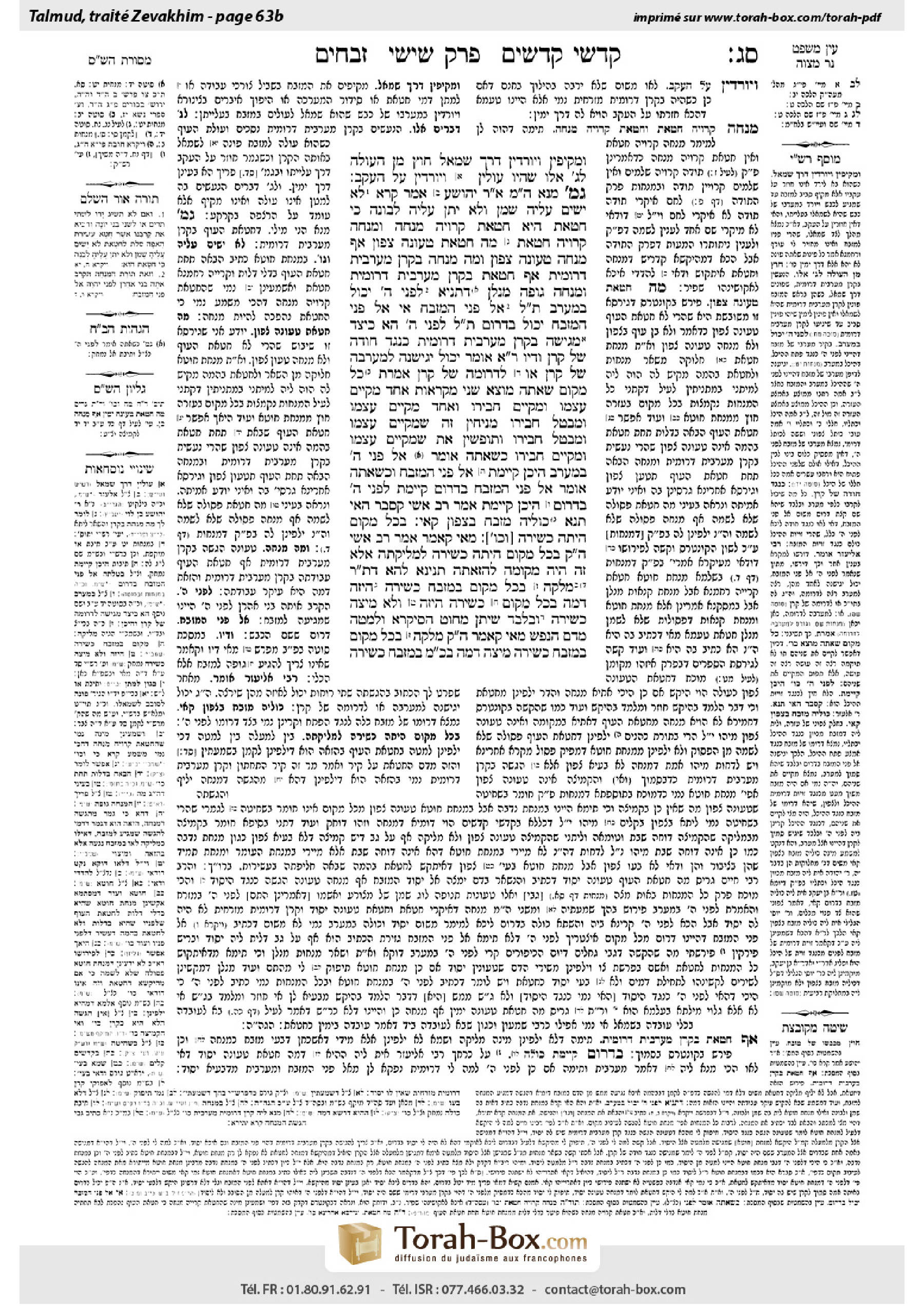
This page of Zevachim includes the Aramaic text, an English translation and an AI-generated French translation, alongside the scan above.
זבחים ס״ג ב · Aramaic and Hebrew text
וּמַקִּיפִין וְיוֹרְדִין דֶּרֶךְ שְׂמֹאל; חוּץ מִן הָעוֹלֶה לִשְׁלֹשָׁה אֵלּוּ – שֶׁהָיוּ עוֹלִין וְיוֹרְדִין עַל הֶעָקֵב.
גְּמָ׳ מְנָא הָנֵי מִילֵּי? אָמַר רַבִּי יְהוֹשֻׁעַ, אָמַר קְרָא: ״לֹא יָשִׂים עָלֶיהָ שֶׁמֶן וְלֹא יִתֵּן עָלֶיהָ לְבֹנָה כִּי חַטָּאת הִיא״ – חַטָּאת קְרוּיָה מִנְחָה, וּמִנְחָה קְרוּיָה חַטָּאת;
מָה חַטָּאת טְעוּנָה צָפוֹן – אַף מִנְחָה טְעוּנָה צָפוֹן, וּמָה מִנְחָה בְּקֶרֶן מַעֲרָבִית דְּרוֹמִית – אַף חַטָּאת בְּקֶרֶן מַעֲרָבִית דְּרוֹמִית.
וּמִנְחָה גּוּפַהּ מְנָלַן? דְּתַנְיָא: ״לִפְנֵי ה׳״ – יָכוֹל בַּמַּעֲרָב? תַּלְמוּד לוֹמַר: ״אֶל פְּנֵי הַמִּזְבֵּחַ״.
אִי ״אֶל פְּנֵי הַמִּזְבֵּחַ״ – יָכוֹל בַּדָּרוֹם? תַּלְמוּד לוֹמַר: ״לִפְנֵי ה׳״. הָא כֵּיצַד? מַגִּישָׁהּ בְּקֶרֶן מַעֲרָבִית דְּרוֹמִית כְּנֶגֶד חוּדָּהּ שֶׁל קֶרֶן, וְדַיּוֹ.
רַבִּי אֱלִיעֶזֶר אוֹמֵר: יָכוֹל יַגִּישֶׁנָּה לְמַעֲרָבָהּ שֶׁל קֶרֶן אוֹ לִדְרוֹמָהּ שֶׁל קֶרֶן? אָמַרְתָּ: כׇּל מָקוֹם שֶׁאַתָּה מוֹצֵא שְׁנֵי מִקְרָאוֹת, אֶחָד מְקַיֵּים עַצְמוֹ וּמְקַיֵּים חֲבֵירוֹ, וְאֶחָד מְקַיֵּים עַצְמוֹ וּמְבַטֵּל חֲבֵירוֹ – מַנִּיחִין זֶה שֶׁמְּקַיֵּים עַצְמוֹ וּמְבַטֵּל חֲבֵירוֹ, וְתוֹפְשִׂין אֶת שֶׁמְּקַיֵּים עַצְמוֹ וּמְקַיֵּים חֲבֵירוֹ.
כְּשֶׁאַתָּה אוֹמֵר ״אֶל פְּנֵי ה׳״ בַּמַּעֲרָב, הֵיכָן קִיַּימְתָּ ״אֶל פְּנֵי הַמִּזְבֵּחַ״? וּכְשֶׁאַתָּה אוֹמֵר ״אֶל פְּנֵי הַמִּזְבֵּחַ״ בַּדָּרוֹם, קִיַּימְתָּ ״לִפְנֵי ה׳״.
בַּדָּרוֹם הֵיכָן קִיַּימְתָּ? אָמַר רַב אָשֵׁי: קָסָבַר הַאי תַּנָּא, כּוּלֵּיהּ מִזְבֵּחַ בַּצָּפוֹן קָאֵי.
בְּכׇל מָקוֹם הָיְתָה כְּשֵׁירָה [וְכוּ׳]. מַאי קָאָמַר? אָמַר רַב אָשֵׁי, הָכִי קָאָמַר: בְּכׇל מָקוֹם הָיְתָה כְּשֵׁירָה לִמְלִיקָתָהּ, אֶלָּא זֶה הָיָה מְקוֹמָהּ לְהַזָּאָתָהּ.
תְּנֵינָא לְהָא דְּתָנוּ רַבָּנַן: מְלָקָהּ בְּכׇל מָקוֹם בַּמִּזְבֵּחַ – כְּשֵׁירָה. הִיזָּה דָּמָהּ בְּכׇל מָקוֹם – כְּשֵׁירָה, הִיזָּה וְלֹא מִיצָּה – כְּשֵׁירָה; וּבִלְבַד שֶׁיִּתֵּן מִחוּט הַסִּיקְרָא וּלְמַטָּה מִדַּם הַנֶּפֶשׁ.
מַאי קָאָמַר? הָכִי קָאָמַר: מְלָקָהּ בְּכׇל מָקוֹם בַּמִּזְבֵּחַ – כְּשֵׁירָה. מִיצָּה דָּמָהּ בְּכׇל מָקוֹם בַּמִּזְבֵּחַ – כְּשֵׁירָה,
Zevachim 63b · English translation
and circle the altar until reaching the southwest corner and descend via the left side of the ramp, except for one who ascends for one of these three matters, where they would ascend directly to the southwest corner of the altar, and descend by turning on their heels and retracing the path by which they ascended rather than circling the altar.
GEMARA: The Gemara asks a question about the mishna’s statement that the sacrificial rite of a bird sin offering is performed at the southwest corner of the altar: From where are these matters derived? Rabbi Yehoshua says: The verse states with regard to the sin offering of a destitute sinner, which is a meal offering brought in lieu of an animal or bird: “He shall put no oil upon it, neither shall he put any frankincense on it; for it is a sin offering” (Leviticus 5:11). From this verse it is evident that a sin offering is called a meal offering and a meal offering is called a sin offering, so that their halakhot may be compared.
Just as a sin offering requires slaughtering in the north section of the Temple courtyard, so too, the handful of a meal offering requires sanctification in a service vessel in the north. And just as a meal offering is brought near to the southwest corner of the altar, so too, the blood of a sin offering is sprinkled on the southwest corner of the altar.
The Gemara asks: And with regard to a meal offering itself, from where do we derive that it must be brought near the altar at the southwest corner? As it is taught in a baraita with regard to the verse: “And this is the law of the meal offering…before the Lord, in front of the altar” (Leviticus 6:7). From the phrase: “Before the Lord,” one might have thought that the rite of bringing the meal offering near the altar must be performed at the west side of the altar, which faces the Sanctuary. Therefore, the verse states: “In front of the altar,” which is its south side, from where the priests ascend the ramp.
The baraita continues: If the verse merely stated: “In front of the altar,” one might have thought that the practice of bringing the meal offering near the altar must be performed at the south side of the altar. Therefore, the verse states: “Before the Lord,” which indicates the west side. How can these texts be reconciled? The priest brings it near at the southwest corner of the altar, opposite the edge of the corner of the altar, and that is sufficient.
The baraita continues: Rabbi Eliezer says: One might have thought that the priest may bring it near the altar to the west of the southwest corner or to the south of the southwest corner. You must say: Anywhere you find two verses, and acting in accordance with one of them fulfills itself, i.e., the requirement stated in that verse, and fulfills the requirement stated in the other verse, whereas acting in accordance with the other one of them fulfills itself and negates the requirement stated in the other verse, one leaves the verse that fulfills itself and negates the other, and seizes the verse that fulfills itself and fulfills the other verse as well.
The Gemara explains: In this context, when you say: “Before the Lord,” which indicates that the meal offering should be brought near the altar at the west side of the altar, how have you fulfilled the other part of the verse: “In front of the altar,” which indicates the south side? But when you say: “In front of the altar,” and bring it near the altar at the south side, you have also fulfilled the phrase: “Before the Lord.” Consequently, the meal offering must be brought near the south side of the altar.
The Gemara asks: If one brought the meal offering near the altar at the south side, how have you fulfilled the phrase: “Before the Lord”? Rav Ashi says: This tanna holds that the entire altar stood in the north section of the Temple courtyard. The southern side of the altar was directly aligned with the midpoint of the Temple courtyard, directly opposite the entrance of the Sanctuary, and therefore it is considered “before the Lord.”
§ The mishna teaches that if the sacrificial rite of a bird sin offering was performed in any place on the altar, the offering is valid, but the southwest corner was its designated place. The Gemara asks: What is the mishna saying when it states that the southwest corner was its designated place? The mishna already stated that the sacrificial rite of a bird sin offering should be performed at the southwest corner. Rav Ashi said: This is what the mishna is saying: Any place was valid for its pinching, but the southwest corner was the place for the sprinkling of its blood.
The Gemara notes: We learn in this mishna that which the Sages taught explicitly in a baraita with regard to a bird sin offering: If the priest pinched its nape in any place on the altar, it is valid. If he sprinkled its blood in any place on the altar, it is valid. If he sprinkled the blood, but did not squeeze out the remaining blood upon the lower part of the wall of the altar, in accordance with the verse: “And he shall sprinkle of the blood of the sin offering upon the side of the altar; and the rest of the blood shall be squeezed out at the base of the altar” (Leviticus 5:9), it is nevertheless valid, provided that he places some of the blood of the soul anywhere on the altar from the red line and below.
The Gemara asks: What is the baraita saying? It first states that the offering is valid no matter where on the altar its blood is sprinkled, and it then states that blood must be placed specifically below the red line. The Gemara answers: This is what the baraita is saying: If he pinched its nape in any place on the altar, it is valid. If he squeezed out its blood in any place on the altar, it is valid,
Zevachim 63b · Traduction française (IA)
et fait le tour de l’autel jusqu’à atteindre l’angle sud-ouest, puis descend par le côté gauche de la rampe. Toutefois, celui qui monte pour l’une de ces trois raisons monte directement jusqu’à l’angle sud-ouest de l’autel, puis descend en faisant demi-tour sur ses talons et en revenant sur ses pas, sans faire le tour de l’autel.
GUEMARA : La Guemara pose une question au sujet de la déclaration de la Michna selon laquelle le rite sacrificiel de l’offrande expiatoire d’oiseau s’accomplit à l’angle sud-ouest de l’autel : d’où déduit-on ces règles ? Rabbi Yehoshua dit : Le verset dit, au sujet du sacrifice expiatoire du pécheur indigent, qui est une offrande de farine apportée à la place d’un animal ou d’un oiseau : « Il n’y mettra pas d’huile et n’y mettra pas d’encens, car c’est un sacrifice expiatoire » (Lévitique 5:11). Ce verset montre qu’un sacrifice expiatoire est appelé offrande de farine et qu’une offrande de farine est appelée sacrifice expiatoire ; leurs halakhot peuvent donc être comparées.
De même qu’un sacrifice expiatoire doit être égorgé dans la partie nord du parvis du Temple, de même la poignée d’une offrande de farine doit être sanctifiée dans un ustensile de service, au nord. Et de même qu’une offrande de farine est présentée à l’angle sud-ouest de l’autel, de même le sang d’un sacrifice expiatoire est aspergé sur l’angle sud-ouest de l’autel.
La Guemara demande : Et au sujet de l’offrande de farine elle-même, d’où déduit-on qu’elle doit être présentée à l’autel à l’angle sud-ouest ? Car il est enseigné dans une baraïta au sujet du verset : « Et voici la loi de l’offrande de farine… devant le Seigneur, face à l’autel » (Lévitique 6:7). De l’expression « devant le Seigneur », on aurait pu penser que le rite consistant à présenter l’offrande de farine à l’autel doit s’accomplir du côté ouest de l’autel, qui fait face au Sanctuaire. Le verset dit donc : « face à l’autel », c’est-à-dire du côté sud, d’où les prêtres montent par la rampe.
La baraïta poursuit : Si le verset avait seulement dit : « Face à l’autel », on aurait pu penser que l’offrande de farine doit être présentée du côté sud de l’autel. Le verset dit donc : « Devant le Seigneur », ce qui indique le côté ouest. Comment concilier ces textes ? Le prêtre la présente à l’angle sud-ouest de l’autel, juste en face du bord de l’angle de l’autel, et cela suffit.
La baraïta poursuit : Rabbi Eliezer dit : On aurait pu penser que le prêtre peut présenter l’offrande à l’autel à l’ouest de l’angle sud-ouest ou au sud de cet angle. Il faut dire que, chaque fois que l’on trouve deux versets et que l’application de l’un satisfait à la fois à l’exigence qu’il énonce et à celle qu’énonce l’autre, tandis que l’application de l’autre satisfait à l’exigence qu’il énonce, mais annule celle qu’énonce le premier, on écarte le verset dont l’application satisfait à l’exigence qu’il énonce tout en annulant celle de l’autre, et on retient celui dont l’application satisfait à la fois à l’exigence qu’il énonce et à celle de l’autre.
La Guemara explique : Dans ce contexte, si l’on dit « devant le Seigneur », ce qui indique que l’offrande de farine doit être présentée à l’autel du côté ouest, comment a-t-on satisfait à l’autre partie du verset, « face à l’autel », qui indique le côté sud ? En revanche, si l’on dit « face à l’autel » et qu’on la présente à l’autel du côté sud, on a également satisfait à l’expression « devant le Seigneur ». Par conséquent, l’offrande de farine doit être présentée du côté sud de l’autel.
La Guemara demande : Si l’on a présenté l’offrande de farine à l’autel du côté sud, comment a-t-on satisfait à l’expression « devant le Seigneur » ? Rav Ashi dit : Ce tanna considère que l’autel tout entier se trouvait dans la partie nord du parvis du Temple. Le côté sud de l’autel était dans le prolongement direct du milieu du parvis du Temple, exactement en face de l’entrée du Sanctuaire ; il est donc considéré comme étant « devant le Seigneur ».
§ La Michna enseigne que si le rite sacrificiel d’un sacrifice expiatoire d’oiseau a été accompli à n’importe quel endroit de l’autel, l’offrande est valide, mais que son emplacement désigné était l’angle sud-ouest. La Guemara demande : Que veut dire la Michna en disant que l’angle sud-ouest était son emplacement désigné ? La Michna avait déjà déclaré que le rite sacrificiel d’un sacrifice expiatoire d’oiseau devait s’accomplir à l’angle sud-ouest. Rav Ashi dit : Voici ce que veut dire la Michna : l’incision de la nuque était valable à n’importe quel endroit, mais le sang devait être aspergé à l’angle sud-ouest.
La Guemara note : Nous apprenons dans cette Michna ce que les Sages ont enseigné explicitement dans une baraïta au sujet d’un sacrifice expiatoire d’oiseau : si le prêtre lui a incisé la nuque à n’importe quel endroit de l’autel, l’offrande est valide. S’il a aspergé son sang à n’importe quel endroit de l’autel, elle est valide. S’il a aspergé le sang, mais n’a pas pressé le sang restant sur la partie inférieure du mur de l’autel, conformément au verset : « Il aspergera du sang du sacrifice expiatoire sur le côté de l’autel, et le reste du sang sera pressé à la base de l’autel » (Lévitique 5:9), l’offrande est néanmoins valide, à condition qu’il place une partie du sang vital n’importe où sur l’autel, à partir de la ligne rouge et en dessous.
La Guemara demande : Que dit la baraïta ? Elle commence par dire que l’offrande est valide quel que soit l’endroit de l’autel où son sang est aspergé, puis elle dit que le sang doit être placé précisément sous la ligne rouge. La Guemara répond : Voici ce que dit la baraïta : si le prêtre lui a incisé la nuque à n’importe quel endroit de l’autel, l’offrande est valide. S’il en a pressé le sang à n’importe quel endroit de l’autel, elle est valide,
Traduction française générée par IA à partir de l’édition anglaise de Sefaria. Vérifie toujours un passage avec le texte source.
Text from Sefaria: William Davidson Edition - Vocalized Aramaic (CC BY NC); William Davidson Edition - English (CC BY NC).