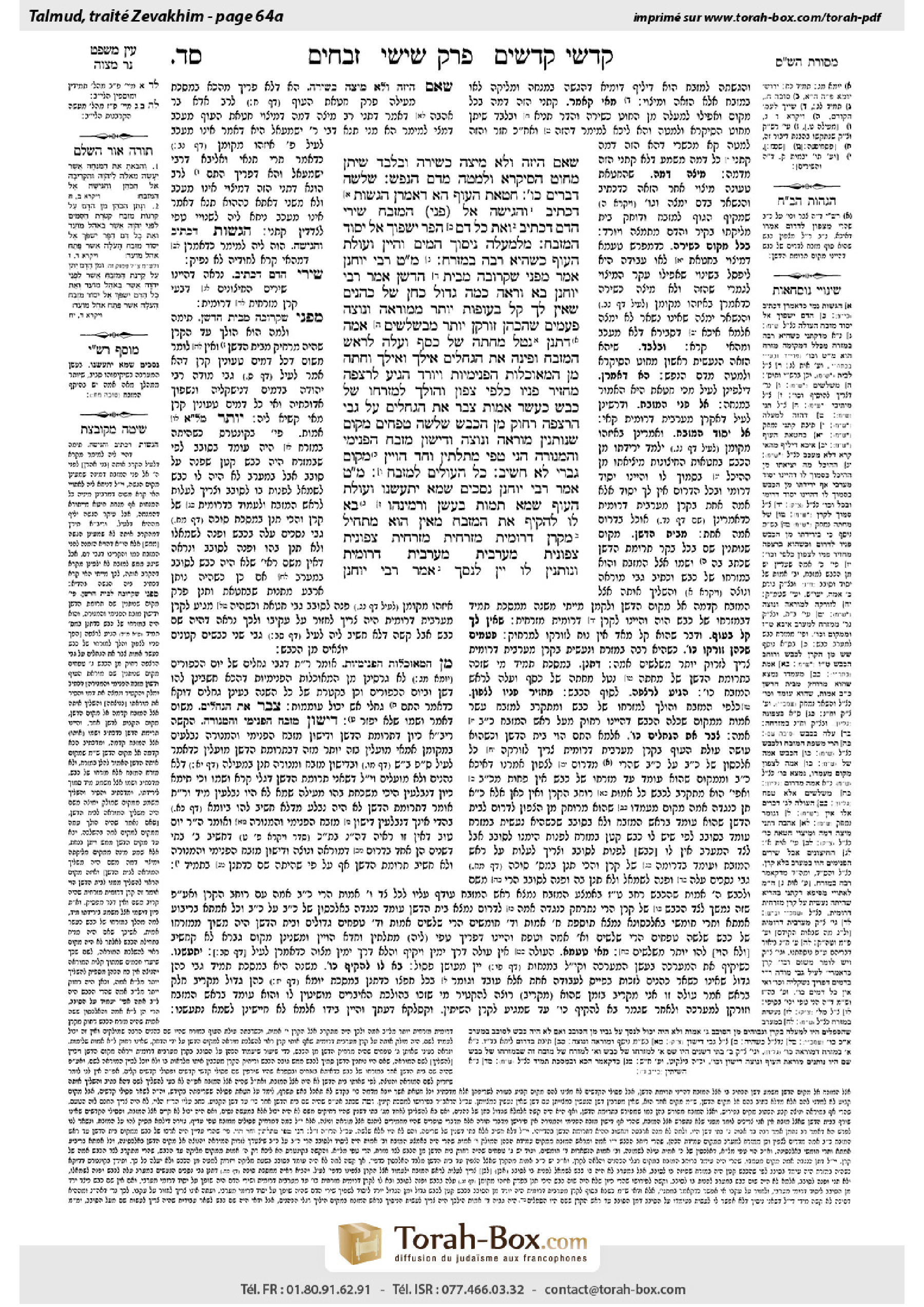
Zevachim 64a: Talmud study for Daf Yomi
Daf Yomi is the daily study of one Talmud folio. Explore 37 tractates with scans, Hebrew text, Sefaria English and AI-generated French translations where annotated.
Passage selection and English or AI-generated French translation are available where the scan has annotations. Daf Study is independent of Torah-Box and Sefaria.
Browse Zevachim · זבחים · All tractatesZevachim 64a text and translations
This page of Zevachim includes the Aramaic text, an English translation and an AI-generated French translation, alongside the scan above.
זבחים ס״ד א · Aramaic and Hebrew text
שֶׁאִם הִיזָּה וְלֹא מִיצָּה – כְּשֵׁירָה; וּבִלְבַד שֶׁיִּתֵּן מִחוּט הַסִּיקְרָא וּלְמַטָּה מִדַּם הַנֶּפֶשׁ.
שְׁלֹשָׁה דְּבָרִים כּוּ׳. חַטַּאת הָעוֹף – הָא דַּאֲמַרַן.
הַגָּשׁוֹת – דִּכְתִיב: ״וְהִגִּישָׁהּ אֶל פְּנֵי הַמִּזְבֵּחַ״. שְׁיָרֵי הַדָּם – דִּכְתִיב: ״וְאֶת כׇּל דַּם הַפָּר יִשְׁפֹּךְ אֶל יְסוֹד הַמִּזְבֵּחַ״.
מִלְּמַעְלָה: נִיסּוּךְ הַמַּיִם, וְהַיַּיִן, וְעוֹלַת הָעוֹף כְּשֶׁהִיא רַבָּה בַּמִּזְרָח. מַאי טַעְמָא? רַבִּי יוֹחָנָן אָמַר: מִפְּנֵי שֶׁקְּרוֹבָה מִבֵּית הַדֶּשֶׁן.
אָמַר רַבִּי יוֹחָנָן: בֹּא וּרְאֵה כַּמָּה גָּדוֹל כֹּחָן שֶׁל כֹּהֲנִים – שֶׁאֵין לָךְ קַל בָּעוֹפוֹת יוֹתֵר מִמּוּרְאָה וְנוֹצָה, פְּעָמִים שֶׁהַכֹּהֵן זוֹרְקָן יוֹתֵר מִשְּׁלֹשִׁים אַמָּה.
דִּתְנַן: נָטַל מַחְתָּה שֶׁל כֶּסֶף, וְעָלָה לְרֹאשׁ הַמִּזְבֵּחַ, וּפִינָּה אֶת הַגֶּחָלִים אֵילָךְ וְאֵילָךְ, וְחָתָה מִן הַמְאוּכָּלוֹת הַפְּנִימִיּוֹת, וְיוֹרֵד. הִגִּיעַ לָרִצְפָּה – מַחֲזִיר פָּנָיו כְּלַפֵּי צָפוֹן, וְהוֹלֵךְ לְמִזְרָחוֹ שֶׁל כֶּבֶשׁ כְּעֶשֶׂר אַמּוֹת. צָבַר אֶת הַגֶּחָלִים עַל גַּבֵּי הָרִצְפָּה רָחוֹק מִן הַכֶּבֶשׁ שְׁלֹשָׁה טְפָחִים – מָקוֹם שֶׁנּוֹתְנִין מוּרְאָה וְנוֹצָה, וְדִישּׁוּן מִזְבֵּחַ הַפְּנִימִי וְהַמְּנוֹרָה.
הָנֵי טְפֵי מִתְּלָתִין וְחַד הָוְיָין! מְקוֹם גַּבְרֵי לָא חָשֵׁיב.
כׇּל הָעוֹלִים לְמִזְבֵּחַ, מַאי טַעְמָא? אָמַר רַבִּי יוֹחָנָן: נְסָכִים – שֶׁמָּא יִתְעַשְּׁנוּ, וְעוֹלַת הָעוֹף – שֶׁמָּא תָּמוּת בֶּעָשָׁן.
וּרְמִינְהוּ: בָּא לוֹ לְהַקִּיף אֶת הַמִּזְבֵּחַ, מֵאַיִן הוּא מַתְחִיל? מִקֶּרֶן דְּרוֹמִית מִזְרָחִית, מִזְרָחִית צְפוֹנִית, צְפוֹנִית מַעֲרָבִית, מַעֲרָבִית דְּרוֹמִית; וְנוֹתְנִין לוֹ יַיִן לְנַסֵּךְ!
אָמַר רַבִּי יוֹחָנָן:
Zevachim 64a · English translation
because if he sprinkled the blood but did not squeeze out the rest of it, it is still valid, provided that he places some of the blood of the soul anywhere on the altar from the red line and below. This version of the baraita states that the offering is valid no matter where on the altar its blood was squeezed out; but it is essential that blood is sprinkled on the lower half of the altar.
§ The mishna teaches that there were three matters for which the portion of the southwest corner below the red line served as the proper location: The sacrificing of a bird sin offering, and the bringing of the meal offerings near the altar, and pouring the remaining blood. The Gemara cites sources to prove that each of these three matters was performed at the southwest corner: The source with regard to the bird sin offering is that which we said earlier (63b), that it is derived from a comparison to meal offerings.
The source for bringing meal offerings near the altar at the southwest corner is derived from that which is written: “And he shall bring it to the front of the altar.” The source for pouring the remaining blood at the southwest corner of the altar is as it is written: “And all the remaining blood of the bull he shall pour out at the base of the altar” (Leviticus 4:7), which the Gemara derives to be referring to the southwest corner (see 53a).
§ The mishna teaches that there were three matters for which the portion of the southwest corner above the red line served as the proper location: The water and wine libations, and sacrificing a bird burnt offering when they were numerous in the east, i.e., the southeast corner. The Gemara asks: What is the reason the sacrificial rites of a bird burnt offering were ideally supposed to be performed at the southeast corner of the altar? Rabbi Yoḥanan says: Because it is the closest of all the corners to the place of the ashes, i.e., the place where the ashes from the altar are placed every morning. The crop and feathers of a bird burnt offering are placed there as well.
The Gemara cites a comment pertaining to the mishna’s statement that when the southeast corner of the altar is too crowded, the sacrificial rites of a bird burnt offering can be performed at the southwest corner: Rabbi Yoḥanan says: Come and see how great was the strength of the priests, as you have no parts of birds lighter than the crop and feathers, and there were times when the priest would toss them more than thirty cubits from the southwest corner of the altar to the place of the ashes.
This is as we learned in a mishna (Tamid 28b) describing the procedure of separating the ashes: The priest would take a coal pan of silver and ascend to the top of the altar and clear the upper layer of coals to this side and to that side, and, using the coal pan, scoop up coals from among the inner, consumed coals and descend the ramp. When he reached the floor of the Temple courtyard, he would turn his face to the left, toward the north, and walk about ten cubits along the eastern side of the ramp. There, he would heap the coals upon the floor at a distance of three handbreadths from the ramp. This was the location where one places the crop and feathers, and the ashes removed from the inner altar and the Candelabrum.
The Gemara challenges: The distance from the southwest corner to the location described in that mishna is more than thirty-one cubits. The Gemara answers: Rabbi Yoḥanan did not consider the space taken up by people, i.e., the priest performing the service, in his calculation.
§ The mishna teaches that everyone who ascends the ramp to the altar ascends via the right side of the ramp, circles the altar until reaching the southwest corner, and descends via the left side of the ramp, with the exception of one ascending in order to perform the wine or water libations, or to sacrifice a bird burnt offering on the southwest corner of the altar. In those cases the priest would ascend directly to the southwest corner. The Gemara asks: What is the reason for these exceptions to the standard practice? Rabbi Yoḥanan says: With regard to the libations, the priest would not walk all the way around the altar lest the wine or water absorb the smoke of the altar fire. And with regard to a bird burnt offering he would not walk all the way around lest the bird die from inhaling the smoke.
The Gemara raises a contradiction from the following mishna (Tamid 33b): If the High Priest was performing the sacrificial rites of the daily offering, after he would place the limbs on the fire on top of the altar and he would come to circle the altar, from where does he start walking? He starts from the southeast corner, continues to the northeast corner, then to the northwest corner, and finally arrives at the southwest corner. And he is given wine to pour on the altar. This indicates that the High Priest circles the altar while holding the wine for the libation, and there is no concern that it will absorb too much smoke.
Rabbi Yoḥanan says:
Zevachim 64a · Traduction française (IA)
car, s’il a aspergé le sang sans en exprimer le reste, le rite demeure valide, à condition qu’il dépose une partie du sang vital n’importe où sur l’autel, depuis la ligne rouge vers le bas. Cette version de la baraïta affirme que l’offrande est valide quel que soit l’endroit de l’autel où son sang a été exprimé ; toutefois, il est essentiel que du sang soit aspergé sur la moitié inférieure de l’autel.
§ La Michna enseigne qu’il y avait trois rites pour lesquels la partie située sous la ligne rouge à l’angle sud-ouest constituait l’emplacement approprié : le sacrifice expiatoire d’un oiseau, l’approche des offrandes de farine près de l’autel et le versement du sang restant. La Guemara cite des sources établissant que chacun de ces trois rites était accompli à l’angle sud-ouest. La source concernant le sacrifice expiatoire d’un oiseau est celle que nous avons mentionnée précédemment (63b) : on le déduit par comparaison avec les offrandes de farine.
La source concernant l’approche des offrandes de farine près de l’autel, à l’angle sud-ouest, est déduite de ce qui est écrit : « Il l’approchera devant l’autel. » La source concernant le versement du sang restant à l’angle sud-ouest de l’autel est le verset : « Il versera tout le sang restant du taureau à la base de l’autel » (Lévitique 4,7), que la Guemara comprend comme faisant référence à l’angle sud-ouest (voir 53a).
§ La Michna enseigne qu’il y avait trois rites pour lesquels la partie située au-dessus de la ligne rouge à l’angle sud-ouest constituait l’emplacement approprié : les libations d’eau et de vin, ainsi que le sacrifice d’un oiseau en holocauste lorsque l’angle est, c’est-à-dire l’angle sud-est, était encombré. La Guemara demande : Pourquoi les rites du sacrifice d’un oiseau en holocauste devaient-ils de préférence être accomplis à l’angle sud-est de l’autel ? Rabbi Yoḥanan dit : Parce que c’est celui de tous les angles qui est le plus proche du lieu des cendres, c’est-à-dire l’endroit où l’on dépose chaque matin les cendres provenant de l’autel. Le jabot et les plumes d’un oiseau offert en holocauste y sont également déposés.
La Guemara cite une remarque relative à l’affirmation de la Michna selon laquelle, lorsque l’angle sud-est de l’autel est trop encombré, les rites du sacrifice d’un oiseau en holocauste peuvent être accomplis à l’angle sud-ouest. Rabbi Yoḥanan dit : « Viens et vois quelle était la grande force des prêtres ! Aucune partie d’un oiseau n’est plus légère que le jabot et les plumes, et pourtant il arrivait que le prêtre les lance à plus de trente coudées, depuis l’angle sud-ouest de l’autel jusqu’au lieu des cendres. »
C’est ce que nous avons appris dans une Michna (Tamid 28b) décrivant la procédure de prélèvement des cendres : le prêtre prenait une pelle à braises en argent, montait au sommet de l’autel et écartait la couche supérieure de braises d’un côté puis de l’autre. À l’aide de la pelle, il recueillait des braises parmi les braises intérieures consumées, puis descendait la rampe. Lorsqu’il atteignait le sol de la cour du Temple, il tournait le visage vers la gauche, en direction du nord, et parcourait environ dix coudées le long du côté est de la rampe. Là, il entassait les braises sur le sol, à trois palmes de la rampe. C’était l’endroit où l’on déposait le jabot et les plumes, ainsi que les cendres retirées de l’autel intérieur et du Candélabre.
La Guemara soulève une difficulté : la distance entre l’angle sud-ouest et l’endroit décrit dans cette Michna dépasse trente et une coudées. La Guemara répond que Rabbi Yoḥanan n’a pas pris en compte, dans son calcul, l’espace occupé par les personnes, c’est-à-dire par le prêtre qui accomplit le service.
§ La Michna enseigne que toute personne qui monte par la rampe jusqu’à l’autel emprunte le côté droit de la rampe, fait le tour de l’autel jusqu’à l’angle sud-ouest, puis descend par le côté gauche de la rampe. Font exception ceux qui montent pour accomplir les libations de vin ou d’eau, ou pour sacrifier un oiseau en holocauste à l’angle sud-ouest de l’autel. Dans ces cas, le prêtre montait directement jusqu’à l’angle sud-ouest. La Guemara demande : Pourquoi ces exceptions à la pratique habituelle ? Rabbi Yoḥanan dit : Pour les libations, le prêtre ne faisait pas tout le tour de l’autel, de peur que le vin ou l’eau n’absorbe la fumée du feu de l’autel. Quant à l’oiseau offert en holocauste, il ne faisait pas tout le tour, de peur que l’oiseau ne meure en inhalant la fumée.
La Guemara soulève une contradiction à partir de la Michna suivante (Tamid 33b) : si le grand prêtre accomplissait les rites de l’offrande quotidienne, après avoir déposé les membres sur le feu au sommet de l’autel, il s’apprêtait à en faire le tour. Par où commençait-il ? Il partait de l’angle sud-est, poursuivait jusqu’à l’angle nord-est, puis jusqu’à l’angle nord-ouest, et arrivait enfin à l’angle sud-ouest. On lui remettait alors du vin à verser sur l’autel. Cela indique que le grand prêtre faisait le tour de l’autel en tenant le vin destiné à la libation, sans craindre qu’il n’absorbe trop de fumée.
Rabbi Yoḥanan dit :
Traduction française générée par IA à partir de l’édition anglaise de Sefaria. Vérifie toujours un passage avec le texte source.
Text from Sefaria: William Davidson Edition - Vocalized Aramaic (CC BY NC); William Davidson Edition - English (CC BY NC).