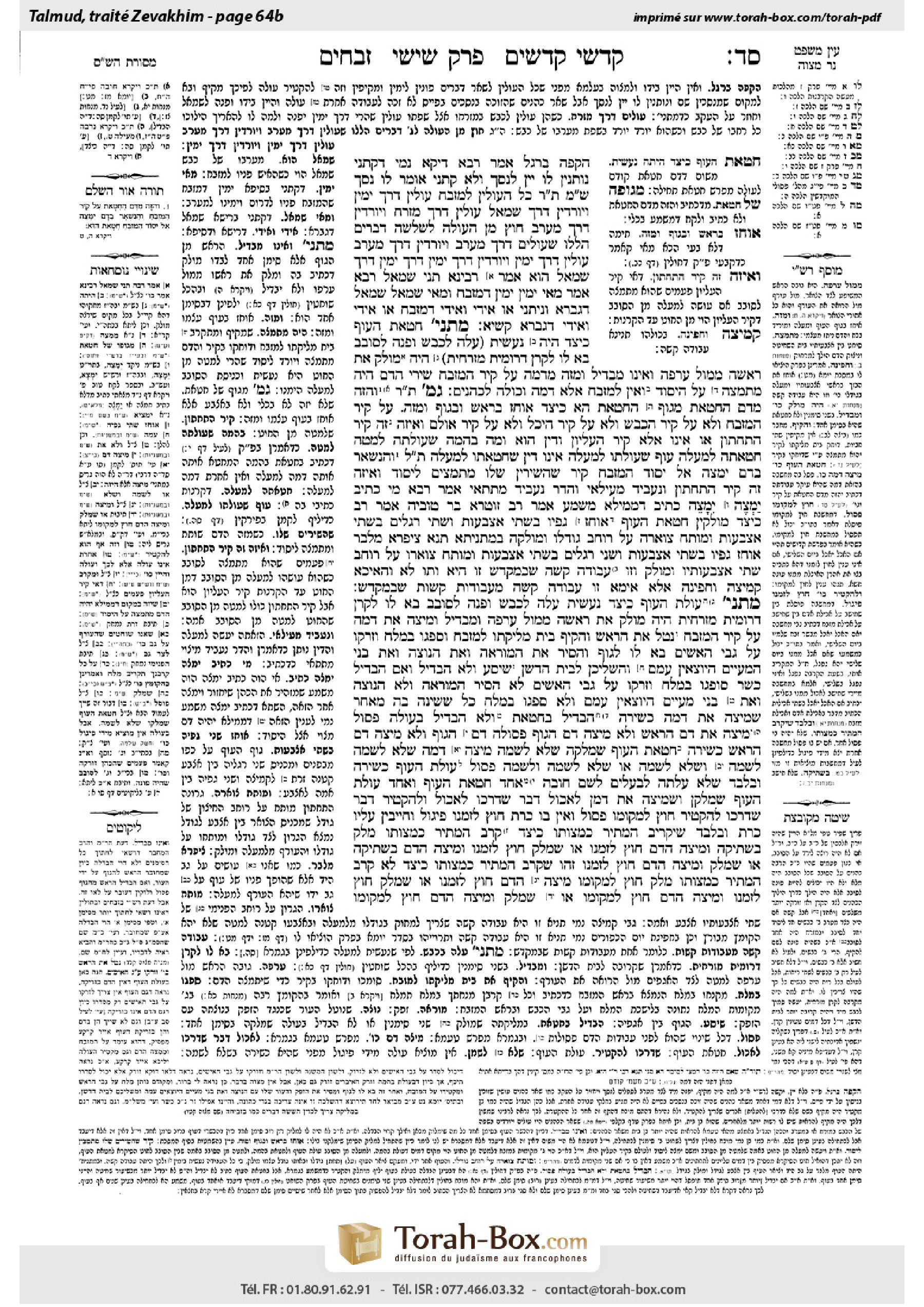
Zevachim 64b: Talmud study for Daf Yomi
Daf Yomi is the daily study of one Talmud folio. Explore 37 tractates with scans, Hebrew text, Sefaria English and AI-generated French translations where annotated.
Passage selection and English or AI-generated French translation are available where the scan has annotations. Daf Study is independent of Torah-Box and Sefaria.
Browse Zevachim · זבחים · All tractatesZevachim 64b text and translations
This page of Zevachim includes the Aramaic text, an English translation and an AI-generated French translation, alongside the scan above.
זבחים ס״ד ב · Aramaic and Hebrew text
הַקָּפָה בָּרֶגֶל. אָמַר רָבָא: דַּיְקָא נָמֵי, דְּקָתָנֵי ״נוֹתְנִין לוֹ יַיִן לְנַסֵּךְ״, וְלָא קָתָנֵי ״אוֹמֵר לוֹ נַסֵּךְ״; שְׁמַע מִינַּהּ.
תָּנוּ רַבָּנַן: כׇּל הָעוֹלִין לְמִזְבֵּחַ – עוֹלִין דֶּרֶךְ יָמִין וְיוֹרְדִין דֶּרֶךְ שְׂמֹאל, עוֹלִין דֶּרֶךְ מִזְרָח וְיוֹרְדִין דֶּרֶךְ מַעֲרָב; חוּץ מִן הָעוֹלֶה לִשְׁלֹשָׁה דְּבָרִים הַלָּלוּ – שֶׁעוֹלִים דֶּרֶךְ מַעֲרָב וְיוֹרְדִין דֶּרֶךְ מַעֲרָב, עוֹלִין דֶּרֶךְ יָמִין וְיוֹרְדִין דֶּרֶךְ יָמִין.
״דֶּרֶךְ יָמִין״?! דֶּרֶךְ שְׂמֹאל הוּא! אָמַר רָבִינָא: תְּנִי ״שְׂמֹאל״. רָבָא אָמַר: מַאי ״יָמִין״ – יָמִין דְּמִזְבֵּחַ, וּמַאי ״שְׂמֹאל״ – שְׂמֹאל דְּגַבְרָא.
וְנִיתְנֵי אוֹ אִידֵּי וְאִידֵּי דְּמִזְבֵּחַ, אוֹ אִידֵּי וְאִידֵּי דְּגַבְרָא! קַשְׁיָא.
מַתְנִי׳ חַטַּאת הָעוֹף כֵּיצַד הָיָה נַעֲשֵׂית? (עָלָה לַכֶּבֶשׁ וּפָנָה לַסּוֹבֵב בָּא לוֹ לְקֶרֶן דְּרוֹמִית מִזְרָחִית), הָיָה מוֹלֵק אֶת רֹאשָׁהּ מִמּוּל עׇרְפָּה וְאֵינוֹ מַבְדִּיל, וּמַזֶּה מִדָּמָהּ עַל קִיר הַמִּזְבֵּחַ. שְׁיָרֵי הַדָּם הָיָה מִתְמַצֶּה עַל הַיְסוֹד; וְאֵין לְמִזְבֵּחַ אֶלָּא דָּמָהּ, וְכוּלָּהּ לַכֹּהֲנִים.
גְּמָ׳ תָּנוּ רַבָּנַן: ״וְהִזָּה מִדַּם הַחַטָּאת״ – מִגּוּף הַחַטָּאת. הָא כֵּיצַד? אוֹחֵז בָּרֹאשׁ וּבַגּוּף, וּמַזֶּה עַל קִיר הַמִּזְבֵּחַ; וְלֹא עַל קִיר הַכֶּבֶשׁ, וְלֹא עַל קִיר הֵיכָל, וְלֹא עַל קִיר אוּלָם. וְאֵיזֶה? זֶה קִיר הַתַּחְתּוֹן.
אוֹ אֵינוֹ אֶלָּא קִיר הָעֶלְיוֹן? וְדִין הוּא: וּמָה בְּהֵמָה, שֶׁעוֹלָתָהּ לְמַטָּה – חַטָּאתָהּ לְמַעְלָה; עוֹף, שֶׁעוֹלָתוֹ לְמַעְלָה – אֵינוֹ דִּין שֶׁחַטָּאתוֹ לְמַעְלָה?!
תַּלְמוּד לוֹמַר: ״וְהַנִּשְׁאָר בַּדָּם יִמָּצֵה אֶל יְסוֹד הַמִּזְבֵּחַ״ – קִיר שֶׁהַשְּׁיָרִין שֶׁלּוֹ מִתְמַצִּים לַיְסוֹד; וְאֵיזֶה? זֶה קִיר הַתַּחְתּוֹן.
וְנַעְבֵּיד מֵעִילַּאי, וַהֲדַר נַעְבֵּיד מִתַּתַּאי! אָמַר רָבָא: מִי כְּתִיב ״יְמַצֶּה״?! ״יִמָּצֵה״ כְּתִיב, דְּמִמֵּילָא מַשְׁמַע.
אָמַר רַב זוּטְרָא בַּר טוֹבִיָּה אָמַר רַב: כֵּיצַד מוֹלְקִין חַטַּאת הָעוֹף? אוֹחֵז גַּפָּיו בִּשְׁתֵּי אֶצְבָּעוֹת וּשְׁתֵּי רַגְלַיִם בִּשְׁתֵּי אֶצְבָּעוֹת, וּמוֹתֵחַ צַוָּארָהּ עַל רוֹחַב גּוּדָלוֹ, וּמוֹלְקָהּ.
בְּמַתְנִיתָא תְּנָא: צִיפְּרָא מִלְּבַר; אוֹחֵז גַּפָּיו בִּשְׁתֵּי אֶצְבָּעוֹת וּשְׁנֵי רַגְלַיִם בִּשְׁתֵּי אֶצְבָּעוֹת, וּמוֹתֵחַ צַוָּארוֹ עַל רוֹחַב שְׁתֵּי אֶצְבְּעוֹתָיו, וּמוֹלֵק. וְזוֹ עֲבוֹדָה קָשָׁה שֶׁבַּמִּקְדָּשׁ.
זוֹ הִיא – וְתוּ לָא?! וְהָאִיכָּא קְמִיצָה וַחֲפִינָה! אֶלָּא אֵימָא: זוֹ עֲבוֹדָה קָשָׁה מֵעֲבוֹדוֹת קָשׁוֹת שֶׁבַּמִּקְדָּשׁ.
מַתְנִי׳ עוֹלַת הָעוֹף כֵּיצַד נַעֲשֵׂית? עָלָה לַכֶּבֶשׁ וּפָנָה לַסּוֹבֵב, בָּא לוֹ לְקֶרֶן דְּרוֹמִית מִזְרָחִית. הָיָה מוֹלֵק אֶת רֹאשָׁהּ מִמּוּל עׇרְפָּה, וּמַבְדִּיל, וּמִיצָּה אֶת דָּמָהּ עַל קִיר הַמִּזְבֵּחַ. נָטַל אֶת הָרֹאשׁ וְהִקִּיף בֵּית מְלִיקָתוֹ לַמִּזְבֵּחַ, סְפָגוֹ בְּמֶלַח, וּזְרָקוֹ עַל גַּבֵּי הָאִשִּׁים.
בָּא לוֹ לַגּוּף, וְהֵסִיר אֶת הַמּוּרְאָה וְאֶת הַנּוֹצָה וְאֶת בְּנֵי הַמֵּעַיִים הַיּוֹצְאִין עִמָּם, וְהִשְׁלִיכָן לְבֵית הַדֶּשֶׁן. שִׁיסַּע, וְלֹא הִבְדִּיל. וְאִם הִבְדִּיל – כָּשֵׁר. סוֹפְגוֹ בְּמֶלַח, וְזֹרְקוֹ עַל גַּבֵּי הָאִשִּׁים.
לֹא הֵסִיר הַמּוּרְאָה וְלֹא הַנּוֹצָה וְאֶת בְּנֵי מֵעַיִים הַיּוֹצְאִין עִמָּם, וְלֹא סְפָגוֹ בְּמֶלַח – כֹּל שֶׁשִּׁינָּה בָּהּ מֵאַחֵר שֶׁמִּיצָּה אֶת דָּמָהּ, כְּשֵׁירָה. הִבְדִּיל בַּחַטָּאת וְלֹא הִבְדִּיל בָּעוֹלָה – פָּסוּל. מִיצָּה אֶת דַּם הָרֹאשׁ וְלֹא מִיצָּה דַּם הַגּוּף – פְּסוּלָה. דַּם הַגּוּף וְלֹא מִיצָּה דַּם הָרֹאשׁ – כְּשֵׁירָה.
חַטַּאת הָעוֹף שֶׁמְּלָקָהּ שֶׁלֹּא לִשְׁמָהּ; מִיצָּה דָּמָהּ שֶׁלֹּא לִשְׁמָהּ; לִשְׁמָהּ וְשֶׁלֹּא לִשְׁמָהּ; אוֹ שֶׁלֹּא לִשְׁמָהּ וְלִשְׁמָהּ – פָּסוּל. עוֹלַת הָעוֹף כְּשֵׁירָה, וּבִלְבַד שֶׁלֹּא עָלְתָה לִבְעָלִים לְשֵׁם חוֹבָה.
אֶחָד חַטַּאת הָעוֹף וְאֶחָד עוֹלַת הָעוֹף, שֶׁמְּלָקָן וְשֶׁמִּיצָּה אֶת דָּמָן – לֶאֱכוֹל דָּבָר שֶׁדַּרְכּוֹ לֶאֱכוֹל, וּלְהַקְטִיר דָּבָר שֶׁדַּרְכּוֹ לְהַקְטִיר חוּץ לִמְקוֹמוֹ; פָּסוּל וְאֵין בּוֹ כָּרֵת. חוּץ לִזְמַנּוֹ – פִּיגּוּל, וְחַיָּיבִין עָלָיו כָּרֵת; וּבִלְבַד שֶׁיַּקְרִיב הַמַּתִּיר כְּמִצְוָתוֹ.
כֵּיצַד קָרַב הַמַּתִּיר כְּמִצְוָתוֹ? מָלַק בִּשְׁתִיקָה, וּמִיצָּה הַדָּם חוּץ לִזְמַנּוֹ; אוֹ שֶׁמָּלַק חוּץ לִזְמַנּוֹ, וּמִיצָּה הַדָּם בִּשְׁתִיקָה; אוֹ שֶׁמָּלַק וּמִיצָּה הַדָּם חוּץ לִזְמַנּוֹ – זֶהוּ שֶׁקָּרַב הַמַּתִּיר כְּמִצְוָתוֹ.
כֵּיצַד לֹא קָרַב הַמַּתִּיר כְּמִצְוָתוֹ? מָלַק חוּץ לִמְקוֹמוֹ, מִיצָּה הַדָּם חוּץ לִזְמַנּוֹ; אוֹ שֶׁמָּלַק חוּץ לִזְמַנּוֹ, וּמִיצָּה הַדָּם חוּץ לִמְקוֹמוֹ; אוֹ שֶׁמָּלַק וּמִיצָּה הַדָּם חוּץ לִמְקוֹמוֹ;
Zevachim 64b · English translation
The circling around the altar by the High Priest is done on foot, i.e., empty-handed, as he was given the wine to pour only once he arrived at the southwest corner. Rava said: The language of the mishna is also precise, as it teaches that he is given wine to pour, and the mishna does not teach that one tells him to pour the wine, which would have indicated that the High Priest was already holding the wine as he circled the altar. The Gemara comments: Conclude from the language of the mishna that the High Priest was given the wine only once he arrived at the southwest corner of the altar.
§ The Sages taught in a baraita: All those who ascend the ramp to the altar ascend via the right side of the ramp and descend via the left side; they ascend via the east side of the ramp and descend via the west side, except for one who ascends for one of these three matters: The wine libation, the water libation, and the sacrificial rite of a bird burnt offering. In these cases, one ascends via the west side of the ramp and descends via the west side; one ascends via the right side and descends via the right side.
The Gemara asks: Does one who ascends via the west side of the ramp do so via the right side? Ascending via the west side of the ramp is the same as ascending via the left. Ravina says: Emend the baraita so that it teaches that he ascends via the left side. Rava says: What is the meaning of the right side mentioned in the latter clause of the baraita? It is the right side from the standpoint of the altar, facing south, in which case the altar’s west side is synonymous with its right side. And what is the meaning of the left side mentioned in the first clause of the baraita? It is the left side from the standpoint of a person facing the altar.
The Gemara objects: But let the baraita be consistent and teach both this case and that case, i.e., the first clause and latter clause, from the standpoint of the altar, or let it teach both this case and that case from the standpoint of a person facing the altar. The Gemara concedes: This is difficult.
MISHNA: The sacrifice of the bird sin offering, how was it performed? The priest would pinch off the bird’s head by cutting opposite its nape with his thumbnail and would not separate the bird’s head from its body. And he sprinkles from its blood on the wall of the altar below the red line. The remaining blood would be squeezed out from the body of the bird on the base of the altar. The altar has only its blood and the entire bird goes to the priests for consumption.
GEMARA: The Sages taught in a baraita: The verse states with regard to the bird sin offering: “And he shall sprinkle of the blood of the sin offering upon the side of the altar” (Leviticus 5:9). This teaches that the blood is sprinkled directly from the body of the sin offering, not with the priest’s finger or from a vessel. How so? The priest holds the head and the body and sprinkles its blood on the wall of the altar. And he does not sprinkle it on the wall of the ramp, and not on the wall of the Sanctuary, and not on the wall of the Entrance Hall. And which is this wall of the altar that the blood is sprinkled on? This is the lower wall, below the red line.
The baraita suggests: Or perhaps the verse is referring only to the upper wall, above the red line. And this should be a logical inference: Just as with regard to an animal offering, where the blood of a burnt offering is applied below the red line (see 10b), nevertheless, the blood of the sin offering is applied above the red line (see Leviticus 4:30), with regard to a bird offering, where the blood of the burnt offering is sprinkled above the red line (see 65a), is it not logical that the blood of its sin offering is sprinkled above the red line?
Therefore, the verse states: “And the rest of the blood shall be squeezed out [yimmatze] at the base of the altar” (Leviticus 5:9), which teaches that the priest sprinkles the blood on the wall where its remaining blood drains to the base of the altar. And which wall is this? This is the lower wall. The surrounding ledge of the altar is located one cubit above the red line, and any blood sprinkled above this ledge will not drip down to the base of the altar. The verse teaches that the blood is sprinkled on the wall of the altar from which it would drip down to the altar’s base unimpeded.
The Gemara suggests: Let the priest perform the sprinkling of the blood above, as the baraita logically deduced, and then perform the squeezing below in fulfillment of the aforementioned verse. Rava said: Is it written: He shall drain [yematze]? It is written: It shall be drained [yimmatze], which indicates that the blood trickles down to the base of the altar by itself. Accordingly, the blood must be sprinkled on a part of the altar wall from which it can trickle down to the base of the altar.
§ Rav Zutra bar Toviyya says that Rav says: How does the priest pinch the nape of a bird sin offering? He holds the bird by its back in the palm of his hand and holds its wings with two fingers, i.e., the middle and index fingers, and its two legs with his next two fingers, i.e., the ring finger and pinky, leaving the head resting between his index finger and thumb, and he stretches its neck over the width of his thumb and pinches its nape with his thumbnail.
The Gemara cites a varying opinion: It was taught in a baraita: The bird is not in the priest’s palm, but rather on the outside of his hand. The priest holds its wings with two fingers and its two legs with two fingers. Using his thumb, the priest bends its head into his palm and stretches its neck over the width of his two fingers, and pinches its nape. And this is the most difficult sacrificial rite in the Temple to perform.
The Gemara asks: This is the most difficult rite to perform, and no other? But isn’t there also the removal of the handful of the meal offering and the handful of the incense on Yom Kippur? The Gemara answers: Rather, say that the pinching procedure was a difficult sacrificial rite, one of the most difficult sacrificial rites in the Temple to perform.
MISHNA: The sacrifice of the bird burnt offering, how was it performed? The priest ascended the ramp and turned to the surrounding ledge and came to the southeast corner of the altar. He would then pinch off the bird’s head by cutting at its nape with his thumbnail and separate the bird’s head from its body, and would squeeze out its blood on the wall of the altar. He took the head and neared the place of its pinching, i.e., its nape, to the altar in order to squeeze the blood from the head. He would then absorb the remaining blood with salt and throw the head onto the fire on the altar.
He then arrived at the body and removed the crop and the feather attached to it and the innards that emerge with them and he tossed them to the place of the ashes. He then ripped the bird lengthwise and did not separate the two halves of the bird; but if he separated them, the offering is valid. He would then absorb the remaining blood with salt and throw the body of the bird onto the fire on the altar.
If he neither removed the crop, nor the feather and the innards that emerge with them, nor absorbed the blood with salt, with regard to any detail that he changed in the sacrificial rites after he squeezed out its blood, the offering is valid. If he separated the head from the body in sacrificing the sin offering, or if he did not separate the head from the body in sacrificing the burnt offering, the offering is disqualified. In a case where he squeezed out the blood of the head and did not squeeze out the blood of the body, it is disqualified. If he squeezed out the blood of the body and did not squeeze out the blood of the head, the offering is valid.
In the case of a bird sin offering that the priest pinched not for its sake, or if he squeezed out its blood not for its sake, or if he did so for its sake and then not for its sake, or not for its sake and then for its sake, it is disqualified, like all other sin offerings that are disqualified when performed not for their sake (see 2a). A bird burnt offering sacrificed not for its sake is valid; it is just that it did not satisfy the obligation of the owner.
With regard to both a bird sin offering and a bird burnt offering where the priest pinched its nape or squeezed out its blood with the intent to partake of an item whose typical manner is such that one partakes of it, or to burn an item whose typical manner is such that one burns it on the altar, outside its designated area, the offering is disqualified. But there is no liability to receive karet for one who partakes of the offering. If his intent was to eat it or burn it beyond its designated time, the offering is piggul and one is liable to receive karet for partaking of the offering, provided that the permitting factor, the blood, was sacrificed in accordance with its mitzva.
How is the permitting factor sacrificed in accordance with its mitzva? If one pinched the nape in silence, i.e., with no disqualifying intent, and squeezed out its blood with the intent to partake of the parts typically eaten or to burn the portions that are to be burned on the altar, beyond its designated time; or in the case of one who pinched with the intent to partake of the offering or burn it on the altar beyond its designated time, and squeezed out its blood in silence; or in the case of one who pinched and squeezed out the blood with the intent to partake of the offering or burn it on the altar beyond its designated time, that is the case of a bird offering where the permitting factor is sacrificed in accordance with its mitzva.
How is the permitting factor not sacrificed in accordance with its mitzva? If the priest pinched the nape of the bird with the intent to partake of it or burn it outside its designated area and squeezed out its blood with the intent to partake of it or burn it beyond its designated time, or he pinched with the intent to partake of it or burn it beyond its designated time and squeezed out its blood with the intent to partake of it or burn it outside its designated area, or if the priest pinched and squeezed out the blood with the intent to partake of it or burn it outside its designated area,
Zevachim 64b · Traduction française (IA)
Le grand prêtre fait le tour de l’autel à pied, c’est-à-dire les mains vides, car on ne lui remet le vin à verser qu’une fois qu’il est arrivé à l’angle sud-ouest. Rava dit : La formulation de la Michna est également précise, puisqu’elle enseigne qu’on lui remet du vin à verser, et non qu’on lui dit de verser le vin, ce qui aurait indiqué que le grand prêtre tenait déjà le vin en faisant le tour de l’autel. La Guemara conclut : Déduis de la formulation de la Michna qu’on ne remet le vin au grand prêtre qu’une fois qu’il est arrivé à l’angle sud-ouest de l’autel.
§ Les Sages ont enseigné dans une baraïta : Tous ceux qui montent la rampe de l’autel le font par son côté droit et redescendent par son côté gauche ; ils montent par le côté est de la rampe et redescendent par le côté ouest, sauf celui qui monte pour l’un de ces trois rites : la libation de vin, la libation d’eau et le rite sacrificiel de l’holocauste d’un oiseau. Dans ces cas, on monte par le côté ouest de la rampe et on redescend par le côté ouest ; on monte par le côté droit et on redescend par le côté droit.
La Guemara demande : Celui qui monte par le côté ouest de la rampe le fait-il par le côté droit ? Monter par le côté ouest de la rampe revient à monter par le côté gauche. Ravina dit : Corrige la baraïta pour qu’elle enseigne qu’il monte par le côté gauche. Rava dit : Que signifie le côté droit mentionné dans la dernière partie de la baraïta ? Il s’agit du côté droit du point de vue de l’autel, tourné vers le sud ; dans ce cas, le côté ouest de l’autel correspond à son côté droit. Et que signifie le côté gauche mentionné dans la première partie de la baraïta ? Il s’agit du côté gauche du point de vue d’une personne faisant face à l’autel.
La Guemara objecte : Mais que la baraïta soit cohérente et enseigne les deux cas, c’est-à-dire la première et la dernière partie, du point de vue de l’autel ; ou bien qu’elle enseigne les deux cas du point de vue d’une personne faisant face à l’autel. La Guemara reconnaît : C’est difficile.
MICHNA : Comment accomplissait-on le sacrifice expiatoire d’un oiseau ? Le prêtre pinçait la tête de l’oiseau en incisant la nuque avec l’ongle de son pouce, sans séparer la tête du corps. Puis il aspergeait le sang sur la paroi de l’autel, sous la ligne rouge. Le sang restant était pressé hors du corps de l’oiseau sur le soubassement de l’autel. Seul son sang revenait à l’autel, et l’oiseau entier revenait aux prêtres pour être consommé.
GUEMARA : Les Sages ont enseigné dans une baraïta : Au sujet du sacrifice expiatoire d’un oiseau, le verset dit : « Il aspergera du sang du sacrifice expiatoire sur le côté de l’autel » (Lévitique 5, 9). Cela enseigne que le sang est aspergé directement depuis le corps du sacrifice expiatoire, et non avec le doigt du prêtre ni depuis un récipient. Comment cela se passe-t-il ? Le prêtre tient la tête et le corps, puis asperge son sang sur la paroi de l’autel. Il ne l’asperge ni sur la paroi de la rampe, ni sur celle du Sanctuaire, ni sur celle du Vestibule. Et quelle est cette paroi de l’autel sur laquelle le sang est aspergé ? C’est la paroi inférieure, sous la ligne rouge.
La baraïta suggère : Ou peut-être le verset ne fait-il référence qu’à la paroi supérieure, au-dessus de la ligne rouge. On pourrait le déduire par raisonnement a fortiori : s’agissant d’un sacrifice animal, où le sang de l’holocauste est appliqué sous la ligne rouge (voir 10b), le sang du sacrifice expiatoire est néanmoins appliqué au-dessus de la ligne rouge (voir Lévitique 4, 30) ; s’agissant d’un sacrifice d’oiseau, où le sang de l’holocauste est aspergé au-dessus de la ligne rouge (voir 65a), n’est-il pas logique que le sang de son sacrifice expiatoire soit aspergé au-dessus de la ligne rouge ?
C’est pourquoi le verset dit : « Et le reste du sang sera pressé [yimmatze] au pied de l’autel » (Lévitique 5, 9), ce qui enseigne que le prêtre asperge le sang sur la paroi d’où le sang restant s’écoule vers le soubassement de l’autel. Et de quelle paroi s’agit-il ? De la paroi inférieure. Le rebord qui fait le tour de l’autel se trouve à une coudée au-dessus de la ligne rouge, et le sang aspergé au-dessus de ce rebord ne s’égoutterait pas jusqu’au soubassement de l’autel. Le verset enseigne que le sang est aspergé sur la paroi de l’autel d’où il pourrait s’écouler sans obstacle jusqu’au soubassement de l’autel.
La Guemara suggère : Que le prêtre asperge le sang en hauteur, comme le raisonnement de la baraïta l’a déduit, puis le presse en bas, conformément au verset cité plus haut. Rava dit : Est-il écrit : « Il fera s’écouler [yematze] » ? Il est écrit : « Il s’écoulera [yimmatze] », ce qui indique que le sang coule de lui-même jusqu’au soubassement de l’autel. Par conséquent, le sang doit être aspergé sur une partie de la paroi de l’autel d’où il peut s’écouler jusqu’à son soubassement.
§ Rav Zutra bar Toviyya dit au nom de Rav : Comment le prêtre pince-t-il la nuque d’un oiseau offert en sacrifice expiatoire ? Il tient l’oiseau par le dos dans la paume de sa main et maintient ses ailes avec deux doigts, le majeur et l’index, et ses deux pattes avec les deux doigts suivants, l’annulaire et l’auriculaire. La tête repose ainsi entre son index et son pouce ; il tend le cou sur la largeur de son pouce et pince la nuque avec l’ongle de son pouce.
La Guemara cite un avis différent : Il a été enseigné dans une baraïta que l’oiseau ne se trouve pas dans la paume du prêtre, mais sur le dos de sa main. Le prêtre tient ses ailes avec deux doigts et ses deux pattes avec deux doigts. Avec son pouce, il ramène la tête dans sa paume et tend le cou sur la largeur de deux de ses doigts, puis pince la nuque. C’est l’un des rites sacrificiels les plus difficiles à accomplir dans le Temple.
La Guemara demande : S’agit-il du rite le plus difficile à accomplir, et n’y en a-t-il pas d’autre ? Mais il y a aussi le prélèvement de la poignée de l’offrande de farine et celui de l’encens à Yom Kippour. La Guemara répond : Il faut plutôt dire que le pincement était un rite sacrificiel difficile, l’un des rites sacrificiels les plus difficiles à accomplir dans le Temple.
MICHNA : Comment accomplissait-on le sacrifice de l’holocauste d’un oiseau ? Le prêtre montait la rampe, se tournait vers le rebord qui faisait le tour de l’autel et arrivait à son angle sud-est. Il pinçait alors la tête de l’oiseau en incisant la nuque avec l’ongle de son pouce, séparait la tête du corps et pressait le sang sur la paroi de l’autel. Il prenait la tête et rapprochait de l’autel l’endroit où il l’avait pincée, c’est-à-dire la nuque, afin d’en presser le sang. Il absorbait ensuite le sang restant avec du sel et jetait la tête dans le feu sur l’autel.
Il s’occupait ensuite du corps et en retirait le jabot, la plume qui y était attachée ainsi que les entrailles qui en sortaient avec lui, puis les jetait à l’endroit des cendres. Il fendait ensuite l’oiseau dans le sens de la longueur sans séparer ses deux moitiés ; mais s’il les séparait, le sacrifice restait valide. Il absorbait ensuite le sang restant avec du sel et jetait le corps de l’oiseau dans le feu sur l’autel.
S’il n’avait retiré ni le jabot, ni la plume et les entrailles qui en sortent avec lui, ni absorbé le sang avec du sel, toute modification apportée à un détail du rite sacrificiel après qu’il avait pressé le sang laissait le sacrifice valide. S’il avait séparé la tête du corps lors du sacrifice expiatoire, ou s’il n’avait pas séparé la tête du corps lors du sacrifice de l’holocauste, le sacrifice était invalide. Si le prêtre avait pressé le sang de la tête sans presser celui du corps, le sacrifice était invalide. S’il avait pressé le sang du corps sans presser celui de la tête, le sacrifice restait valide.
Dans le cas d’un sacrifice expiatoire d’oiseau dont le prêtre avait pincé la nuque sans l’offrir pour son propre compte, ou dont il avait pressé le sang sans l’offrir pour son propre compte, ou s’il avait agi d’abord pour son propre compte puis sans l’offrir pour son propre compte, ou d’abord sans l’offrir pour son propre compte puis pour son propre compte, le sacrifice était invalide, comme tous les autres sacrifices expiatoires qui sont invalides lorsqu’ils sont accomplis sans être offerts pour leur propre compte (voir 2a). Un holocauste d’oiseau offert sans l’être pour son propre compte reste valide ; il n’a simplement pas acquitté l’obligation du propriétaire.
Pour un sacrifice expiatoire d’oiseau comme pour un holocauste d’oiseau, si le prêtre pince la nuque ou presse le sang avec l’intention de consommer une partie habituellement consommée, ou de brûler sur l’autel une partie habituellement brûlée, hors de l’endroit qui lui est assigné, le sacrifice est invalide. Toutefois, celui qui consomme le sacrifice n’encourt pas la peine de karet. Si son intention est de le consommer ou de le brûler après le temps qui lui est assigné, le sacrifice devient piggoul et celui qui le consomme encourt la peine de karet, à condition que l’élément qui rend le sacrifice permis, le sang, ait été offert conformément à sa mitsva.
Comment l’élément qui rend le sacrifice permis est-il offert conformément à sa mitsva ? Si le prêtre pince la nuque sans intention disqualifiante, puis presse le sang avec l’intention de consommer les parties habituellement consommées ou de brûler sur l’autel les portions destinées à y être brûlées après le temps qui leur est assigné ; ou s’il pince la nuque avec l’intention de consommer le sacrifice ou de le brûler sur l’autel après le temps qui lui est assigné, puis presse le sang sans intention particulière ; ou s’il pince la nuque puis presse le sang avec l’intention de consommer le sacrifice ou de le brûler sur l’autel après le temps qui lui est assigné : voilà un cas de sacrifice d’oiseau où l’élément qui le rend permis est offert conformément à sa mitsva.
Comment l’élément qui rend le sacrifice permis n’est-il pas offert conformément à sa mitsva ? Si le prêtre pince la nuque de l’oiseau avec l’intention de le consommer ou de le brûler hors de l’endroit qui lui est assigné, puis presse son sang avec l’intention de le consommer ou de le brûler après le temps qui lui est assigné ; ou s’il pince la nuque avec l’intention de le consommer ou de le brûler après le temps qui lui est assigné, puis presse son sang avec l’intention de le consommer ou de le brûler hors de l’endroit qui lui est assigné ; ou si le prêtre pince la nuque puis presse le sang avec l’intention de le consommer ou de le brûler hors de l’endroit qui lui est assigné,
Traduction française générée par IA à partir de l’édition anglaise de Sefaria. Vérifie toujours un passage avec le texte source.
Text from Sefaria: William Davidson Edition - Vocalized Aramaic (CC BY NC); William Davidson Edition - English (CC BY NC).