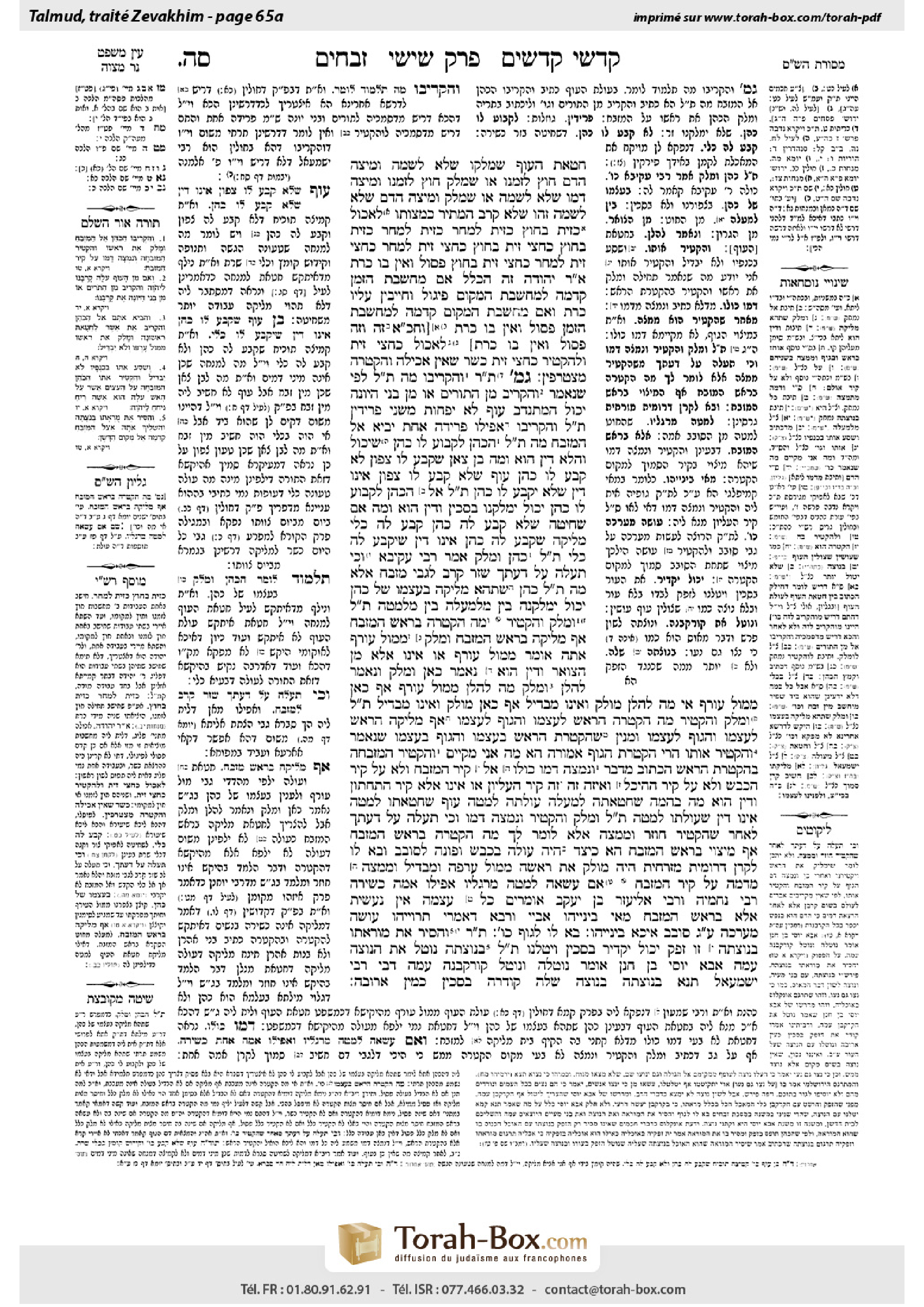
Zevachim 65a: Talmud study for Daf Yomi
Daf Yomi is the daily study of one Talmud folio. Explore 37 tractates with scans, Hebrew text, Sefaria English and AI-generated French translations where annotated.
Passage selection and English or AI-generated French translation are available where the scan has annotations. Daf Study is independent of Torah-Box and Sefaria.
Browse Zevachim · זבחים · All tractatesZevachim 65a text and translations
This page of Zevachim includes the Aramaic text, an English translation and an AI-generated French translation, alongside the scan above.
זבחים ס״ה א · Aramaic and Hebrew text
חַטַּאת הָעוֹף (שֶׁמְּלָקוֹ) [שֶׁמְּלָקָהּ] שֶׁלֹּא לִשְׁמָהּ, וּמִיצָּה הַדָּם חוּץ לִזְמַנּוֹ; אוֹ שֶׁמָּלַק חוּץ לִזְמַנּוֹ, וּמִיצָּה דָּמוֹ שֶׁלֹּא לִשְׁמָהּ; אוֹ שֶׁמָּלַק וּמִיצָּה הַדָּם שֶׁלֹּא לִשְׁמָהּ – זֶהוּ שֶׁלֹּא קָרַב הַמַּתִּיר כְּמִצְוָתוֹ.
לֶאֱכוֹל כְּזַיִת בַּחוּץ כְּזַיִת לְמָחָר, כְּזַיִת לְמָחָר כְּזַיִת בַּחוּץ, כַּחֲצִי זַיִת בַּחוּץ כַּחֲצִי זַיִת לְמָחָר, כַּחֲצִי זַיִת לְמָחָר כַּחֲצִי זַיִת בַּחוּץ – פָּסוּל, וְאֵין בּוֹ כָּרֵת.
אָמַר רַבִּי יְהוּדָה, זֶה הַכְּלָל: אִם מַחְשֶׁבֶת הַזְּמַן קָדְמָה לְמַחְשֶׁבֶת הַמָּקוֹם – פִּיגּוּל, וְחַיָּיבִין עָלָיו כָּרֵת. וְאִם מַחְשֶׁבֶת הַמָּקוֹם קָדְמָה לְמַחְשֶׁבֶת הַזְּמַן – פָּסוּל, וְאֵין בּוֹ כָּרֵת. [וַחֲכָמִים אוֹמְרִים: זֶה וָזֶה פָּסוּל וְאֵין בּוֹ כָּרֵת.]
לֶאֱכוֹל כַּחֲצִי זַיִת וּלְהַקְטִיר כַּחֲצִי זַיִת – כָּשֵׁר, שֶׁאֵין אֲכִילָה וְהַקְטָרָה מִצְטָרְפִין.
גְּמָ׳ תָּנוּ רַבָּנַן: ״וְהִקְרִיבוֹ״ – מָה תַּלְמוּד לוֹמַר?
לְפִי שֶׁנֶּאֱמַר: ״וְהִקְרִיב מִן הַתֹּרִים אוֹ מִן בְּנֵי הַיּוֹנָה״ – יָכוֹל הַמִּתְנַדֵּב עוֹף לֹא יִפְחוֹת מִשְּׁנֵי פְּרִידִין? תַּלְמוּד לוֹמַר: ״וְהִקְרִיבוֹ״ – אֲפִילּוּ פְּרִידָה אַחַת יָבִיא אֶל הַמִּזְבֵּחַ.
מָה תַּלְמוּד לוֹמַר: ״הַכֹּהֵן״? לִקְבּוֹעַ לוֹ כֹּהֵן. שֶׁיָּכוֹל וַהֲלֹא דִּין הוּא: וּמָה בֶּן צֹאן, שֶׁקָּבַע לוֹ צָפוֹן – לָא קָבַע לוֹ כֹּהֵן; עוֹף, שֶׁלָּא קָבַע לוֹ צָפוֹן – אֵינוֹ דִּין שֶׁלֹּא יִקְבַּע לוֹ כֹּהֵן?! תַּלְמוּד לוֹמַר: ״(אֶל) הַכֹּהֵן״ – לִקְבּוֹעַ לוֹ כֹּהֵן.
יָכוֹל יִמְלְקֶנּוּ בְּסַכִּין? וְדִין הוּא: וּמָה אִם שְׁחִיטָה, שֶׁלֹּא קָבַע לָהּ כֹּהֵן – קָבַע לָהּ כְּלִי; מְלִיקָה, שֶׁקָּבַע לָהּ כֹּהֵן – אֵינוֹ דִּין שֶׁיִּקְבַּע לָהּ כְּלִי?!
תַּלְמוּד לוֹמַר: ״כֹּהֵן... וּמָלַק״. אָמַר רַבִּי עֲקִיבָא: וְכִי תַּעֲלֶה עַל דַּעְתְּךָ שֶׁזָּר קָרֵב לְגַבֵּי מִזְבֵּחַ?! אֶלָּא מָה תַּלְמוּד לוֹמַר: ״כֹּהֵן״? שֶׁתְּהֵא מְלִיקָה בְּעַצְמוֹ שֶׁל כֹּהֵן.
יָכוֹל יִמְלְקֶנָּה בֵּין מִלְּמַעְלָה בֵּין מִלְּמַטָּה? תַּלְמוּד לוֹמַר: ״וּמָלַק... וְהִקְטִיר״ – מָה הַקְטָרָה בְּרֹאשׁ הַמִּזְבֵּחַ, אַף מְלִיקָה בְּרֹאשׁ הַמִּזְבֵּחַ.
״וּמָלַק״ – מִמּוּל עוֹרֶף. אַתָּה אוֹמֵר מִמּוּל עוֹרֶף; אוֹ אֵינוֹ אֶלָּא מִן הַצַּוָּאר? וְדִין הוּא: נֶאֱמַר כָּאן ״וּמָלַק״, וְנֶאֱמַר לְהַלָּן ״וּמָלַק״; מָה לְהַלָּן מִמּוּל עוֹרֶף, אַף כָּאן מִמּוּל עוֹרֶף!
אִי – מָה לְהַלָּן מוֹלֵק וְאֵינוֹ מַבְדִּיל, אַף כָּאן מוֹלֵק וְאֵינוֹ מַבְדִּיל?! תַּלְמוּד לוֹמַר: ״וּמָלַק וְהִקְטִיר״; מָה הַקְטָרָה – הָרֹאשׁ לְעַצְמוֹ וְהַגּוּף לְעַצְמוֹ, אַף מְלִיקָה – הָרֹאשׁ לְעַצְמוֹ וְהַגּוּף לְעַצְמוֹ.
וּמִנַּיִן שֶׁהַקְטָרַת הָרֹאשׁ בְּעַצְמוֹ וְהַגּוּף בְּעַצְמוֹ? שֶׁנֶּאֱמַר: ״וְהִקְטִיר אוֹתוֹ״ – הֲרֵי הַקְטָרַת הַגּוּף אֲמוּרָה; הָא מָה אֲנִי מְקַיֵּים ״וְהִקְטִיר הַמִּזְבֵּחָה״? בְּהַקְטָרַת הָרֹאשׁ הַכָּתוּב מְדַבֵּר.
״וְנִמְצָה דָּמוֹ״ – כּוּלּוֹ. ״עַל קִיר הַמִּזְבֵּחַ״ – וְלֹא עַל קִיר הַכֶּבֶשׁ, וְלֹא עַל קִיר הַהֵיכָל; וְאֵיזֶה זֶה? זֶה קִיר הָעֶלְיוֹן.
אוֹ אֵינוֹ אֶלָּא קִיר הַתַּחְתּוֹן? וְדִין הוּא: מָה בְּהֵמָה, שֶׁחַטָּאתָהּ לְמַעְלָה – עוֹלָתָהּ לְמַטָּה; עוֹף, שֶׁחַטָּאתוֹ לְמַטָּה – אֵינוֹ דִּין שֶׁעוֹלָתוֹ לְמַטָּה?
תַּלְמוּד לוֹמַר: ״וּמָלַק... וְהִקְטִיר... וְנִמְצָה דָּמוֹ״ – וְכִי תַּעֲלֶה עַל דַּעְתְּךָ לְאַחַר שֶׁהִקְטִיר חוֹזֵר וּמְמַצֶּה?! אֶלָּא לוֹמַר לָךְ: מָה הַקְטָרָה בְּרֹאשׁ הַמִּזְבֵּחַ, אַף מִיצּוּי בְּרֹאשׁ הַמִּזְבֵּחַ. הָא כֵּיצַד? הָיָה עוֹלֶה בַּכֶּבֶשׁ וּפוֹנֶה לַסּוֹבֵב, וּבָא לוֹ לְקֶרֶן דְּרוֹמִית מִזְרָחִית; הָיָה מוֹלֵק אֶת רֹאשָׁהּ מִמּוּל עׇרְפָּה וּמַבְדִּיל, וּמְמַצֶּה מִדָּמָהּ עַל קִיר הַמִּזְבֵּחַ. אִם עֲשָׂאָהּ לְמַטָּה מֵרַגְלָיו, אֲפִילּוּ אַמָּה – כְּשֵׁירָה.
רַבִּי נְחֶמְיָה וְרַבִּי אֱלִיעֶזֶר בֶּן יַעֲקֹב אוֹמְרִים: כׇּל עַצְמָהּ אֵין נַעֲשֵׂית אֶלָּא בְּרֹאשׁ הַמִּזְבֵּחַ. מַאי בֵּינַיְיהוּ?
אַבָּיֵי וְרָבָא דְּאָמְרִי תַּרְוַיְיהוּ: עוֹשֶׂה מַעֲרָכָה עַל גַּבֵּי סוֹבֵב אִיכָּא בֵּינַיְיהוּ.
בָּא לוֹ לַגּוּף כּוּ׳. תָּנוּ רַבָּנַן: ״וְהֵסִיר אֶת מֻרְאָתוֹ בְּנֹצָתָהּ״ – זוֹ זֶפֶק.
יָכוֹל יַקְדִּיר בְּסַכִּין וְיִטְּלֶנּוּ? תַּלְמוּד לוֹמַר: ״בְּנֹצָתָהּ״ – נוֹטֵל אֶת הַנּוֹצָה עִמָּהּ. אַבָּא יוֹסֵי בֶּן חָנָן אוֹמֵר: נוֹטְלָהּ וְנוֹטֵל קוּרְקְבָנָהּ עִמָּהּ.
דְּבֵי רַבִּי יִשְׁמָעֵאל תָּנָא: ״בְּנֹצָתָהּ״ – בְּנוֹצָה שֶׁלָּהּ; קוֹדְרָהּ בְּסַכִּין כְּמִין אֲרוּבָּה.
Zevachim 65a · English translation
or in the case of a bird sin offering where one pinched its nape not for its sake and squeezed out its blood with the intent of consuming it or burning it beyond its designated time, or in a case where he pinched its nape with the intent to consume it or burn it beyond its designated time and squeezed out its blood not for its sake, or in a case where he pinched its nape and squeezed out its blood not for its sake, that is a case of a bird offering whose permitting factor is not sacrificed in accordance with its mitzva.
If one pinched the nape of the bird and squeezed out its blood with the intent to eat an olive-bulk of the offering outside its designated area and an olive-bulk the next day, or an olive-bulk the next day and an olive-bulk outside its designated area, or half an olive-bulk outside its designated area and half an olive-bulk the next day, or half an olive-bulk the next day and half an olive-bulk outside its designated area, the offering is disqualified and it does not include liability to receive karet.
Rabbi Yehuda disagreed and said that this is the principle: If the improper intent with regard to the time preceded the intent with regard to the area, the offering is piggul and one is liable to receive karet for eating it. And if the intent with regard to the area preceded the intent with regard to the time, the offering is disqualified and it does not include liability to receive karet. And the Rabbis say: In both this case where the intent with regard to time came first and that case where the intent with regard to area came first, the offering is disqualified and it does not include liability to receive karet.
If his intent was to eat half an olive-bulk and to burn half an olive-bulk not at the appropriate time or in the appropriate area, the offering is valid, because eating and burning do not join together.
GEMARA: The Sages taught a baraita with regard to the verse pertaining to a bird burnt offering: “And the priest shall bring it to the altar, and pinch off its head, and make it smoke on the altar” (Leviticus 1:15). What is the meaning when the verse states: And the priest shall bring it to the altar? Since the previous verse states that “he shall bring his offering,” this verse should have started with the phrase “And he shall pinch off its head.”
Since it is stated in the preceding verse: “And if his offering to the Lord be a burnt offering of birds, then he shall bring his offering of doves, or of pigeons” (Leviticus 1:14), one might have thought that one who donates a bird as an offering may not donate fewer than two birds. Therefore, the verse states: “And the priest shall bring it,” indicating that one may bring even one bird to be sacrificed on the altar.
The baraita continues analyzing the verse: What is the meaning when the verse states that “the priest shall bring it to the altar” (Leviticus 1:15)? It is to establish that only a priest may pinch its nape, as one might have thought that even a non-priest may perform this procedure. Could this not be derived through logical inference: And if with regard to a sheep burnt offering, with regard to which the verse established that it must be slaughtered in the north (see Leviticus 1:11), it did not establish that it must be slaughtered by a priest (see 32a), then in the case of a bird burnt offering, with regard to which the verse did not establish that its nape must be pinched in the north, is it not logical that the verse does not establish that its nape must be pinched by a priest? To counter this, the verse states that “the priest shall bring it to the altar,” in order to establish that its nape must be pinched specifically by a priest.
The baraita continues: One might have thought that the priest should pinch its nape with a knife. And one could derive this through a logical inference: And if with regard to slaughtering, with regard to which the verse did not establish that it must be performed by a priest, it established that it must be performed with an instrument, i.e., a knife (see 97b); then in the case of pinching, which the verse established must be performed by a priest, is it not logical that the verse establishes that it must be performed with an instrument?
To counter this, the verse states: “And the priest shall bring it near the altar and pinch off its head.” In explanation of this verse, Rabbi Akiva said: Could it enter your mind that a non-priest may approach the altar in order to sacrifice an offering? Since this is impossible, the verse does not need to state that the sacrificial rite is performed by a priest. Rather, what is the meaning when the verse states: “The priest”? It means that the pinching must be performed with the very body of the priest.
The baraita continues to analyze the verse: One might have thought that the priest may pinch the bird’s nape whether above the red line of the altar or below it. To counter this, the verse states: “And the priest shall bring it unto the altar and pinch off its head, and make it smoke on the altar.” The verse juxtaposes the pinching to the burning of the bird on the altar to teach that just as the burning occurs atop the altar, so too, the pinching occurs on the top part of the wall of the altar.
The baraita continues: The verse states that the priest shall “pinch off its head,” which must be performed at the nape. Do you say that the pinching occurs at the nape, or is it only at the throat? It can be derived through a logical inference: It is stated here, with regard to a bird burnt offering: “And pinch off its head” (Leviticus 1:15), and it is stated there, with regard to a bird sin offering: “And pinch off its head opposite its nape, but shall not separate it” (Leviticus 5:8). Just as there, the head is pinched at the nape, so too here, the head is pinched at the nape.
If the halakha of a bird burnt offering is derived from that of a bird sin offering, perhaps it should also be derived that just as there, the priest pinches off the head but does not separate it completely from the body, so too here, with regard to a bird burnt offering, he pinches off the head but does not separate it from the body. To counter this, the verse states with regard to a bird burnt offering: “And pinch off its head, and make it smoke on the altar” (Leviticus 1:15). This indicates that just as with regard to the burning of the bird burnt offering, the head is burned by itself and the body is burned by itself, so too with regard to the pinching, the head is by itself and the body is by itself, i.e., the head is completely detached from the body.
The baraita continues: And from where is it derived that the burning of the head is by itself and the body is burned by itself? As it is stated: “And he shall rend it by its wings…and the priest shall make it smoke upon the altar” (Leviticus 1:17). Since the burning of the body is stated in this verse, how do I realize the meaning of the earlier phrase: “And make it smoke on the altar” (Leviticus 1:15)? One must conclude that the verse is speaking about the burning of the head.
The baraita continues to expound the verse stated with regard to a bird burnt offering: “And its blood shall be drained out on the wall of the altar” (Leviticus 1:15). When the verse states: “And its blood shall be drained out,” it means that all of it must be drained out. The continuation of the verse indicates that it must be drained out “on the wall of the altar,” and not on the wall of the ramp, nor on the wall of the Sanctuary. And which wall of the altar is this? This is the upper wall, i.e., above the red line.
Or perhaps the verse is referring only to the lower wall, i.e., below the red line; and this can be supported by a logical inference: And if with regard to an animal offering, where the blood of its sin offering is applied above the red line, the blood of its burnt offering is applied below the red line, then with regard to a bird offering, where the blood of its sin offering is sprinkled below the red line, is it not logical that the blood of its burnt offering is sprinkled below the red line?
To counter this, the verse states: “And pinch off its head, and make it smoke on the altar; and its blood shall be drained out.” Could it enter your mind that after he has burned the bird, the priest goes back and drains out its blood? Rather, the verse serves to tell you: Just as the burning occurs atop the altar, so too, the draining occurs atop the altar. How so? The priest would ascend the ramp and turn to the surrounding ledge and arrive at the southeast corner. He would pinch off the bird’s head at its nape, and separate it from its body. He would then squeeze out its blood on the wall of the altar beside him. Nevertheless, if the priest performed the squeezing below his feet, i.e., below the surrounding ledge, even one cubit beneath the ledge, it is valid.
The baraita concludes by citing a dissenting opinion: Rabbi Neḥemya and Rabbi Eliezer ben Ya’akov say: The entire rite of a bird burnt offering is performed only atop the altar. The Gemara asks: Since the first tanna and Rabbi Neḥemya and Rabbi Eliezer ben Ya’akov agree that the bird must be burned atop the altar and its blood must be squeezed on the top part of the wall of the altar, what is the difference between them?
Abaye and Rava both say: There is a difference between them with regard to whether one may form an arrangement of wood on the surrounding ledge and burn the bird there. According to the first tanna, this is permitted when needed, and therefore it is valid if the priest squeezes out the blood on the wall up to a cubit below the surrounding ledge. According to Rabbi Neḥemya and Rabbi Eliezer ben Ya’akov, one may never burn the bird on the surrounding ledge, and therefore it is not valid if the priest squeezed out the blood below the surrounding ledge.
§ The mishna teaches that after the priest throws the bird’s head onto the fire on the altar, he arrives at the body and removes the crop and the feathers attached to it and the innards that emerge with them, and tosses them to the place of the ashes. The Sages taught in a baraita with regard to the verse pertaining to a bird burnt offering: “And he shall take away murato with its feathers” (Leviticus 1:16). This word, murato, is referring to the crop.
Had the verse written only “its crop,” one might have thought that the priest may cut the skin with a knife and take the crop without any other part of the bird. Therefore, the verse states: “With its feathers [benotzatah],” which teaches that he takes the feathers with it, i.e., he must remove the skin with the feathers still attached. The Gemara presents another opinion: Abba Yosei ben Ḥanan says: He takes the crop and he also takes its gizzard with it.
A Sage from the school of Rabbi Yishmael taught: The word benotzatah is a contraction of the words benotza shelah, meaning its feathers. This teaches that the priest cuts it with a knife, creating an opening like a window opposite the crop. This allows him to remove the crop with only the feathers and skin directly opposite it, and that is what he brings to the place of the ashes.
Zevachim 65a · Traduction française (IA)
ou, dans le cas d’un sacrifice expiatoire d’oiseau, lorsqu’il a pincé la nuque de l’oiseau sans le faire pour lui-même, puis en a fait sortir le sang avec l’intention d’en consommer ou d’en brûler une quantité supérieure au délai prescrit ; ou lorsqu’il lui a pincé la nuque avec l’intention d’en consommer ou d’en brûler une quantité supérieure au délai prescrit, puis en a fait sortir le sang sans le faire pour lui-même ; ou encore lorsqu’il lui a pincé la nuque et en a fait sortir le sang sans le faire pour lui-même : c’est le cas d’un sacrifice d’oiseau dont l’acte qui le rend permis n’a pas été accompli conformément à sa mitsva.
Si l’on a pincé la nuque de l’oiseau et fait sortir son sang avec l’intention de consommer un kazaït du sacrifice hors de l’aire prescrite et un kazaït le lendemain, ou un kazaït le lendemain et un kazaït hors de l’aire prescrite, ou un demi-kazaït hors de l’aire prescrite et un demi-kazaït le lendemain, ou un demi-kazaït le lendemain et un demi-kazaït hors de l’aire prescrite, le sacrifice est invalidé, mais cela n’entraîne pas la responsabilité passible de karet.
Rabbi Yehouda n’était pas d’accord et dit : voici le principe. Si l’intention incorrecte concernant le délai a précédé celle concernant l’aire, le sacrifice est piggoul et celui qui le consomme est passible de karet. Si l’intention concernant l’aire a précédé celle concernant le délai, le sacrifice est invalidé, mais cela n’entraîne pas la responsabilité passible de karet. Les Sages disent : dans les deux cas, que l’intention concernant le délai soit venue en premier ou que celle concernant l’aire soit venue en premier, le sacrifice est invalidé, mais cela n’entraîne pas la responsabilité passible de karet.
Si son intention était de consommer un demi-kazaït et d’en brûler un demi-kazaït à un moment ou en un lieu qui ne conviennent pas, le sacrifice est valide, car consommer et brûler ne s’additionnent pas.
GUEMARA : Les Sages ont enseigné une baraïta au sujet du verset concernant l’holocauste d’oiseau : « Le prêtre l’apportera à l’autel, lui pincera la tête et la fera brûler sur l’autel » (Lévitique 1,15). Que signifie l’expression « Le prêtre l’apportera à l’autel » ? Puisque le verset précédent dit : « il apportera son offrande », celui-ci aurait dû commencer par : « Et il lui pincera la tête. »
Puisqu’il est dit dans le verset précédent : « Si son offrande à l’Éternel est un holocauste d’oiseaux, il apportera son offrande de tourterelles ou de pigeons » (Lévitique 1,14), on aurait pu penser que celui qui offre un oiseau ne peut en offrir moins de deux. C’est pourquoi le verset dit : « Le prêtre l’apportera », ce qui indique qu’on peut apporter un seul oiseau pour le sacrifier sur l’autel.
La baraïta poursuit l’analyse du verset : que signifie l’expression « le prêtre l’apportera à l’autel » (Lévitique 1,15) ? Elle établit que seul un prêtre peut lui pincer la nuque, car on aurait pu penser qu’un non-prêtre peut également accomplir cet acte. Ne peut-on pas le déduire par raisonnement a fortiori ? Si, pour l’holocauste d’un mouton, au sujet duquel le verset a établi qu’il doit être égorgé au nord (voir Lévitique 1,11), il n’a pas établi qu’il doit être égorgé par un prêtre (voir 32a), alors, pour l’holocauste d’un oiseau, au sujet duquel le verset n’a pas établi que sa nuque doit être pincée au nord, n’est-il pas logique qu’il n’ait pas établi que sa nuque doit être pincée par un prêtre ? Pour écarter cette déduction, le verset dit : « Le prêtre l’apportera à l’autel », afin d’établir que sa nuque doit être pincée précisément par un prêtre.
La baraïta poursuit : on aurait pu penser que le prêtre doit lui pincer la nuque avec un couteau. On pourrait le déduire par raisonnement a fortiori : si, pour l’égorgement, au sujet duquel le verset n’a pas établi qu’il doit être accompli par un prêtre, il a établi qu’il doit être accompli avec un instrument, c’est-à-dire un couteau (voir 97b), alors, pour le pincement, que le verset a établi comme devant être accompli par un prêtre, n’est-il pas logique qu’il ait établi qu’il doit être accompli avec un instrument ?
Pour écarter cette déduction, le verset dit : « Le prêtre l’approchera de l’autel et lui pincera la tête. » À propos de ce verset, Rabbi Akiva dit : Peut-il te venir à l’esprit qu’un non-prêtre puisse s’approcher de l’autel afin d’offrir un sacrifice ? Puisque cela est impossible, le verset n’a pas besoin de préciser que le rite sacrificiel est accompli par un prêtre. Que signifie donc le mot « le prêtre » ? Il signifie que le pincement doit être accompli avec le corps même du prêtre.
La baraïta poursuit l’analyse du verset : on aurait pu penser que le prêtre peut pincer la nuque de l’oiseau aussi bien au-dessus qu’au-dessous de la ligne rouge de l’autel. Pour écarter cette possibilité, le verset dit : « Le prêtre l’approchera de l’autel, lui pincera la tête et la fera brûler sur l’autel. » Le verset met en parallèle le pincement de l’oiseau et sa combustion sur l’autel, pour enseigner que, de même que la combustion a lieu sur le dessus de l’autel, de même le pincement a lieu sur la partie supérieure du mur de l’autel.
La baraïta poursuit : le verset dit que le prêtre lui « pincera la tête », ce qui doit être accompli au niveau de la nuque. Faut-il comprendre que le pincement a lieu à la nuque, ou seulement à la gorge ? On peut le déduire par raisonnement a fortiori. Ici, à propos de l’holocauste d’oiseau, il est dit : « Il lui pincera la tête » (Lévitique 1,15), et là, à propos du sacrifice expiatoire d’oiseau, il est dit : « Il lui pincera la tête en face de la nuque, sans la détacher » (Lévitique 5,8). De même que là, la tête est pincée à la nuque, de même ici, la tête est pincée à la nuque.
Si la halakha de l’holocauste d’oiseau est déduite de celle du sacrifice expiatoire d’oiseau, peut-être faut-il également en déduire que, de même que là, le prêtre pince la tête sans la détacher complètement du corps, de même ici, pour l’holocauste d’oiseau, il pince la tête sans la détacher du corps. Pour écarter cette possibilité, le verset dit à propos de l’holocauste d’oiseau : « Il lui pincera la tête et la fera brûler sur l’autel » (Lévitique 1,15). Cela indique que, de même que, lors de la combustion de l’holocauste d’oiseau, la tête est brûlée séparément et le corps séparément, de même, lors du pincement, la tête est séparée du corps, c’est-à-dire qu’elle en est complètement détachée.
La baraïta poursuit : d’où déduit-on que la tête est brûlée séparément et que le corps est brûlé séparément ? Car il est dit : « Il le déchirera par ses ailes… et le prêtre le fera brûler sur l’autel » (Lévitique 1,17). Puisque la combustion du corps est mentionnée dans ce verset, comment faut-il comprendre l’expression précédente : « Il la fera brûler sur l’autel » (Lévitique 1,15) ? Il faut en conclure que le verset parle de la combustion de la tête.
La baraïta poursuit l’exégèse du verset concernant l’holocauste d’oiseau : « Son sang sera pressé contre le mur de l’autel » (Lévitique 1,15). L’expression « Son sang sera pressé » signifie que tout son sang doit être pressé. La suite du verset indique qu’il doit être pressé « contre le mur de l’autel », et non contre le mur de la rampe ni contre celui du Sanctuaire. De quel mur de l’autel s’agit-il ? Du mur supérieur, c’est-à-dire au-dessus de la ligne rouge.
Ou peut-être le verset ne fait-il référence qu’au mur inférieur, c’est-à-dire au-dessous de la ligne rouge. On pourrait l’appuyer par un raisonnement a fortiori : si, pour un sacrifice animal, alors que le sang du sacrifice expiatoire est appliqué au-dessus de la ligne rouge, le sang de l’holocauste est appliqué au-dessous de cette ligne, alors, pour un sacrifice d’oiseau, dont le sang du sacrifice expiatoire est aspergé au-dessous de la ligne rouge, n’est-il pas logique que le sang de l’holocauste soit aspergé au-dessous de la ligne rouge ?
Pour écarter cette possibilité, le verset dit : « Il lui pincera la tête et la fera brûler sur l’autel ; et son sang sera pressé. » Peut-il te venir à l’esprit qu’après avoir brûlé l’oiseau, le prêtre retourne ensuite pour en presser le sang ? Le verset vient plutôt t’enseigner que, de même que la combustion a lieu sur le dessus de l’autel, de même le sang est pressé sur le dessus de l’autel. Comment cela se passe-t-il ? Le prêtre montait par la rampe, se tournait vers le rebord qui entourait l’autel et arrivait à l’angle sud-est. Il pinçait l’oiseau à la nuque et séparait sa tête de son corps. Il pressait ensuite son sang contre le mur de l’autel, à côté de lui. Néanmoins, si le prêtre pressait le sang sous ses pieds, c’est-à-dire au-dessous du rebord, même à une coudée sous celui-ci, le sacrifice était valide.
La baraïta conclut en citant une opinion divergente : Rabbi Neḥemya et Rabbi Eliezer ben Ya’akov disent : tout le rite de l’holocauste d’oiseau s’accomplit uniquement sur le dessus de l’autel. La Guemara demande : puisque le premier tanna, Rabbi Neḥemya et Rabbi Eliezer ben Ya’akov conviennent que l’oiseau doit être brûlé sur le dessus de l’autel et que son sang doit être pressé contre la partie supérieure du mur de l’autel, en quoi leurs avis diffèrent-ils ?
Abayé et Rava disent tous deux qu’ils diffèrent sur la question de savoir s’il est permis de disposer du bois sur le rebord qui entoure l’autel et d’y brûler l’oiseau. Selon le premier tanna, cela est permis si nécessaire ; le sacrifice est donc valide si le prêtre presse le sang contre le mur jusqu’à une coudée au-dessous du rebord. Selon Rabbi Neḥemya et Rabbi Eliezer ben Ya’akov, on ne peut jamais brûler l’oiseau sur le rebord ; le sacrifice n’est donc pas valide si le prêtre a pressé le sang au-dessous de celui-ci.
§ La Michna enseigne qu’après avoir jeté la tête de l’oiseau sur le feu de l’autel, le prêtre s’approche du corps et en retire le jabot, les plumes qui y sont attachées ainsi que les entrailles qui en sortent avec elles, puis les jette à l’endroit des cendres. Les Sages ont enseigné dans une baraïta, au sujet du verset concernant l’holocauste d’oiseau : « Il retirera son murato avec ses plumes » (Lévitique 1,16). Le mot murato désigne le jabot.
Si le verset avait seulement dit « son jabot », on aurait pu penser que le prêtre peut couper la peau avec un couteau et retirer le jabot sans aucune autre partie de l’oiseau. C’est pourquoi le verset dit : « Avec ses plumes [benotzatah] », ce qui enseigne qu’il emporte les plumes avec lui, c’est-à-dire qu’il doit retirer la peau en laissant les plumes qui y sont attachées. La Guemara présente une autre opinion : Abba Yosei ben Ḥanan dit qu’il prend le jabot et aussi le gésier qui l’accompagne.
Un Sage de l’école de Rabbi Yishmaël enseigna : le mot benotzatah est une contraction des mots benotza shelah, qui signifient « ses plumes ». Cela enseigne que le prêtre le découpe au couteau, ouvrant une fenêtre en face du jabot. Il peut ainsi retirer le jabot en n’emportant que les plumes et la peau situées juste en face ; c’est ce qu’il apporte à l’endroit des cendres.
Traduction française générée par IA à partir de l’édition anglaise de Sefaria. Vérifie toujours un passage avec le texte source.
Text from Sefaria: William Davidson Edition - Vocalized Aramaic (CC BY NC); William Davidson Edition - English (CC BY NC).