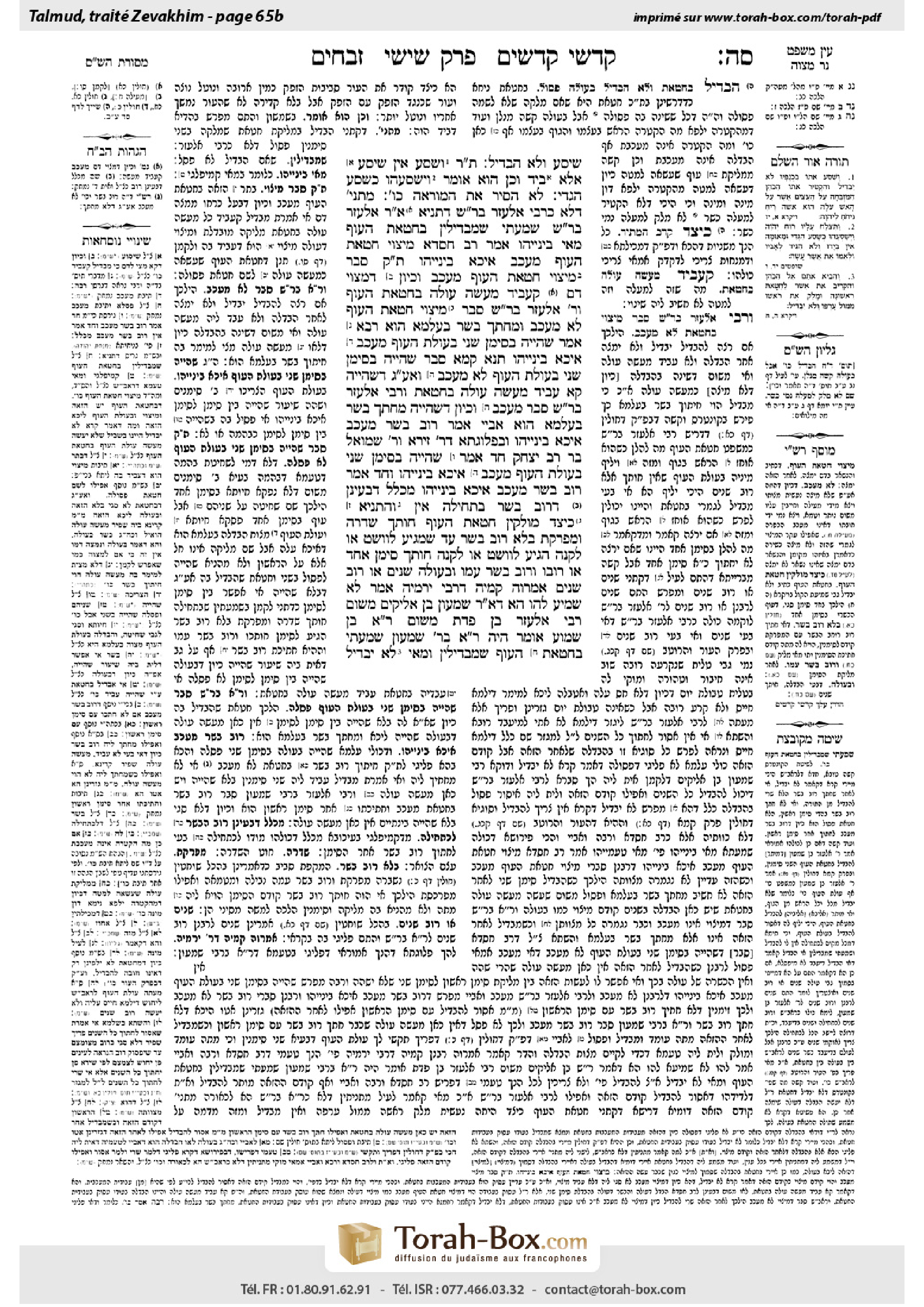
Zevachim 65b: Talmud study for Daf Yomi
Daf Yomi is the daily study of one Talmud folio. Explore 37 tractates with scans, Hebrew text, Sefaria English and AI-generated French translations where annotated.
Passage selection and English or AI-generated French translation are available where the scan has annotations. Daf Study is independent of Torah-Box and Sefaria.
Browse Zevachim · זבחים · All tractatesZevachim 65b text and translations
This page of Zevachim includes the Aramaic text, an English translation and an AI-generated French translation, alongside the scan above.
זבחים ס״ה ב · Aramaic and Hebrew text
שִׁיסַּע וְלֹא הִבְדִּיל. תָּנוּ רַבָּנַן: ״וְשִׁסַּע״ – אֵין שִׁיסַּע אֶלָּא בַּיָּד, וְכֵן הוּא אוֹמֵר: ״וַיְשַׁסְּעֵהוּ כְּשַׁסַּע הַגְּדִי״.
לֹא הֵסִיר אֶת הַמּוּרְאָה כּוּ׳. מַתְנִיתִין דְּלָא כְּרַבִּי אֶלְעָזָר בְּרַבִּי שִׁמְעוֹן; דְּתַנְיָא, אָמַר רַבִּי אֶלְעָזָר בְּרַבִּי שִׁמְעוֹן: שָׁמַעְתִּי שֶׁמַּבְדִּילִין בְּחַטַּאת הָעוֹף.
מַאי בֵּינַיְיהוּ? אָמַר רַב חִסְדָּא: מִיצּוּי חַטַּאת הָעוֹף מְעַכֵּב אִיכָּא בֵּינַיְיהוּ. תַּנָּא קַמָּא סָבַר: מִיצּוּי חַטַּאת הָעוֹף מְעַכֵּב; וְכֵיוָן דְּמִצּוּי דָּם, קָעָבֵיד מַעֲשֵׂה עוֹלָה בְּחַטַּאת הָעוֹף.
וְרַבִּי אֶלְעָזָר בְּרַבִּי שִׁמְעוֹן סָבַר: מִיצּוּי חַטַּאת הָעוֹף לֹא מְעַכֵּב, וּמְחַתֵּךְ בָּשָׂר בְּעָלְמָא הוּא.
רָבָא אָמַר: שְׁהִיָּיה בְּסִימָן שֵׁנִי בְּעוֹלַת הָעוֹף מְעַכֵּב אִיכָּא בֵּינַיְיהוּ. תַּנָּא קַמָּא סָבַר: שְׁהִיָּיה בְּסִימָן שֵׁנִי בְּעוֹלַת הָעוֹף – לֹא מְעַכֵּב; וְאַף עַל גַּב דִּשְׁהִיָּיה, קָא עָבֵיד מַעֲשֵׂה עוֹלָה בְּחַטָּאת.
וְרַבִּי אֶלְעָזָר בְּרַבִּי שִׁמְעוֹן סָבַר: מְעַכֵּב; וְכֵיוָן דִּשְׁהִיָּיה, מְחַתֵּךְ בָּשָׂר בְּעָלְמָא הוּא.
אַבָּיֵי אָמַר: רוֹב בָּשָׂר מְעַכֵּב אִיכָּא בֵּינַיְיהוּ.
וּבִפְלוּגְתָּא דְּרַבִּי זֵירָא וְרַבִּי שְׁמוּאֵל בַּר רַב יִצְחָק; חַד אָמַר: שְׁהִיָּיה בְּסִימָן שֵׁנִי בְּעוֹלַת הָעוֹף מְעַכֵּב אִיכָּא בֵּינַיְיהוּ, וְחַד אָמַר: רוֹב בָּשָׂר מְעַכֵּב אִיכָּא בֵּינַיְיהוּ.
מִכְּלָל דְּבָעֵינַן דְּרוֹב בָּשָׂר בַּתְּחִילָּה?! אִין; וְהָתַנְיָא: כֵּיצַד מוֹלְקִין חַטַּאת הָעוֹף? חוֹתֵךְ שִׁדְרָה וּמַפְרֶקֶת בְּלֹא רוֹב בָּשָׂר, עַד שֶׁמַּגִּיעַ לַוֶּושֶׁט אוֹ לַקָּנֶה. הִגִּיעַ לַוֶּושֶׁט אוֹ לַקָּנֶה – חוֹתֵךְ סִימָן אֶחָד אוֹ רוּבּוֹ, וְרוֹב בָּשָׂר עִמּוֹ. וּבָעוֹלָה – שְׁנַיִם אוֹ רוֹב שְׁנַיִם.
אַמְרוּהָ קַמֵּיהּ דְּרַבִּי יִרְמְיָה, אָמַר: לָא שְׁמִיעַ לְהוּ הָא דְּאָמַר רַבִּי שִׁמְעוֹן בֶּן אֶלְיָקִים מִשּׁוּם רַבִּי אֶלְעָזָר בֶּן פְּדָת מִשּׁוּם רַבִּי אֶלְעָזָר בֶּן שַׁמּוּעַ? אוֹמֵר הָיָה רַבִּי אֶלְעָזָר בְּרַבִּי שִׁמְעוֹן: שָׁמַעְתִּי בְּחַטַּאת הָעוֹף שֶׁמַּבְדִּילִין. וּמַאי ״לֹא יַבְדִּיל״ –
Zevachim 65b · English translation
§ The mishna teaches that after removing the crop and the feathers and innards that emerged with it, the priest ripped the bird lengthwise and did not separate the two halves of the bird. In this regard the Sages taught in a baraita: The verse states: “And he shall rend” (Leviticus 1:17). The act of rending is performed only by hand, and so too, the verse states with regard to Samson: “And he rent it as one would have rent a kid, and he had nothing in his hand” (Judges 14:6).
§ The mishna teaches that if the priest did not remove the crop, or he changed any detail of the sacrificial rite after he squeezed out the blood, the offering is valid. If he separated the head from the body of a bird sin offering, it is disqualified. The Gemara says: The mishna is not in accordance with the opinion of Rabbi Elazar, son of Rabbi Shimon, as it is taught in a baraita that Rabbi Elazar, son of Rabbi Shimon, said: I heard that one may separate the head from the body of a bird sin offering.
The Gemara asks: What is the reason for the difference between them, i.e., what is the basis of the disagreement? Rav Ḥisda says: The difference between them concerns the question of whether squeezing out the blood of a bird sin offering after its blood has been sprinkled is indispensable. The first tanna, whose opinion is cited in the mishna, holds that squeezing out the blood of a bird sin offering is indispensable. And since squeezing out the blood is indispensable, the priest will have to squeeze out the blood after separating the head from the body, and he will have performed the rite of a bird burnt offering on a bird sin offering, which disqualifies the offering (see 66a).
And Rabbi Elazar, son of Rabbi Shimon, holds that squeezing out the blood of a bird sin offering is not indispensable. Consequently, if the priest would separate the bird’s head from its body, he would refrain from squeezing out the blood, in which case the rite is dissimilar to that of a bird burnt offering. And the separation of the head is considered as though the priest was merely cutting flesh, and the offering is valid.
Rava says there is an alternative explanation of the dispute: It is possible that all agree that squeezing the blood of a bird sin offering is indispensable, and there is a difference between them with regard to whether interrupting the pinching before severing the second siman, i.e., the gullet or windpipe, one of the organs that must be cut in the ritual slaughter, of a bird burnt offering disqualifies the offering. The first tanna holds that interrupting the pinching before severing the second siman of a bird burnt offering does not disqualify the offering, and therefore, if the priest separates the head of a bird sin offering from its body, even though he interrupted the pinching before severing the second siman, he has performed the rite of a bird burnt offering on a bird sin offering, which disqualifies it.
And Rabbi Elazar, son of Rabbi Shimon, holds that interrupting the pinching of a bird burnt offering disqualifies the offering. Therefore, in the case of a bird sin offering, since the priest interrupted the pinching before severing the second siman, even if he separates the head from the body he is merely cutting flesh, i.e., it is an insignificant act because he is not performing the rite of a burnt offering on a sin offering, and the offering is not disqualified.
Abaye says there is a third explanation of the dispute between the tanna’im: It is possible that all agree that interrupting the pinching before severing the second siman disqualifies a bird burnt offering, and there is a difference between them with regard to whether cutting the majority of the flesh of the nape of a bird sin offering is indispensable.
The Gemara points out: And Rava and Abaye disagree with regard to the issue that is the subject of the dispute between Rabbi Zeira and Rabbi Shmuel bar Rav Yitzḥak. One says that the difference between the first tanna and Rabbi Elazar, son of Rabbi Shimon, concerns whether interrupting the pinching before severing the second siman of a bird burnt offering disqualifies the offering. And one says that the difference between them concerns whether cutting the majority of the flesh of the nape of a bird sin offering is indispensable.
The Gemara asks: Since there is a dispute concerning whether cutting the majority of the flesh of the nape of a bird sin offering is indispensable, can it be deduced by inference that all agree that we require the priest to cut the majority of the flesh ab initio? The Gemara responds: Yes; and similarly it was taught in baraita: How does one pinch the nape of a bird sin offering? Using his thumbnail, the priest cuts the spine and nape, without cutting through the majority of the flesh, until he reaches either the gullet or the windpipe. Upon reaching the gullet or the windpipe, he cuts one siman entirely, or at least the majority of it, and he cuts the majority of the flesh with it. And in the case of a bird burnt offering, he cuts the two simanim or the majority of the two simanim.
The Gemara relates that the Rabbis said this dispute between the amora’im concerning the reason for the opinion of Rabbi Elazar, son of Rabbi Shimon, before Rabbi Yirmeya. Rabbi Yirmeya said: Have they not heard that which Rabbi Shimon ben Elyakim said in the name of Rabbi Elazar ben Pedat, in the name of Rabbi Elazar ben Shammua: Rabbi Elazar, son of Rabbi Shimon, used to say: I heard that one may completely separate the head of a bird sin offering from its body. And what is the meaning of the verse that states: “But shall not separate it” (Leviticus 5:8)?
Zevachim 65b · Traduction française (IA)
§ La Michna enseigne qu’après avoir retiré le jabot ainsi que les plumes et les entrailles qui en étaient sorties, le prêtre fendit l’oiseau dans le sens de la longueur sans en séparer les deux moitiés. À ce sujet, les Sages enseignèrent dans une baraïta : Le verset dit : « Il le fendra » (Lévitique 1,17). La fente s’effectue uniquement à la main ; de même, le verset dit au sujet de Samson : « Il le fendit comme on aurait fendu un chevreau, et il n’avait rien dans la main » (Juges 14,6).
§ La Michna enseigne que si le prêtre n’a pas retiré le jabot, ou s’il a modifié un détail du rite sacrificiel après avoir fait sortir le sang, l’offrande est valide. En revanche, s’il a séparé la tête du corps d’un oiseau offert en sacrifice expiatoire, celui-ci est invalidé. La Guemara dit : La Michna n’est pas conforme à l’opinion de Rabbi Elazar, fils de Rabbi Shimon, car il est enseigné dans une baraïta que Rabbi Elazar, fils de Rabbi Shimon, a dit : J’ai entendu qu’on peut séparer la tête du corps d’un oiseau offert en sacrifice expiatoire.
La Guemara demande : Quelle est la raison de cette différence entre eux, c’est-à-dire sur quoi porte leur désaccord ? Rav Ḥisda dit : Leur désaccord porte sur la question de savoir si l’expression du sang d’un oiseau offert en sacrifice expiatoire, après que son sang a été aspergé, est indispensable. Le premier tanna, dont l’opinion est rapportée dans la Michna, considère que cette expression du sang est indispensable. Or, puisqu’elle l’est, le prêtre devra exprimer le sang après avoir séparé la tête du corps ; il aura alors accompli le rite d’un oiseau offert en holocauste sur un oiseau offert en sacrifice expiatoire, ce qui invalide l’offrande (voir 66a).
Rabbi Elazar, fils de Rabbi Shimon, considère que l’expression du sang d’un oiseau offert en sacrifice expiatoire n’est pas indispensable. Par conséquent, si le prêtre séparait la tête de l’oiseau de son corps, il s’abstiendrait d’exprimer le sang ; dans ce cas, le rite serait différent de celui d’un oiseau offert en holocauste. La séparation de la tête serait alors considérée comme si le prêtre ne faisait que couper de la chair, et l’offrande serait valide.
Rava propose une autre explication du désaccord : il est possible que tous reconnaissent que l’expression du sang d’un oiseau offert en sacrifice expiatoire est indispensable, et que leur désaccord porte sur la question de savoir si l’interruption de la melika avant la section du second siman — l’œsophage ou la trachée, l’un des organes qui doivent être sectionnés lors de l’abattage rituel d’un oiseau — invalide l’offrande d’un oiseau offert en holocauste. Le premier tanna considère que l’interruption de la melika avant la section du second siman d’un oiseau offert en holocauste n’invalide pas l’offrande. Par conséquent, si le prêtre séparait la tête d’un oiseau offert en sacrifice expiatoire de son corps, même s’il avait interrompu la melika avant de sectionner le second siman, il aurait accompli le rite d’un oiseau offert en holocauste sur un oiseau offert en sacrifice expiatoire, ce qui l’invaliderait.
Rabbi Elazar, fils de Rabbi Shimon, considère que l’interruption de la melika d’un oiseau offert en holocauste invalide l’offrande. Ainsi, dans le cas d’un oiseau offert en sacrifice expiatoire, puisque le prêtre a interrompu la melika avant de sectionner le second siman, même s’il sépare la tête du corps, il ne fait que couper de la chair ; autrement dit, son acte est sans conséquence, puisqu’il n’accomplit pas le rite d’un holocauste sur un sacrifice expiatoire, et l’offrande n’est pas invalidée.
Abaye propose une troisième explication du désaccord entre les tannaïm : il est possible que tous reconnaissent que l’interruption de la melika avant la section du second siman invalide l’offrande d’un oiseau offert en holocauste, et que leur désaccord porte sur la question de savoir si le fait de couper la majeure partie de la chair de la nuque d’un oiseau offert en sacrifice expiatoire est indispensable.
La Guemara fait remarquer que Rava et Abaye sont en désaccord sur la question qui oppose Rabbi Zeira et Rabbi Shmuel bar Rav Yitzḥak. Selon l’un, la différence entre le premier tanna et Rabbi Elazar, fils de Rabbi Shimon, porte sur la question de savoir si l’interruption de la melika avant la section du second siman d’un oiseau offert en holocauste invalide l’offrande. Selon l’autre, leur désaccord porte sur la question de savoir si le fait de couper la majeure partie de la chair de la nuque d’un oiseau offert en sacrifice expiatoire est indispensable.
La Guemara demande : Puisqu’il y a un désaccord sur la question de savoir si le fait de couper la majeure partie de la chair de la nuque d’un oiseau offert en sacrifice expiatoire est indispensable, peut-on en déduire que tous reconnaissent qu’il faut, a priori, que le prêtre coupe la majeure partie de la chair ? La Guemara répond : Oui. De même, il a été enseigné dans une baraïta : Comment pratique-t-on la melika de la nuque d’un oiseau offert en sacrifice expiatoire ? Avec l’ongle du pouce, le prêtre coupe la colonne vertébrale et la nuque sans trancher la majeure partie de la chair, jusqu’à atteindre l’œsophage ou la trachée. Une fois arrivé à l’œsophage ou à la trachée, il en sectionne entièrement un siman, ou au moins la majeure partie, et coupe avec celui-ci la majeure partie de la chair. Dans le cas d’un oiseau offert en holocauste, il sectionne les deux simanim, ou la majeure partie des deux.
La Guemara rapporte que les Rabbins exposèrent devant Rabbi Yirmeya ce désaccord entre les amoraïm quant à la raison de l’opinion de Rabbi Elazar, fils de Rabbi Shimon. Rabbi Yirmeya dit : N’ont-ils donc pas entendu ce que Rabbi Shimon ben Elyakim a dit au nom de Rabbi Elazar ben Pedat, au nom de Rabbi Elazar ben Shammua : Rabbi Elazar, fils de Rabbi Shimon, avait coutume de dire : J’ai entendu qu’on peut séparer complètement la tête du corps d’un oiseau offert en sacrifice expiatoire. Que signifie alors le verset qui dit : « Mais tu ne le sépareras pas » (Lévitique 5,8) ?
Traduction française générée par IA à partir de l’édition anglaise de Sefaria. Vérifie toujours un passage avec le texte source.
Text from Sefaria: William Davidson Edition - Vocalized Aramaic (CC BY NC); William Davidson Edition - English (CC BY NC).