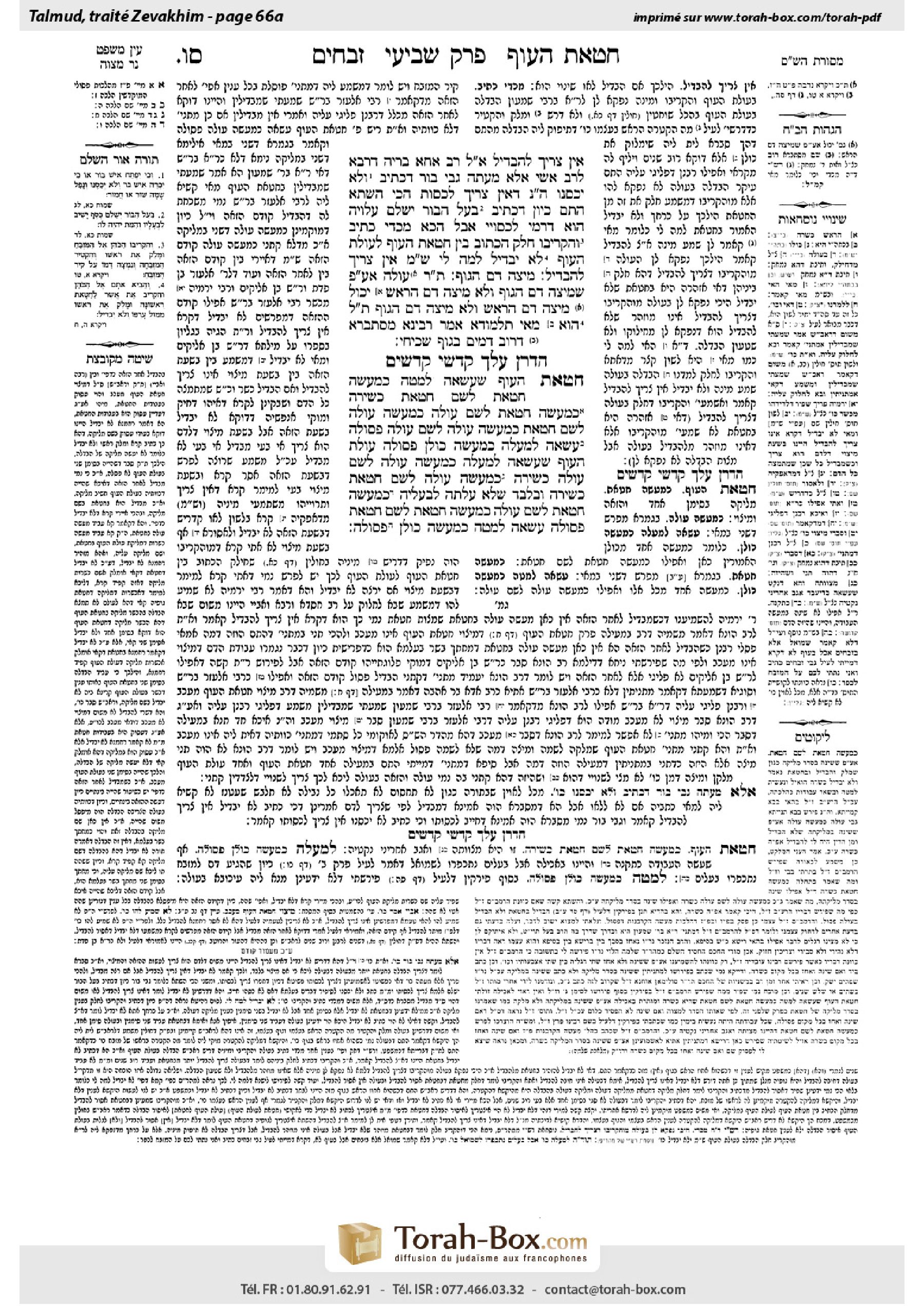
Zevachim 66a: Talmud study for Daf Yomi
Daf Yomi is the daily study of one Talmud folio. Explore 37 tractates with scans, Hebrew text, Sefaria English and AI-generated French translations where annotated.
Passage selection and English or AI-generated French translation are available where the scan has annotations. Daf Study is independent of Torah-Box and Sefaria.
Browse Zevachim · זבחים · All tractatesZevachim 66a text and translations
This page of Zevachim includes the Aramaic text, an English translation and an AI-generated French translation, alongside the scan above.
זבחים ס״ו א · Aramaic and Hebrew text
אֵין צָרִיךְ לְהַבְדִּיל. אֲמַר לֵיהּ רַב אַחָא בְּרֵיהּ דְּרָבָא לְרַב אָשֵׁי: אֶלָּא מֵעַתָּה, גַּבֵּי בוֹר דִּכְתִיב ״וְלֹא יְכַסֶּנּוּ״ – הָכִי נָמֵי דְּאֵין צָרִיךְ לְכַסּוֹת?!
הָכִי הַשְׁתָּא?! הָתָם, כֵּיוָן דִּכְתִיב ״בַּעַל הַבּוֹר יְשַׁלֵּם״ – עִלָּוֵיהּ הוּא דִּרְמֵי לְכַסּוֹיֵי. אֲבָל הָכָא, מִכְּדֵי כְּתִיב ״וְהִקְרִיבוֹ״ – חָלַק הַכָּתוּב בֵּין חַטַּאת הָעוֹף לְעוֹלַת הָעוֹף;
״לֹא יַבְדִּיל״ לְמָה לִי? שְׁמַע מִינַּהּ: אֵין צָרִיךְ לְהַבְדִּיל.
מִיצָּה דַּם הַגּוּף. תָּנוּ רַבָּנַן: ״עוֹלָה״ – אַף עַל פִּי שֶׁמִּיצָּה דַּם הַגּוּף וְלֹא מִיצָּה דַּם הָרֹאשׁ. יָכוֹל מִיצָּה דַּם הָרֹאשׁ וְלֹא מִיצָּה דַּם הַגּוּף? תַּלְמוּד לוֹמַר: ״הוּא״.
מַאי תַּלְמוּדָא? אָמַר רָבִינָא: מִסְתַּבְּרָא, דְּרוֹב דָּמִים בַּגּוּף שְׁכִיחִי.
הֲדַרַן עֲלָךְ קׇדְשֵׁי קָדָשִׁים
מַתְנִי' חַטַּאת הָעוֹף שֶׁעֲשָׂאָהּ לְמַטָּה, כְּמַעֲשֵׂה חַטָּאת, לְשֵׁם חַטָּאת — כְּשֵׁירָה.
כְּמַעֲשֵׂה חַטָּאת לְשֵׁם עוֹלָה, כְּמַעֲשֵׂה עוֹלָה לְשֵׁם חַטָּאת, כְּמַעֲשֵׂה עוֹלָה לְשֵׁם עוֹלָה – פְּסוּלָה. עֲשָׂאָהּ לְמַעְלָה כְּמַעֲשֵׂה כּוּלָּן – פְּסוּלָה.
עוֹלַת הָעוֹף שֶׁעֲשָׂאָהּ לְמַעְלָה; כְּמַעֲשֵׂה עוֹלָה לְשֵׁם עוֹלָה – כְּשֵׁירָה. כְּמַעֲשֵׂה עוֹלָה לְשֵׁם חַטָּאת – כְּשֵׁירָה, וּבִלְבַד שֶׁלֹּא עָלְתָה לִבְעָלֶיהָ.
כְּמַעֲשֵׂה חַטָּאת לְשֵׁם עוֹלָה, כְּמַעֲשֵׂה חַטָּאת לְשֵׁם חַטָּאת – פְּסוּלָה. עֲשָׂאָהּ לְמַטָּה; כְּמַעֲשֵׂה כּוּלָּן – פְּסוּלָה.
Zevachim 66a · English translation
It means that the priest does not have to separate it, but not that it is prohibited to do so. Rav Aḥa, son of Rava, said to Rav Ashi: If that is so, then with regard to a pit in the public domain, where it is written: “And if a man shall open a pit…and does not cover it” (Exodus 21:33), can one claim that this verse also means that he does not have to cover it?
The Gemara responds: How can these cases be compared? There, with regard to a pit, since it is written in the following verse: “The owner of the pit shall pay” (Exodus 21:34), it is evident that it is incumbent upon him to cover the pit. But here, since it is written with regard to a bird burnt offering: “And the priest shall bring it to the altar” (Leviticus 1:15), the term “it” indicates that the verse is referring only to a burnt offering, and the verse has thereby differentiated between a bird sin offering and a bird burnt offering.
Consequently, it is obvious that whereas the priest must completely separate the head of a bird burnt offering, this is not the halakha with regard to a sin offering. Why do I need the verse to state with regard to a bird sin offering: “But shall not separate it” (Leviticus 5:8)? Conclude from this verse that it is not forbidden to separate the head of a bird sin offering from the body, but rather one does not have to separate it.
§ The mishna teaches that if the priest squeezed out the blood of the head and did not squeeze out the blood of the body, it is disqualified. If he squeezed out the blood of the body and did not squeeze out the blood of the head, the offering is valid. The Sages taught in a baraita: In reference to a bird burnt offering, the verse states, seemingly unnecessarily: “It is a burnt offering” (Leviticus 1:17). This teaches that even though the priest squeezed out the blood of the body and did not squeeze out the blood of the head, it is valid. One might have thought that if the priest squeezed out the blood of the head and did not squeeze out the blood of the body the offering is still valid. Therefore, the verse states: “It is.”
The Gemara asks: What is the biblical derivation for the opinion that the offering is valid if the priest squeezed out only the blood of the body but not if he squeezed out only the blood of the head? Ravina said: There is no conclusive proof from the language of the verse itself, but it stands to reason that this is the case, as most of the blood is found in the body, not the head.
MISHNA: If the priest sacrificed a bird sin offering in its designated place below the red line, and he sacrificed it according to the procedure of a sin offering with pinching, i.e., cutting from the nape with a fingernail, and sprinkling, and he sacrificed it for the sake of a sin offering, the offering is fit. This is the manner in which a priest is to sacrifice a sin offering ab initio.
If the priest sacrificed the bird sin offering below the red line in the middle of the altar and according to the procedure of a sin offering, but he sacrificed it for the sake of a burnt offering; or if he sacrificed it according to the procedure of a burnt offering, even if he sacrificed it for the sake of a sin offering; or if he sacrificed it according to the procedure of a burnt offering for the sake of a burnt offering; in all these cases the sin offering is disqualified. If one sacrificed a bird sin offering above the red line according to the procedure of any of the offerings, it is disqualified, because he did not sacrifice it in its designated place.
A bird burnt offering that one sacrificed in its designated place above the red line according to the procedure of a burnt offering and for the sake of a burnt offering is fit. This is the manner in which a priest is to sacrifice a burnt offering ab initio. If he sacrificed a bird burnt offering above the red line according to the procedure of the burnt offering but for the sake of a sin offering, the offering is fit, but it did not satisfy the obligation of its owner.
If the priest sacrificed a bird burnt offering according to the procedure of a sin offering for the sake of a burnt offering, or according to the procedure of a sin offering for the sake of a sin offering, the offering is disqualified. If he sacrificed it below the red line according to the procedure of any of the offerings, it is disqualified, because he did not sacrifice it in its designated place.
Zevachim 66a · Traduction française (IA)
Cela signifie que le prêtre n’est pas tenu de la séparer, mais non qu’il lui est interdit de le faire. Rav Aḥa, fils de Rava, dit à Rav Ashi : Si tel est le cas, alors, à propos d’une fosse dans le domaine public, au sujet de laquelle il est écrit : « Si un homme ouvre une fosse… et ne la couvre pas » (Exode 21:33), peut-on prétendre que ce verset signifie également qu’il n’est pas tenu de la couvrir ?
La Guemara répond : Comment comparer ces cas ? Là, à propos d’une fosse, puisqu’il est écrit dans le verset suivant : « Le propriétaire de la fosse devra payer » (Exode 21:34), il est évident qu’il lui incombe de la couvrir. Mais ici, puisqu’il est écrit au sujet d’un holocauste d’oiseau : « Le prêtre l’apportera à l’autel » (Lévitique 1:15), le terme « l’ » indique que le verset ne concerne qu’un holocauste ; le verset a ainsi établi une distinction entre un sacrifice expiatoire d’oiseau et un holocauste d’oiseau.
Par conséquent, il est évident que, tandis que le prêtre doit séparer complètement la tête d’un holocauste d’oiseau, il n’en va pas ainsi pour un sacrifice expiatoire. Pourquoi le verset doit-il préciser, à propos d’un sacrifice expiatoire d’oiseau : « Mais ne la séparera pas » (Lévitique 5:8) ? Déduis de ce verset qu’il n’est pas interdit de séparer la tête d’un sacrifice expiatoire d’oiseau du corps ; simplement, on n’est pas tenu de la séparer.
§ La Michna enseigne que si le prêtre a fait couler le sang de la tête et n’a pas fait couler celui du corps, le sacrifice est invalide. S’il a fait couler le sang du corps et n’a pas fait couler celui de la tête, le sacrifice est valide. Les Sages ont enseigné dans une baraïta : À propos d’un holocauste d’oiseau, le verset dit, apparemment de façon superflue : « C’est un holocauste » (Lévitique 1:17). Cela enseigne que même si le prêtre a fait couler le sang du corps sans faire couler celui de la tête, le sacrifice est valide. On aurait pu penser que si le prêtre avait fait couler le sang de la tête sans faire couler celui du corps, le sacrifice serait également valide. Le verset précise donc : « C’est. »
La Guemara demande : Quelle déduction biblique fonde l’opinion selon laquelle le sacrifice est valide si le prêtre n’a fait couler que le sang du corps, mais non s’il n’a fait couler que celui de la tête ? Ravina dit : Les termes mêmes du verset n’en fournissent pas de preuve concluante, mais cela s’explique par le raisonnement, car la majeure partie du sang se trouve dans le corps, et non dans la tête.
MICHNA : Si le prêtre a sacrifié un sacrifice expiatoire d’oiseau à l’endroit qui lui est assigné, sous la ligne rouge, selon le rite d’un sacrifice expiatoire — en le pinçant avec l’ongle à la nuque, puis en faisant l’aspersion — et en vue d’un sacrifice expiatoire, le sacrifice est valide. C’est ainsi qu’un prêtre doit accomplir le rite d’un sacrifice expiatoire a priori.
Si le prêtre a sacrifié le sacrifice expiatoire d’oiseau sous la ligne rouge, au milieu de l’autel, selon le rite d’un sacrifice expiatoire, mais en vue d’un holocauste ; ou s’il l’a sacrifié selon le rite d’un holocauste, même en vue d’un sacrifice expiatoire ; ou s’il l’a sacrifié selon le rite d’un holocauste en vue d’un holocauste, dans tous ces cas, le sacrifice expiatoire est invalide. Si quelqu’un a sacrifié un sacrifice expiatoire d’oiseau au-dessus de la ligne rouge selon le rite de n’importe quel sacrifice, il est invalide, car il ne l’a pas sacrifié à l’endroit qui lui est assigné.
Un holocauste d’oiseau sacrifié à l’endroit qui lui est assigné, au-dessus de la ligne rouge, selon le rite d’un holocauste et en vue d’un holocauste, est valide. C’est ainsi qu’un prêtre doit accomplir le rite d’un holocauste a priori. Si le prêtre a sacrifié un holocauste d’oiseau au-dessus de la ligne rouge selon le rite d’un holocauste, mais en vue d’un sacrifice expiatoire, le sacrifice est valide, mais il n’a pas acquitté l’obligation de son propriétaire.
Si le prêtre a sacrifié un holocauste d’oiseau selon le rite d’un sacrifice expiatoire en vue d’un holocauste, ou selon le rite d’un sacrifice expiatoire en vue d’un sacrifice expiatoire, le sacrifice est invalide. S’il l’a sacrifié sous la ligne rouge selon le rite de n’importe quel sacrifice, il est invalide, car il ne l’a pas sacrifié à l’endroit qui lui est assigné.
Traduction française générée par IA à partir de l’édition anglaise de Sefaria. Vérifie toujours un passage avec le texte source.
Text from Sefaria: William Davidson Edition - Vocalized Aramaic (CC BY NC); William Davidson Edition - English (CC BY NC).