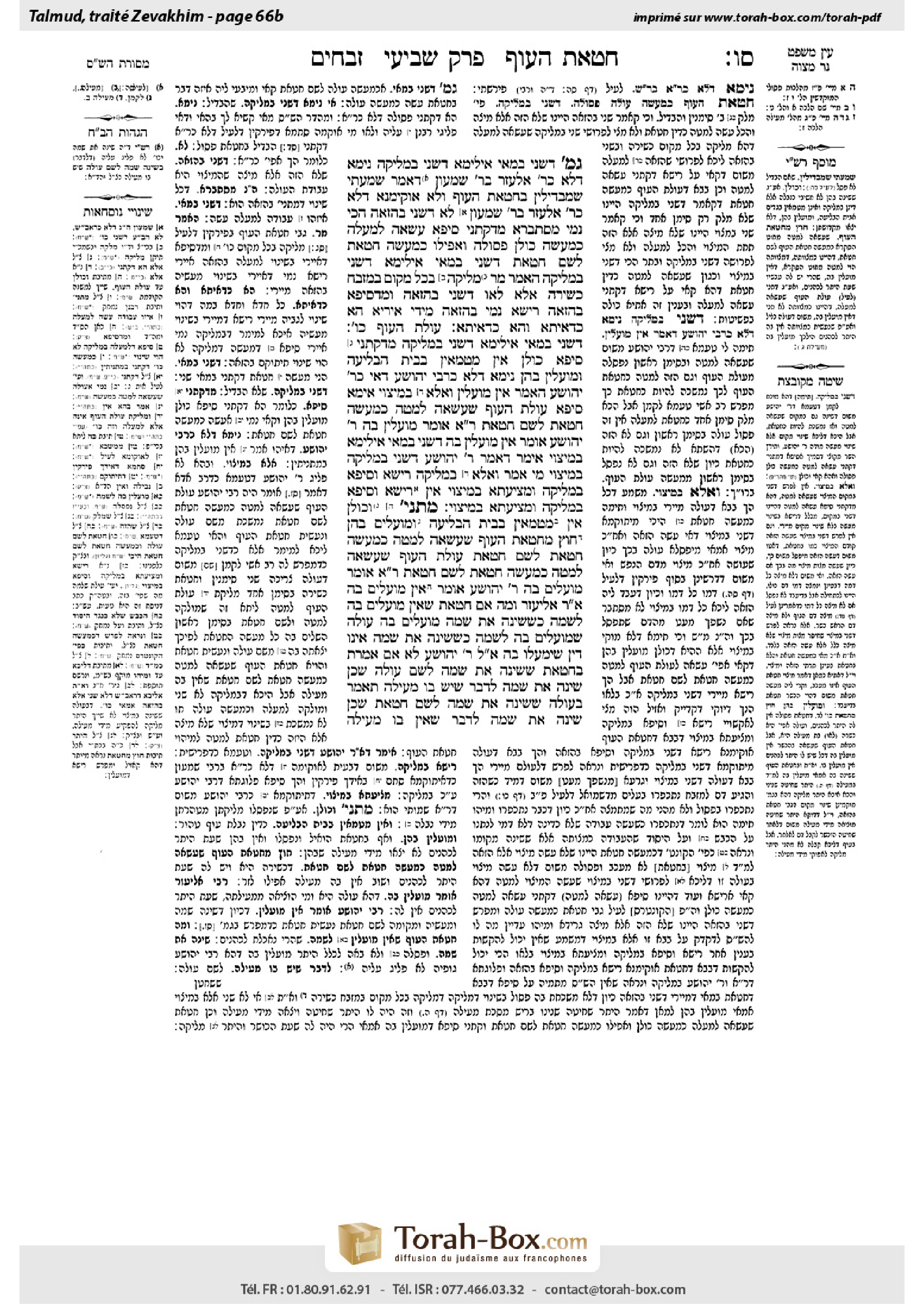
Zevachim 66b: Talmud study for Daf Yomi
Daf Yomi is the daily study of one Talmud folio. Explore 37 tractates with scans, Hebrew text, Sefaria English and AI-generated French translations where annotated.
Passage selection and English or AI-generated French translation are available where the scan has annotations. Daf Study is independent of Torah-Box and Sefaria.
Browse Zevachim · זבחים · All tractatesZevachim 66b text and translations
This page of Zevachim includes the Aramaic text, an English translation and an AI-generated French translation, alongside the scan above.
זבחים ס״ו ב · Aramaic and Hebrew text
גְּמָ׳ דְּשַׁנִּי בְּמַאי? אִילֵימָא דְּשַׁנִּי בִּמְלִיקָה – נֵימָא דְּלָא כְּרַבִּי אֶלְעָזָר בְּרַבִּי שִׁמְעוֹן, דְּאָמַר: שָׁמַעְתִּי שֶׁמַּבְדִּילִין בְּחַטַּאת הָעוֹף?
וְלָא אוֹקֵימְנָא דְּלָא כְּרַבִּי אֶלְעָזָר בְּרַבִּי שִׁמְעוֹן?!
לָא; דְּשַׁנִּי בְּהַזָּאָה.
הָכִי נָמֵי מִסְתַּבְּרָא – מִדְּקָתָנֵי סֵיפָא: עֲשָׂאָהּ לְמַעְלָה כְּמַעֲשֵׂה כּוּלָּן – פְּסוּלָה, וַאֲפִילּוּ כְּמַעֲשֵׂה חַטָּאת לְשֵׁם חַטָּאת. דְּשַׁנִּי בְּמַאי? אִילֵימָא דְּשַׁנִּי בִּמְלִיקָה, הָאָמַר מָר: מְלִיקָה בְּכׇל מָקוֹם בַּמִּזְבֵּחַ – כְּשֵׁירָה! אֶלָּא לָאו דְּשַׁנִּי בְּהַזָּאָה? וּמִדְּסֵיפָא בְּהַזָּאָה, רֵישָׁא נָמֵי בְּהַזָּאָה.
מִידֵּי אִירְיָא?! הָא כִּדְאִיתָא, וְהָא כִּדְאִיתָא!
עוֹלַת הָעוֹף כּוּ׳. דְּשַׁנִּי בְּמַאי?
אִילֵּימָא דְּשַׁנִּי בִּמְלִיקָה; מִדְּקָתָנֵי סֵיפָא: כּוּלָּן אֵין מְטַמְּאִין בְּבֵית הַבְּלִיעָה, וּמוֹעֲלִין בָּהֶן – נֵימָא דְּלָא כְּרַבִּי יְהוֹשֻׁעַ? דְּאִי כְּרַבִּי יְהוֹשֻׁעַ, הָאָמַר: אֵין מוֹעֲלִין!
וְאֶלָּא בְּמִיצּוּי?
אֵימָא סֵיפָא: עוֹלַת הָעוֹף שֶׁעֲשָׂאָהּ לְמַטָּה כְּמַעֲשֵׂה חַטָּאת לְשֵׁם חַטָּאת – רַבִּי אֱלִיעֶזֶר אוֹמֵר: מוֹעֲלִין בָּהּ, רַבִּי יְהוֹשֻׁעַ אוֹמֵר: אֵין מוֹעֲלִין בָּהּ. דְּשַׁנִּי בְּמַאי?
אִילֵּימָא בְּמִיצּוּי, אֵימַר דְּאָמַר רַבִּי יְהוֹשֻׁעַ – דְּשַׁנִּי בִּמְלִיקָה; בְּמִיצּוּי מִי אָמַר?!
וְאֶלָּא בִּמְלִיקָה? רֵישָׁא וְסֵיפָא בִּמְלִיקָה, וּמְצִיעֲתָא בְּמִיצּוּי?!
אִין; רֵישָׁא וְסֵיפָא בִּמְלִיקָה, וּמְצִיעֲתָא בְּמִיצּוּי.
מַתְנִי׳ וְכוּלָּן אֵין מְטַמְּאִין בְּבֵית הַבְּלִיעָה, וּמוֹעֲלִים בָּהֶן; חוּץ מֵחַטַּאת הָעוֹף שֶׁעֲשָׂאָהּ לְמַטָּה כְּמַעֲשֵׂה חַטָּאת לְשֵׁם חַטָּאת.
עוֹלַת הָעוֹף שֶׁעֲשָׂאָהּ לְמַטָּה כְּמַעֲשֵׂה חַטָּאת לְשֵׁם חַטָּאת – רַבִּי אֱלִיעֶזֶר אוֹמֵר: מוֹעֲלִים בָּהּ, רַבִּי יְהוֹשֻׁעַ אוֹמֵר: אֵין מוֹעֲלִים בָּהּ.
אָמַר רַבִּי אֱלִיעֶזֶר: וּמָה אִם חַטָּאת, שֶׁאֵין מוֹעֲלִים בָּהּ לִשְׁמָהּ – כְּשֶׁשִּׁינָּה אֶת שְׁמָהּ מוֹעֲלִים בָּהּ; עוֹלָה, שֶׁמּוֹעֲלִים בָּהּ לִשְׁמָהּ – כְּשֶׁשִּׁינָּה אֶת שְׁמָהּ אֵינוֹ דִּין שֶׁיִּמְעֲלוּ בָּהּ?!
אָמַר לוֹ רַבִּי יְהוֹשֻׁעַ: לֹא; אִם אָמַרְתָּ בְּחַטָּאת שֶׁשִּׁינָּה אֶת שְׁמָהּ לְשֵׁם עוֹלָה – שֶׁכֵּן שִׁינָּה אֶת שְׁמָהּ לְדָבָר שֶׁיֵּשׁ בּוֹ מְעִילָה; תֹּאמַר בְּעוֹלָה שֶׁשִּׁינָּה אֶת שְׁמָהּ לְשֵׁם חַטָּאת – שֶׁכֵּן שִׁינָּה אֶת שְׁמָהּ לְדָבָר שֶׁאֵין בּוֹ מְעִילָה?!
Zevachim 66b · English translation
GEMARA: According to the mishna, a bird sin offering that one sacrificed according to the procedure of a burnt offering is disqualified. The Gemara asks: With regard to what rite did the priest change the procedure? If we say that he changed the pinching by severing the head completely, as is proper for a burnt offering, shall we say that the mishna is not in accordance with the opinion of Rabbi Elazar, son of Rabbi Shimon, who says: I heard that the priests would sever the head completely even in the sacrifice of a bird sin offering?
The Gemara responds: And what is wrong with this conclusion? Have we not already explained that the mishna in the previous chapter (65a), with regard to pinching, is not in accordance with the opinion of Rabbi Elazar, son of Rabbi Shimon?
The Gemara offers another explanation: No, the mishna is referring to a case where the priest changed the procedure in the rite of sprinkling by squeezing out all the blood at once, as one would do with a burnt offering, rather than first sprinkling the blood on the altar as is proper for a sin offering. Under such circumstances, Rabbi Elazar, son of Rabbi Shimon, would also agree that the offering is disqualified.
This, too, stands to reason that the mishna is referring to a change in the sprinkling. This can be inferred from the fact that the mishna teaches in the latter clause: If one sacrificed a bird sin offering above the red line according to the procedure of any of the offerings, it is disqualified, and this applies even if he sacrificed it according to the procedure of a sin offering and for the sake of a sin offering. With regard to what rite did the priest change the location of the procedure? If we say that he changed the pinching, performing it above the red line, didn’t the Master already say with regard to a bird sin offering that pinching is valid anywhere on the altar? Rather, is it not that he changed the location of the sprinkling? And since the ruling of the latter clause is stated with regard to sprinkling, by inference, the ruling of the first clause is also stated with regard to sprinkling.
The Gemara responds to this proof: Are the cases comparable? This case is as it is, and that case is as it is. Even if the ruling of the latter clause is stated with regard to a change in the location of the sprinkling, the ruling of the first clause may still be stated with regard to a change in the procedure of the pinching, in which case the mishna would not be in accordance with the opinion of Rabbi Elazar, son of Rabbi Shimon.
§ According to the mishna, a bird burnt offering that one sacrificed according to the procedure of a sin offering is disqualified. The Gemara asks: With regard to what rite did the priest change the procedure?
If we say that he changed the pinching of the bird’s nape by leaving the head partially attached, as is proper for a sin offering, then from the fact that the latter clause, i.e., the first clause of the next mishna (66b), teaches: All of the offerings enumerated above do not render one who swallows their meat ritually impure when it is in the throat, and one who benefits from them is liable for misuse of consecrated property, by inference, we must say that the mishna is not in accordance with the opinion of Rabbi Yehoshua. As, if it is in accordance with the opinion of Rabbi Yehoshua, doesn’t he say later on in that mishna concerning a burnt offering whose nape was pinched according to the procedure of a sin offering: One who derives benefit from it is not liable for misusing consecrated property?
Rather, the mishna must be referring to a change in the procedure of squeezing out the blood. Instead of squeezing out the blood, the priest sprinkled it on the wall of the altar as if it were a sin offering. In this case, even Rabbi Yehoshua would concede that one is liable for misusing it.
But say the last clause of the subsequent mishna: In the case of a bird burnt offering that one sacrificed below the red line according to the procedure of a sin offering, and for the sake of a sin offering, Rabbi Eliezer says: One who benefits from it is liable for misuse of consecrated property, as it remains a burnt offering. Rabbi Yehoshua says: One who benefits from it is not liable for misuse of consecrated property, as the bird assumes the status of a sin offering. Here, with regard to what rite did the priest change the procedure and perform it as if it were a sin offering?
If we say that he changed the squeezing, this poses a difficulty, as it is reasonable to say that Rabbi Yehoshua says that one is not liable for misuse specifically when the priest changed the pinching, as pinching a burnt offering for a bird as though it were a sin offering changes its status; but does he say this in a case where it was pinched properly, and the priest changed the squeezing procedure alone? It is unreasonable to suggest that the offering changes its status at this later stage.
Rather, this final clause must be referring to a change with regard to the pinching. But can it be that the first clause concerning a sin offering sacrificed as a burnt offering and the last clause concerning the dispute between Rabbi Eliezer and Rabbi Yehoshua are both referring to a change with regard to the pinching, but the middle clause concerning a burnt offering sacrificed as a sin offering is referring to a change with regard to the squeezing?
The Gemara answers: Indeed, the first clause and the last clause are referring to a change with regard to the pinching, and the middle clause is referring to a change with regard to the squeezing.
MISHNA: And all of the offerings enumerated in the previous mishna, even those that are disqualified and may not be eaten or sacrificed, still differ from carcasses of unslaughtered kosher birds in that they do not render one who swallows their meat ritually impure when the meat is in the throat. This is because the pinching of the napes of bird offerings, like the slaughter of animals, prevents them from assuming the status of a carcass. But nevertheless, since they are forbidden to the priests, one who derives benefit from any of them is liable for misusing consecrated property. This is the halakha in all cases except for the bird sin offering that one sacrificed below the red line according to the procedure of the sin offering and for the sake of a sin offering. Since it was sacrificed properly and it is permitted for priests to partake of a fit sin offering, there is no liability for misuse of consecrated property.
In the case of a bird burnt offering that one improperly sacrificed below the red line according to the procedure of the sin offering, and one did so for the sake of a sin offering, Rabbi Eliezer says: One who derives benefit from it is liable for misusing consecrated property, as it remains a burnt offering, whose meat is never permitted to the priests. Rabbi Yehoshua says: One who derives benefit from it is not liable for misusing consecrated property. Since the entire sacrificial process was conducted according to the procedure of a sin offering, the offering assumes the status of a sin offering in this regard.
The mishna recounts the dispute between the tanna’im. Rabbi Eliezer said: And if in the case of a sin offering that was sacrificed for its sake, one is not liable for misusing it, and nevertheless, when one changed its designation and sacrificed it not for its sake, one is liable for misusing it, then in the case of a burnt offering, where one is liable for misusing it even when it was sacrificed for its sake, when one changed its designation and sacrificed it not for its sake is it not right that he is liable for misusing it?
Rabbi Yehoshua said to him: No, that a fortiori inference is not correct, as if you said with regard to a sin offering for which one changed its designation and sacrificed it for the sake of a burnt offering that there is liability for misuse, this is reasonable, because he changed its designation to an item for which there is liability for misuse. Would you say in the case of a burnt offering for which one changed its designation and sacrificed it for the sake of a sin offering that there is liability for misuse, as in that case he changed its designation to an item for which there is no liability for its misuse?
Zevachim 66b · Traduction française (IA)
GUEMARA : Selon la Michna, un sacrifice expiatoire d’oiseau offert selon le rite d’un holocauste est disqualifié. La Guemara demande : À quelle étape le prêtre a-t-il modifié le rite ? Si l’on dit qu’il a modifié la mélika en tranchant entièrement la tête, comme il convient de le faire pour un holocauste, faut-il en conclure que la Michna ne suit pas l’opinion de Rabbi Elazar, fils de Rabbi Shimon, qui dit : « J’ai entendu que les prêtres tranchaient entièrement la tête même lors du sacrifice expiatoire d’un oiseau » ?
La Guemara répond : Et qu’y a-t-il de problématique à tirer cette conclusion ? N’avons-nous pas déjà expliqué que la Michna du chapitre précédent (65a), concernant la mélika, ne suit pas l’opinion de Rabbi Elazar, fils de Rabbi Shimon ?
La Guemara propose une autre explication : Non, la Michna parle d’un cas où le prêtre a modifié le rite de l’aspersion en faisant jaillir tout le sang d’un seul coup, comme on le ferait pour un holocauste, au lieu d’asperger d’abord le sang sur l’autel, comme il convient de le faire pour un sacrifice expiatoire. Dans ces circonstances, Rabbi Elazar, fils de Rabbi Shimon, conviendrait lui aussi que l’offrande est disqualifiée.
Il est également raisonnable de conclure que la Michna parle d’une modification de l’aspersion. On peut le déduire de ce que la Michna enseigne dans sa dernière clause : « Si l’on a offert un sacrifice expiatoire d’oiseau au-dessus de la ligne rouge selon le rite de n’importe quelle offrande, il est disqualifié », même si on l’a offert selon le rite d’un sacrifice expiatoire et pour un sacrifice expiatoire. À quelle étape le prêtre a-t-il modifié le rite ? Si l’on dit qu’il a modifié la mélika en l’effectuant au-dessus de la ligne rouge, le Maître n’a-t-il pas déjà dit qu’en ce qui concerne un sacrifice expiatoire d’oiseau, la mélika est valide partout sur l’autel ? Ne faut-il pas plutôt dire qu’il a modifié l’emplacement de l’aspersion ? Et puisque la décision de la dernière clause porte sur l’aspersion, on peut en déduire que celle de la première clause porte également sur l’aspersion.
La Guemara répond à cette preuve : Ces cas sont-ils comparables ? Chacun doit être considéré séparément. Même si la décision de la dernière clause porte sur une modification de l’emplacement de l’aspersion, celle de la première clause peut néanmoins porter sur une modification du rite de la mélika, auquel cas la Michna ne suivrait pas l’opinion de Rabbi Elazar, fils de Rabbi Shimon.
§ Selon la Michna, un holocauste d’oiseau offert selon le rite d’un sacrifice expiatoire est disqualifié. La Guemara demande : À quelle étape le prêtre a-t-il modifié le rite ?
Si l’on dit qu’il a modifié la mélika de la nuque de l’oiseau en laissant la tête partiellement attachée, comme il convient de le faire pour un sacrifice expiatoire, alors, puisque la dernière clause — c’est-à-dire la première clause de la Michna suivante (66b) — enseigne que toutes les offrandes énumérées plus haut ne rendent pas rituellement impur celui qui en avale la chair lorsque celle-ci se trouve dans sa gorge, et que celui qui en tire profit est passible pour usage illicite de biens consacrés, il faut en déduire que la Michna ne suit pas l’opinion de Rabbi Yehoshua. En effet, si elle suivait son opinion, celui-ci ne dit-il pas plus loin dans cette Michna, au sujet d’un holocauste dont la nuque a été incisée selon le rite d’un sacrifice expiatoire, que celui qui en tire profit n’est pas passible pour usage illicite de biens consacrés ?
Il faut plutôt dire que la Michna parle d’une modification du rite d’extraction du sang. Au lieu d’en faire jaillir le sang, le prêtre l’a aspergé sur la paroi de l’autel comme s’il s’agissait d’un sacrifice expiatoire. Dans ce cas, même Rabbi Yehoshua admettrait que l’on est passible pour usage illicite de biens consacrés.
Mais considérons la dernière clause de la Michna suivante : dans le cas d’un holocauste d’oiseau offert sous la ligne rouge selon le rite d’un sacrifice expiatoire et pour un sacrifice expiatoire, Rabbi Eliezer dit : « Celui qui en tire profit est passible pour usage illicite de biens consacrés », car il reste un holocauste. Rabbi Yehoshua dit : « Celui qui en tire profit n’est pas passible pour usage illicite de biens consacrés », car l’oiseau acquiert le statut d’un sacrifice expiatoire. Ici, à quelle étape le prêtre a-t-il modifié le rite pour agir comme s’il s’agissait d’un sacrifice expiatoire ?
Si l’on dit qu’il a modifié l’extraction du sang, cela pose une difficulté : il est raisonnable de dire que Rabbi Yehoshua affirme qu’on n’est pas passible pour usage illicite uniquement lorsque le prêtre a modifié la mélika, car inciser la nuque d’un holocauste d’oiseau comme s’il s’agissait d’un sacrifice expiatoire en modifie le statut. Mais l’affirme-t-il aussi dans un cas où la mélika a été effectuée correctement et où le prêtre a modifié uniquement le rite d’extraction du sang ? Il serait déraisonnable de suggérer que l’offrande change de statut à ce stade ultérieur.
Il faut plutôt dire que cette dernière clause parle d’une modification de la mélika. Mais se peut-il que la première clause, qui concerne un sacrifice expiatoire offert comme un holocauste, et la dernière clause, qui traite de la controverse entre Rabbi Eliezer et Rabbi Yehoshua, parlent toutes deux d’une modification de la mélika, tandis que la clause intermédiaire, qui concerne un holocauste offert comme un sacrifice expiatoire, parle d’une modification de l’extraction du sang ?
La Guemara répond : En effet, la première et la dernière clauses parlent d’une modification de la mélika, et la clause intermédiaire parle d’une modification de l’extraction du sang.
MICHNA : Toutes les offrandes énumérées dans la Michna précédente, même celles qui sont disqualifiées et ne peuvent être ni consommées ni offertes, diffèrent néanmoins des carcasses d’oiseaux purs non abattus en ceci qu’elles ne rendent pas rituellement impur celui qui en avale la chair lorsque celle-ci se trouve dans sa gorge. En effet, la mélika de la nuque des oiseaux offerts, comme l’abattage des animaux, les empêche d’acquérir le statut de carcasse. Néanmoins, puisqu’elles sont interdites aux prêtres, celui qui tire profit de l’une d’elles est passible pour usage illicite de biens consacrés. Cette halakha s’applique dans tous les cas, sauf au sacrifice expiatoire d’oiseau offert sous la ligne rouge selon le rite d’un sacrifice expiatoire et pour un sacrifice expiatoire. Puisqu’il a été offert correctement et qu’un sacrifice expiatoire valide est permis aux prêtres, il n’y a pas de responsabilité pour usage illicite de biens consacrés.
Dans le cas d’un holocauste d’oiseau offert illicitement sous la ligne rouge selon le rite d’un sacrifice expiatoire et pour un sacrifice expiatoire, Rabbi Eliezer dit : « Celui qui en tire profit est passible pour usage illicite de biens consacrés », car il reste un holocauste, dont la chair n’est jamais permise aux prêtres. Rabbi Yehoshua dit : « Celui qui en tire profit n’est pas passible pour usage illicite de biens consacrés. » Puisque toute la procédure sacrificielle a été accomplie selon le rite d’un sacrifice expiatoire, l’offrande acquiert à cet égard le statut d’un sacrifice expiatoire.
La Michna rapporte la controverse entre les tannaïm. Rabbi Eliezer dit : « Si, dans le cas d’un sacrifice expiatoire offert pour lui-même, on n’est pas passible pour usage illicite, mais que, lorsqu’on en change la désignation et qu’on l’offre non pour lui-même, on est passible pour usage illicite, alors, dans le cas d’un holocauste, pour lequel on est passible pour usage illicite même lorsqu’il est offert pour lui-même, n’est-il pas d’autant plus évident qu’on est passible pour usage illicite lorsqu’on en change la désignation et qu’on l’offre non pour lui-même ? »
Rabbi Yehoshua lui dit : « Non, ce raisonnement a fortiori n’est pas valable. Si tu dis, au sujet d’un sacrifice expiatoire dont on a changé la désignation et qu’on a offert pour un holocauste, qu’il y a responsabilité pour usage illicite, cela est raisonnable, puisqu’on en a changé la désignation pour celle d’un objet dont l’usage illicite entraîne une responsabilité. Mais dirais-tu, dans le cas d’un holocauste dont on a changé la désignation et qu’on a offert pour un sacrifice expiatoire, qu’il y a responsabilité pour usage illicite, alors qu’on en a changé la désignation pour celle d’un objet dont l’usage illicite n’entraîne pas de responsabilité ? »
Traduction française générée par IA à partir de l’édition anglaise de Sefaria. Vérifie toujours un passage avec le texte source.
Text from Sefaria: William Davidson Edition - Vocalized Aramaic (CC BY NC); William Davidson Edition - English (CC BY NC).