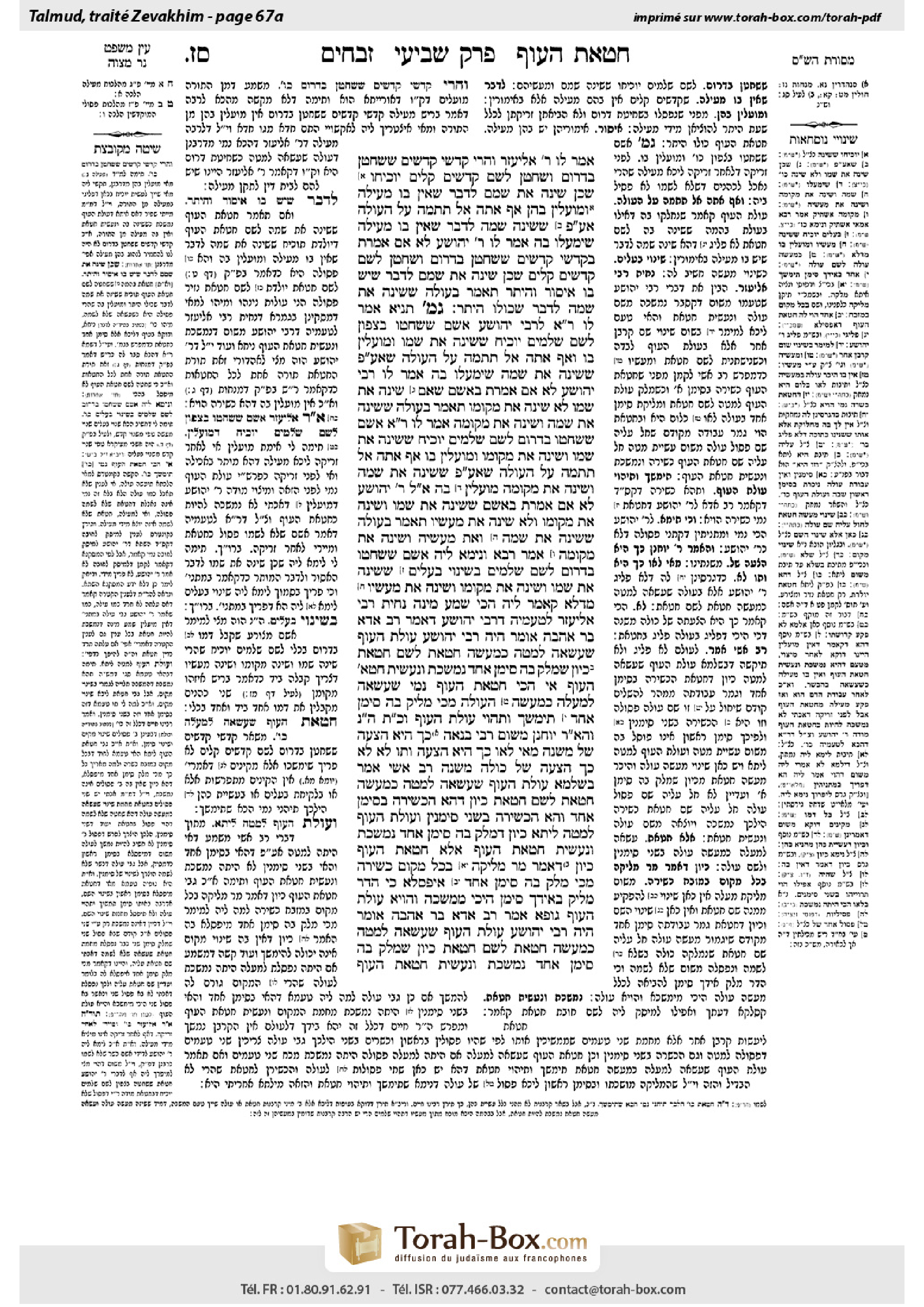
Zevachim 67a: Talmud study for Daf Yomi
Daf Yomi is the daily study of one Talmud folio. Explore 37 tractates with scans, Hebrew text, Sefaria English and AI-generated French translations where annotated.
Passage selection and English or AI-generated French translation are available where the scan has annotations. Daf Study is independent of Torah-Box and Sefaria.
Browse Zevachim · זבחים · All tractatesZevachim 67a text and translations
This page of Zevachim includes the Aramaic text, an English translation and an AI-generated French translation, alongside the scan above.
זבחים ס״ז א · Aramaic and Hebrew text
אָמַר לוֹ רַבִּי אֱלִיעֶזֶר: וַהֲרֵי קׇדְשֵׁי קָדָשִׁים שֶׁשְּׁחָטָן בַּדָּרוֹם וּשְׁחָטָן לְשֵׁם קֳדָשִׁים קַלִּים יוֹכִיחוּ – שֶׁכֵּן שִׁינָּה אֶת שְׁמָם לְדָבָר שֶׁאֵין בּוֹ מְעִילָה, וּמוֹעֲלִין בָּהֶן; אַף אַתָּה אַל תִּתְמַהּ עַל הָעוֹלָה – אַף עַל פִּי שֶׁשִּׁינָּה שְׁמָהּ לְדָבָר שֶׁאֵין בּוֹ מְעִילָה, שֶׁיִּמְעֲלוּ בָּהּ!
אָמַר לוֹ רַבִּי יְהוֹשֻׁעַ: לֹא; אִם אָמַרְתָּ בְּקׇדְשֵׁי קָדָשִׁים שֶׁשְּׁחָטָן בַּדָּרוֹם וּשְׁחָטָן לְשֵׁם קֳדָשִׁים קַלִּים – שֶׁכֵּן שִׁינָּה אֶת שְׁמָם לְדָבָר שֶׁיֵּשׁ בּוֹ אִיסּוּר וְהֶיתֵּר; תֹּאמַר בְּעוֹלָה – שֶׁשִּׁינָּה אֶת שְׁמָהּ לְדָבָר שֶׁכּוּלּוֹ הֶיתֵּר?!
גְּמָ׳ תַּנְיָא, אָמַר לוֹ רַבִּי אֱלִיעֶזֶר לְרַבִּי יְהוֹשֻׁעַ: אָשָׁם שֶׁשְּׁחָטוֹ בַּצָּפוֹן לְשֵׁם שְׁלָמִים יוֹכִיחַ – שֶׁשִּׁינָּה אֶת שְׁמוֹ, וּמוֹעֲלִין בּוֹ; וְאַף אַתָּה אַל תִּתְמַהּ עַל הָעוֹלָה – שֶׁאַף עַל פִּי שֶׁשִּׁינָּה אֶת שְׁמָהּ, שֶׁיִּמְעֲלוּ בָּהּ.
אָמַר לוֹ רַבִּי יְהוֹשֻׁעַ: לֹא; אִם אָמַרְתָּ בְּאָשָׁם – שֶׁאִם שִׁינָּה אֶת שְׁמוֹ לֹא שִׁינָּה אֶת מְקוֹמוֹ; תֹּאמַר בְּעוֹלָה – שֶׁשִּׁינָּה אֶת שְׁמָהּ וְשִׁינָּה אֶת מְקוֹמָהּ?!
אָמַר לוֹ רַבִּי אֱלִיעֶזֶר: אָשָׁם שֶׁשְּׁחָטוֹ בַּדָּרוֹם לְשֵׁם שְׁלָמִים יוֹכִיחַ – שֶׁשִּׁינָּה אֶת שְׁמוֹ וְשִׁינָּה אֶת מְקוֹמוֹ, וּמוֹעֲלִין בּוֹ; אַף אַתָּה אַל תִּתְמַהּ עַל הָעוֹלָה – שֶׁאַף עַל פִּי שֶׁשִּׁינָּה אֶת שְׁמָהּ וְשִׁינָּה אֶת מְקוֹמָהּ, מוֹעֲלִין בָּהּ.
אָמַר לוֹ רַבִּי יְהוֹשֻׁעַ: לֹא; אִם אָמַרְתָּ בְּאָשָׁם – שֶׁשִּׁינָּה אֶת שְׁמוֹ וְשִׁינָּה אֶת מְקוֹמוֹ, וְלֹא שִׁינָּה אֶת מַעֲשָׂיו; תֹּאמַר בְּעוֹלָה – שֶׁשִּׁינָּה אֶת שְׁמָהּ וְאֶת מַעֲשֶׂיהָ, וְשִׁינָּה אֶת מְקוֹמָהּ?!
אָמַר רָבָא, וְנֵימָא לֵיהּ: אָשָׁם שֶׁשְּׁחָטוֹ בַּדָּרוֹם לְשֵׁם שְׁלָמִים בְּשִׁינּוּי בְּעָלִים – שֶׁשִּׁינָּה אֶת שְׁמוֹ, וְשִׁינָּה אֶת מְקוֹמוֹ, וְשִׁינָּה אֶת מַעֲשָׂיו!
מִדְּלָא קָאָמַר לֵיהּ הָכִי, שְׁמַע מִינַּהּ: נְחֵית רַבִּי אֱלִיעֶזֶר לְטַעְמֵיהּ דְּרַבִּי יְהוֹשֻׁעַ – דְּאָמַר רַב אַדָּא בַּר אַהֲבָה, אוֹמֵר הָיָה רַבִּי יְהוֹשֻׁעַ: עוֹלַת הָעוֹף שֶׁעֲשָׂאָהּ לְמַטָּה כְּמַעֲשֵׂה חַטָּאת לְשֵׁם חַטָּאת – כֵּיוָן שֶׁמָּלַק בָּהּ סִימָן אֶחָד, נִמְשֶׁכֶת וְנַעֲשֵׂית חַטַּאת הָעוֹף.
אִי הָכִי, חַטַּאת הָעוֹף נָמֵי – שֶׁעֲשָׂאָהּ לְמַעְלָה כְּמַעֲשֵׂה הָעוֹלָה; מִכִּי מָלֵיק בַּהּ סִימָן אֶחָד, תִּימָּשֵׁךְ וְתֶהֱוֵי עוֹלַת הָעוֹף! וְכִי תֵּימָא הָכִי נָמֵי, וְהָא אָמַר רַבִּי יוֹחָנָן מִשּׁוּם רַבִּי בְּנָאָה: כָּךְ הִיא הַצָּעָה שֶׁל מִשְׁנָה! מַאי, לָאו כָּךְ הִיא הַצָּעָה – וְתוּ לָא?
לָא; כָּךְ הַצָּעָה שֶׁל כּוּלָּהּ מִשְׁנָה.
רַב אָשֵׁי אָמַר: בִּשְׁלָמָא עוֹלַת הָעוֹף שֶׁעֲשָׂאָהּ לְמַטָּה כְּמַעֲשֵׂה חַטָּאת לְשֵׁם חַטָּאת – כֵּיוָן דְּהָא הֶכְשֵׁירָהּ בְּסִימָן אֶחָד וְהָא הֶכְשֵׁירָהּ בִּשְׁנֵי סִימָנִין; וְעוֹלַת הָעוֹף לְמַטָּה לֵיתַהּ; כֵּיוָן דְּמָלַק בָּהּ סִימָן אֶחָד – נִמְשֶׁכֶת וְנַעֲשֵׂית חַטַּאת הָעוֹף.
אֶלָּא חַטַּאת הָעוֹף, כֵּיוָן דְּאָמַר מָר: מְלִיקָה – בְּכׇל מָקוֹם כְּשֵׁירָה; מִכִּי מָלֵק בַּהּ סִימָן אֶחָד – אִיפַּסְלָא; כִּי הֲדַר מָלֵיק בְּאִידַּךְ סִימָן – הֵיכִי מִמַּשְׁכָה וְהָוְיָא עוֹלַת הָעוֹף?
גּוּפָא – אָמַר רַב אַדָּא בַּר אַהֲבָה, אוֹמֵר הָיָה רַבִּי יְהוֹשֻׁעַ: עוֹלַת הָעוֹף שֶׁעֲשָׂאָהּ לְמַטָּה כְּמַעֲשֵׂה חַטָּאת לְשֵׁם חַטָּאת – כֵּיוָן שֶׁמָּלַק בָּהּ סִימָן אֶחָד, נִמְשֶׁכֶת וְנַעֲשֵׂית חַטַּאת הָעוֹף.
Zevachim 67a · English translation
Rabbi Eliezer said to him: The case of offerings of the most sacred order that one slaughtered in the south of the Temple courtyard and slaughtered for the sake of offerings of lesser sanctity, will prove that the fact that one changed the offering’s designation to an item that is not subject to the halakhot of misuse is not a relevant factor. As in this case, one changed their designation to an item that is not subject to the halakhot of misuse and, nevertheless, one is liable for misusing them. You too should not be puzzled about the burnt offering, concerning which even though one changed its designation to an item that is not subject to the halakhot of misuse, the halakha is that one would be liable for misusing it.
Rabbi Yehoshua said to him: No, that is no proof, as if you said with regard to offerings of the most sacred order that one slaughtered in the south of the Temple courtyard, and slaughtered them for the sake of offerings of lesser sanctity, that one is liable for misusing them, that is reasonable. The reason is that one who slaughtered them changed their designation to an item for which there are both prohibited and permitted elements as offerings of lesser sanctity. Although one is not liable for misuse of their flesh, after the blood is sprinkled one is liable for misuse of the portions consumed on the altar. Would you say the halakha is the same in the case of a burnt offering for which one changed its designation to an item that is permitted in its entirety, i.e., a bird sin offering, which is eaten by the priests and none of it is burned on the altar?
GEMARA: The discussion between Rabbi Eliezer and Rabbi Yehoshua is taught in a baraita, where it is recounted in greater detail: Rabbi Eliezer said to Rabbi Yehoshua: The case of a guilt offering that one slaughtered in the north of the Temple courtyard for the sake of a peace offering will prove my point, as here the one who performed the slaughter changed its designation to an item for which there is no liability for misuse, and yet one is liable for misusing it. And you too should not be puzzled about the bird burnt offering that was sacrificed as a sin offering, concerning which even though the one who performed the slaughter changed its designation to an item for which there is no liability for misuse, the halakha is that one is liable for misusing it.
Rabbi Yehoshua said to him: No, if you say that this is the halakha with regard to a guilt offering sacrificed as a peace offering, as although the one who performed the slaughter changed its designation, he still did not change its location but sacrificed it in the north of the Temple courtyard, which is the appropriate location for both guilt offerings and peace offerings, shall you also say that this is the halakha with regard to a bird burnt offering sacrificed below the red line as a sin offering, where the one who performed the slaughter changed its designation and also changed its location?
Rabbi Eliezer said to him: A guilt offering that one slaughtered in the south of the Temple courtyard for the sake of a peace offering will prove my point, as here the one who performed the slaughter changed its designation and also changed its location, and yet one is liable for misusing it. You too should not be puzzled about the bird burnt offering that was sacrificed below the red line as a sin offering, concerning which even though the one who performed the slaughter changed its designation and also changed its location, the halakha is that one is liable for misusing it.
Rabbi Yehoshua said to him: No, if you say that this this is the halakha with regard to a guilt offering sacrificed as a peace offering, in which case the one who performed the slaughter changed its designation and changed its location, but he did not change its procedure, shall you also say that this is the halakha with regard to a bird burnt offering sacrificed entirely according to the procedure of a sin offering, in which case the one who performed the slaughter changed its designation and procedure and also changed its location?
The baraita ends here, and it would appear that Rabbi Eliezer had no response to this claim. Rava said: Why? Let him say to Rabbi Yehoshua that a guilt offering that one slaughtered in the south of the Temple courtyard for the sake of a peace offering with a deviation with regard to the offering’s owner, i.e., he slaughtered it for the sake of someone other than the offering’s owner, will prove my opinion; as this is tantamount to a case where the one who performed the slaughter changed its designation and changed its location and also changed its procedure, yet one is liable for its misuse.
Rava concluded: Since he did not say this to him, learn from it that at this stage Rabbi Eliezer grasped Rabbi Yehoshua’s line of reasoning; as Rav Adda bar Ahava says that Rabbi Yehoshua would say the following reasoning: In the case of a bird burnt offering that one sacrificed below the red line according to the procedure of a sin offering and for the sake of a sin offering, once he pinched one of the organs that must be severed in ritual slaughter [siman], i.e., either the gullet or the windpipe, the offering is removed from its status as a burnt offering and becomes a bird sin offering.
The Gemara challenges: If so, then in the case of a bird sin offering that one sacrificed above the red line according to the procedure of a burnt offering, too, as soon as he pinches one siman it should be removed from its status as a sin offering and become a bird burnt offering. And if you would say that indeed that is so, this is difficult: But doesn’t Rabbi Yoḥanan say in the name of Rabbi Bena’a that this is the accurate presentation of the mishna? What, does he not mean that this is the accurate presentation in the sense that Rabbi Yehoshua’s principle applies specifically to the case stated in the mishna, namely, that of a burnt offering sacrificed as a sin offering, and to nothing more?
The Gemara answers: No, what Rabbi Bena’a means is that this is the accurate presentation of the entire mishna. Just as Rabbi Yehoshua disagrees with Rabbi Eliezer with regard to a bird burnt offering sacrificed entirely as a sin offering, he holds similarly that a bird sin offering sacrificed entirely as a burnt offering assumes the status of a burnt offering.
Rav Ashi said: The two cases are different. Granted, Rabbi Yehoshua’s principle applies to a bird burnt offering that one sacrificed below the red line according to the procedure of a sin offering and for the sake of a sin offering. Since the method of preparing this bird sin offering is by pinching one siman, and the method of preparing that bird burnt offering is by pinching two simanim, and since there can be no bird burnt offering below the red line, therefore once he pinched one siman below the red line, the offering is removed from its status as a burnt offering and becomes a bird sin offering.
But one cannot say this with regard to a bird sin offering that was sacrificed as a burnt offering. Since the Master said with regard to the bird sin offering: Pinching is valid everywhere on the altar, it follows that as soon as one pinched one siman for the sake of a burnt offering it was disqualified, like any other sin offering pinched for the sake of a different type of offering. Consequently, when he then pinched the other siman according to the procedure of a burnt offering, how could it then be removed from its status as a sin offering and become a bird burnt offering?
§ The Gemara discusses the matter itself, that Rav Adda bar Ahava says that Rabbi Yehoshua would say: In the case of a bird burnt offering that one sacrificed below the red line according to the procedure of a sin offering and for the sake of a sin offering, once he pinched one siman, the offering is removed from its status as a burnt offering and becomes a bird sin offering.
Zevachim 67a · Traduction française (IA)
Rabbi Eliezer lui dit : Le cas d’offrandes de sainteté suprême abattues au sud de la cour du Temple pour des offrandes de moindre sainteté prouve que le fait d’avoir changé la désignation de l’offrande en celle d’un objet qui n’est pas soumis aux lois du sacrilège n’est pas pertinent. En effet, dans ce cas, leur désignation a été changée en celle d’un objet qui n’est pas soumis aux lois du sacrilège, et pourtant on est passible de sacrilège à leur égard. Toi non plus, ne t’étonne donc pas au sujet de l’holocauste : bien que sa désignation ait été changée en celle d’un objet qui n’est pas soumis aux lois du sacrilège, la halakha veut qu’on soit passible de sacrilège à son égard.
Rabbi Yehoshua lui dit : Non, ce n’est pas une preuve. Si tu disais, au sujet d’offrandes de sainteté suprême abattues au sud de la cour du Temple pour des offrandes de moindre sainteté, qu’on est passible de sacrilège à leur égard, ce serait raisonnable. En effet, celui qui les a abattues a changé leur désignation en celle d’offrandes de moindre sainteté, qui comportent à la fois des éléments interdits et permis. Bien qu’on ne soit pas passible de sacrilège pour leur chair, après l’aspersion du sang, on est passible de sacrilège pour les portions consommées sur l’autel. Dirais-tu que la halakha est la même dans le cas d’un holocauste dont la désignation a été changée en celle d’une offrande entièrement permise, c’est-à-dire un sacrifice expiatoire d’oiseau, que les prêtres mangent et dont rien n’est brûlé sur l’autel ?
GUEMARA : La discussion entre Rabbi Eliezer et Rabbi Yehoshua est rapportée plus en détail dans une baraïta : Rabbi Eliezer dit à Rabbi Yehoshua : Le cas d’un sacrifice de culpabilité abattu au nord de la cour du Temple pour une offrande de paix prouve mon argument. En effet, dans ce cas, celui qui a procédé à l’abattage a changé la désignation de l’offrande en celle d’un objet pour lequel on n’est pas passible de sacrilège, et pourtant on est passible de sacrilège à son égard. Toi non plus, ne t’étonne donc pas au sujet de l’holocauste d’oiseau sacrifié comme sacrifice expiatoire : bien que celui qui a procédé à l’abattage ait changé la désignation de l’offrande en celle d’un objet pour lequel on n’est pas passible de sacrilège, la halakha veut qu’on soit passible de sacrilège à son égard.
Rabbi Yehoshua lui dit : Non. Si tu dis que telle est la halakha pour un sacrifice de culpabilité offert comme sacrifice de paix, car, bien que celui qui a procédé à l’abattage ait changé la désignation de l’offrande, il n’en a pas changé le lieu : il l’a offert au nord de la cour du Temple, emplacement qui convient aussi bien aux sacrifices de culpabilité qu’aux sacrifices de paix, dirais-tu également que telle est la halakha pour un holocauste d’oiseau offert sous la ligne rouge comme sacrifice expiatoire, alors que celui qui a procédé à l’abattage en a changé la désignation et le lieu ?
Rabbi Eliezer lui dit : Un sacrifice de culpabilité abattu au sud de la cour du Temple pour un sacrifice de paix prouve mon argument. En effet, dans ce cas, celui qui a procédé à l’abattage a changé la désignation de l’offrande et le lieu, et pourtant on est passible de sacrilège à son égard. Toi non plus, ne t’étonne donc pas au sujet de l’holocauste d’oiseau offert sous la ligne rouge comme sacrifice expiatoire : bien que celui qui a procédé à l’abattage ait changé la désignation de l’offrande et le lieu, la halakha veut qu’on soit passible de sacrilège à son égard.
Rabbi Yehoshua lui dit : Non. Si tu dis que telle est la halakha pour un sacrifice de culpabilité offert comme sacrifice de paix, auquel cas celui qui a procédé à l’abattage a changé la désignation de l’offrande et le lieu, mais non le rite, dirais-tu également que telle est la halakha pour un holocauste d’oiseau offert entièrement selon le rite d’un sacrifice expiatoire, auquel cas celui qui a procédé à l’abattage a changé la désignation de l’offrande, le rite et le lieu ?
La baraïta s’achève ici, et il semblerait que Rabbi Eliezer n’ait pas répondu à cet argument. Rava dit : Pourquoi ? Qu’il dise à Rabbi Yehoshua qu’un sacrifice de culpabilité abattu au sud de la cour du Temple pour un sacrifice de paix, avec une déviation concernant le propriétaire de l’offrande — c’est-à-dire qu’il l’a abattu au nom d’une personne autre que le propriétaire de l’offrande — prouve son opinion. Car cela équivaut à un cas où celui qui a procédé à l’abattage a changé la désignation de l’offrande, le lieu et le rite, et pourtant on est passible de sacrilège à son égard.
Rava conclut : Puisqu’il ne lui a pas répondu ainsi, déduis-en qu’à ce stade Rabbi Eliezer avait compris le raisonnement de Rabbi Yehoshua. En effet, Rav Adda bar Ahava dit que Rabbi Yehoshua avançait le raisonnement suivant : dans le cas d’un holocauste d’oiseau offert sous la ligne rouge selon le rite d’un sacrifice expiatoire et pour un sacrifice expiatoire, dès qu’on a pincé l’un des organes qui doivent être sectionnés lors de l’abattage rituel [siman], c’est-à-dire l’œsophage ou la trachée, l’offrande perd son statut d’holocauste et devient un sacrifice expiatoire d’oiseau.
La Guemara objecte : Si tel est le cas, alors, dans le cas aussi d’un sacrifice expiatoire d’oiseau offert au-dessus de la ligne rouge selon le rite d’un holocauste, dès qu’on pince un siman, il devrait perdre son statut de sacrifice expiatoire et devenir un holocauste d’oiseau. Et si tu dis que c’est bien le cas, une difficulté se pose : Rabbi Yoḥanan ne dit-il pas au nom de Rabbi Bena’a que telle est la version exacte de la Michna ? Ne veut-il pas dire que la version exacte signifie que le principe de Rabbi Yehoshua s’applique spécifiquement au cas mentionné dans la Michna, à savoir un holocauste offert comme sacrifice expiatoire, et à aucun autre cas ?
La Guemara répond : Non, Rabbi Bena’a veut dire que telle est la version exacte de toute la Michna. De même que Rabbi Yehoshua conteste Rabbi Eliezer au sujet d’un holocauste d’oiseau offert entièrement comme sacrifice expiatoire, il soutient de même qu’un sacrifice expiatoire d’oiseau offert entièrement comme holocauste prend le statut d’un holocauste.
Rav Ashi dit : Les deux cas sont différents. Il est vrai que le principe de Rabbi Yehoshua s’applique à un holocauste d’oiseau offert sous la ligne rouge selon le rite d’un sacrifice expiatoire et pour un sacrifice expiatoire. En effet, pour préparer ce sacrifice expiatoire d’oiseau, on pince un siman, tandis que pour préparer cet holocauste d’oiseau, on pince deux simanim. Et comme il ne peut y avoir d’holocauste d’oiseau sous la ligne rouge, dès qu’on pince un siman à cet endroit, l’offrande perd son statut d’holocauste et devient un sacrifice expiatoire d’oiseau.
Mais on ne peut pas dire la même chose d’un sacrifice expiatoire d’oiseau offert comme holocauste. Puisque le Maître a dit au sujet du sacrifice expiatoire d’oiseau : « Le pincement est valide partout sur l’autel », il s’ensuit que dès qu’on a pincé un siman pour un holocauste, l’offrande a été invalidée, comme tout autre sacrifice expiatoire dont on pince le cou pour un autre type d’offrande. Par conséquent, lorsqu’il a ensuite pincé l’autre siman selon le rite d’un holocauste, comment l’offrande aurait-elle pu alors perdre son statut de sacrifice expiatoire et devenir un holocauste d’oiseau ?
§ La Guemara examine la question elle-même. Rav Adda bar Ahava dit que Rabbi Yehoshua avançait le raisonnement suivant : dans le cas d’un holocauste d’oiseau offert sous la ligne rouge selon le rite d’un sacrifice expiatoire et pour un sacrifice expiatoire, dès qu’on a pincé un siman, l’offrande perd son statut d’holocauste et devient un sacrifice expiatoire d’oiseau.
Traduction française générée par IA à partir de l’édition anglaise de Sefaria. Vérifie toujours un passage avec le texte source.
Text from Sefaria: William Davidson Edition - Vocalized Aramaic (CC BY NC); William Davidson Edition - English (CC BY NC).