Zevachim 67b: Talmud study for Daf Yomi
Daf Yomi is the daily study of one Talmud folio. Explore 37 tractates with scans, Hebrew text, Sefaria English and AI-generated French translations where annotated.
Passage selection and English or AI-generated French translation are available where the scan has annotations. Daf Study is independent of Torah-Box and Sefaria.
Browse Zevachim · זבחים · All tractatesZevachim 67b text and translations
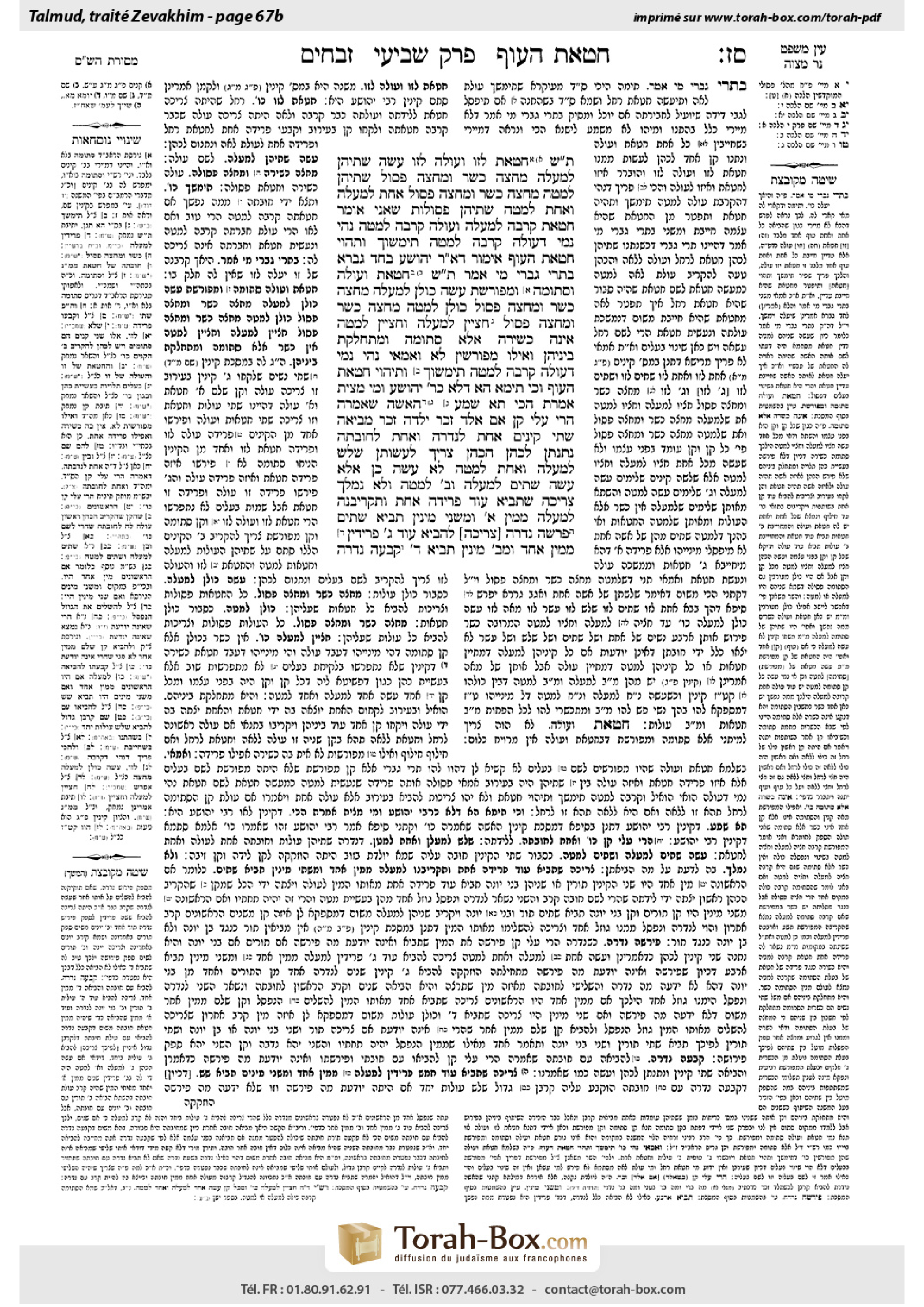
This page of Zevachim includes the Aramaic text, an English translation and an AI-generated French translation, alongside the scan above.
זבחים ס״ז ב · Aramaic and Hebrew text
תָּא שְׁמַע: חַטָּאת לָזוֹ וְעוֹלָה לָזוֹ;
עָשָׂה שְׁתֵּיהֶן לְמַעְלָה – מֶחֱצָה כָּשֵׁר וּמֶחֱצָה פָּסוּל. שְׁתֵּיהֶן לְמַטָּה – מֶחֱצָה כָּשֵׁר וּמֶחֱצָה פָּסוּל. אַחַת לְמַעְלָה וְאַחַת לְמַטָּה – שְׁתֵּיהֶן פְּסוּלוֹת; שֶׁאֲנִי אוֹמֵר: חַטָּאת קְרֵבָה לְמַעְלָה, וְעוֹלָה קְרֵבָה לְמַטָּה.
נְהִי נָמֵי דְּעוֹלָה קְרֵבָה לְמַטָּה, תִּימְשׁוֹךְ וְתֶהֱוֵי חַטַּאת הָעוֹף!
אֵימוֹר דְּאָמַר רַבִּי יְהוֹשֻׁעַ – בְּחַד גַּבְרָא; בִּתְרֵי גַבְרֵי מִי אָמַר?!
תָּא שְׁמַע: חַטָּאת וְעוֹלָה, וּסְתוּמָה, וּמְפוֹרֶשֶׁת –
עָשָׂה כּוּלָּן לְמַעְלָה – מֶחֱצָה כָּשֵׁר וּמֶחֱצָה פָּסוּל. כּוּלָּן לְמַטָּה – מֶחֱצָה כָּשֵׁר וּמֶחֱצָה פָּסוּל. חֶצְיָין לְמַעְלָה וְחֶצְיָין לְמַטָּה – אֵינָהּ כְּשֵׁירָה אֶלָּא סְתוּמָה, וּמִתְחַלֶּקֶת בֵּינֵיהֶן.
וְאִילּוּ מְפוֹרָשִׁין – לָא; וְאַמַּאי? נְהִי נָמֵי דְּעוֹלָה קְרֵבָה לְמַטָּה, תִּימְשׁוֹךְ וְתִיהְוֵי חַטַּאת הָעוֹף!
וְכִי תֵּימָא הָא דְּלָא כְּרַבִּי יְהוֹשֻׁעַ – וּמִי מָצֵית אָמְרַתְּ הָכִי?!
תָּא שְׁמַע, הָאִשָּׁה שֶׁאָמְרָה: ״הֲרֵי עָלַי קֵן אִם אֵלֵד זָכָר״; יָלְדָה זָכָר – מְבִיאָה שְׁתֵּי קִינִּים, אַחַת לְנִדְרָהּ וְאַחַת לְחוֹבָתָהּ.
נְתָנָתַן לַכֹּהֵן – הַכֹּהֵן צָרִיךְ לַעֲשׂוֹתָן שָׁלֹשׁ לְמַעְלָה וְאַחַת לְמַטָּה.
לֹא עָשָׂה כֵּן, אֶלָּא עָשָׂה שְׁתַּיִם לְמַעְלָה וּשְׁתַּיִם לְמַטָּה, וְלֹא נִמְלַךְ – צְרִיכָה שֶׁתָּבִיא עוֹד פְּרֵידָה אַחַת, וְתַקְרִיבֶנָּה לְמַעְלָה.
מִמִּין אֶחָד. וּמִשְּׁנֵי מִינִין – תָּבִיא שְׁתַּיִם.
פֵּרְשָׁה נִדְרָהּ – [צְרִיכָה] לְהָבִיא עוֹד שָׁלֹשׁ פְּרֵידִין.
מִמִּין אֶחָד. וּמִשְּׁנֵי מִינִין – תָּבִיא אַרְבַּע.
קָבְעָה נִדְרָהּ –
Zevachim 67b · English translation
The Gemara suggests: Come and hear a challenge to this principle from a mishna in tractate Kinnim (24a). A woman after childbirth must bring two bird offerings: A burnt offering and a sin offering. The mishna discusses a case where two women after childbirth, one of whom already brought her burnt offering and one of whom already brought her sin offering, bring their remaining offerings to the Temple, a sin offering for this one and a burnt offering for that one, but confusion has arisen as to which bird is which.
If the priest sacrificed both of them above the red line, half of the birds, i.e., one of them, is fit, as in any event the burnt offering has been sacrificed properly, and half of the birds, i.e., the other one, is disqualified. Likewise, if he sacrificed both of them below the red line, half are fit, as in any event the sin offering was sacrificed properly, and half are disqualified. If he sacrificed one above the red line and one below, they are both disqualified, as I say that perhaps the sin offering was sacrificed above, and the burnt offering was sacrificed below.
But according to Rav Adda bar Ahava’s explanation of Rabbi Yehoshua’s principle, the sin offering should be deemed fit in any event; even though the burnt offering was indeed sacrificed below the red line, it should be removed from its status as a burnt offering and become a bird sin offering.
The Gemara rejects this claim: It is reasonable to say that Rabbi Yehoshua stated his principle with regard to one person, whose offering the priest sacrificed below the red line instead of above it; but did he state it with regard to two people, one of whose offering the priest sacrificed for the sake of the other person? In the case of the two women, the priest sacrificed the offering for the sake of a different person altogether, and Rabbi Yehoshua would concede that such an offering does not become a sin offering.
The Gemara suggests: Come and hear another challenge from a mishna in tractate Kinnim (24a). The mishna discusses a case of two women who jointly brought three pairs of birds, as follows: The birds of one pair were designated as a sin offering and a burnt offering respectively, but it was not specified which woman’s obligation they were to satisfy; and the second pair was unspecified as to which bird was to be which offering; and the third pair was specified as to both the type of offering of each bird and whose obligation each bird was to satisfy.
If the priest sacrificed all of them above the red line, half of the birds are fit, as in any event the burnt offerings have been sacrificed properly, and half are disqualified. Likewise, if he sacrificed all of them below the red line, half are fit, as in any event the sin offerings were sacrificed properly, and half are disqualified. If he sacrificed half of every pair above the red line and half of it below, but it is unclear which bird he sacrificed above and which he sacrificed below, only the unspecified pair is fit, as by sacrificing one above and one below the priest has in effect designated them. And since the women brought the birds jointly, the fit pair is divided between them, one bird counting toward the obligation of each woman.
The mishna teaches that only the unspecified pair is fit, while the specified birds are not, as perhaps each bird was sacrificed on the wrong side of the red line and disqualified. But why should that be the halakha? According to Rav Adda bar Ahava’s explanation of Rabbi Yehoshua’s principle, even if the burnt offering was indeed sacrificed below the red line, it should be removed from its status as a burnt offering and become a bird sin offering.
And if you would say that this mishna is not in accordance with the opinion of Rabbi Yehoshua, how can you say that?
The Gemara explains: Come and hear evidence that the mishnayot in tractate Kinnim are in accordance with the opinion of Rabbi Yehoshua from another mishna in the same chapter (24b): The mishna discusses the case of a woman who said: It is incumbent upon me to bring one nest, i.e., one pair of bird offerings, if I give birth to a male child. Since all women who give birth must bring one pair of birds in any event, if she ultimately gave birth to a male, she must bring two nests, one for her vow and one for her obligation.
If she gave them to the priest without specifying which bird is to be which type of offering, the priest must sacrifice three above the red line and one below. This is because the obligatory pair must consist of a burnt offering and a sin offering, while a pair of birds brought to fulfill a vow must consist of two burnt offerings.
If the priest did not do so, but rather, thinking that both pairs were obligatory, sacrificed two above and two below, and he did not consult the woman before sacrificing them, she must bring one more bird [perida] and sacrifice it above the red line to satisfy her remaining obligation.
This is the halakha only if both pairs were of the same species of bird, either doves or pigeons; but if the two pairs were of two different species, and the priest does not remember which pair he sacrificed first, she must bring two more birds, one of each species. Whichever pair was sacrificed first is deemed the obligatory pair, and the woman must bring a bird of the other species to satisfy her remaining obligation of a burnt offering. But since it is not known which species of bird that is, she must bring one of each.
If the woman initially specified which species of bird she would bring for her vow but subsequently forgot what species she specified, and she then brought two pairs of a single species, and the priest mistakenly sacrificed two birds above the red line and two below, then she must bring three more birds, all as burnt offerings. One must be of the species she brought, to replace the bird mistakenly sacrificed below, and the other two must be of the other species, in case that was the species she specified in the first place.
This is the halakha only if both pairs that she brought were of the same species. But if they were of two different species, and the priest does not remember which pair he sacrificed first, she must bring four, two of each species. This is because no matter which species she specified, the priest may have sacrificed the pair of that species first, leaving none of that species to satisfy even part of her vow. She therefore may still need to satisfy an entire vow of either species.
The mishna continues: If, besides forgetting which species of bird she specified to bring for her vow, the woman also committed to sacrificing the birds of her vow together with the burnt offering of the obligatory pair, but the priest mistakenly sacrificed two birds above the red line and two below,
Zevachim 67b · Traduction française (IA)
La Guemara propose : « Viens et entends » une objection à ce principe tirée d’une Michna du traité Kinnim (24a). Une femme qui a accouché doit apporter deux offrandes d’oiseaux : un holocauste et un sacrifice expiatoire. La Michna traite du cas de deux femmes qui ont accouché, dont l’une a déjà apporté son holocauste et l’autre son sacrifice expiatoire, et qui apportent au Temple les offrandes qui leur restent : un sacrifice expiatoire pour l’une et un holocauste pour l’autre. Mais on ne sait plus quel oiseau est lequel.
Si le prêtre a sacrifié les deux au-dessus de la ligne rouge, la moitié des oiseaux, c’est-à-dire l’un d’eux, est apte, puisque, quoi qu’il en soit, l’holocauste a été sacrifié comme il convient, et l’autre moitié, c’est-à-dire l’autre oiseau, est disqualifiée. De même, s’il les a sacrifiés tous deux au-dessous de la ligne rouge, la moitié est apte, puisque, quoi qu’il en soit, le sacrifice expiatoire a été sacrifié comme il convient, et l’autre moitié est disqualifiée. S’il en a sacrifié un au-dessus de la ligne rouge et l’autre au-dessous, ils sont tous deux disqualifiés, car je dis que le sacrifice expiatoire a peut-être été sacrifié au-dessus et l’holocauste au-dessous.
Mais, selon l’explication de Rav Adda bar Ahava du principe de Rabbi Yehoshua, le sacrifice expiatoire devrait être considéré comme apte dans tous les cas ; même si l’holocauste a effectivement été sacrifié au-dessous de la ligne rouge, il devrait perdre son statut d’holocauste et devenir un sacrifice expiatoire d’oiseau.
La Guemara rejette cette objection : il est raisonnable de dire que Rabbi Yehoshua a énoncé son principe à propos d’une seule personne, dont le prêtre a sacrifié l’offrande au-dessous de la ligne rouge au lieu de la sacrifier au-dessus ; mais l’a-t-il énoncé à propos de deux personnes, lorsque le prêtre a sacrifié l’offrande de l’une pour l’autre ? Dans le cas des deux femmes, le prêtre a sacrifié l’offrande pour une personne tout à fait différente, et Rabbi Yehoshua reconnaîtrait qu’une telle offrande ne devient pas un sacrifice expiatoire.
La Guemara propose : « Viens et entends » une autre objection tirée d’une Michna du traité Kinnim (24a). La Michna traite du cas de deux femmes qui ont apporté ensemble trois paires d’oiseaux, comme suit : les oiseaux d’une paire étaient désignés respectivement comme sacrifice expiatoire et holocauste, sans qu’il soit précisé à laquelle des deux femmes ils devaient être imputés ; pour la deuxième paire, il n’était pas précisé quel oiseau devait constituer quelle offrande ; et, pour la troisième paire, étaient précisés à la fois le type d’offrande de chaque oiseau et la femme dont il devait satisfaire l’obligation.
Si le prêtre les a tous sacrifiés au-dessus de la ligne rouge, la moitié des oiseaux est apte, puisque, quoi qu’il en soit, les holocaustes ont été sacrifiés comme il convient, et l’autre moitié est disqualifiée. De même, s’il les a tous sacrifiés au-dessous de la ligne rouge, la moitié est apte, puisque, quoi qu’il en soit, les sacrifices expiatoires ont été sacrifiés comme il convient, et l’autre moitié est disqualifiée. S’il a sacrifié la moitié de chaque paire au-dessus de la ligne rouge et l’autre moitié au-dessous, sans qu’on sache quel oiseau il a sacrifié au-dessus ni lequel il a sacrifié au-dessous, seule la paire dont la désignation n’était pas précisée est apte, car, en sacrifiant un oiseau au-dessus et l’autre au-dessous, le prêtre les a en fait désignés. Et comme les femmes ont apporté les oiseaux ensemble, la paire apte est partagée entre elles, un oiseau étant compté pour l’obligation de chacune.
La Michna enseigne que seule la paire dont la désignation n’était pas précisée est apte, tandis que les oiseaux dont les désignations étaient précisées ne le sont pas, car il se peut que chaque oiseau ait été sacrifié du mauvais côté de la ligne rouge et ait ainsi été disqualifié. Mais pourquoi est-ce là la halakha ? Selon l’explication de Rav Adda bar Ahava du principe de Rabbi Yehoshua, même si l’holocauste a effectivement été sacrifié au-dessous de la ligne rouge, il devrait perdre son statut d’holocauste et devenir un sacrifice expiatoire d’oiseau.
Et si tu dis que cette Michna n’est pas conforme à l’opinion de Rabbi Yehoshua, comment peux-tu l’affirmer ?
La Guemara apporte une preuve : « Viens et entends », à partir d’une autre Michna du même chapitre (24b), que les Michnayot du traité Kinnim sont conformes à l’opinion de Rabbi Yehoshua. La Michna traite du cas d’une femme qui a dit : « Je m’engage à apporter un nid », c’est-à-dire une paire d’offrandes d’oiseaux, si je donne naissance à un garçon. Puisque toutes les femmes qui accouchent doivent de toute façon apporter une paire d’oiseaux, si elle donne finalement naissance à un garçon, elle doit apporter deux nids, l’un pour son vœu et l’autre pour son obligation.
Si elle les a remis au prêtre sans préciser quel oiseau devait correspondre à quel type d’offrande, le prêtre doit en sacrifier trois au-dessus de la ligne rouge et un au-dessous. En effet, la paire apportée au titre de l’obligation doit comporter un holocauste et un sacrifice expiatoire, tandis qu’une paire d’oiseaux apportée pour accomplir un vœu doit comporter deux holocaustes.
Si le prêtre n’a pas agi ainsi, mais qu’il a sacrifié deux oiseaux au-dessus de la ligne rouge et deux au-dessous, pensant que les deux paires étaient apportées au titre de l’obligation, et qu’il n’a pas consulté la femme avant de les sacrifier, celle-ci doit apporter un oiseau supplémentaire [perida] et le sacrifier au-dessus de la ligne rouge afin de satisfaire à l’obligation qui lui reste.
Cette halakha ne s’applique que si les deux paires étaient de la même espèce d’oiseau, soit des tourterelles, soit des pigeons ; mais si les deux paires étaient de deux espèces différentes et que le prêtre ne se rappelle pas quelle paire il a sacrifiée en premier, elle doit apporter deux oiseaux supplémentaires, un de chaque espèce. Quelle que soit la paire sacrifiée en premier, elle est considérée comme la paire apportée au titre de l’obligation, et la femme doit apporter un oiseau de l’autre espèce afin de satisfaire à l’obligation qui lui reste d’apporter un holocauste. Mais comme on ignore de quelle espèce il s’agit, elle doit en apporter un de chaque espèce.
Si la femme avait d’abord précisé quelle espèce d’oiseau elle apporterait pour son vœu, mais qu’elle a ensuite oublié quelle espèce elle avait précisée, puis qu’elle a apporté deux paires d’oiseaux d’une seule espèce, et que le prêtre a sacrifié par erreur deux oiseaux au-dessus de la ligne rouge et deux au-dessous, elle doit apporter trois oiseaux supplémentaires, tous comme holocaustes. L’un doit être de l’espèce qu’elle a apportée, pour remplacer l’oiseau sacrifié par erreur au-dessous ; les deux autres doivent être de l’autre espèce, au cas où ce serait celle qu’elle avait précisée au départ.
Cette halakha ne s’applique que si les deux paires qu’elle a apportées étaient de la même espèce. Mais si elles étaient de deux espèces différentes et que le prêtre ne se rappelle pas quelle paire il a sacrifiée en premier, elle doit en apporter quatre, deux de chaque espèce. En effet, quelle que soit l’espèce qu’elle avait précisée, le prêtre a pu sacrifier en premier la paire de cette espèce, ne laissant alors aucun oiseau de cette espèce pour satisfaire même une partie de son vœu. Il se peut donc qu’elle doive encore accomplir un vœu entier portant sur l’une ou l’autre espèce.
La Michna poursuit : si, en plus d’avoir oublié quelle espèce d’oiseau elle avait précisé apporter pour son vœu, la femme s’était également engagée à sacrifier les oiseaux de son vœu en même temps que l’holocauste de la paire apportée au titre de l’obligation, mais que le prêtre a sacrifié par erreur deux oiseaux au-dessus de la ligne rouge et deux au-dessous,
Traduction française générée par IA à partir de l’édition anglaise de Sefaria. Vérifie toujours un passage avec le texte source.
Text from Sefaria: William Davidson Edition - Vocalized Aramaic (CC BY NC); William Davidson Edition - English (CC BY NC).