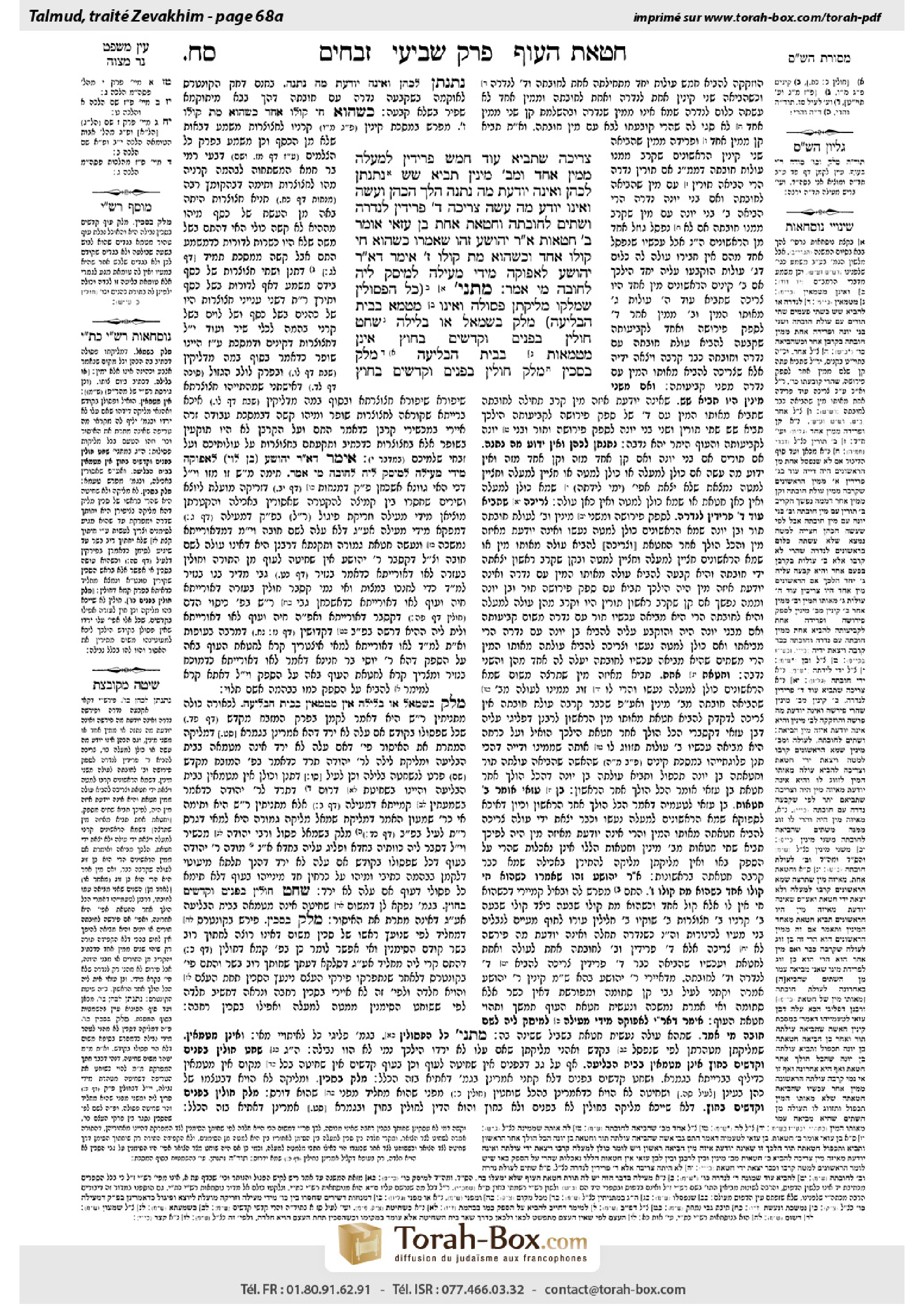
Zevachim 68a: Talmud study for Daf Yomi
Daf Yomi is the daily study of one Talmud folio. Explore 37 tractates with scans, Hebrew text, Sefaria English and AI-generated French translations where annotated.
Passage selection and English or AI-generated French translation are available where the scan has annotations. Daf Study is independent of Torah-Box and Sefaria.
Browse Zevachim · זבחים · All tractatesZevachim 68a text and translations
This page of Zevachim includes the Aramaic text, an English translation and an AI-generated French translation, alongside the scan above.
זבחים ס״ח א · Aramaic and Hebrew text
צְרִיכָה שֶׁתָּבִיא עוֹד חָמֵשׁ פְּרֵידִין לְמַעְלָה.
מִמִּין אֶחָד. וּמִשְּׁנֵי מִינִין – תָּבִיא שֵׁשׁ.
נְתָנָתַן לַכֹּהֵן, וְאֵינָהּ יוֹדַעַת מָה נָתְנָה; הָלַךְ הַכֹּהֵן וְעָשָׂה, וְאֵינוֹ יוֹדֵעַ מָה עָשָׂה – צְרִיכָה אַרְבַּע פְּרִידִין לְנִדְרָהּ, וּשְׁתַּיִם לְחוֹבָתָהּ, וְחַטָּאת אַחַת.
בֶּן עַזַּאי אוֹמֵר: שְׁתֵּי חַטָּאוֹת.
אָמַר רַבִּי יְהוֹשֻׁעַ, זֶהוּ שֶׁאָמְרוּ: כְּשֶׁהוּא חַי – קוֹלוֹ אֶחָד, וּכְשֶׁהוּא מֵת – קוֹלוֹ שִׁבְעָה.
אֵימַר דַּאֲמַר רַבִּי יְהוֹשֻׁעַ – לְאַפּוֹקַהּ מִידֵי מְעִילָה; לְמִיסַּק לֵיהּ לְחוֹבָה מִי אָמַר?!
מַתְנִי׳ כׇּל הַפְּסוּלִין שֶׁמָּלְקוּ – מְלִיקָתָן פְּסוּלָה, וְאֵינָן מְטַמְּאוֹת בְּבֵית הַבְּלִיעָה. מָלַק בִּשְׂמֹאל אוֹ בַּלַּיְלָה, שָׁחַט חוּלִּין בִּפְנִים וְקָדָשִׁים בַּחוּץ – אֵינָן מְטַמְּאוֹת בְּבֵית הַבְּלִיעָה.
מָלַק בְּסַכִּין; מָלַק חוּלִּין בִּפְנִים וְקָדָשִׁים בַּחוּץ;
Zevachim 68a · English translation
she must bring another five birds and sacrifice them all above the red line as burnt offerings. Since her commitment was not satisfied, she has not fulfilled even part of her vow. She must therefore bring two burnt offerings of each species to ensure that she fulfills her vow, and she must bring another bird to replace the initial obligatory burnt offering and fulfill her commitment to bring them together.
This is the halakha only if both pairs that she brought were of the same species. But if they were of two different species, and the priest does not remember which he sacrificed first as the obligatory pair, she must bring six, two of each species to ensure that she fulfills her vow, and one more of each species to ensure that she properly replaces the original burnt offering of the obligatory pair and fulfills her commitment.
If the woman specified the species of bird for her vow but then forgot which species she specified, and she gave two pairs of birds to the priest but does not know now what species she gave, or even if she gave him one or two species of birds, and the priest went and sacrificed the birds but does not know now what he sacrificed where, in this case, she must bring seven birds, as follows: Four birds, two of each species, for her vow; and two more birds, one of each species, for her obligatory burnt offering, in case the priest sacrificed a sin offering of a certain species and the burnt offering must now match that species; and one sin offering of either species, in case the priest sacrificed them all as burnt offerings.
Ben Azzai says she must bring two sin offerings, one of each species, as he holds that if the priest sacrificed a bird of a certain species specifically as the obligatory burnt offering, the sin offering must now match that species.
The mishna concludes: Rabbi Yehoshua said that there is a parable that explains this situation: This is what people say about a sheep: When it is alive it makes one sound, and when it is dead it makes seven sounds. Its two horns become trumpets, its two shinbones become flutes, its skin becomes a drumhead, its large intestines become harp strings, and its small intestines become lyre strings. Here too, because of the uncertainty as to what had occurred, the woman must bring seven extra birds. Since Rabbi Yehoshua summarizes the mishna, the mishnayot in this chapter must be in accordance with his opinion. According to Rav Adda bar Ahava’s explanation of Rabbi Yehoshua’s principle, burnt offerings of birds sacrificed as sin offerings become valid sin offerings. Why then, according to these mishnayot, are they disqualified?
The Gemara responds: Rav Adda bar Ahava’s explanation is not at odds with these mishnayot; while it is reasonable to say, i.e., to explain, that Rabbi Yehoshua said that the offering becomes a sin offering insofar as to exclude one who derives benefit from it from liability for misuse of consecrated property, did he say that it becomes a sin offering so expansively as to indicate that it would satisfy the owner’s obligation? In the cases in the mishnayot in Kinnim, all burnt offerings that were sacrificed as sin offerings are not subject to the halakhot of misuse of consecrated property, but the women must nevertheless bring replacement offerings.
MISHNA: With regard to any of those people disqualified from performing the Temple service who pinched the nape of a bird offering, their pinching is not valid, but the offering’s meat does not render one who swallows it ritually impure when it is in the throat, as would the meat of a kosher bird that was not ritually slaughtered. If a priest pinched it with the thumbnail of his left hand, or if he pinched it at night, or if he slaughtered a non-sacred bird inside the Temple courtyard or a sacrificial bird outside the Temple courtyard, in all these cases, although it is prohibited to consume these birds, they do not render one ritually impure when they are in the throat, as the halakhic status of pinching is like that of slaughtering.
If he pinched with a knife and not with his thumbnail; or if he pinched a non-sacred bird inside the Temple courtyard or a sacrificial bird outside the Temple courtyard;
Zevachim 68a · Traduction française (IA)
Elle doit apporter cinq autres oiseaux et les sacrifier tous au-dessus de la ligne rouge comme holocaustes. Puisque son engagement n’a pas été satisfait, elle n’a accompli aucune partie de son vœu. Elle doit donc apporter deux holocaustes de chaque espèce afin de s’assurer d’accomplir son vœu, et apporter un autre oiseau pour remplacer l’holocauste obligatoire initial et honorer son engagement de les apporter ensemble.
Cette halakha ne s’applique que si les deux paires qu’elle a apportées étaient de la même espèce. Mais si elles étaient de deux espèces différentes et que le prêtre ne se souvient pas quelle paire il a sacrifiée en premier comme paire obligatoire, elle doit en apporter six : deux de chaque espèce pour s’assurer d’accomplir son vœu, et un de chaque espèce en plus pour s’assurer de remplacer correctement l’holocauste initial de la paire obligatoire et d’honorer son engagement.
Si la femme a précisé l’espèce d’oiseau qu’elle vouait, mais a ensuite oublié laquelle, et qu’elle a remis deux paires d’oiseaux au prêtre sans savoir désormais de quelle espèce ils étaient ni même s’il s’agissait d’une ou de deux espèces, et que le prêtre est allé sacrifier les oiseaux sans savoir désormais lesquels il a sacrifiés à quel endroit, elle doit, dans ce cas, apporter sept oiseaux, comme suit : quatre oiseaux, deux de chaque espèce, pour son vœu ; deux autres oiseaux, un de chaque espèce, pour son holocauste obligatoire, au cas où le prêtre aurait sacrifié un sacrifice expiatoire d’une certaine espèce et où l’holocauste devrait maintenant être de la même espèce ; et un sacrifice expiatoire de l’une ou l’autre espèce, au cas où le prêtre les aurait tous sacrifiés comme holocaustes.
Ben Azzai dit qu’elle doit apporter deux sacrifices expiatoires, un de chaque espèce, car, selon lui, si le prêtre a sacrifié un oiseau d’une certaine espèce précisément comme holocauste obligatoire, le sacrifice expiatoire doit maintenant être de la même espèce.
La Michna conclut : Rabbi Yehoshua a dit qu’une parabole explique cette situation : voici ce que les gens disent au sujet d’un mouton : vivant, il émet un son ; mort, il en émet sept. Ses deux cornes deviennent des trompettes, ses deux tibias des flûtes, sa peau une membrane de tambour, ses gros intestins des cordes de harpe et ses intestins grêles des cordes de lyre. De même ici, en raison de l’incertitude quant à ce qui s’est produit, la femme doit apporter sept oiseaux supplémentaires. Puisque Rabbi Yehoshua résume la Michna, les michnayot de ce chapitre doivent être conformes à son opinion. Selon l’explication que Rav Adda bar Ahava donne du principe de Rabbi Yehoshua, les holocaustes d’oiseaux sacrifiés comme sacrifices expiatoires deviennent des sacrifices expiatoires valides. Pourquoi donc, selon ces michnayot, sont-ils invalides ?
La Guemara répond : l’explication de Rav Adda bar Ahava n’est pas en contradiction avec ces michnayot. Il est raisonnable de dire, c’est-à-dire d’expliquer, que Rabbi Yehoshua a dit que l’offrande devient un sacrifice expiatoire dans la mesure où celui qui en tire profit échappe à la responsabilité pour détournement d’un bien consacré. Mais a-t-il dit qu’elle devient un sacrifice expiatoire au point de satisfaire à l’obligation du propriétaire ? Dans les cas des michnayot de Kinnim, les holocaustes sacrifiés comme sacrifices expiatoires ne sont pas soumis aux halakhot du détournement d’un bien consacré, mais les femmes doivent néanmoins apporter des offrandes de remplacement.
MICHNA : Si l’une des personnes inaptes à accomplir le service au Temple a sectionné la nuque d’un oiseau offert en sacrifice, son sectionnement n’est pas valide, mais la chair de l’offrande ne rend pas rituellement impur celui qui l’avale lorsqu’elle se trouve dans sa gorge, contrairement à la chair d’un oiseau cachère qui n’a pas été abattu rituellement. Si un prêtre l’a sectionnée avec l’ongle du pouce de sa main gauche, ou s’il l’a sectionnée la nuit, ou s’il a abattu un oiseau non consacré dans la cour du Temple ou un oiseau sacrificiel hors de la cour du Temple, dans tous ces cas, bien qu’il soit interdit de consommer ces oiseaux, ils ne rendent pas rituellement impur celui qui les a dans la gorge, car le statut halakhique du sectionnement est semblable à celui de l’abattage rituel.
S’il a sectionné la nuque avec un couteau et non avec l’ongle du pouce ; ou s’il a sectionné la nuque d’un oiseau non consacré dans la cour du Temple ou celle d’un oiseau sacrificiel hors de la cour du Temple ;
Traduction française générée par IA à partir de l’édition anglaise de Sefaria. Vérifie toujours un passage avec le texte source.
Text from Sefaria: William Davidson Edition - Vocalized Aramaic (CC BY NC); William Davidson Edition - English (CC BY NC).