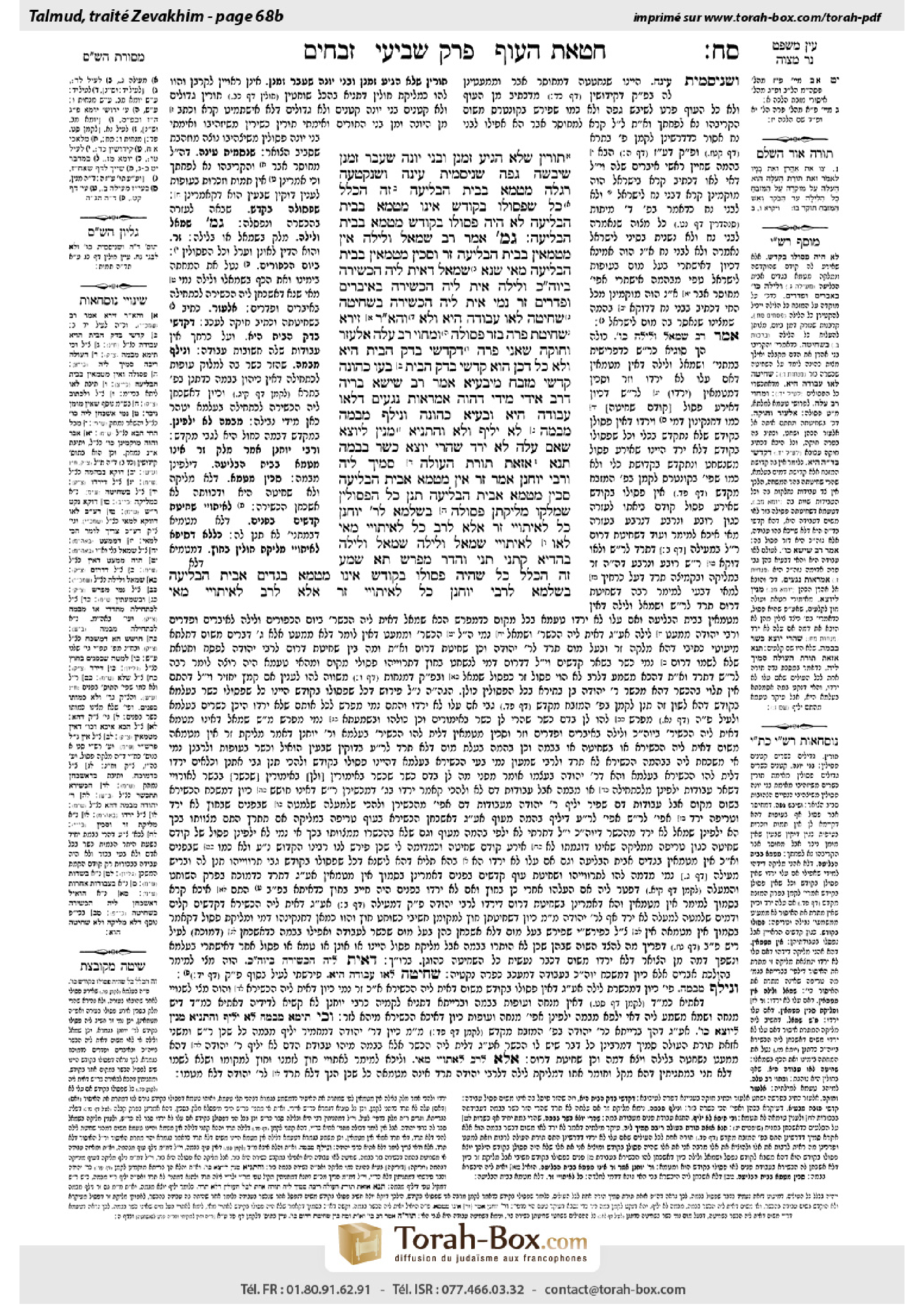
Zevachim 68b: Talmud study for Daf Yomi
Daf Yomi is the daily study of one Talmud folio. Explore 37 tractates with scans, Hebrew text, Sefaria English and AI-generated French translations where annotated.
Passage selection and English or AI-generated French translation are available where the scan has annotations. Daf Study is independent of Torah-Box and Sefaria.
Browse Zevachim · זבחים · All tractatesZevachim 68b text and translations
This page of Zevachim includes the Aramaic text, an English translation and an AI-generated French translation, alongside the scan above.
זבחים ס״ח ב · Aramaic and Hebrew text
תּוֹרִין שֶׁלֹּא הִגִּיעַ זְמַנָּן, וּבְנֵי יוֹנָה שֶׁעָבַר זְמַנָּן; שֶׁיָּבְשָׁה גַּפָּהּ, שֶׁנִּסְמֵית עֵינָהּ וְשֶׁנִּקְטְעָה רַגְלָהּ – מְטַמֵּא בְּבֵית הַבְּלִיעָה.
זֶה הַכְּלָל: כֹּל שֶׁפְּסוּלוֹ בַּקּוֹדֶשׁ – אֵינוֹ מְטַמֵּא בְּבֵית הַבְּלִיעָה; לֹא הָיָה פְּסוּלוֹ בַּקּוֹדֶשׁ – מְטַמֵּא בְּבֵית הַבְּלִיעָה.
גְּמָ׳ אָמַר רַב: שְׂמֹאל וְלַיְלָה – אֵין מְטַמְּאִין בְּבֵית הַבְּלִיעָה, זָר וְסַכִּין – מְטַמְּאִין בְּבֵית הַבְּלִיעָה.
מַאי שְׁנָא שְׂמֹאל – דְּאִית לֵיהּ הֶכְשֵׁירָה בְּיוֹם הַכִּפּוּרִים, וְלַיְלָה – אִית לֵיהּ הֶכְשֵׁירָה בְּאֵיבָרִים וּפְדָרִים; זָר נָמֵי – אִית לֵיהּ הֶכְשֵׁירָה בִּשְׁחִיטָה! שְׁחִיטָה לָאו עֲבוֹדָה הִיא.
וְלָא?! וְהָא אָמַר רַבִּי זֵירָא: שְׁחִיטַת פָּרָה בְּזָר – פְּסוּלָה; וּמַחְוֵי רַב עֲלַהּ: אֶלְעָזָר וְ״חוּקָּה״!
שָׁאנֵי פָּרָה, דְּקׇדְשֵׁי בֶּדֶק הַבַּיִת הִיא.
וְלָא כֹּל דְּכֵן הוּא: קׇדְשֵׁי בֶּדֶק הַבַּיִת בָּעוּ כְּהוּנָּה, קׇדְשֵׁי מִזְבֵּחַ מִיבַּעְיָא?!
אָמַר רַב שִׁישָׁא בְּרֵיהּ דְּרַב אִידִי: מִידֵּי דְּהָוֵה אַמַּרְאוֹת נְגָעִים – דְּלָאו עֲבוֹדָה הִיא, וּבָעֲיָא כְּהוּנָּה.
וְנֵילַף מִבָּמָה!
מִבָּמָה לָא יָלֵיף.
וְלָא?! וְהָתַנְיָא: מִנַּיִן לַיּוֹצֵא שֶׁאִם עָלָה לֹא יֵרֵד – שֶׁהֲרֵי יוֹצֵא כָּשֵׁר בְּבָמָה.
תָּנָא אַ״זֹּאת תּוֹרַת הָעוֹלָה״ סְמִיךְ לֵיהּ.
וְרַבִּי יוֹחָנָן אָמַר: זָר אֵין מְטַמֵּא אַבֵּית הַבְּלִיעָה, סַכִּין מְטַמֵּא אַבֵּית הַבְּלִיעָה.
תְּנַן: כׇּל הַפְּסוּלִין שֶׁמָּלְקוּ – מְלִיקָתָן פְּסוּלָה. בִּשְׁלָמָא לְרַבִּי יוֹחָנָן, ״כֹּל״ – לְאֵיתוֹיֵי זָר. אֶלָּא לְרַב, ״כׇּל״ – לְאֵיתוֹיֵי מַאי?
(לָאו) לְאֵיתוֹיֵי שְׂמֹאל וְלַיְלָה. שְׂמֹאל וְלַיְלָה בְּהֶדְיָא קָתָנֵי! תָּנֵי וַהֲדַר מְפָרֵשׁ.
תָּא שְׁמַע: זֶה הַכְּלָל – כֹּל שֶׁהָיָה פְּסוּלוֹ בַּקּוֹדֶשׁ, אֵינוֹ מְטַמֵּא בְּגָדִים אַבֵּית הַבְּלִיעָה. בִּשְׁלָמָא לְרַבִּי יוֹחָנָן, ״כֹּל״ לְאֵיתוֹיֵי זָר. אֶלָּא לְרַב, לְאֵיתוֹיֵי מַאי?
Zevachim 68b · English translation
or if he pinched doves whose time of fitness for sacrifice has not yet arrived, as they are too young to be sacrificed; or if he pinched pigeons whose time of fitness has passed, as they are too old; or if he pinched the nape of a fledgling whose wing was withered, or whose eye was blinded, or whose leg was severed; in all these cases, although the bird’s nape was pinched, it renders one who swallows it ritually impure when it is in the throat.
This is the principle: The meat of any bird that was initially fit for sacrifice and whose disqualification occurred in the course of the service in the sacred Temple courtyard does not render one who swallows it ritually impure when it is in the throat. The meat of any bird whose disqualification did not occur in the sacred area, but rather was disqualified before the service began, renders one ritually impure when it is in the throat.
GEMARA: Rav says: Pinching with the thumbnail of the left hand and pinching at night do not cause the offering’s meat to render one who swallows it ritually impure when it is in the throat as would the carcass of an unslaughtered bird; but pinching by a non-priest and pinching, i.e., cutting from the nape of the neck, with a knife rather than the fingernail do cause the meat to render one ritually impure when it is in the throat.
The Gemara challenges: What is different about the first two cases that prevents the bird from assuming the status of a carcass? Temple service with the left hand has an instance of validity during the service on Yom Kippur, when the High Priest enters the Holy of Holies holding the spoon of incense in his left hand. And Temple service at night has an instance of validity in the burning of limbs and fats of offerings on the altar, which may be burned throughout the night. But a non-priest also has an instance of validity in the slaughter of animal offerings. Why then does Rav rule that pinching by a non-priest renders the bird a carcass? The Gemara answers: Slaughter is not considered a full-fledged sacrificial rite, and therefore it cannot be compared to pinching.
The Gemara asks: And is it not a full-fledged rite? But doesn’t Rabbi Zeira say that the slaughter of a red heifer by a non-priest is not valid, which indicates that it is a full-fledged rite? And Rav showed a source in the Torah for this halakha: The verses concerning the red heifer mention both Elazar the priest as performing the slaughter and the word “statute,” which is mentioned in the verse: “This is the statute of the law” (Numbers 19:2), teaching that Elazar’s involvement was halakhically required.
The Gemara answers: The red heifer is different, as it has the halakhic status of an item consecrated for Temple maintenance rather than for sacrifice on the altar. Therefore, its slaughter cannot teach the halakha concerning an actual offering.
The Gemara asks: But can it not be inferred a fortiori that slaughter is a sacrificial rite? If animals that have the status of items consecrated for Temple maintenance, which are of lesser sanctity, require slaughter by the priesthood, is it necessary to say that the slaughter of animals consecrated for sacrifice on the altar, which are of greater sanctity, is a sacrificial rite that should require a priest? Apparently, the fact that non-priests may slaughter offerings proves that certain sacrificial rites apply to them.
Rav Sheisha, son of Rav Idi, said: The slaughter of a red heifer does not constitute Temple service at all, and therefore it cannot be compared to the slaughter of an offering. The halakha is just as it is with regard to the examination of the shades of leprous marks, which does not constitute Temple service but requires a declaration of purity or impurity by the priesthood.
The Gemara asks: But let us derive from the halakha of a private altar, which was a valid medium for sacrificing offerings before the Temple was built, where non-priests were permitted to pinch the napes of bird offerings, that there is a circumstance in which pinching by non-priests is valid. Why then does the bird assume the status of a carcass when the pinching is performed by a non-priest?
The Gemara answers: One cannot derive the halakhot of the Temple service from the halakhot of a private altar, which was considered non-sacred by comparison.
The Gemara asks: And can one not derive the halakhot of the Temple service from the halakhot of a private altar? But isn’t it taught in a baraita: From where is it derived with regard to an item, e.g., the limbs of an offering, which emerged from the Temple courtyard and was thereby rendered unfit for sacrifice upon the altar, that if it nevertheless ascended upon the altar it shall not descend? It is derived from the fact that an item that emerged is valid for sacrifice on a private altar. This indicates that one can learn from the halakhot of a private altar with regard to the Temple service.
The Gemara answers: The tanna of that baraita relies on the verse: “This is the law of the burnt offering [ha’ola]” (Leviticus 6:2), from which it is derived that any item that ascends [ola] upon the altar shall not descend from it, even if it was disqualified. In other words, the verse is the actual source for the halakha of the baraita, whereas the case of a private altar is cited merely in support of this ruling.
Until this point the Gemara has discussed the opinion of Rav, who holds that the pinching of a non-priest renders the bird a carcass with regard to ritual impurity. But Rabbi Yoḥanan says: If a non-priest pinched the nape of a bird offering, the meat does not render one who swallows it ritually impure when it is in the throat; but if a priest pinched it, i.e., cut it from the nape of the neck, with a knife, the meat renders one ritually impure when it is in the throat.
The Gemara brings proof for the opinion of Rabbi Yoḥanan from that which we learned in the mishna: If any of those disqualified for Temple service pinched the nape of a bird offering, their pinching is not valid, but the meat does not render one who swallows it ritually impure when it is in the throat. Granted, according to Rabbi Yoḥanan, the word: Any, is written to add that even the pinching of a non-priest does not render the bird a carcass. But according to Rav, who holds that it does render the bird a carcass, what is added by the word: Any?
The Gemara answers: It is written to add pinching with the left hand or pinching at night. The Gemara challenges: The word: Any, is unnecessary with regard to teaching the cases of pinching with the left hand and pinching at night, as they are taught in the mishna explicitly. The Gemara answers: According to Rav, the word: Any, is not meant to add a specific case. Rather the mishna teaches the principle and then explains using specific examples.
The Gemara suggests: Come and hear proof from the continuation of the mishna: This is the principle: The meat of any bird whose disqualification occurred during the course of the service in the sacred Temple courtyard does not render the garments of one who swallows it ritually impure when the meat is in the throat. Granted, according to Rabbi Yoḥanan, the word: Any, is written to add that even the pinching of a non-priest does not render the bird a carcass. But according to Rav, who holds that it does render the bird a carcass, what is added by the word: Any?
Zevachim 68b · Traduction française (IA)
ou s’il a pincé des tourterelles dont le moment d’aptitude au sacrifice n’était pas encore venu, car elles étaient trop jeunes pour être sacrifiées ; ou s’il a pincé des pigeons dont la période d’aptitude était passée, car ils étaient trop âgés ; ou s’il a pincé la nuque d’un oisillon dont l’aile était desséchée, dont l’œil était aveugle ou dont la patte avait été sectionnée ; dans tous ces cas, bien que la nuque de l’oiseau ait été pincée, celui qui l’avale devient rituellement impur lorsque la chair se trouve dans sa gorge.
Voici le principe : la chair de tout oiseau qui était initialement apte au sacrifice et dont l’inaptitude est survenue au cours du service dans la cour sacrée du Temple ne rend pas rituellement impur celui qui l’avale lorsque la chair se trouve dans sa gorge. La chair de tout oiseau dont l’inaptitude n’est pas survenue dans le domaine sacré, mais qui était déjà inapte avant le début du service, rend rituellement impur celui qui l’avale lorsque la chair se trouve dans sa gorge.
GUEMARA : Rav dit : le pincement avec l’ongle du pouce de la main gauche et le pincement effectué la nuit n’ont pas pour effet que la chair de l’offrande rende rituellement impur celui qui l’avale lorsque la chair se trouve dans sa gorge, comme le ferait la carcasse d’un oiseau non abattu rituellement. En revanche, le pincement effectué par un non-prêtre et le pincement, c’est-à-dire la coupure de la nuque avec un couteau plutôt qu’avec l’ongle, rendent la chair rituellement impure lorsqu’on l’avale et qu’elle se trouve dans la gorge.
La Guemara objecte : En quoi les deux premiers cas diffèrent-ils pour que l’oiseau ne prenne pas le statut de carcasse ? Le service du Temple accompli de la main gauche est valide dans le cas du service de Yom Kippour, lorsque le grand prêtre entre dans le Saint des Saints en tenant la cuillère à encens de la main gauche. Le service du Temple accompli la nuit est également valide dans le cas de la combustion sur l’autel des membres et des graisses des offrandes, qui peut avoir lieu toute la nuit. Mais il existe aussi un cas où un non-prêtre peut intervenir : l’abattage rituel des offrandes animales. Pourquoi Rav statue-t-il donc que le pincement effectué par un non-prêtre confère à l’oiseau le statut de carcasse ? La Guemara répond : l’abattage rituel n’est pas considéré comme un rite sacrificiel à part entière et ne peut donc pas être comparé au pincement.
La Guemara demande : N’est-ce pourtant pas un rite à part entière ? Rabbi Zeira ne dit-il pas que l’abattage de la vache rousse par un non-prêtre n’est pas valide, ce qui indique qu’il s’agit d’un rite à part entière ? Rav a également tiré de la Torah la source de cette halakha : les versets concernant la vache rousse mentionnent Éléazar le prêtre comme celui qui procède à l’abattage, ainsi que le mot « statut », qui figure dans le verset : « Ceci est le statut de la loi » (Nombres 19, 2), enseignant que la participation d’Éléazar était requise selon la halakha.
La Guemara répond : le cas de la vache rousse est différent, car elle a le statut d’un bien consacré à l’entretien du Temple, et non d’un sacrifice destiné à l’autel. Son abattage ne peut donc pas enseigner la halakha concernant une véritable offrande.
La Guemara demande : Ne peut-on pas déduire a fortiori que l’abattage rituel est un rite sacrificiel ? Si les animaux consacrés à l’entretien du Temple, qui ont une sainteté moindre, doivent être abattus par les prêtres, à plus forte raison l’abattage des animaux consacrés au sacrifice sur l’autel, qui ont une sainteté supérieure, constitue-t-il un rite sacrificiel qui devrait requérir un prêtre. Apparemment, le fait que des non-prêtres puissent abattre rituellement des offrandes prouve que certains rites sacrificiels peuvent être accomplis par eux.
Rav Shésha, fils de Rav Idi, dit : l’abattage de la vache rousse ne constitue pas du tout un service du Temple et ne peut donc pas être comparé à l’abattage rituel d’une offrande. Il en va de même de l’examen des nuances des marques de lèpre : il ne constitue pas un service du Temple, mais exige des prêtres qu’ils déclarent la personne pure ou impure.
La Guemara demande : Ne peut-on pas déduire de la halakha de l’autel privé, qui permettait de sacrifier valablement des offrandes avant la construction du Temple et où les non-prêtres étaient autorisés à pincer la nuque des offrandes d’oiseaux, qu’il existe une situation où le pincement effectué par des non-prêtres est valide ? Pourquoi l’oiseau prend-il donc le statut de carcasse lorsque le pincement est effectué par un non-prêtre ?
La Guemara répond : on ne peut pas déduire les halakhot du service du Temple de celles de l’autel privé, qui était considéré comme profane par comparaison.
La Guemara demande : Ne peut-on donc pas déduire les halakhot du service du Temple de celles de l’autel privé ? N’est-il pas enseigné dans une baraïta : d’où déduit-on que si un élément, par exemple les membres d’une offrande, a quitté la cour du Temple et est ainsi devenu impropre au sacrifice sur l’autel, il ne doit pas en être retiré s’il y est néanmoins monté ? On le déduit du fait qu’un élément qui a quitté la cour peut être sacrifié sur un autel privé. Cela indique que l’on peut déduire les halakhot du service du Temple de celles de l’autel privé.
La Guemara répond : le tanna de cette baraïta s’appuie sur le verset : « Voici la loi de l’holocauste [ha’ola] » (Lévitique 6, 2), dont on déduit que tout élément qui monte [ola] sur l’autel ne doit pas en descendre, même s’il est devenu impropre. Autrement dit, le verset constitue la source véritable de la halakha de la baraïta, tandis que le cas de l’autel privé n’est cité qu’à l’appui de cette décision.
Jusqu’ici, la Guemara a discuté l’opinion de Rav, selon laquelle le pincement effectué par un non-prêtre confère à l’oiseau le statut de carcasse en matière d’impureté rituelle. Mais Rabbi Yoḥanan dit : si un non-prêtre a pincé la nuque d’une offrande d’oiseau, la chair ne rend pas rituellement impur celui qui l’avale lorsqu’elle se trouve dans sa gorge ; mais si un prêtre l’a coupée à la nuque avec un couteau, la chair rend rituellement impur celui qui l’avale lorsqu’elle se trouve dans sa gorge.
La Guemara apporte une preuve à l’opinion de Rabbi Yoḥanan à partir de ce que nous avons appris dans la Michna : si l’une des personnes inaptes au service du Temple a pincé la nuque d’une offrande d’oiseau, son pincement n’est pas valide, mais la chair ne rend pas rituellement impur celui qui l’avale lorsqu’elle se trouve dans sa gorge. Selon Rabbi Yoḥanan, il est compréhensible que le mot « tout » soit employé pour inclure le cas où même le pincement effectué par un non-prêtre ne confère pas à l’oiseau le statut de carcasse. Mais selon Rav, qui estime qu’il lui confère ce statut, qu’ajoute le mot « tout » ?
La Guemara répond : il est employé pour inclure le pincement de la main gauche ou le pincement effectué la nuit. La Guemara objecte : le mot « tout » est inutile pour enseigner les cas du pincement de la main gauche et du pincement effectué la nuit, puisqu’ils sont explicitement mentionnés dans la Michna. La Guemara répond : selon Rav, le mot « tout » n’a pas pour fonction d’ajouter un cas particulier. La Michna énonce plutôt le principe, puis l’explique au moyen d’exemples précis.
La Guemara propose : examinons la suite de la Michna, qui peut fournir une preuve : « Voici le principe : la chair de tout oiseau dont l’inaptitude est survenue au cours du service dans la cour sacrée du Temple ne rend pas rituellement impurs les vêtements de celui qui l’avale lorsque la chair se trouve dans sa gorge. » Selon Rabbi Yoḥanan, il est compréhensible que le mot « tout » soit employé pour inclure le cas où même le pincement effectué par un non-prêtre ne confère pas à l’oiseau le statut de carcasse. Mais selon Rav, qui estime qu’il lui confère ce statut, qu’ajoute le mot « tout » ?
Traduction française générée par IA à partir de l’édition anglaise de Sefaria. Vérifie toujours un passage avec le texte source.
Text from Sefaria: William Davidson Edition - Vocalized Aramaic (CC BY NC); William Davidson Edition - English (CC BY NC).