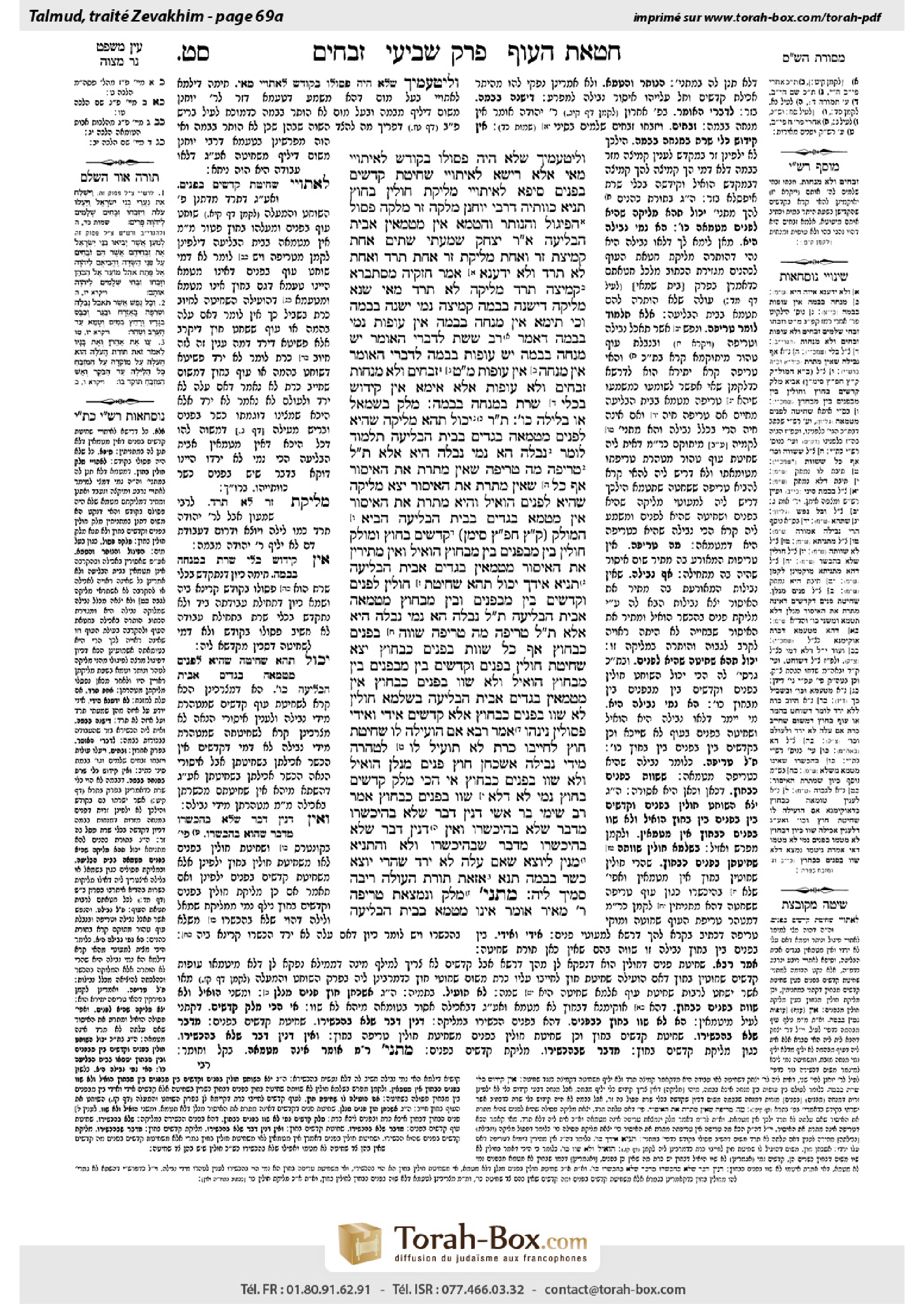
Zevachim 69a: Talmud study for Daf Yomi
Daf Yomi is the daily study of one Talmud folio. Explore 37 tractates with scans, Hebrew text, Sefaria English and AI-generated French translations where annotated.
Passage selection and English or AI-generated French translation are available where the scan has annotations. Daf Study is independent of Torah-Box and Sefaria.
Browse Zevachim · זבחים · All tractatesZevachim 69a text and translations
This page of Zevachim includes the Aramaic text, an English translation and an AI-generated French translation, alongside the scan above.
זבחים ס״ט א · Aramaic and Hebrew text
וְלִיטַעְמָיךְ, ״שֶׁלֹּא הָיָה פְּסוּלוֹ בַּקּוֹדֶשׁ״ לְאֵיתוֹיֵי מַאי?
אֶלָּא רֵישָׁא לְאֵיתוֹיֵי שְׁחִיטַת קָדָשִׁים בִּפְנִים, סֵיפָא לְאֵיתוֹיֵי מְלִיקַת חוּלִּין בַּחוּץ.
תַּנְיָא כְּוָותֵיהּ דְּרַבִּי יוֹחָנָן: מְלָקָהּ זָר, מְלָקָהּ פָּסוּל, הַפִּיגּוּל וְהַנּוֹתָר וְהַטָּמֵא – אֵין מְטַמְּאִין אַבֵּית הַבְּלִיעָה.
אָמַר רַבִּי יִצְחָק: שָׁמַעְתִּי שְׁתַּיִם – אַחַת קְמִיצַת זָר, וְאַחַת מְלִיקַת זָר; אַחַת תֵּרֵד, וְאַחַת לֹא תֵּרֵד; וְלָא יָדַעְנָא. אָמַר חִזְקִיָּה, מִסְתַּבְּרָא: קְמִיצָה תֵּרֵד, מְלִיקָה לֹא תֵּרֵד.
מַאי שְׁנָא מְלִיקָה – דְּיֶשְׁנָהּ בְּבָמָה, קְמִיצָה נָמֵי – יֶשְׁנָהּ בְּבָמָה!
וְכִי תֵימָא אֵין מִנְחָה בְּבָמָה, אֵין עוֹפוֹת נָמֵי בְּבָמָה!
דְּאָמַר רַב שֵׁשֶׁת: לְדִבְרֵי הָאוֹמֵר יֵשׁ מִנְחָה בְּבָמָה – יֵשׁ עוֹפוֹת בְּבָמָה. לְדִבְרֵי הָאוֹמֵר אֵין מִנְחָה – אֵין עוֹפוֹת. מַאי טַעְמָא? ״זְבָחִים״ וְלֹא מְנָחוֹת, ״זְבָחִים״ וְלֹא עוֹפוֹת.
אֶלָּא אֵימָא: אֵין קִידּוּשׁ בִּכְלִי שָׁרֵת בְּמִנְחָה בְּבָמָה.
מָלַק בִּשְׂמֹאל אוֹ בַּלַּיְלָה כּוּ׳. תָּנוּ רַבָּנַן: יָכוֹל תְּהֵא מְלִיקָה שֶׁהִיא לִפְנִים, מְטַמְּאָה בְּגָדִים בְּבֵית הַבְּלִיעָה? תַּלְמוּד לוֹמַר: ״נְבֵלָה״.
הָא נָמֵי נְבֵלָה הִיא! אֶלָּא תַּלְמוּד לוֹמַר: ״טְרֵיפָה״; מָה טְרֵיפָה – שֶׁאֵין מַתֶּרֶת אֶת הָאִיסּוּר, אַף כֹּל – שֶׁאֵין מַתֶּרֶת אֶת הָאִיסּוּר.
(יצא) [יָצָאת] מְלִיקָה שֶׁהִיא לִפְנִים – הוֹאִיל וְהִיא מַתֶּרֶת אֶת הָאִיסּוּר, אֵין מְטַמֵּא בְּגָדִים בְּבֵית הַבְּלִיעָה.
הֵבִיא הַמּוֹלֵק (קֵ״ץ חָפֵ״ץ – סִימָן) קָדָשִׁים בַּחוּץ, וּמוֹלֵק חוּלִּין בֵּין מִבִּפְנִים בֵּין מִבַּחוּץ – הוֹאִיל וְאֵין מַתִּירִין אֶת הָאִיסּוּר, מְטַמְּאִין בְּגָדִים אַבֵּית הַבְּלִיעָה.
תַּנְיָא אִידַּךְ: יָכוֹל תְּהֵא שְׁחִיטַת חוּלִּין לִפְנִים, וְקָדָשִׁים בֵּין מִבִּפְנִים וּבֵין מִבַּחוּץ, מְטַמְּאָה אַבֵּית הַבְּלִיעָה? תַּלְמוּד לוֹמַר: ״נְבֵלָה״.
הָא נָמֵי נְבֵלָה הִיא! אֶלָּא תַּלְמוּד לוֹמַר: ״טְרֵיפָה״; מָה טְרֵיפָה – שָׁוָוה בִּפְנִים כְּבַחוּץ, אַף כֹּל – שָׁווֹת בִּפְנִים כְּבַחוּץ.
יָצָא שְׁחִיטַת חוּלִּין בִּפְנִים, וְקָדָשִׁים בֵּין מִבִּפְנִים בֵּין מִבַּחוּץ – הוֹאִיל וְלֹא שָׁווּ בִּפְנִים כְּבַחוּץ, אֵין מְטַמְּאִין בְּגָדִים אַבֵּית הַבְּלִיעָה.
בִּשְׁלָמָא חוּלִּין – לֹא שָׁווּ בִּפְנִים כְּבַחוּץ; אֶלָּא קָדָשִׁים – אִידֵּי וְאִידֵּי פְּסוּלִין נִינְהוּ!
אָמַר רָבָא: אִם הוֹעִילָה לוֹ שְׁחִיטַת חוּץ לְחַיְּיבוֹ כָּרֵת, לֹא תּוֹעִיל לוֹ לְטַהֲרָהּ מִידֵי נְבֵילָה?!
אַשְׁכְּחַן חוּץ, פָּנִים מְנָלַן? הוֹאִיל וְלֹא שָׁווּ בִּפְנִים כְּבַחוּץ.
אִי הָכִי, מָלַק קָדָשִׁים בַּחוּץ נָמֵי לָא – דְּלָא שָׁווּ בִּפְנִים כְּבַחוּץ!
אָמַר רַב שִׁימִי בַּר אָשֵׁי: דָּנִין דָּבָר שֶׁלֹּא בְּהֶיכְשֵׁרוֹ מִדָּבָר שֶׁלֹּא בְּהֶיכְשֵׁרוֹ; וְאֵין דָּנִין דָּבָר שֶׁלֹּא בְּהֶיכְשֵׁרוֹ מִדָּבָר שֶׁבְּהֶיכְשֵׁרוֹ.
וְלָא?! וְהָתַנְיָא: מִנַּיִן לְיוֹצֵא – שֶׁאִם עָלָה לֹא יֵרֵד? שֶׁהֲרֵי יוֹצֵא כָּשֵׁר בְּבָמָה.
תַּנָּא אַ״זֹּאת תּוֹרַת הָעוֹלָה״ רִיבָּה סְמִיךְ לֵיהּ.
מַתְנִי׳ מָלַק וְנִמְצֵאת טְרֵיפָה – רַבִּי מֵאִיר אוֹמֵר: אֵינָהּ מְטַמֵּא בְּבֵית הַבְּלִיעָה,
Zevachim 69a · English translation
The Gemara responds: And according to your reasoning, one could infer the opposite from the following clause: The meat of any bird whose disqualification did not occur in the sacred Temple courtyard transmits ritual impurity to one who swallows it. Here, according to Rabbi Yoḥanan, what disqualification is added if not pinching by a non-priest?
Rather, both clauses add other disqualifications not mentioned in the mishna. The former clause, concerning an offering that was disqualified in the Temple courtyard, is written to add that the slaughter of sacrificial birds inside the Temple courtyard does not render them carcasses. The latter clause, with regard to an offering disqualified outside the Temple courtyard, is written to add that the pinching of non-sacred birds outside the Temple courtyard does render them carcasses.
It is taught in a baraita in accordance with the opinion of Rabbi Yoḥanan: In a case where a non-priest pinched a bird offering, or a priest disqualified from the Temple service pinched it, or it became piggul, i.e., it was sacrificed with the intent to consume it beyond its designated time, or it became notar, i.e., its meat remained uneaten beyond its designated time, or it became ritually impure, in all these cases, even though the meat of these birds may not be consumed, they still do not render one who swallows them ritually impure when they are in the throat.
Rabbi Yitzḥak says: I heard [shamati] two halakhot, one concerning the removal of a handful from a meal offering by a non-priest for burning on the altar, and one concerning the pinching of a bird offering by a non-priest. Although both offerings are disqualified, I heard that one shall descend from the altar if it ascended, and one shall not descend; but I do not know which halakha applies to which case. Ḥizkiyya said: It stands to reason that in the case of the removal of the handful the offering shall descend and in the case of pinching the offering shall not descend.
The Gemara asks: What is different about pinching by a non-priest that would allow the bird to be sacrificed if it ascended onto the altar? If the difference is that for a non-priest to do so would be valid on a private altar, where all sacrificial rites were performed by non-priests, this does not constitute a difference, as the removal of the handful by a non-priest would also be valid on a private altar.
And if you would say that no handfuls were removed on private altars because no meal offering was sacrificed on a private altar, as meal offerings were brought before the construction of the Temple only on the altar in the Tabernacle, you must also say that there was no pinching either, as according to this opinion no birds were sacrificed on a private altar either.
As Rav Sheshet says: According to the statement of the one who says that a meal offering was sacrificed on a private altar, birds were sacrificed on a private altar. According to the statement of the one who says that no meal offering was sacrificed on a private altar, no birds were sacrificed there either. What is the reason for this? This is because the Torah, in describing the offerings brought at Mount Sinai, before the Tabernacle was built, mentions slaughtered offerings (see Exodus 24:5) but not meal offerings; it mentions slaughtered offerings, i.e., animal offerings, but not birds.
Rather, say that even though both pinching the nape of a bird offering and removing the handful of a meal offering by a non-priest are valid on a private altar, the halakhot of meal offerings sacrificed on a private altar cannot be compared to those of meal offerings sacrificed in the Temple. This is because in the case of a meal offering sacrificed on a private altar, there is no consecration in a service vessel of the handful removed from it. By contrast, in the Temple, the handful must always be consecrated in a service vessel.
§ The mishna rules that if a priest pinched with his left hand, or if he pinched at night, the offering does not render one ritually impure when in his throat. With regard to this issue the Sages taught: One might have thought that invalid pinching that occurs inside the Temple courtyard, such as pinching with the left hand or pinching at night, would cause the offering to render the garments of one who swallows it ritually impure when it is in the throat. Therefore the verse states: “Every soul that eats a carcass…shall be impure until the evening” (Leviticus 17:15). Bird offerings whose napes were pinched inside the Temple courtyard are not considered carcasses.
The Gemara asks: Isn’t a bird offering whose nape was pinched inside the Temple courtyard also a carcass? Rather, the halakha of the mishna is derived from that which the verse states: “Every soul that eats a carcass or a tereifa…shall be impure until the evening” (Leviticus 17:15). A tereifa is an animal with a wound that will cause it to die within twelve months. It is derived from this verse that just as having the status of a tereifa does not render permitted any forbidden bird, so too, any type of death that does not render permitted any forbidden bird renders the animal a carcass with regard to ritual impurity.
Consequently, invalid pinching that is performed inside the Temple courtyard is excluded, since it renders permitted a forbidden bird, as it is permitted to sacrifice such a disqualified offering if it ascended onto the altar, whereas it was prohibited to sacrifice such a disqualified offering if it was not pinched. The meat of such an offering therefore does not render the garments of one who swallows it ritually impure when it is in the throat.
This principle includes two other cases of invalid pinching, for which the Gemara gives a two-word mnemonic: Ketz, ḥefetz. These words are acronyms for the cases of one who pinches the napes of sacrificial birds outside the Temple courtyard, and one who pinches the napes of non-sacred birds whether inside the Temple courtyard or outside of it. Since these offerings do not render permitted any forbidden bird, as these offerings may not be sacrificed even if brought onto the altar, they render the garments of one who swallows them ritually impure when they are in the throat.
It is taught in another baraita: One might have thought that the slaughter of non-sacred birds inside the Temple courtyard, or the slaughter of sacrificial birds whether inside or outside of it, would cause their meat to render the garments of one who swallows it ritually impure when it is in the throat. Therefore the verse states: “Every soul that eats a carcass…shall be impure until the evening.” Birds that have been slaughtered in this manner are not considered carcasses, and so they do not impart ritual impurity.
The Gemara asks: Isn’t a bird slaughtered in one of these manners also a carcass? Rather, it is derived from that which the verse states: “Every soul that eats a carcass or a tereifa…shall be impure until the evening,” as follows: Just as the status of a tereifa is the same, if the bird is slaughtered inside the Temple courtyard as it is if the bird is slaughtered outside of it, i.e., forbidden, so too all forbidden birds whose status is the same if slaughtered inside the Temple courtyard as it is if they were slaughtered outside of it constitute carcasses.
Consequently, the slaughter of non-sacred birds inside the Temple courtyard, or of sacrificial birds whether inside or outside of it, is excluded, since the status of such birds is not the same if they are slaughtered inside the Temple courtyard as if they are slaughtered outside of it. The meat of such an offering therefore does not render the garments of one who swallows it ritually impure when it is in the throat.
The Gemara challenges: Granted, the status of non-sacred birds is not the same if slaughtered inside the Temple courtyard as if they are slaughtered outside of it, as if slaughtered inside the Temple courtyard they are forbidden, while if slaughtered outside of it they are permitted. But with regard to sacrificial birds, in both this case and that case, whether slaughtered inside the Temple courtyard or outside of it, they are disqualified.
Rava says: The halakha with regard to slaughtered sacrificial birds outside the Temple should not be derived from the verse at all, but rather by logic. If the slaughter of a sacrificial bird outside the Temple courtyard has sufficient effect on it as proper slaughter to render the one who slaughtered it liable to excision from the World-to-Come [karet], which is the punishment for slaughtering offerings outside the Temple courtyard (see 107a), could it be that it does not have sufficient effect on the bird as proper slaughter to render it ritually pure by preventing it from assuming the status of a carcass?
The Gemara asks: We found a source for the halakha with regard to the slaughter of sacrificial birds outside the Temple courtyard; from where do we derive this halakha with regard to their slaughter inside the Temple courtyard? The Gemara answers that it is derived from the principle articulated above: Since their status is not the same if they are slaughtered inside the Temple courtyard as if they are slaughtered outside of it, as one who slaughters a sacrificial bird outside the Temple courtyard is liable to receive karet, the status of a carcass does not apply.
The Gemara challenges: If so, it follows that if the priest pinched sacrificial birds outside the Temple courtyard, they are also not considered carcasses, as their status is not the same if they are pinched inside the Temple courtyard as if they are pinched outside of it; if they are pinched inside, they are fit offerings, and if they are pinched outside, they are disqualified. This conclusion would contradict the mishna, which rules that sacrificial birds pinched outside the Temple courtyard are considered carcasses, and they render one who eats their meat impure.
Rav Shimi bar Ashi says: One can derive the halakha with regard to an item that is prepared not in its valid manner, i.e., sacrificial birds slaughtered outside the Temple courtyard, from the halakha with regard to another item that is prepared not in its valid manner, i.e., sacrificial birds slaughtered inside it. But one cannot derive the halakha with regard to an item that is prepared not in its valid manner, i.e., sacrificial birds pinched outside the Temple courtyard, from the halakha with regard to an item that is prepared in its valid manner, i.e., those pinched inside it. The cases of a bird pinched outside and a bird pinched inside the Temple courtyard are not subject to comparison, so one cannot derive conclusions from the differences between them.
The Gemara asks: And can one not derive the halakha with regard to disqualified offerings from the halakha with regard to fit offerings? But isn’t it taught in a baraita: From where is it derived with regard to an item that emerged from the Temple courtyard and was thereby disqualified, that if it nevertheless ascended upon the altar it shall not descend? It is derived from the fact that an item that emerged is valid for sacrifice on a private altar, i.e., that disqualification was not applicable to an offering sacrificed on a private altar, as there was no Temple. Here, the baraita derives the halakha with regard to a disqualified offering from the halakha with regard to a fit one.
The Gemara answers: The tanna of that baraita relies on the phrase: “This is the law of the burnt offering [ha’ola]” (Leviticus 6:2), a seemingly superfluous general phrase which is interpreted homiletically to include the halakha that any item that ascends [ola] upon the altar shall not descend from it, even if it was disqualified. The verse is the actual source for the halakha of the baraita, whereas the case of a private altar is cited merely in support of this ruling.
MISHNA: If the priest pinched the nape of the bird’s neck properly and then it was found to be a tereifa, and it was therefore disqualified from being sacrificed and forbidden for consumption by a priest, Rabbi Meir says: An olive-bulk of its meat does not render one who swallows it ritually impure when it is in the throat, as the pinching prevents it from assuming the status of a carcass.
Zevachim 69a · Traduction française (IA)
La Guemara répond : Selon ton raisonnement, on pourrait déduire le contraire de la clause suivante : la viande de tout oiseau dont l’invalidation n’a pas eu lieu dans la cour du Temple transmet l’impureté rituelle à celui qui l’avale. Ici, selon Rabbi Yoḥanan, quelle invalidation est ajoutée, si ce n’est la mélika pratiquée par un non-prêtre ?
En réalité, les deux clauses ajoutent d’autres invalidations qui ne sont pas mentionnées dans la Michna. La première clause, à propos d’une offrande invalidée dans la cour du Temple, vient enseigner que l’abattage d’oiseaux consacrés dans la cour du Temple ne leur confère pas le statut de cadavres. La dernière clause, à propos d’une offrande invalidée hors de la cour du Temple, vient enseigner que la mélika d’oiseaux non consacrés hors de la cour du Temple leur confère le statut de cadavres.
Une baraïta enseigne conformément à l’opinion de Rabbi Yoḥanan : si un non-prêtre a pratiqué la mélika d’un oiseau offert en sacrifice, si un prêtre inapte au service du Temple l’a pratiquée, ou encore si l’offrande est devenue piggul, c’est-à-dire si elle a été sacrifiée avec l’intention d’en consommer la viande après le délai prescrit, si elle est devenue notar, c’est-à-dire si sa viande n’a pas été consommée dans le délai prescrit, ou si elle est devenue rituellement impure, dans tous ces cas, bien que la viande de ces oiseaux ne puisse être consommée, elle ne rend pas rituellement impur celui qui l’avale lorsqu’elle se trouve dans sa gorge.
Rabbi Yitzḥak dit : J’ai entendu [shamati] deux halakhot, l’une concernant le prélèvement d’une poignée d’une offrande de farine par un non-prêtre pour la brûler sur l’autel, l’autre concernant la mélika d’un oiseau offert en sacrifice par un non-prêtre. Bien que les deux offrandes soient invalides, j’ai entendu que l’une doit être retirée de l’autel si elle y est montée, tandis que l’autre ne doit pas en être retirée ; mais j’ignore quelle halakha s’applique à quel cas. Ḥizkiyya dit : Il est logique que, dans le cas du prélèvement de la poignée, l’offrande doive descendre, tandis que, dans le cas de la mélika, elle ne doive pas descendre.
La Guemara demande : Qu’est-ce qui distingue la mélika pratiquée par un non-prêtre, de sorte que l’oiseau puisse être offert en sacrifice s’il est monté sur l’autel ? Si la différence tient au fait qu’un non-prêtre peut accomplir cet acte sur un autel privé, où tous les rites sacrificiels étaient exécutés par des non-prêtres, cela ne constitue pas une différence, car le prélèvement de la poignée par un non-prêtre serait également valable sur un autel privé.
Et si tu dis qu’aucune poignée n’était prélevée sur les autels privés parce qu’aucune offrande de farine n’y était sacrifiée — les offrandes de farine n’ayant été apportées, avant la construction du Temple, que sur l’autel du Tabernacle —, il faut également dire qu’aucune mélika n’y était pratiquée, car, selon cette opinion, aucun oiseau n’était non plus sacrifié sur un autel privé.
Car Rav Sheshet dit : Selon celui qui affirme qu’une offrande de farine était sacrifiée sur un autel privé, des oiseaux y étaient également sacrifiés. Selon celui qui affirme qu’aucune offrande de farine n’y était sacrifiée, aucun oiseau n’y était non plus sacrifié. Pour quelle raison ? Parce que la Torah, lorsqu’elle décrit les offrandes apportées au mont Sinaï avant la construction du Tabernacle, mentionne des sacrifices d’animaux abattus (voir Exode 24:5), mais pas d’offrandes de farine ; elle mentionne des sacrifices d’animaux abattus, mais pas d’oiseaux.
En réalité, même si la mélika d’un oiseau offert en sacrifice et le prélèvement de la poignée d’une offrande de farine par un non-prêtre sont tous deux valables sur un autel privé, on ne peut pas comparer les règles des offrandes de farine sacrifiées sur un autel privé à celles des offrandes de farine sacrifiées dans le Temple. En effet, dans le cas d’une offrande de farine sacrifiée sur un autel privé, la poignée prélevée n’est pas consacrée dans un ustensile de service. Au Temple, en revanche, la poignée doit toujours être consacrée dans un ustensile de service.
§ La Michna enseigne que si un prêtre a pratiqué la mélika de la main gauche, ou s’il l’a pratiquée la nuit, l’offrande ne rend pas impur celui qui l’avale lorsqu’elle se trouve dans sa gorge. À ce sujet, les Sages ont enseigné : On aurait pu penser qu’une mélika invalide pratiquée dans la cour du Temple, par exemple avec la main gauche ou la nuit, ferait que l’offrande rende rituellement impurs les vêtements de celui qui l’avale lorsqu’elle se trouve dans sa gorge. C’est pourquoi le verset dit : « Toute personne qui mange un cadavre […] sera impure jusqu’au soir » (Lévitique 17:15). Les oiseaux offerts en sacrifice dont la nuque a été tranchée par mélika dans la cour du Temple ne sont pas considérés comme des cadavres.
La Guemara demande : Un oiseau offert en sacrifice dont la nuque a été tranchée par mélika dans la cour du Temple n’est-il pas lui aussi un cadavre ? En réalité, la halakha de la Michna se déduit de ce que dit le verset : « Toute personne qui mange un cadavre ou un animal tréfa […] sera impure jusqu’au soir » (Lévitique 17:15). Un animal tréfa est un animal blessé par une plaie qui entraînera sa mort dans les douze mois. On déduit de ce verset que, de même que le statut de tréfa ne rend permis aucun oiseau interdit, de même toute sorte de mise à mort qui ne rend permis aucun oiseau interdit confère à l’animal le statut de cadavre en matière d’impureté rituelle.
Par conséquent, les cas de mélika invalide pratiquée dans la cour du Temple sont exclus, car elle rend permis un oiseau interdit : il est permis de sacrifier une offrande ainsi invalidée si elle est montée sur l’autel, alors qu’il était interdit de sacrifier cette offrande invalidée si sa nuque n’avait pas été tranchée par mélika. La viande d’une telle offrande ne rend donc pas rituellement impurs les vêtements de celui qui l’avale lorsqu’elle se trouve dans sa gorge.
Ce principe comprend deux autres cas de mélika invalide, pour lesquels la Guemara donne un aide-mémoire de deux mots : Ketz, ḥefetz. Ces mots sont des acronymes désignant les cas où l’on tranche par mélika la nuque d’oiseaux consacrés hors de la cour du Temple, et où l’on tranche par mélika la nuque d’oiseaux non consacrés, dans la cour du Temple ou hors de celle-ci. Puisque ces actes ne rendent permis aucun oiseau interdit — car ces offrandes ne peuvent pas être sacrifiées, même si elles sont apportées sur l’autel —, ils rendent rituellement impurs les vêtements de celui qui les avale lorsqu’ils se trouvent dans sa gorge.
Une autre baraïta enseigne : On aurait pu penser que l’abattage d’oiseaux non consacrés dans la cour du Temple, ou l’abattage d’oiseaux consacrés, dans la cour du Temple ou hors de celle-ci, ferait que leur viande rende rituellement impurs les vêtements de celui qui l’avale lorsqu’elle se trouve dans sa gorge. C’est pourquoi le verset dit : « Toute personne qui mange un cadavre […] sera impure jusqu’au soir. » Les oiseaux abattus de cette manière ne sont pas considérés comme des cadavres et ne transmettent donc pas l’impureté rituelle.
La Guemara demande : Un oiseau abattu de l’une de ces manières n’est-il pas lui aussi un cadavre ? En réalité, on déduit la règle de ce que dit le verset : « Toute personne qui mange un cadavre ou un animal tréfa […] sera impure jusqu’au soir », de la manière suivante : de même que le statut d’un animal tréfa est identique que l’oiseau soit abattu dans la cour du Temple ou hors de celle-ci, c’est-à-dire qu’il est interdit, de même tous les oiseaux interdits dont le statut est identique lorsqu’ils sont abattus dans la cour du Temple ou hors de celle-ci constituent des cadavres.
Par conséquent, les cas de l’abattage d’oiseaux non consacrés dans la cour du Temple, ou d’oiseaux consacrés dans la cour du Temple ou hors de celle-ci, sont exclus, car le statut de ces oiseaux n’est pas le même selon qu’ils sont abattus dans la cour du Temple ou hors de celle-ci. La viande d’une telle offrande ne rend donc pas rituellement impurs les vêtements de celui qui l’avale lorsqu’elle se trouve dans sa gorge.
La Guemara objecte : Certes, le statut des oiseaux non consacrés n’est pas le même selon qu’ils sont abattus dans la cour du Temple ou hors de celle-ci, car, abattus dans la cour du Temple, ils sont interdits, tandis qu’abattus hors de celle-ci, ils sont permis. Mais, en ce qui concerne les oiseaux consacrés, dans les deux cas — qu’ils soient abattus dans la cour du Temple ou hors de celle-ci —, ils sont invalides.
Rava dit : La règle concernant les oiseaux consacrés abattus hors du Temple ne doit pas du tout être déduite du verset, mais plutôt de la logique. Si l’abattage d’un oiseau consacré hors de la cour du Temple a un effet suffisant pour être considéré comme un abattage valide et rendre celui qui l’a pratiqué passible d’excision du monde à venir [karet] — peine encourue pour l’abattage d’offrandes hors de la cour du Temple (voir 107a) —, se peut-il qu’il n’ait pas un effet suffisant sur l’oiseau pour être considéré comme un abattage valide et le rendre rituellement pur en l’empêchant de prendre le statut de cadavre ?
La Guemara demande : Nous avons trouvé une source pour la règle concernant l’abattage d’oiseaux consacrés hors de la cour du Temple ; d’où déduit-on cette règle pour leur abattage dans la cour du Temple ? La Guemara répond qu’on la déduit du principe énoncé précédemment : puisque leur statut n’est pas le même lorsqu’ils sont abattus dans la cour du Temple ou hors de celle-ci — car celui qui abat un oiseau consacré hors de la cour du Temple est passible de karet —, le statut de cadavre ne s’applique pas.
La Guemara objecte : Si c’est ainsi, il s’ensuit que si le prêtre a pratiqué la mélika d’oiseaux consacrés hors de la cour du Temple, ceux-ci ne sont pas non plus considérés comme des cadavres, puisque leur statut n’est pas le même selon que la mélika est pratiquée dans la cour du Temple ou hors de celle-ci : pratiquée à l’intérieur, elle donne des offrandes aptes, et pratiquée à l’extérieur, des offrandes invalides. Cette conclusion contredirait la Michna, qui enseigne que les oiseaux consacrés dont la nuque a été tranchée par mélika hors de la cour du Temple sont considérés comme des cadavres et que celui qui mange leur viande devient impur.
Rav Shimi bar Ashi dit : On peut déduire la règle concernant un élément accompli de manière invalide — c’est-à-dire des oiseaux consacrés abattus hors de la cour du Temple — de la règle concernant un autre élément accompli de manière invalide — c’est-à-dire des oiseaux consacrés abattus dans la cour du Temple. Mais on ne peut pas déduire la règle concernant un élément accompli de manière invalide — c’est-à-dire des oiseaux consacrés dont la nuque a été tranchée par mélika hors de la cour du Temple — de la règle concernant un élément accompli de manière valide — c’est-à-dire ceux dont la nuque a été tranchée par mélika dans la cour du Temple. Les cas de l’oiseau dont la nuque a été tranchée par mélika à l’extérieur et de celui dont la nuque a été tranchée par mélika à l’intérieur de la cour du Temple ne peuvent être comparés ; on ne peut donc tirer aucune conclusion de leurs différences.
La Guemara demande : Ne peut-on donc pas déduire la règle concernant les offrandes invalides de celle qui concerne les offrandes aptes ? Pourtant, une baraïta enseigne : D’où déduit-on, à propos d’un élément qui est sorti de la cour du Temple et a ainsi été invalidé, que, s’il est néanmoins monté sur l’autel, il ne doit pas en descendre ? On le déduit du fait qu’un élément qui est sorti est apte à être sacrifié sur un autel privé, c’est-à-dire que cette invalidation ne s’appliquait pas à une offrande sacrifiée sur un autel privé, puisqu’il n’y avait pas de Temple. Ici, la baraïta déduit la règle concernant une offrande invalide de celle qui concerne une offrande apte.
La Guemara répond : Le tanna de cette baraïta s’appuie sur l’expression « Telle est la loi de l’holocauste [ha’ola] » (Lévitique 6:2), une expression générale apparemment superflue, interprétée de manière homilétique pour inclure la règle selon laquelle tout élément qui monte [ola] sur l’autel ne doit pas en descendre, même s’il a été invalidé. Le verset est la véritable source de la règle enseignée dans la baraïta, tandis que le cas de l’autel privé n’est cité qu’à l’appui de cette décision.
MICHNA : Si le prêtre a correctement tranché par mélika la nuque de l’oiseau, puis qu’on a découvert que celui-ci était tréfa, et donc inapte à être sacrifié et interdit à la consommation pour un prêtre, Rabbi Meïr dit : Un volume d’olive de sa viande ne rend pas rituellement impur celui qui l’avale lorsqu’elle se trouve dans sa gorge, car la mélika l’empêche de prendre le statut de cadavre.
Traduction française générée par IA à partir de l’édition anglaise de Sefaria. Vérifie toujours un passage avec le texte source.
Text from Sefaria: William Davidson Edition - Vocalized Aramaic (CC BY NC); William Davidson Edition - English (CC BY NC).