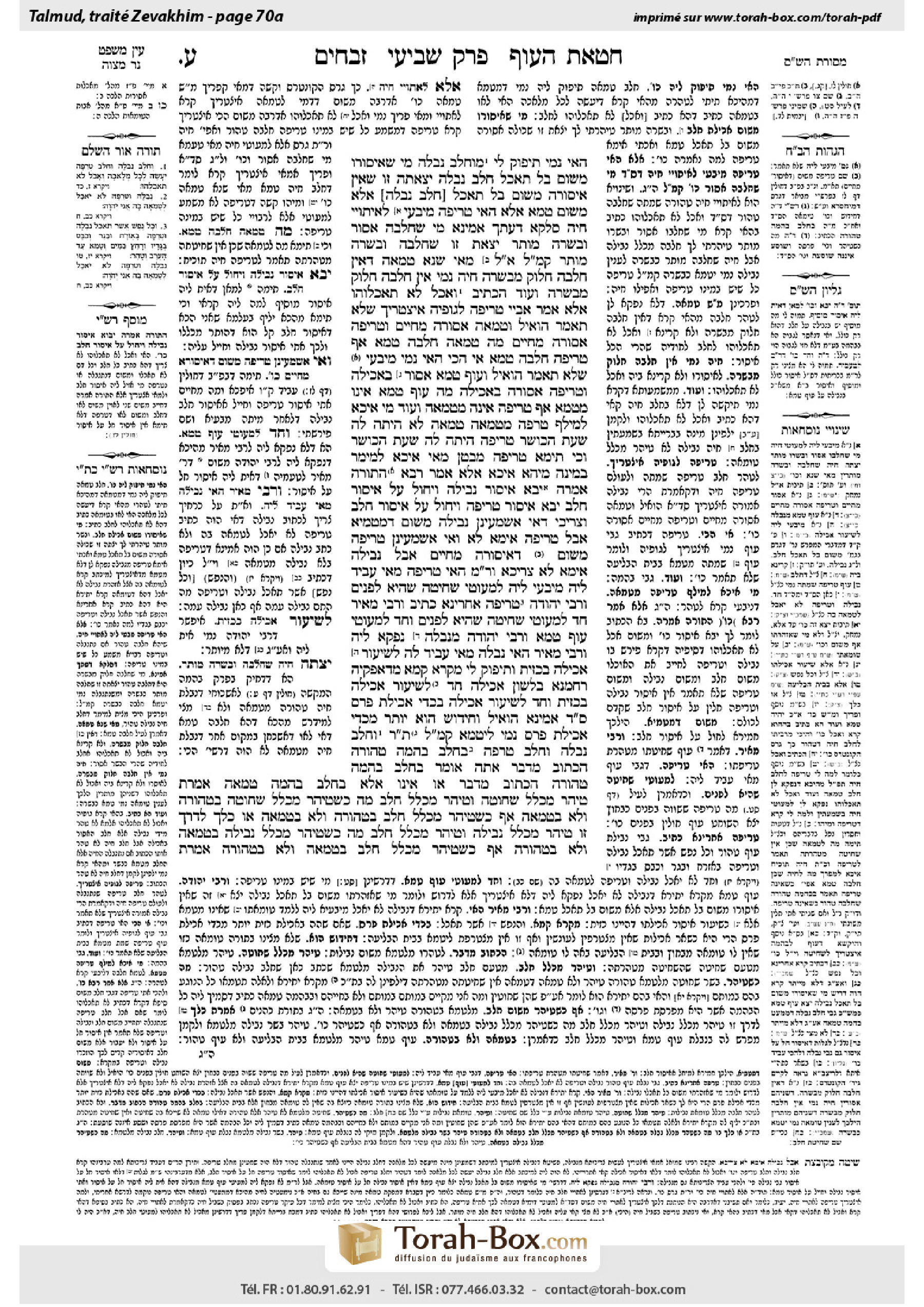
Zevachim 70a: Talmud study for Daf Yomi
Daf Yomi is the daily study of one Talmud folio. Explore 37 tractates with scans, Hebrew text, Sefaria English and AI-generated French translations where annotated.
Passage selection and English or AI-generated French translation are available where the scan has annotations. Daf Study is independent of Torah-Box and Sefaria.
Browse Zevachim · זבחים · All tractatesZevachim 70a text and translations
This page of Zevachim includes the Aramaic text, an English translation and an AI-generated French translation, alongside the scan above.
זבחים ע׳ א · Aramaic and Hebrew text
הַאי נָמֵי תִּיפּוֹק לִי מִ״וְּחֵלֶב נְבֵלָה״ –
מִי שֶׁאִיסּוּרוֹ מִשּׁוּם בַּל תֹּאכַל חֵלֶב נְבֵלָה; יָצָאתָה זוֹ שֶׁאֵין אִיסּוּרָהּ מִשּׁוּם בַּל תֹּאכַל [חֵלֶב נְבֵלָה], אֶלָּא מִשּׁוּם טָמֵא!
אֶלָּא הַאי טְרֵיפָה מִיבְּעֵי לְאֵיתוֹיֵי חַיָּה – סָלְקָא דַּעְתָּךְ אָמֵינָא: מִי שֶׁחֶלְבָּהּ אָסוּר וּבְשָׂרָהּ מוּתָּר, יָצָאת זוֹ שֶׁחֶלְבָּהּ וּבְשָׂרָהּ מוּתָּר; קָא מַשְׁמַע לַן.
אֲמַר לֵיהּ: מַאי שְׁנָא טְמֵאָה – דְּאֵין חֶלְבָּהּ חָלוּק מִבְּשָׂרָהּ; חַיָּה נָמֵי – אֵין חֶלְבָּהּ חָלוּק מִבְּשָׂרָהּ! וְעוֹד, הָכְתִיב: ״וְאָכֹל לֹא תֹאכְלוּהוּ״!
אֶלָּא אָמַר אַבָּיֵי: טְרֵיפָה לְגוּפֵיהּ אִיצְטְרִיךְ; שֶׁלֹּא תֹּאמַר: הוֹאִיל וּטְמֵאָה אֲסוּרָה מֵחַיִּים, וּטְרֵיפָה אֲסוּרָה מֵחַיִּים – מָה טְמֵאָה חֶלְבָּהּ טָמֵא, אַף טְרֵיפָה חֶלְבָּהּ טָמֵא.
אִי הָכִי, הַאי נָמֵי מִיבְּעֵי; שֶׁלֹּא תֹּאמַר: הוֹאִיל וְעוֹף טָמֵא אָסוּר בַּאֲכִילָה, וּטְרֵיפָה אֲסוּרָה בַּאֲכִילָה – מָה עוֹף טָמֵא אֵינוֹ מְטַמֵּא, אַף טְרֵיפָה אֵינָהּ מְטַמְּאָה!
וְעוֹד, מִי אִיכָּא לְמֵילַף טְרֵפָה מִטְּמֵאָה?! טְמֵאָה לֹא הָיְתָה לָהּ שְׁעַת הַכּוֹשֶׁר, טְרֵיפָה הָיְתָה לָהּ שְׁעַת הַכּוֹשֶׁר! וְכִי תֵּימָא: טְרֵיפָה מִבֶּטֶן מַאי אִיכָּא לְמֵימַר? בְּמִינַהּ מִיהָא אִיכָּא!
אֶלָּא אָמַר רָבָא, הַתּוֹרָה אָמְרָה: יָבֹא אִיסּוּר נְבֵילָה וְיָחוּל עַל אִיסּוּר חֵלֶב, יָבֹא אִיסּוּר טְרֵיפָה וְיָחוּל עַל אִיסּוּר חֵלֶב.
וּצְרִיכִי; דְּאִי אַשְׁמְעִינַן נְבֵילָה – מִשּׁוּם דִּמְטַמְּיָא, אֲבָל טְרֵיפָה אֵימָא לָא; וְאִי אַשְׁמְעִינַן טְרֵיפָה – מִשּׁוּם דְּאִיסּוּרָהּ מֵחַיִּים, אֲבָל נְבֵילָה אֵימָא לָא; צְרִיכָא.
וְרַבִּי מֵאִיר, הַאי ״טְרֵפָה״ מַאי עָבֵיד לֵיהּ? מִיבְּעֵי לֵיהּ לְמַעוֹטֵי שְׁחִיטָה שֶׁהִיא לִפְנִים.
וְרַבִּי יְהוּדָה – ״טְרֵפָה״ אַחֲרִינָא כְּתִיב.
וְרַבִּי מֵאִיר – חַד לְמַעוֹטֵי שְׁחִיטָה שֶׁהִיא לִפְנִים, וְחַד לְמַעוֹטֵי עוֹף טָמֵא.
וְרַבִּי יְהוּדָה – מִ״נְּבֵלָה״ נָפְקָא לֵיהּ.
וְרַבִּי מֵאִיר – הַאי ״נְבֵלָה״ מַאי עָבֵיד לֵהּ? לְשִׁיעוּר אֲכִילָה בִּכְזַיִת.
וְתִיפּוֹק לִי מִקְּרָא קַמָּא, מִדְּאַפְּקֵיהּ רַחֲמָנָא בִּלְשׁוֹן אֲכִילָה!
חַד לְשִׁיעוּר אֲכִילָה בִּכְזַיִת, וְחַד לְשִׁיעוּר אֲכִילָה בִּכְדֵי אֲכִילַת פְּרָס.
סָלְקָא דַּעְתָּךְ אָמֵינָא: הוֹאִיל וְחִידּוּשׁ הוּא – יוֹתֵר מִכְּדֵי אֲכִילַת פְּרָס נָמֵי לִיטַמֵּא; קָא מַשְׁמַע לַן.
תָּנוּ רַבָּנַן: ״וְחֵלֶב נְבֵלָה וְחֵלֶב טְרֵפָה״ – בְּחֵלֶב בְּהֵמָה טְהוֹרָה הַכָּתוּב מְדַבֵּר.
אַתָּה אוֹמֵר בְּחֵלֶב בְּהֵמָה טְהוֹרָה הַכָּתוּב מְדַבֵּר; אוֹ אֵינוֹ אֶלָּא בְּחֵלֶב בְּהֵמָה טְמֵאָה?
אָמַרְתָּ: טִיהֵר מִכְּלַל שְׁחוּטָה, וְטִיהֵר מִכְּלַל חֵלֶב; מָה כְּשֶׁטִּיהֵר מִכְּלַל שְׁחוּטָה – בִּטְהוֹרָה וְלֹא בִּטְמֵאָה, אַף כְּשֶׁטִּיהֵר מִכְּלַל חֵלֶב – בִּטְהוֹרָה וְלֹא בִּטְמֵאָה.
אוֹ כְּלָךְ לְדֶרֶךְ זוֹ: טִיהֵר מִכְּלַל נְבֵילָה, וְטִיהֵר מִכְּלַל חֵלֶב; מָה כְּשֶׁטִּיהֵר מִכְּלַל נְבֵילָה – בִּטְמֵאָה וְלֹא בִּטְהוֹרָה, אַף כְּשֶׁטִּיהֵר מִכְּלַל חֵלֶב – בִּטְמֵאָה וְלֹא בִּטְהוֹרָה!
אָמְרַתְּ:
Zevachim 70a · English translation
The Gemara challenges: According to this logic, one can also derive the halakha that the forbidden fat of the carcass of a non-kosher animal is impure from the verse: “And the fat of a carcass, and the fat of a tereifa, may be used for any other service” (Leviticus 7:24), which teaches that such forbidden fat is ritually pure.
The continuation of the verse: “But you shall in no way eat of it,” indicates that the verse renders pure only fat that is forbidden specifically due to the prohibition: You shall not eat the forbidden fat of a carcass, i.e., the forbidden fat of kosher animals. This serves to exclude this forbidden fat of a non-kosher animal, which is not forbidden due to the prohibition: You shall not eat the forbidden fat of a carcass, but rather due to the prohibition against eating a non-kosher animal. Since the verse that states that fats are ritually pure is referring only to kosher animals, the forbidden fat of a carcass of a non-kosher animal must be impure. Rav Sheizevi’s derivation of this halakha from the word tereifa is therefore superfluous.
Rather, this word “tereifa” is necessary to include the forbidden fat of a carcass of a kosher undomesticated animal, to teach that it is ritually pure; as it might enter your mind to say that only the forbidden fat of carcasses of those animals whose fat is forbidden and whose meat is permitted if slaughtered, i.e., kosher domesticated animals, is ritually pure, and this serves to exclude this forbidden fat of carcasses of those animals whose fat and meat are both permitted if slaughtered, i.e., kosher undomesticated animals, whose fat is impure. To counter this possibility, the word “tereifa” teaches us that the fat of a carcass of any animal that can become a tereifa is ritually pure, including the fat of kosher undomesticated animals.
He said to him: If it is derived from the verse that the forbidden fat of a carcass of a kosher undomesticated animal is pure, what is different about a non-kosher animal that would cause its forbidden fat to be impure? If the difference is that its fat is not distinct from its meat, as both are forbidden for consumption, the fat of a kosher undomesticated animal is also not distinct from its meat, as both are permitted. And furthermore, isn’t it written later in the verse: “But you shall in no way eat of it” (Leviticus 7:24)? This phrase is interpreted (70b) as excluding the fat of undomesticated animals, teaching that it is impure.
Rather, Abaye said: The word “tereifa” in this verse was necessary for its own sake, to teach that the forbidden fat of a carcass of a tereifa of a kosher domesticated animal is pure. The inclusion of the word teaches that you should not say that since a non-kosher animal is forbidden while still alive, and a tereifa is forbidden while still alive, therefore just as the forbidden fat of a non-kosher animal is impure, so too the forbidden fat of a tereifa is impure. The word “tereifa” therefore teaches that it is pure.
The Gemara asks: But if so, i.e., if one could have learned the halakha of the forbidden fat of a tereifa from the halakha of the forbidden fat of a non-kosher animal, then this word “tereifa” in the verse concerning the impurity of a kosher bird carcass (Leviticus 17:15) is also necessary for its own sake, to teach that the carcass of a kosher bird that is a tereifa is impure. It is necessary for this to be written with regard to the carcass of a kosher bird so that you should not say as follows: Since a non-kosher bird is forbidden for consumption, and a tereifa is forbidden for consumption, therefore just as a non-kosher bird does not impart impurity, so too a tereifa does not impart impurity. According to Rabbi Yehuda, the word is necessary to include the slaughtered kosher bird that is a tereifa, not a carcass.
And furthermore, is it possible to derive the halakha concerning a tereifa from that concerning a non-kosher animal, as suggested? The two cases are incomparable, as a non-kosher animal never had a kosher period before being forbidden, whereas a tereifa had a kosher period before becoming a tereifa. And if you would say: What can be said with regard to an animal that is a tereifa from the womb, which never had a kosher period? In any event, there are kosher animals among its species, i.e., the tereifa is a member of a kosher species, which cannot be said of a non-kosher animal.
Rather, Rava said: The word tereifa in the verse concerning forbidden fat (Leviticus 7:24) teaches a different halakha. By stating: “But you shall in no way eat of it,” referring to the forbidden fat of a carcass, the Torah states: Let the prohibition of eating a carcass come and take effect where the prohibition of eating forbidden fat already exists. One who eats the forbidden fat of a carcass is liable both for eating forbidden fat and for eating from a carcass. Likewise, the word “tereifa” in the verse teaches: Let the prohibition of eating a tereifa come and take effect where the prohibition of eating forbidden fat already exists, so that one who eats the forbidden fat of a tereifa is liable for transgressing two prohibitions.
And both the word “carcass” and the word “tereifa” are necessary, even though they teach similar halakhot. As, had the verse taught us about additional liability only with regard to the forbidden fat of a carcass, one might have thought that it applies to only a carcass, as it imparts ritual impurity, but with regard to a tereifa, which does not, one might say that the additional liability does not apply. And had the verse taught us this halakha only with regard to a tereifa, one might have thought that it applies only to a tereifa, as its prohibition takes effect while it is still alive, but with regard to a carcass, which becomes forbidden only when it dies, one might say that it does not apply. Both words are therefore necessary.
§ The Gemara has established that according to Rabbi Yehuda, the word “tereifa” in the verse concerning the impurity of a kosher bird carcass (Leviticus 17:15) teaches that a slaughtered bird that is a tereifa imparts ritual impurity. The Gemara asks: And what does Rabbi Meir, who holds that a slaughtered bird that is a tereifa does not impart ritual impurity, do with this word “tereifa”? The Gemara answers: It is necessary to exclude the slaughter of non-sacred birds that occurs inside the Temple courtyard, teaching that it does not cause them to impart ritual impurity as would a carcass, even though they are forbidden for consumption.
And how does Rabbi Yehuda derive this halakha? The Gemara answers: Another instance of the word tereifa is written concerning the ritual impurity of birds: “A carcass, or a tereifa, he shall not eat to become impure with it” (Leviticus 22:8). Rabbi Yehuda derives the halakha from this verse.
And how does Rabbi Meir interpret the appearance of the word tereifa in both verses? The Gemara answers: One is necessary to exclude the slaughter that occurs inside the Temple courtyard as mentioned above, and one is necessary to exclude a non-kosher bird, to teach that the carcass of a non-kosher bird does not impart ritual impurity.
And how does Rabbi Yehuda derive that the carcass of a non-kosher bird does not impart ritual impurity? The Gemara answers: He derives it from the word “carcass” in the verse: “A carcass, or a tereifa, he shall not eat to become impure with it” (Leviticus 22:8), which indicates that only carcasses of birds that are forbidden for consumption due to their status as a carcass are impure. Non-kosher birds are forbidden due to their non-kosher status, not due to their status as a carcass.
The Gemara asks: And what does Rabbi Meir do with this word “carcass”? The Gemara answers: Since the verse mentions eating, Rabbi Meir holds that the word “carcass” is written to teach that the minimum measure of consumption of the meat of a bird carcass that renders one impure is an olive-bulk, which is the standard legal measure of consumption for Torah laws in general.
The Gemara challenges: But let him derive this measure from the first verse: “And every soul that eats a carcass…shall be impure” (Leviticus 17:15), from the fact that the Merciful One expresses this halakha using the language of consumption.
The Gemara responds: Both verses are necessary, one to indicate that the measure of consumption that renders one impure is an olive-bulk, and one to indicate that the maximum measure of time for consumption of the olive-bulk is the time it takes to eat a half-loaf of bread. One who takes longer than this standard measure of time will not contract impurity.
It is necessary for the Torah to indicate this latter halakha as well, as otherwise it might enter your mind to say: Since the impurity of carcasses of birds is a novelty, as one contracts it by eating rather than by touching or carrying, perhaps its halakhot are unusually stringent and even one who eats an olive-bulk in more than the time it takes to eat a half-loaf of bread should also contract impurity. Therefore, the verse teaches us otherwise.
§ The Gemara cites a baraita concerning the impurity of the forbidden fat of a carcass. The Sages taught: When the verse: “And the fat of a carcass, and the fat of a tereifa, may be used for any other service” (Leviticus 7:24) teaches that such fat is pure, the verse speaks of the forbidden fat of a kosher animal.
The baraita challenges: Do you say that the verse speaks of the forbidden fat of a kosher animal, or perhaps does it only speak of the forbidden fat of a non-kosher animal?
You may say in response: The Torah renders a slaughtered animal pure of the impurity of a carcass due to the fact that it was ritually slaughtered. And likewise the Torah renders the forbidden fat of a carcass pure, due to the fact that it is forbidden fat. Therefore, the two cases are comparable: Just as when the Torah renders a slaughtered animal pure due to the fact that it was slaughtered, it is referring only to a kosher animal and not to a non-kosher animal, which is impure even when ritually slaughtered, so too, when the Torah renders forbidden fat pure due to the fact that it is forbidden fat, it is referring only to a kosher animal and not to a non-kosher animal.
The baraita challenges: Or perhaps go this way and maintain that since the Torah renders the carcass of a non-kosher animal ritually pure, removing it from the category of a carcass, and likewise the Torah renders the forbidden fat of a carcass pure, due to the fact that it is forbidden fat; therefore, the two cases are comparable: Just as when the Torah renders the carcass of a non-kosher animal pure, removing it from the category of a carcass, it is referring only to a non-kosher animal and not to a kosher animal, the carcass of which imparts impurity, so too, when the Torah renders forbidden fat pure due to the fact that it is forbidden fat, it is referring only to a non-kosher animal and not to a kosher animal.
You may say in response:
Zevachim 70a · Traduction française (IA)
La Guemara objecte : selon cette logique, on pourrait également déduire du verset la halakha selon laquelle le suif interdit de la carcasse d’un animal non cachère est impur : « Le suif d’une carcasse et le suif d’une bête tréfa peuvent servir à tout autre usage » (Lévitique 7,24), ce qui enseigne que ce suif interdit est rituellement pur.
La suite du verset, « Mais vous n’en mangerez en aucun cas », indique que le verset ne déclare pur que le suif interdit spécifiquement en vertu de l’interdit de manger le suif d’une carcasse, c’est-à-dire le suif interdit des animaux cachères. Cela exclut le suif interdit d’un animal non cachère, qui n’est pas interdit en vertu de l’interdit de manger le suif d’une carcasse, mais en vertu de l’interdit de manger un animal non cachère. Puisque le verset qui déclare les suifs rituellement purs ne concerne que les animaux cachères, le suif interdit de la carcasse d’un animal non cachère doit être impur. La déduction de Rav Sheizevi de cette halakha à partir du mot « tréfa » est donc superflue.
Mais le mot « tréfa » est nécessaire pour inclure le suif interdit de la carcasse d’un animal sauvage cachère et enseigner qu’il est rituellement pur. On aurait pu penser que seul le suif interdit des carcasses d’animaux dont le suif est interdit, mais dont la viande est permise s’ils sont abattus rituellement — c’est-à-dire les animaux domestiques cachères — est rituellement pur. On aurait alors exclu le suif interdit des carcasses d’animaux dont le suif et la viande sont tous deux permis s’ils sont abattus rituellement — c’est-à-dire les animaux sauvages cachères — et considéré leur suif comme impur. Pour écarter cette possibilité, le mot « tréfa » nous enseigne que le suif de la carcasse de tout animal susceptible de devenir tréfa est rituellement pur, y compris le suif des animaux sauvages cachères.
Il lui dit : si l’on déduit du verset que le suif interdit de la carcasse d’un animal sauvage cachère est pur, en quoi un animal non cachère diffère-t-il, au point que son suif interdit serait impur ? Si c’est parce que son suif ne se distingue pas de sa viande, puisque les deux sont interdits à la consommation, le suif d’un animal sauvage cachère ne se distingue pas non plus de sa viande, puisque les deux sont permis. De plus, n’est-il pas écrit plus loin dans le verset : « Mais vous n’en mangerez en aucun cas » (Lévitique 7,24) ? Cette expression est interprétée (70b) comme excluant le suif des animaux sauvages et enseignant qu’il est impur.
Mais Abayé a dit : le mot « tréfa » dans ce verset est nécessaire pour lui-même, afin d’enseigner que le suif interdit de la carcasse d’un animal domestique cachère tréfa est pur. Son inclusion enseigne qu’il ne faut pas dire que, puisqu’un animal non cachère est interdit alors qu’il est encore vivant, et qu’un animal tréfa est lui aussi interdit alors qu’il est encore vivant, le suif interdit d’un animal tréfa serait impur, tout comme celui d’un animal non cachère. Le mot « tréfa » enseigne donc qu’il est pur.
La Guemara demande : Mais si l’on raisonne ainsi, c’est-à-dire si l’on peut déduire la halakha concernant le suif interdit d’un animal tréfa de celle concernant le suif interdit d’un animal non cachère, le mot « tréfa » dans le verset relatif à l’impureté de la carcasse d’un oiseau cachère (Lévitique 17,15) est lui aussi nécessaire pour lui-même, afin d’enseigner que la carcasse d’un oiseau cachère tréfa est impure. Il fallait mentionner cette précision au sujet de la carcasse d’un oiseau cachère afin qu’on ne dise pas ceci : puisqu’un oiseau non cachère est interdit à la consommation et qu’un oiseau tréfa est interdit à la consommation, de même qu’un oiseau non cachère ne transmet pas l’impureté, un oiseau tréfa ne la transmet pas non plus. Selon Rabbi Yehuda, le mot est nécessaire pour inclure l’oiseau cachère tréfa abattu rituellement, et non une carcasse.
De plus, peut-on déduire la halakha concernant un animal tréfa de celle concernant un animal non cachère, comme cela a été suggéré ? Les deux cas ne sont pas comparables : un animal non cachère n’a jamais été permis avant d’être interdit, tandis qu’un animal tréfa a été permis avant de devenir tréfa. Et si l’on objecte qu’un animal tréfa dès la matrice n’a jamais été permis, il reste que des animaux cachères appartiennent à la même espèce que lui ; autrement dit, cet animal tréfa appartient à une espèce cachère, ce qu’on ne peut pas dire d’un animal non cachère.
Mais Rava a dit : le mot « tréfa » dans le verset relatif au suif interdit (Lévitique 7,24) enseigne une autre halakha. En disant : « Mais vous n’en mangerez en aucun cas », à propos du suif interdit d’une carcasse, la Torah déclare : que l’interdit de manger une carcasse vienne s’appliquer là où l’interdit de manger du suif interdit existe déjà. Celui qui mange le suif interdit d’une carcasse est passible à la fois pour avoir mangé du suif interdit et pour avoir mangé d’une carcasse. De même, le mot « tréfa » dans le verset enseigne que l’interdit de manger un animal tréfa vient s’appliquer là où l’interdit de manger du suif interdit existe déjà, de sorte que celui qui mange le suif interdit d’un animal tréfa est passible pour avoir transgressé deux interdits.
Les mots « carcasse » et « tréfa » sont tous deux nécessaires, bien qu’ils enseignent des halakhot similaires. En effet, si le verset nous avait enseigné la responsabilité supplémentaire uniquement au sujet du suif interdit d’une carcasse, on aurait pu penser qu’elle ne s’applique qu’à une carcasse, puisqu’elle transmet l’impureté ; mais, au sujet d’un animal tréfa, qui ne transmet pas l’impureté, on aurait pu penser que cette responsabilité supplémentaire ne s’applique pas. Et si le verset nous avait enseigné cette halakha uniquement au sujet d’un animal tréfa, on aurait pu penser qu’elle ne s’applique qu’à un animal tréfa, puisque son interdit prend effet alors qu’il est encore vivant ; mais, au sujet d’une carcasse, qui ne devient interdite qu’à sa mort, on aurait pu penser qu’elle ne s’applique pas. Les deux mots sont donc nécessaires.
§ La Guemara a établi que, selon Rabbi Yehuda, le mot « tréfa » dans le verset relatif à l’impureté de la carcasse d’un oiseau cachère (Lévitique 17,15) enseigne qu’un oiseau cachère tréfa abattu rituellement transmet l’impureté rituelle. La Guemara demande : que fait Rabbi Meïr, qui soutient qu’un oiseau cachère tréfa abattu rituellement ne transmet pas l’impureté rituelle, de ce mot « tréfa » ? La Guemara répond : ce mot est nécessaire pour exclure l’abattage d’oiseaux non consacrés dans la cour du Temple, et enseigner que leur abattage ne les rend pas impurs comme une carcasse, bien qu’ils soient interdits à la consommation.
Et comment Rabbi Yehuda déduit-il cette halakha ? La Guemara répond : un autre emploi du mot « tréfa » figure au sujet de l’impureté rituelle des oiseaux : « Il ne mangera ni carcasse ni bête tréfa, afin de se rendre impur par elle » (Lévitique 22,8). Rabbi Yehuda déduit cette halakha de ce verset.
Et comment Rabbi Meïr interprète-t-il la présence du mot « tréfa » dans les deux versets ? La Guemara répond : l’un est nécessaire pour exclure l’abattage dans la cour du Temple, comme indiqué plus haut, et l’autre pour exclure un oiseau non cachère, afin d’enseigner que la carcasse d’un oiseau non cachère ne transmet pas l’impureté rituelle.
Et comment Rabbi Yehuda déduit-il que la carcasse d’un oiseau non cachère ne transmet pas l’impureté rituelle ? La Guemara répond : il le déduit du mot « carcasse » dans le verset : « Il ne mangera ni carcasse ni bête tréfa, afin de se rendre impur par elle » (Lévitique 22,8). Cela indique que seules les carcasses d’oiseaux interdits à la consommation en raison de leur statut de carcasse sont impures. Les oiseaux non cachères sont interdits en raison de leur statut non cachère, et non de leur statut de carcasse.
La Guemara demande : et que fait Rabbi Meïr de ce mot « carcasse » ? La Guemara répond : puisque le verset parle de manger, Rabbi Meïr estime que le mot « carcasse » enseigne que la quantité minimale de viande d’une carcasse d’oiseau qu’il faut consommer pour devenir impur est d’un volume d’olive, la mesure légale habituelle de consommation dans les lois de la Torah en général.
La Guemara objecte : mais qu’il déduise cette mesure du premier verset : « Toute personne qui mange une carcasse… sera impure » (Lévitique 17,15), puisque le Miséricordieux exprime cette halakha en employant le terme « manger ».
La Guemara répond : les deux versets sont nécessaires, l’un pour indiquer que la quantité consommée qui rend impur est d’un volume d’olive, l’autre pour préciser que le délai maximal pour consommer ce volume d’olive est le temps nécessaire pour manger un demi-pain. Celui qui met plus de temps que ce délai ne contracte pas l’impureté.
La Torah devait également indiquer cette dernière halakha, car autrement on aurait pu penser ceci : puisque l’impureté des carcasses d’oiseaux constitue une nouveauté, car on la contracte en mangeant plutôt qu’en touchant ou en portant, ses règles sont peut-être exceptionnellement rigoureuses et même celui qui mange un volume d’olive en un temps supérieur à celui qu’il faut pour manger un demi-pain contracte également l’impureté. Le verset nous enseigne donc le contraire.
§ La Guemara cite une baraïta concernant l’impureté du suif interdit d’une carcasse. Les Sages ont enseigné : lorsque le verset « Le suif d’une carcasse et le suif d’une bête tréfa peuvent servir à tout autre usage » (Lévitique 7,24) enseigne que ce suif est pur, il parle du suif interdit d’un animal cachère.
La baraïta objecte : dis-tu que le verset parle du suif interdit d’un animal cachère, ou peut-être parle-t-il seulement du suif interdit d’un animal non cachère ?
On peut répondre ainsi : la Torah déclare pur un animal abattu rituellement, le soustrayant à l’impureté d’une carcasse parce qu’il a été abattu rituellement. De même, la Torah déclare pur le suif interdit d’une carcasse parce qu’il s’agit de suif interdit. Les deux cas sont donc comparables : de même que, lorsque la Torah déclare pur un animal abattu rituellement parce qu’il a été abattu, elle ne parle que d’un animal cachère et non d’un animal non cachère, qui est impur même lorsqu’il est abattu rituellement, de même, lorsque la Torah déclare pur le suif interdit parce qu’il s’agit de suif interdit, elle ne parle que d’un animal cachère et non d’un animal non cachère.
La baraïta objecte : ou peut-être faut-il raisonner ainsi et soutenir que, puisque la Torah déclare rituellement pure la carcasse d’un animal non cachère, la soustrayant à la catégorie des carcasses, et qu’elle déclare également pur le suif interdit d’une carcasse parce qu’il s’agit de suif interdit, les deux cas sont comparables : de même que, lorsque la Torah déclare pure la carcasse d’un animal non cachère en la soustrayant à la catégorie des carcasses, elle ne parle que d’un animal non cachère et non d’un animal cachère, dont la carcasse transmet l’impureté, de même, lorsque la Torah déclare pur le suif interdit parce qu’il s’agit de suif interdit, elle ne parle que d’un animal non cachère et non d’un animal cachère.
On peut répondre ainsi :
Traduction française générée par IA à partir de l’édition anglaise de Sefaria. Vérifie toujours un passage avec le texte source.
Text from Sefaria: William Davidson Edition - Vocalized Aramaic (CC BY NC); William Davidson Edition - English (CC BY NC).