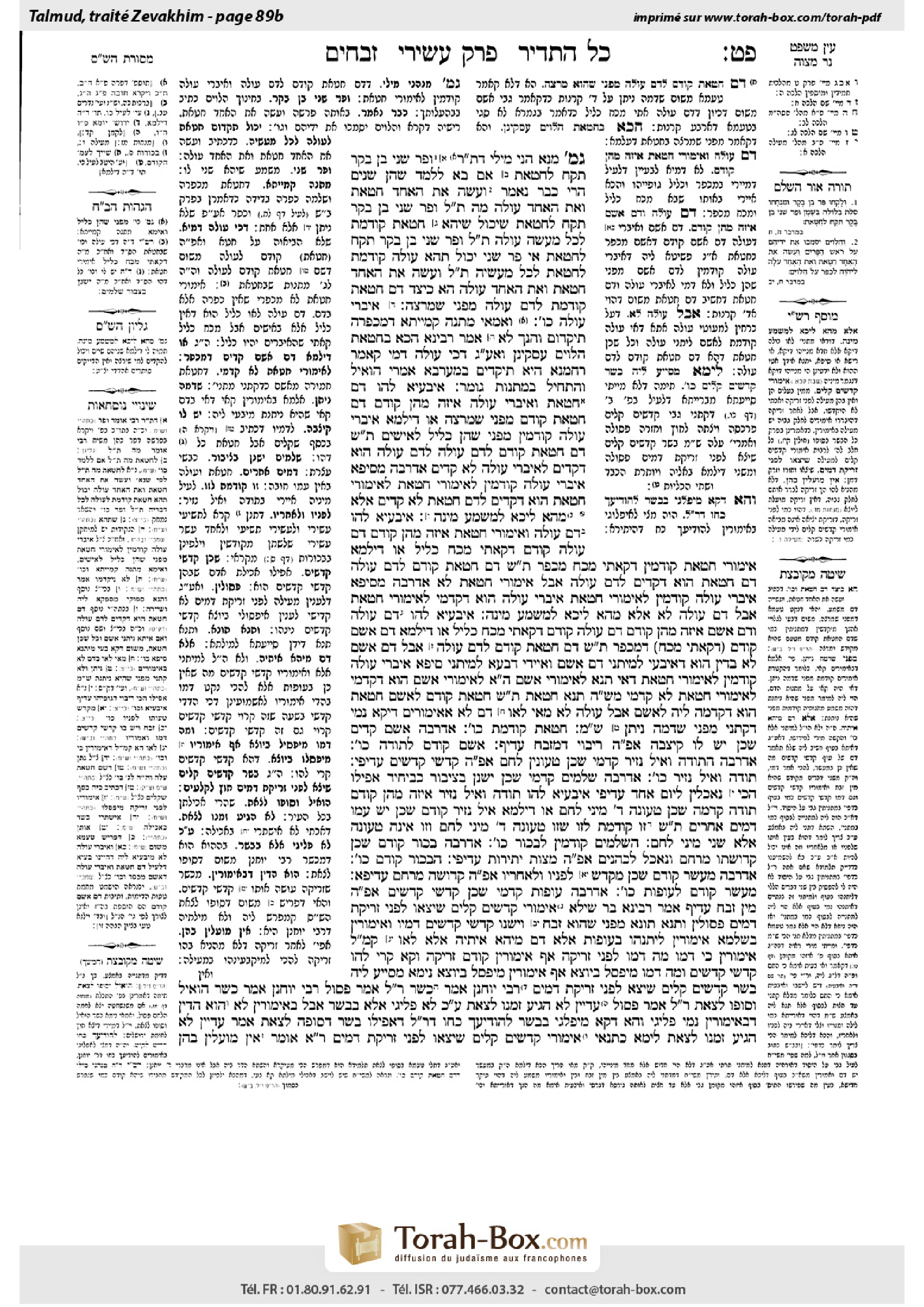
Zevachim 89b: Talmud study for Daf Yomi
Daf Yomi is the daily study of one Talmud folio. Explore 37 tractates with scans, Hebrew text, Sefaria English and AI-generated French translations where annotated.
Passage selection and English or AI-generated French translation are available where the scan has annotations. Daf Study is independent of Torah-Box and Sefaria.
Browse Zevachim · זבחים · All tractatesZevachim 89b text and translations
This page of Zevachim includes the Aramaic text, an English translation and an AI-generated French translation, alongside the scan above.
זבחים פ״ט ב · Aramaic and Hebrew text
גְּמָ׳ מְנָא הָנֵי מִילֵּי? דְּתָנוּ רַבָּנַן: ״וּפַר שֵׁנִי בֶן בָּקָר תִּקַּח לְחַטָּאת״ –
אִם בָּא לְלַמֵּד שֶׁהֵן שְׁנַיִם, הֲרֵי כְּבָר נֶאֱמַר: ״וַעֲשֵׂה אֶת הָאֶחָד חַטָּאת וְאֶת הָאֶחָד עֹלָה״; מָה תַּלְמוּד לוֹמַר: ״וּפַר שֵׁנִי בֶן בָּקָר תִּקַּח לְחַטָּאת״? שֶׁיָּכוֹל שֶׁיְּהֵא חַטָּאת קוֹדֶמֶת לְכׇל מַעֲשֵׂה עוֹלָה, תַּלְמוּד לוֹמַר: ״וּפַר שֵׁנִי בֶן בָּקָר תִּקַּח לְחַטָּאת״.
אִי ״פַּר שֵׁנִי״, יָכוֹל תְּהֵא עוֹלָה קוֹדֶמֶת לְחַטָּאת לְכׇל מַעֲשֶׂיהָ? תַּלְמוּד לוֹמַר: ״וַעֲשֵׂה אֶת הָאֶחָד חַטָּאת וְאֶת הָאֶחָד עֹלָה״. הָא כֵּיצַד? דַּם חַטָּאת קוֹדֶמֶת לְדַם עוֹלָה – מִפְּנֵי שֶׁמְּרַצָּה; אֵיבְרֵי עוֹלָה כּוּ׳.
וְאַמַּאי? מַתָּנָה קַמַּיְיתָא דִּמְכַפְּרָה – תִּיקְדּוֹם, וְהָנָךְ לָא!
אָמַר רָבִינָא: הָכָא בְּחַטַּאת הַלְוִיִּם עָסְקִינַן; וְאַף עַל גַּב דְּכִי עוֹלָה דָּמֵי, קָאָמַר רַחֲמָנָא הִיא תִּיקְדּוֹם. בְּמַעְרְבָא אָמְרִי: הוֹאִיל וְהִתְחִיל בְּמַתָּנוֹת, גּוֹמֵר.
אִיבַּעְיָא לְהוּ: דַּם חַטָּאת וְאֵיבְרֵי עוֹלָה, אֵיזֶה מֵהֶן קוֹדֵם? דַּם חַטָּאת קוֹדֵם – מִפְּנֵי שֶׁמְּרַצֶּה, אוֹ דִילְמָא אֵיבְרֵי עוֹלָה קוֹדְמִין – מִפְּנֵי שֶׁהֵן כָּלִיל לָאִישִּׁים?
תָּא שְׁמַע: דַּם חַטָּאת קוֹדֵם לְדַם עוֹלָה. לְדַם עוֹלָה הוּא דְּקָדֵים, לְאֵיבְרֵי עוֹלָה לָא קָדֵים.
אַדְּרַבָּה, מִסֵּיפָא: אֵיבְרֵי עוֹלָה קוֹדְמִין לְאֵימוּרֵי חַטָּאת. לְאֵימוּרֵי חַטָּאת הוּא דְּקָדֵים, לְדַם חַטָּאת לָא קָדֵים! אֶלָּא מֵהָא לֵיכָּא לְמִשְׁמַע מִינַּהּ.
אִיבַּעְיָא לְהוּ: דַּם עוֹלָה וְאֵימוּרֵי חַטָּאת, אֵיזֶה מֵהֶן קוֹדֵם? דַּם עוֹלָה קוֹדֵם – דְּקָאָתֵי מִכֹּחַ כָּלִיל, אוֹ דִילְמָא אֵימוּרֵי חַטָּאת קוֹדְמִין – (דְּקָאָתֵי) [דְּקָאָתוּ] מִכֹּחַ מְכַפֵּר?
תָּא שְׁמַע: דַּם חַטָּאת קוֹדֵם לְדַם עוֹלָה. דַּם חַטָּאת הוּא דְּקָדֵים לְדַם עוֹלָה, אֲבָל אֵימוּרֵי חַטָּאת לָא.
אַדְּרַבָּה, מִסֵּיפָא: אֵיבְרֵי עוֹלָה קוֹדְמִין לְאֵימוּרֵי חַטָּאת. אֵיבְרֵי עוֹלָה הוּא דְּקָדְמִי לְאֵימוּרֵי חַטָּאת, אֲבָל דָּם עוֹלָה לָא! אֶלָּא מֵהָא לֵיכָּא לְמִשְׁמַע מִינַּהּ.
אִיבַּעְיָא לְהוּ: דַּם עוֹלָה וְדַם אָשָׁם, אֵיזֶה מֵהֶן קוֹדֵם? דַּם עוֹלָה קוֹדֵם – דְּקָאָתֵי מִכֹּחַ כָּלִיל; אוֹ דִילְמָא דַּם אָשָׁם קוֹדֵם – (דְּקָאָתֵי מִכֹּחַ) דִּמְכַפֵּר?
תָּא שְׁמַע: דַּם חַטָּאת קוֹדֵם לְדַם עוֹלָה. אֲבָל דַּם אָשָׁם – לָא.
בְּדִין הוּא דְּאִיבְּעִי לְמִיתְנֵי דַּם אָשָׁם; וְאַיְּידֵי דִּבְעָא לְמִיתְנֵי סֵיפָא: אֵיבְרֵי עוֹלָה קוֹדְמִין לְאֵימוּרֵי חַטָּאת –
דְּאִי תְּנָא לְאֵימוּרֵי אָשָׁם, הֲוָה אָמֵינָא: לְאֵימוּרֵי אָשָׁם הוּא דְּקָדְמִי, לְאֵימוּרֵי חַטָּאת לָא קָדְמִי – מִשּׁוּם הָכִי תְּנָא חַטָּאת.
תָּא שְׁמַע: חַטָּאת קוֹדֶם לְאָשָׁם – חַטָּאת הוּא דְּקָדְמָה לֵיהּ לְאָשָׁם, אֲבָל עוֹלָה לָא. מַאי, לָאו דָּם?
לָא; אַאֵימוּרִים. דַּיְקָא נָמֵי, דְּקָתָנֵי ״מִפְּנֵי שֶׁדָּמָהּ נִיתָּן״. שְׁמַע מִינַּהּ.
חַטָּאת קוֹדֶמֶת כּוּ׳. אַדְּרַבָּה – אָשָׁם קָדֵים, שֶׁכֵּן יֵשׁ לוֹ קִיצְּבָה! אֲפִילּוּ הָכִי, רִיבּוּי דְּמִזְבֵּחַ עֲדִיף.
אָשָׁם קוֹדֵם לְתוֹדָה כּוּ׳. אַדְּרַבָּה – הַתּוֹדָה וְאֵיל נָזִיר קָדְמִי, שֶׁכֵּן טְעוּנִין לֶחֶם! אֲפִילּוּ הָכִי, קׇדְשֵׁי קָדָשִׁים עֲדִיפִי.
תּוֹדָה וְאֵיל נָזִיר כּוּ׳. אַדְּרַבָּה – שְׁלָמִים קָדְמִי, שֶׁכֵּן יֶשְׁנָן בְּצִיבּוּר כִּבְיָחִיד! אֲפִילּוּ הָכִי, נֶאֱכָלִין לְיוֹם אֶחָד עֲדִיפִי.
אִיבַּעְיָא לְהוּ: תּוֹדָה וְאֵיל נָזִיר – אֵיזֶה מֵהֶן קוֹדֵם? תּוֹדָה קָדְמָה, שֶׁכֵּן טְעוּנָה אַרְבָּעָה מִינֵי לֶחֶם; אוֹ דִילְמָא אֵיל נָזִיר קוֹדֵם, שֶׁכֵּן יֵשׁ עִמּוֹ דָּמִים אֲחֵרִים? תָּא שְׁמַע: זוֹ קוֹדֶמֶת לָזוֹ, שֶׁזּוֹ טְעוּנָה אַרְבָּעָה מִינֵי לֶחֶם, וְזוֹ אֵינָהּ טְעוּנָה אֶלָּא שְׁנֵי מִינֵי לֶחֶם.
וְהַשְּׁלָמִים קוֹדְמִין לִבְכוֹר כּוּ׳. אַדְּרַבָּה – בְּכוֹר קוֹדֵם, שֶׁכֵּן קְדוּשָּׁתוֹ מֵרֶחֶם, וְנֶאֱכָל לַכֹּהֲנִים! אֲפִילּוּ הָכִי, מִצְוֹת יְתֵירוֹת עֲדִיפִי.
הַבְּכוֹר קוֹדֵם כּוּ׳. אַדְּרַבָּה – מַעֲשֵׂר קוֹדֵם, שֶׁכֵּן מְקַדֵּשׁ לְפָנָיו וּלְאַחֲרָיו! אֲפִילּוּ הָכִי, קְדוּשָּׁה מֵרֶחֶם עֲדִיפָא.
מַעֲשֵׂר קוֹדֵם לָעוֹפוֹת כּוּ׳. אַדְּרַבָּה – עוֹפוֹת קָדְמִי, שֶׁכֵּן קׇדְשֵׁי קָדָשִׁים! אֲפִילּוּ הָכִי, מִין זֶבַח עָדִיף.
אָמַר רָבִינָא בַּר שֵׁילָא: אֵימוּרֵי קָדָשִׁים קַלִּים שֶׁיָּצְאוּ לִפְנֵי זְרִיקַת דָּמִים – פְּסוּלִין. וּתְנָא תּוּנָא: מִפְּנֵי שֶׁהוּא זֶבַח, וְיֶשְׁנוֹ קׇדְשֵׁי קָדָשִׁים – דָּמָיו וְאֵימוּרִין.
בִּשְׁלָמָא אֵימוּרִין – לֵיתַנְהוּ בְּעוֹפוֹת; אֶלָּא דָּם מִיהָא אִיתֵיהּ! אֶלָּא לָאו קָא מַשְׁמַע לַן: אֵימוּרִין כִּי דָּמוֹ –
מָה דָּמוֹ לִפְנֵי זְרִיקָה, אַף אֵימוּרִין קוֹדֶם זְרִיקָה – וְקָא קָרֵי לְהוּ קׇדְשֵׁי קָדָשִׁים; וּמָה דָּמוֹ מִיפְּסֵל בְּיוֹצֵא, אַף אֵימוּרִין מִיפְּסֵל בְּיוֹצֵא.
נֵימָא מְסַיַּיע לֵיהּ: בְּשַׂר קָדָשִׁים קַלִּים שֶׁיָּצָא לִפְנֵי זְרִיקַת דָּמִים – רַבִּי יוֹחָנָן אָמַר: כָּשֵׁר, רֵישׁ לָקִישׁ אָמַר: פְּסוּל.
רַבִּי יוֹחָנָן אָמַר כָּשֵׁר – הוֹאִיל וְסוֹפוֹ לָצֵאת, רֵישׁ לָקִישׁ אָמַר פָּסוּל – עֲדַיִין לֹא הִגִּיעַ זְמַנּוֹ לָצֵאת. עַד כָּאן לָא פְּלִיגִי – אֶלָּא בְּבָשָׂר, אֲבָל בְּאֵימוּרִין לָא!
הוּא הַדִּין דִּבְאֵימוּרִין נָמֵי פְּלִיגִי; וְהָא דְּקָא מִיפַּלְגִי בְּבָשָׂר – לְהוֹדִיעֲךָ כֹּחוֹ דְּרֵישׁ לָקִישׁ, דַּאֲפִילּוּ בָּשָׂר דְּסוֹפָהּ לָצֵאת, אֲמַר: עֲדַיִין לֹא הִגִּיעַ זְמַנּוֹ לָצֵאת.
לֵימָא כְּתַנָּאֵי: אֵימוּרֵי קָדָשִׁים קַלִּים שֶׁיָּצְאוּ לִפְנֵי זְרִיקַת דָּמִים – רַבִּי אֱלִיעֶזֶר אוֹמֵר: אֵין מוֹעֲלִין בָּהֶן,
Zevachim 89b · English translation
GEMARA: The mishna teaches that the placement of the blood of a sin offering precedes the sprinkling of the blood of a burnt offering, whereas the burning of the limbs of a burnt offering precedes the burning of the portions of a sin offering. The Gemara asks: From where are these matters derived? The Gemara answers: This is as the Sages taught in a baraita discussing a verse about the consecration of the Levites: “Then let them take a young bull, and its meal offering, fine flour mingled with oil; and a second young bull you shall take for a sin offering” (Numbers 8:8).
The baraita explains: If this verse comes to teach that they are two bulls, this is superfluous, as it is already stated: “And offer the one for a sin offering and the other for a burnt offering” (Numbers 8:12). Why must the verse state: “And a second young bull you shall take for a sin offering”? As one might have thought that the sin offering should precede all the rites of the burnt offering, therefore the verse states: “And a second young bull you shall take for a sin offering,” which indicates that the sin offering actually comes second to the burnt offering.
The baraita continues: If the verse had stated only that the sin offering is the second bull, one might have thought that the burnt offering precedes the sin offering with regard to all its rites. Therefore, the verse states: “And offer the one for a sin offering and the other for a burnt offering,” indicating that the sin offering precedes the burnt offering. How can these verses be reconciled? The placement of the blood of the sin offering precedes the sprinkling of the blood of the burnt offering because it effects acceptance, whereas the burnt offering does not effect atonement. And burning the limbs of the burnt offering on the altar precedes burning the portions of the sin offering, in fulfillment of the phrase: “And a second young bull you shall take for a sin offering.”
The Gemara asks: But why do all four placements of the blood of the sin offering precede the sprinkling of the blood of the burnt offering? Let only the first placement of blood, which effects atonement, take precedence, and those other placements should not come before the sprinkling of the blood of the burnt offering.
Ravina said: In the verse here, we are dealing with the sin offering brought by the Levites for their consecration. And even though it does not effect atonement and is therefore comparable to a burnt offering, the Merciful One states that the sin offering precedes the burnt offering with regard to the presentation of the blood. This indicates that in general, all four placements of the blood of a sin offering precede the sprinkling of the blood of the burnt offering, despite the fact that only the first placement effects atonement. In the West, Eretz Yisrael, they say there is another answer: Once the priest commenced with the placements of the blood of the sin offering, he completes all of them before sprinkling the blood of the burnt offering.
§ A dilemma was raised before the Sages: If there is blood of a sin offering and limbs of a burnt offering to be sacrificed, which of them precedes the other? Does the blood of the sin offering take precedence, due to the fact that it effects acceptance? Or perhaps the limbs of the burnt offering take precedence, due to the fact that they are entirely burned in the flames of the altar.
The Gemara suggests: Come and hear, as the mishna teaches that the blood of a sin offering precedes the blood of a burnt offering. One can infer from this that the blood of the sin offering does not precede all elements of the burnt offering; it is only with regard to the blood of the burnt offering that it takes precedence, whereas it does not take precedence with regard to the limbs of the burnt offering.
The Gemara rejects this proof: On the contrary, the opposite conclusion can be inferred from the latter clause of the mishna, which teaches that limbs of a burnt offering precede the portions of the sin offering consumed on the altar. This indicates that it is only with regard to the portions of the sin offering consumed on the altar that the limbs of the burnt offering take precedence, but they do not take precedence with regard to the blood of the sin offering. The Gemara concludes: Rather, no inference is to be learned from this mishna concerning this matter.
A dilemma was raised before the Sages: If there is blood of a burnt offering to be sprinkled and portions of a sin offering to be burned, which of them precedes the other? Does the blood of the burnt offering take precedence, as it comes from an offering that is burned in its entirety on the altar? Or perhaps the portions of the sin offering to be burned take precedence because they come from an offering that effects atonement.
The Gemara suggests: Come and hear, as the mishna teaches that the blood of the sin offering precedes the blood of the burnt offering. One can infer from this that it is only the blood of the sin offering that precedes the blood of the burnt offering, but the portions of the sin offering to be burned do not take precedence.
The Gemara rejects this proof: On the contrary, the opposite conclusion can be inferred from the latter clause of the mishna, which teaches that the limbs of the burnt offering precede the portions of the sin offering to be consumed on the altar. This indicates that it is only the limbs of the burnt offering that precede the portions of the sin offering to be burned, but the blood of the burnt offering does not. The Gemara again concludes: Rather, no inference is to be learned from this mishna concerning this dilemma.
A dilemma was raised before the Sages: If there is blood of a burnt offering and blood of a guilt offering to be sprinkled on the altar, which of them precedes the other? Does the blood of the burnt offering take precedence, as it comes from an offering that is burned in its entirety on the altar? Or perhaps the blood of a guilt offering takes precedence, as it effects atonement.
The Gemara suggests: Come and hear, as the mishna teaches that the blood of the sin offering precedes the blood of the burnt offering. One can infer from here: But the blood of a guilt offering does not precede the blood of a burnt offering.
The Gemara rejects this proof: By right the mishna should have taught this halakha with regard to blood of a guilt offering. One could then have inferred that the blood of a sin offering, which takes precedence over the blood of a guilt offering, also precedes blood of a burnt offering. But since the mishna wants to teach the latter clause: The burning of the limbs of a burnt offering precedes the portions of a sin offering, it also mentions a sin offering in the former clause.
The Gemara explains why the latter clause had to mention a sin offering rather than a guilt offering: As, had the mishna taught this principle of the latter clause with regard to the portions of a guilt offering, I would say that it is only the portions of a guilt offering over which the limbs of a burnt offering take precedence, but they do not take precedence over the portions of a sin offering, as a sin offering is of greater sanctity than a guilt offering. Due to this reason the mishna in the former clause also taught this principle with regard to a sin offering, and one cannot infer from this that its halakha does not apply to the guilt offering.
The Gemara suggests: Come and hear, as the mishna states that a sin offering precedes a guilt offering. One can infer from this that it is only a sin offering that precedes a guilt offering, but a burnt offering does not. What, is the mishna not referring to the sprinkling of the blood, which would indicate that the blood of a burnt offering does not precede the blood of a guilt offering?
The Gemara rejects this explanation: No, it is referring to the precedence of the sacrificial portions consumed on the altar. The Gemara adds that the language of the mishna is also precise in this regard, as it teaches that the sin offering takes precedence due to the fact that its blood is placed on the four corners of the altar, rather than simply teaching: It is placed on the four corners of the altar, as it would have taught had it been speaking of the blood. One can therefore conclude from the statement of the mishna that its subject is the sacrificial portions burned on the altar, not the blood.
§ The mishna teaches: A sin offering precedes a guilt offering due to the fact that its blood is placed on the four corners of the altar and the remainder of its blood is poured on the base of the altar. The Gemara challenges: On the contrary, the guilt offering should precede the sin offering, as it has a fixed minimal value of two shekels, as stated in the Torah (see Leviticus 5:15), whereas the sin offering has no minimal value. The Gemara explains: Even so, the fact that the sin offering requires more placements of the blood on the altar is of greater importance.
The mishna further teaches: A guilt offering precedes a thanks offering and the nazirite’s ram due to the fact that it is an offering of the most sacred order. The Gemara challenges: On the contrary, the thanks offering and the nazirite’s ram should precede the guilt offering, as they require loaves to be brought with them. The Gemara explains: Even so, the fact that the guilt offering is an offering of the most sacred order is of greater importance.
The mishna teaches: A thanks offering and the nazirite’s ram precede a peace offering due to the fact that they are eaten for only one day. The Gemara challenges: On the contrary, peace offerings should precede the thanks offering and the nazirite’s ram, as they are offered by the community as well as by the individual. A communal peace offering is sacrificed on the festival of Shavuot, but there is no communal thanks offering or nazirite’s ram. The Gemara explains: Even so, the fact that the thanks offering and the nazirite’s ram are eaten for only one day is of greater importance.
A dilemma was raised before the Sages: If there is a thanks offering and a nazirite’s ram to be sacrificed, which of them precedes the other? Does the thanks offering take precedence, as it requires four types of loaves, whereas the nazirite’s ram requires only two? Or perhaps the nazirite’s ram takes precedence, as there are other offerings whose blood is placed on the altar together with the nazirite’s ram. A nazirite is required to sacrifice a burnt offering and a sin offering, as well as a ram. The Gemara answers: Come and hear a baraita that explicitly discusses this case: This offering precedes that offering, as this offering, i.e., the thanks offering, requires four types of loaves, and that offering, the nazirite’s ram, requires only two types of loaves.
The mishna teaches: And the peace offering precedes the firstborn offering due to the fact that the peace offering requires two placements of the blood on the altar that are four, and the placement of hands on the animal’s head, and libations, and the wavings of the breast and thigh. The Gemara challenges: On the contrary, the sacrifice of the firstborn offering should precede the peace offering, as it is sanctified from the womb and it is eaten only by the priests, whereas the peace offering may be eaten by non-priests. The Gemara explains: Even so, the fact that additional mitzvot are performed in the case of the peace offering is of greater importance.
The mishna further teaches: The firstborn offering precedes the animal tithe offering because it is sanctified from the womb and is eaten only by the priests. The Gemara challenges: On the contrary, the animal tithe offering should precede the firstborn offering, as if one mistakenly called the ninth or eleventh animal that emerged from the pen the tenth, those animals that came out before or after the tenth are also sanctified. The Gemara explains: Even so, the fact that the firstborn is sanctified from the womb is of greater importance.
The mishna teaches: The animal tithe offering precedes bird offerings due to the fact that it requires slaughtering, whereas the bird’s nape is pinched; and furthermore, there are two elements of the animal tithe offering that have the status of offerings of the most sacred order: Its blood, which is presented on the altar, and its portions that are burned on the altar. The Gemara challenges: On the contrary, bird offerings should precede the animal tithe offering, as they are offerings of the most sacred order, whether they are burnt offerings or sin offerings. The Gemara explains: Even so, the fact that the animal tithe is a type of offering that requires slaughtering is of greater importance.
§ Ravina bar Sheila says with regard to the sacrificial portions that are consumed on the altar: Sacrificial portions of offerings of lesser sanctity that left the Temple courtyard before the sprinkling of the blood are disqualified. And the tanna of the mishna also taught: The animal tithe offering precedes bird offerings due to the fact that it requires slaughtering, and there are two elements of the animal tithe offering that have the status of offerings of the most sacred order: Its blood and its sacrificial portions consumed on the altar.
The Gemara explains how Ravina bar Sheila interprets the mishna in support of his opinion: Granted, there are no sacrificial portions consumed on the altar from a bird offering, but its blood at least is sprinkled. Why, then, does the mishna mention the blood? Rather, is it not mentioned in order to teach us that the status of the sacrificial portions consumed on the altar from the animal tithe offering and other offerings of lesser sanctity is comparable to the status of its blood?
The Gemara explains the implications of this comparison. Just as its blood referred to in the mishna is blood before its sprinkling on the altar, as afterward it no longer has any sanctity, so too, the sacrificial portions mentioned in the mishna are from before the sprinkling of the blood, and the mishna calls them at this stage offerings of the most sacred order. And therefore one can infer from this that just as the animal tithe’s blood is disqualified by leaving the Temple courtyard, so too, the sacrificial portions to be burned on the altar are disqualified by leaving the courtyard.
The Gemara attempts to prove the opinion of Ravina bar Sheila. Let us say that the following dispute between amora’im supports his statement: With regard to flesh of offerings of lesser sanctity that left the Temple courtyard before the sprinkling of the blood, Rabbi Yoḥanan says that it is fit and Reish Lakish says that it is disqualified.
The Gemara clarifies this dispute: Rabbi Yoḥanan says that it is fit, since it will ultimately leave the Temple courtyard, as offerings of lesser sanctity may be eaten anywhere within the walls of Jerusalem. Reish Lakish says that it is unfit, as its time to leave the Temple courtyard has not yet arrived because the flesh cannot be taken out until after the sprinkling of the blood. The Gemara infers that these amora’im disagree only with regard to the flesh of the offering, which will eventually leave the Temple courtyard. But with regard to the sacrificial portions of the offering, which will never leave the courtyard, they do not disagree, as Rabbi Yoḥanan concedes that those portions are disqualified.
The Gemara rejects this proof: The same is true with regard to the sacrificial portions, i.e., these amora’im also disagree in that case, as Rabbi Yoḥanan holds they are fit. And the reason that they disagree explicitly with regard to the flesh is to convey to you the far-reaching nature of the opinion of Reish Lakish, as even with regard to the flesh, which will ultimately leave the Temple courtyard, he says that it is disqualified, because its time to leave the courtyard has not yet arrived.
The Gemara suggests: Let us say that this dispute between amora’im is parallel to a dispute between tanna’im: With regard to the sacrificial portions of offerings of lesser sanctity that left the Temple courtyard before the sprinkling of the blood, Rabbi Eliezer says that one who benefits from them is not liable for misuse of consecrated property,
Zevachim 89b · Traduction française (IA)
GUEMARA : La Michna enseigne que la présentation du sang d’un sacrifice expiatoire précède l’aspersion du sang d’un holocauste, tandis que la combustion des membres d’un holocauste précède celle des parts d’un sacrifice expiatoire. La Guemara demande : D’où déduit-on ces règles ? La Guemara répond : C’est ce que les Sages ont enseigné dans une baraïta à propos d’un verset relatif à la consécration des Lévites : « Qu’ils prennent alors un jeune taureau, avec son offrande de céréales, de la fleur de farine mêlée d’huile ; et tu prendras un second jeune taureau comme sacrifice expiatoire » (Nombres 8, 8).
La baraïta explique : Si ce verset vise à enseigner qu’il s’agit de deux taureaux, cela est superflu, car il est déjà dit : « Offre l’un comme sacrifice expiatoire et l’autre comme holocauste » (Nombres 8, 12). Pourquoi le verset précise-t-il : « Et tu prendras un second jeune taureau comme sacrifice expiatoire » ? On aurait pu penser que le sacrifice expiatoire devait précéder tous les rites de l’holocauste. Le verset précise donc : « Et tu prendras un second jeune taureau comme sacrifice expiatoire », ce qui indique que le sacrifice expiatoire vient en réalité après l’holocauste.
La baraïta poursuit : Si le verset avait seulement indiqué que le sacrifice expiatoire est le second taureau, on aurait pu penser que l’holocauste précède le sacrifice expiatoire pour tous ses rites. Le verset précise donc : « Offre l’un comme sacrifice expiatoire et l’autre comme holocauste », ce qui indique que le sacrifice expiatoire précède l’holocauste. Comment concilier ces versets ? La présentation du sang du sacrifice expiatoire précède l’aspersion du sang de l’holocauste, car elle procure l’agrément, tandis que l’holocauste ne procure pas l’expiation. En revanche, la combustion des membres de l’holocauste sur l’autel précède celle des parts du sacrifice expiatoire, conformément à l’expression : « Et tu prendras un second jeune taureau comme sacrifice expiatoire ».
La Guemara demande : Mais pourquoi les quatre présentations du sang du sacrifice expiatoire précèdent-elles l’aspersion du sang de l’holocauste ? Que seule la première présentation du sang, qui procure l’expiation, ait priorité ; les autres présentations ne devraient pas précéder l’aspersion du sang de l’holocauste.
Ravina a dit : Dans le verset cité ici, il s’agit du sacrifice expiatoire apporté par les Lévites lors de leur consécration. Bien qu’il ne procure pas l’expiation et soit donc comparable à un holocauste, le Miséricordieux enseigne que le sacrifice expiatoire précède l’holocauste pour la présentation du sang. Cela indique qu’en règle générale, les quatre présentations du sang d’un sacrifice expiatoire précèdent l’aspersion du sang de l’holocauste, bien que seule la première présentation procure l’expiation. En Occident, c’est-à-dire en Erets Israël, on donne une autre réponse : une fois que le prêtre a commencé les présentations du sang du sacrifice expiatoire, il les achève toutes avant d’asperger le sang de l’holocauste.
§ Une question fut posée aux Sages : S’il y a le sang d’un sacrifice expiatoire et les membres d’un holocauste à offrir, lequel a priorité ? Le sang du sacrifice expiatoire a-t-il priorité, puisqu’il procure l’agrément ? Ou peut-être les membres de l’holocauste ont-ils priorité, puisqu’ils sont entièrement consumés par le feu de l’autel.
La Guemara propose : Viens et entends, car la Michna enseigne que le sang du sacrifice expiatoire précède le sang de l’holocauste. On peut en déduire que le sang du sacrifice expiatoire ne précède pas tous les éléments de l’holocauste ; il n’a priorité que sur le sang de l’holocauste, mais pas sur ses membres.
La Guemara rejette cette preuve : Au contraire, on peut déduire la conclusion inverse de la dernière partie de la Michna, qui enseigne que les membres de l’holocauste précèdent les parts du sacrifice expiatoire consumées sur l’autel. Cela indique que les membres de l’holocauste n’ont priorité que sur les parts du sacrifice expiatoire consumées sur l’autel, mais pas sur le sang du sacrifice expiatoire. La Guemara conclut : On ne peut donc tirer aucune déduction de cette Michna sur cette question.
Une question fut posée aux Sages : S’il y a le sang d’un holocauste à asperger et des parts d’un sacrifice expiatoire à brûler, lequel a priorité ? Le sang de l’holocauste a-t-il priorité, puisqu’il provient d’un sacrifice entièrement consumé sur l’autel ? Ou peut-être les parts du sacrifice expiatoire à brûler ont-elles priorité, puisqu’elles proviennent d’un sacrifice qui procure l’expiation.
La Guemara propose : Viens et entends, car la Michna enseigne que le sang du sacrifice expiatoire précède le sang de l’holocauste. On peut en déduire que seul le sang du sacrifice expiatoire précède celui de l’holocauste, mais que les parts du sacrifice expiatoire à brûler n’ont pas priorité.
La Guemara rejette cette preuve : Au contraire, on peut déduire la conclusion inverse de la dernière partie de la Michna, qui enseigne que les membres de l’holocauste précèdent les parts du sacrifice expiatoire destinées à être consumées sur l’autel. Cela indique que les membres de l’holocauste précèdent les parts du sacrifice expiatoire à brûler, mais que le sang de l’holocauste ne les précède pas. La Guemara conclut à nouveau : On ne peut donc tirer aucune déduction de cette Michna au sujet de cette question.
Une question fut posée aux Sages : S’il y a le sang d’un holocauste et celui d’un sacrifice de culpabilité à asperger sur l’autel, lequel a priorité ? Le sang de l’holocauste a-t-il priorité, puisqu’il provient d’un sacrifice entièrement consumé sur l’autel ? Ou peut-être le sang du sacrifice de culpabilité a-t-il priorité, puisqu’il procure l’expiation.
La Guemara propose : Viens et entends, car la Michna enseigne que le sang du sacrifice expiatoire précède le sang de l’holocauste. On peut en déduire ceci : le sang d’un sacrifice de culpabilité ne précède pas celui de l’holocauste.
La Guemara rejette cette preuve : La Michna aurait dû enseigner cette halakha au sujet du sang d’un sacrifice de culpabilité. On aurait alors pu en déduire que le sang d’un sacrifice expiatoire, qui a priorité sur le sang d’un sacrifice de culpabilité, précède également le sang d’un holocauste. Mais comme la Michna veut enseigner dans sa dernière partie que la combustion des membres d’un holocauste précède les parts d’un sacrifice expiatoire, elle mentionne aussi un sacrifice expiatoire dans sa première partie.
La Guemara explique pourquoi la dernière partie devait mentionner un sacrifice expiatoire plutôt qu’un sacrifice de culpabilité : si la Michna avait énoncé ce principe au sujet des parts d’un sacrifice de culpabilité, j’aurais dit que les membres de l’holocauste n’ont priorité que sur les parts d’un sacrifice de culpabilité, mais pas sur celles d’un sacrifice expiatoire, car le sacrifice expiatoire a un degré de sainteté supérieur à celui du sacrifice de culpabilité. C’est pour cette raison que, dans la première partie, la Michna a également énoncé ce principe au sujet d’un sacrifice expiatoire ; on ne peut donc pas en déduire que cette halakha ne s’applique pas au sacrifice de culpabilité.
La Guemara propose : Viens et entends, car la Michna affirme qu’un sacrifice expiatoire précède un sacrifice de culpabilité. On peut en déduire que seul un sacrifice expiatoire précède un sacrifice de culpabilité, mais pas un holocauste. La Michna ne parle-t-elle pas de l’aspersion du sang, ce qui indiquerait que le sang d’un holocauste ne précède pas celui d’un sacrifice de culpabilité ?
La Guemara rejette cette explication : Non, il s’agit de la priorité des parts sacrificielles consumées sur l’autel. La Guemara ajoute que la formulation de la Michna est également précise à cet égard : elle enseigne que le sacrifice expiatoire a priorité parce que son sang est placé sur les quatre angles de l’autel, au lieu de dire simplement : « Il est placé sur les quatre angles de l’autel », comme elle l’aurait dit si elle parlait du sang. On peut donc conclure de la déclaration de la Michna qu’elle traite des parts sacrificielles brûlées sur l’autel, et non du sang.
§ La Michna enseigne : Un sacrifice expiatoire précède un sacrifice de culpabilité, car son sang est placé sur les quatre angles de l’autel et le reste de son sang est versé à la base de l’autel. La Guemara objecte : Au contraire, le sacrifice de culpabilité devrait précéder le sacrifice expiatoire, car sa valeur minimale est fixée à deux sicles, comme l’indique la Torah (voir Lévitique 5, 15), tandis que le sacrifice expiatoire n’a aucune valeur minimale. La Guemara explique : Malgré cela, le fait que le sacrifice expiatoire exige davantage de présentations du sang sur l’autel est plus important.
La Michna enseigne également : Un sacrifice de culpabilité précède un sacrifice d’action de grâce et le bélier du nazir, car il appartient à la catégorie des sacrifices de sainteté supérieure. La Guemara objecte : Au contraire, le sacrifice d’action de grâce et le bélier du nazir devraient précéder le sacrifice de culpabilité, puisqu’ils doivent être accompagnés de pains. La Guemara explique : Malgré cela, le fait que le sacrifice de culpabilité appartienne à la catégorie des sacrifices de sainteté supérieure est plus important.
La Michna enseigne : Un sacrifice d’action de grâce et le bélier du nazir précèdent un sacrifice de paix, car ils ne se consomment que pendant un jour. La Guemara objecte : Au contraire, les sacrifices de paix devraient précéder le sacrifice d’action de grâce et le bélier du nazir, puisqu’ils sont offerts aussi bien par la communauté que par un particulier. Un sacrifice de paix communautaire est offert à Chavouot, mais il n’existe ni sacrifice d’action de grâce communautaire ni bélier de nazir communautaire. La Guemara explique : Malgré cela, le fait que le sacrifice d’action de grâce et le bélier du nazir ne se consomment que pendant un jour est plus important.
Une question fut posée aux Sages : S’il y a un sacrifice d’action de grâce et un bélier de nazir à offrir, lequel a priorité ? Le sacrifice d’action de grâce a-t-il priorité, puisqu’il exige quatre sortes de pains, alors que le bélier du nazir n’en exige que deux ? Ou peut-être le bélier du nazir a-t-il priorité, car d’autres sacrifices sont offerts avec lui et leur sang est présenté sur l’autel. Un nazir doit offrir un holocauste et un sacrifice expiatoire, ainsi qu’un bélier. La Guemara répond : Viens et entends une baraïta qui traite explicitement de ce cas : Cette offrande précède cette offrande, car cette offrande, c’est-à-dire le sacrifice d’action de grâce, exige quatre sortes de pains, tandis que cette offrande, le bélier du nazir, n’en exige que deux sortes.
La Michna enseigne : Le sacrifice de paix précède l’offrande du premier-né, car il exige deux présentations du sang sur l’autel qui en comptent quatre, l’imposition des mains sur la tête de l’animal, des libations et les balancements de la poitrine et de la cuisse. La Guemara objecte : Au contraire, l’offrande du premier-né devrait précéder le sacrifice de paix, puisqu’elle est consacrée dès la matrice et n’est consommée que par les prêtres, tandis que le sacrifice de paix peut être consommé par des non-prêtres. La Guemara explique : Malgré cela, le fait que le sacrifice de paix implique l’accomplissement de mitsvot supplémentaires est plus important.
La Michna enseigne également : L’offrande du premier-né précède l’offrande de la dîme animale, car elle est consacrée dès la matrice et n’est consommée que par les prêtres. La Guemara objecte : Au contraire, l’offrande de la dîme animale devrait précéder celle du premier-né, car si l’on désigne par erreur comme dixième l’animal sorti de l’enclos en neuvième ou en onzième position, les animaux sortis avant ou après le dixième sont également consacrés. La Guemara explique : Malgré cela, le fait que le premier-né soit consacré dès la matrice est plus important.
La Michna enseigne : L’offrande de la dîme animale précède les offrandes d’oiseaux, car elle nécessite l’abattage, tandis que l’oiseau est mis à mort par mélika ; en outre, deux éléments de l’offrande de la dîme animale ont le statut de sacrifices de sainteté supérieure : son sang, qui est présenté sur l’autel, et ses parts, qui y sont brûlées. La Guemara objecte : Au contraire, les offrandes d’oiseaux devraient précéder l’offrande de la dîme animale, car ce sont des sacrifices de sainteté supérieure, qu’il s’agisse d’holocaustes ou de sacrifices expiatoires. La Guemara explique : Malgré cela, le fait que la dîme animale soit un type de sacrifice qui nécessite l’abattage est plus important.
§ Ravina bar Sheila dit au sujet des parts sacrificielles consumées sur l’autel : Les parts sacrificielles d’offrandes de moindre sainteté qui ont quitté le parvis du Temple avant l’aspersion du sang sont invalides. Le tanna de la Michna a également enseigné : L’offrande de la dîme animale précède les offrandes d’oiseaux, car elle nécessite l’abattage, et deux éléments de l’offrande de la dîme animale ont le statut de sacrifices de sainteté supérieure : son sang et ses parts sacrificielles consumées sur l’autel.
La Guemara explique comment Ravina bar Sheila interprète la Michna à l’appui de son opinion : Certes, une offrande d’oiseau n’a pas de parts sacrificielles consumées sur l’autel, mais son sang, au moins, est aspergé. Pourquoi, alors, la Michna mentionne-t-elle le sang ? N’est-ce pas plutôt pour nous enseigner que le statut des parts sacrificielles consumées sur l’autel provenant de l’offrande de la dîme animale et d’autres offrandes de moindre sainteté est comparable à celui de son sang ?
La Guemara explique les conséquences de cette comparaison. De même que le sang auquel la Michna fait référence est le sang avant son aspersion sur l’autel, car ensuite il ne conserve plus aucune sainteté, de même, les parts sacrificielles mentionnées dans la Michna sont celles d’avant l’aspersion du sang, et la Michna les qualifie à ce stade de sacrifices de sainteté supérieure. On peut donc en déduire que, de même que le sang de la dîme animale est invalidé s’il quitte le parvis du Temple, les parts sacrificielles destinées à être brûlées sur l’autel sont elles aussi invalidées si elles quittent le parvis.
La Guemara tente d’étayer l’opinion de Ravina bar Sheila. On peut dire que la controverse suivante entre amoraïm appuie son propos : au sujet de la chair d’offrandes de moindre sainteté qui a quitté le parvis du Temple avant l’aspersion du sang, Rabbi Yoḥanan dit qu’elle est valide, tandis que Reish Lakish dit qu’elle est invalide.
La Guemara précise cette controverse : Rabbi Yoḥanan dit qu’elle est valide, puisqu’elle quittera finalement le parvis du Temple, car les offrandes de moindre sainteté peuvent être consommées partout à l’intérieur des murailles de Jérusalem. Reish Lakish dit qu’elle est invalide, car le moment où elle peut quitter le parvis du Temple n’est pas encore arrivé : la chair ne peut être emportée qu’après l’aspersion du sang. La Guemara déduit que ces amoraïm ne sont en désaccord qu’au sujet de la chair du sacrifice, qui finira par quitter le parvis du Temple. Mais, au sujet des parts sacrificielles du sacrifice, qui ne quitteront jamais le parvis, ils ne sont pas en désaccord, puisque Rabbi Yoḥanan admet que ces parts sont invalides.
La Guemara rejette cette preuve : Il en va de même pour les parts sacrificielles, c’est-à-dire que ces amoraïm sont également en désaccord dans ce cas, puisque Rabbi Yoḥanan estime qu’elles sont valides. S’ils s’opposent explicitement au sujet de la chair, c’est pour faire ressortir toute la portée de l’opinion de Reish Lakish : même au sujet de la chair, qui finira par quitter le parvis du Temple, il dit qu’elle est invalide, car le moment où elle peut quitter le parvis n’est pas encore arrivé.
La Guemara propose : On peut dire que cette controverse entre amoraïm correspond à une controverse entre tannaïm : au sujet des parts sacrificielles d’offrandes de moindre sainteté qui ont quitté le parvis du Temple avant l’aspersion du sang, Rabbi Eliezer dit que celui qui en tire profit n’est pas passible pour détournement de biens consacrés,
Traduction française générée par IA à partir de l’édition anglaise de Sefaria. Vérifie toujours un passage avec le texte source.
Text from Sefaria: William Davidson Edition - Vocalized Aramaic (CC BY NC); William Davidson Edition - English (CC BY NC).