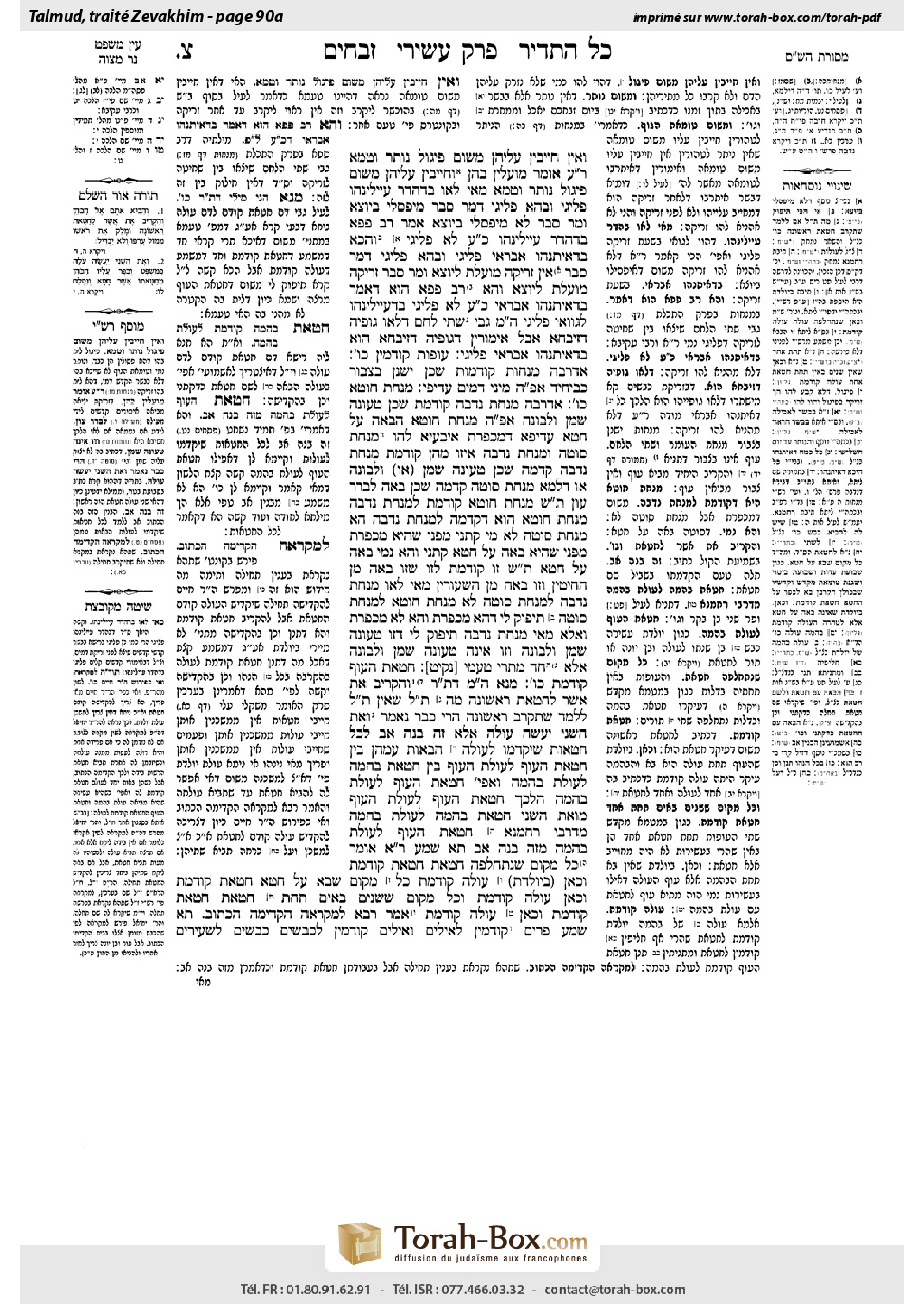
Zevachim 90a: Talmud study for Daf Yomi
Daf Yomi is the daily study of one Talmud folio. Explore 37 tractates with scans, Hebrew text, Sefaria English and AI-generated French translations where annotated.
Passage selection and English or AI-generated French translation are available where the scan has annotations. Daf Study is independent of Torah-Box and Sefaria.
Browse Zevachim · זבחים · All tractatesZevachim 90a text and translations
This page of Zevachim includes the Aramaic text, an English translation and an AI-generated French translation, alongside the scan above.
זבחים צ׳ א · Aramaic and Hebrew text
וְאֵין חַיָּיבִין עֲלֵיהֶן מִשּׁוּם פִּיגּוּל נוֹתָר וְטָמֵא; רַבִּי עֲקִיבָא אוֹמֵר: מוֹעֲלִין בָּהֶן, וְחַיָּיבִין עֲלֵיהֶן מִשּׁוּם פִּיגּוּל נוֹתָר וְטָמֵא.
מַאי, לָאו בְּדַהֲדַר עַיְּילִינְהוּ פְּלִיגִי? וּבְהָא פְּלִיגִי: דְּמָר סָבַר מִיפַּסְלִי בְּיוֹצֵא, וּמָר סָבַר לָא מִיפַּסְלִי בְּיוֹצֵא.
אָמַר רַב פָּפָּא: בְּדַהֲדַר עַיְּילִינְהוּ – כּוּלֵּי עָלְמָא לָא פְּלִיגִי; וְהָכָא בִּדְאִיתַנְהוּ אַבָּרַאי פְּלִיגִי, וּבְהָא פְּלִיגִי: דְּמָר סָבַר אֵין זְרִיקָה מוֹעֶלֶת לַיּוֹצֵא, וּמָר סָבַר זְרִיקָה מוֹעֶלֶת לַיּוֹצֵא.
וְהָא רַב פָּפָּא הוּא דְּאָמַר: בִּדְאִיתַנְהוּ אַבָּרַאי – כּוּלֵּי עָלְמָא לָא פְּלִיגִי, בִּדְעַיְּילִינְהוּ לְגַוַּואי פְּלִיגִי!
הָנֵי מִילֵּי גַּבֵּי שְׁתֵּי לֶחֶם – דְּלָאו גּוּפֵיהּ דְּזִיבְחָא; אֲבָל אֵימוּרִין, דְּגוּפֵיהּ דְּזִיבְחָא הוּא – בִּדְאִיתַנְהוּ אַבָּרַאי פְּלִיגִי.
עוֹפוֹת קוֹדְמִין כּוּ׳. אַדְּרַבָּה – מְנָחוֹת קוֹדְמוֹת, שֶׁכֵּן יֶשְׁנָן בְּצִבּוּר כְּבַיָּחִיד! אֲפִילּוּ הָכִי, מִינֵי דָמִים עֲדִיפִי.
מִנְחַת חוֹטֵא כּוּ׳. אַדְּרַבָּה – מִנְחַת נְדָבָה קוֹדֶמֶת, שֶׁכֵּן טְעוּנָה שֶׁמֶן וּלְבוֹנָה! אֲפִילּוּ הָכִי, מִנְחַת חוֹטֵא הַבָּאָה עַל חֵטְא עֲדִיפָא, דִּמְכַפֶּרֶת.
אִיבַּעְיָא לְהוּ: מִנְחַת סוֹטָה וּמִנְחַת נְדָבָה, אֵיזוֹ מֵהֶן קוֹדֶמֶת? מִנְחַת נְדָבָה קָדְמָה – שֶׁכֵּן טְעוּנָה שֶׁמֶן (אוֹ) וּלְבוֹנָה, אוֹ דִלְמָא מִנְחַת סוֹטָה קָדְמָה – שֶׁכֵּן בָּאָה לְבָרֵר עָוֹן?
תָּא שְׁמַע: מִנְחַת חוֹטֵא קוֹדֶמֶת לְמִנְחַת נְדָבָה. מִנְחַת חוֹטֵא הוּא דְּקָדְמָה לְמִנְחַת נְדָבָה, הָא מִנְחַת סוֹטָה – לָא! מִי קָתָנֵי ״מִפְּנֵי שֶׁהִיא מְכַפֶּרֶת״?! ״מִפְּנֵי שֶׁהִיא בָּאָה עַל חֵטְא״ קָתָנֵי, וְהָא נָמֵי בָּאָה עַל חֵטְא.
תָּא שְׁמַע: זוֹ קוֹדֶמֶת לָזוֹ, שֶׁזּוֹ בָּאָה מִן הַחִיטִּין וְזוֹ בָּאָה מִן הַשְּׂעוֹרִין. מַאי, לָאו מִנְחַת נְדָבָה לְמִנְחַת סוֹטָה? לָא, מִנְחַת חוֹטֵא לְמִנְחַת סוֹטָה.
תִּיפּוֹק לִי דְּהָא מְכַפְּרָא וְהָא לָא מְכַפְּרָא!
וְאֶלָּא מַאי, מִנְחַת נְדָבָה? תִּיפּוֹק לִי דְּזוֹ טְעוּנָה שֶׁמֶן וּלְבוֹנָה, וְזוֹ אֵינָהּ טְעוּנָה שֶׁמֶן וּלְבוֹנָה! אֶלָּא חַד מִתְּרֵי טַעְמֵי [נָקֵיט].
חַטַּאת הָעוֹף קוֹדֶמֶת כּוּ׳. מְנָא הָנֵי מִילֵּי? דְּתָנוּ רַבָּנַן: ״וְהִקְרִיב אֶת אֲשֶׁר לַחַטָּאת רִאשׁוֹנָה״ – מָה תַּלְמוּד לוֹמַר? שֶׁאֵין תַּלְמוּד לוֹמַר לְלַמֵּד שֶׁתִּקְרַב רִאשׁוֹנָה, הֲרֵי כְּבָר נֶאֱמַר: ״וְאֶת הַשֵּׁנִי יַעֲשֶׂה עֹלָה״.
אֶלָּא זֶה בָּנָה אָב לְכׇל חַטָּאוֹת שֶׁיִּקְדְּמוּ (לְעוֹלָה) [לְעוֹלוֹת] הַבָּאוֹת עִמָּהֶן – בֵּין חַטַּאת הָעוֹף לְעוֹלַת הָעוֹף, בֵּין חַטַּאת בְּהֵמָה לְעוֹלַת בְּהֵמָה, וַאֲפִילּוּ חַטַּאת הָעוֹף לְעוֹלַת בְּהֵמָה.
הִלְכָּךְ, חַטַּאת הָעוֹף לְעוֹלַת הָעוֹף – מִ״וְּאֶת הַשֵּׁנִי״, חַטַּאת בְּהֵמָה לְעוֹלַת בְּהֵמָה – מִדְּרַבִּי רַחֲמָנָא, חַטַּאת הָעוֹף לְעוֹלַת בְּהֵמָה – מִזֶּה בָּנָה אָב.
תָּא שְׁמַע, רַבִּי אֱלִיעֶזֶר אוֹמֵר: כׇּל מָקוֹם שֶׁנִּתְחַלְּפָה חַטָּאת – חַטָּאת קוֹדֶמֶת, וְכָאן (בְּיוֹלֶדֶת) – עוֹלָה קוֹדֶמֶת.
כׇּל מָקוֹם שֶׁבָּא עַל חֵטְא – חַטָּאת קוֹדֶמֶת, וְכָאן עוֹלָה קוֹדֶמֶת; וְכׇל מָקוֹם שֶׁשְּׁנַיִם בָּאִים תַּחַת חַטָּאת – חַטָּאת קוֹדֶמֶת, וְכָאן עוֹלָה קוֹדֶמֶת.
אָמַר רָבָא: לְמִקְרָאָהּ הִקְדִּימָהּ הַכָּתוּב.
תָּא שְׁמַע: פָּרִים קוֹדְמִין לְאֵילִים, וְאֵילִים קוֹדְמִין לִכְבָשִׁים, כְּבָשִׂים לִשְׂעִירִים.
Zevachim 90a · English translation
and one is not liable to receive karet for them due to prohibitions against eating piggul or notar, or for partaking of the flesh while he is ritually impure. All these prohibitions apply only if the sacrificial portions are otherwise fit for sacrifice. Rabbi Akiva says that one who benefits from them is liable for misuse of consecrated property, and one is liable to receive karet for eating them due to the prohibitions of piggul, notar, or partaking of the flesh while he is ritually impure.
The Gemara explains: What, is it not correct to say that they disagree with regard to a case where after taking the portions to be burned out of the Temple courtyard one then brought them back into the courtyard before the sprinkling of the blood? And, if so, it is with regard to this very point that they disagree: As one Sage, Rabbi Eliezer, holds that the portions are disqualified by leaving the courtyard, and one Sage, Rabbi Akiva, holds that the portions are not disqualified by leaving the courtyard.
The Gemara rejects this claim: Rav Pappa said that with regard to a case where after taking these portions out of the Temple courtyard one then brought them back into the courtyard before the sprinkling of the blood, everyone agrees they are fit. And here they disagree with regard to a case where these portions are outside the courtyard when the blood is sprinkled on the altar. And they disagree with regard to this following matter: As one Sage, Rabbi Eliezer, holds that the sprinkling of the blood is not effective with regard to those portions that were taken out of the courtyard, i.e., it does not render them fit, and one Sage, Rabbi Akiva, holds that the sprinkling of the blood is effective with regard to those portions that were taken out of the courtyard, i.e., it renders them fit.
The Gemara challenges: But Rav Pappa’s statement here apparently contradicts his claim concerning the two loaves brought with the two sheep on the festival of Shavuot. The sprinkling of the blood of the sheep renders those two loaves fit for consumption by the priests, and the dispute between Rabbi Eliezer and Rabbi Akiva also applies in that case. The Gemara elaborates: Rav Pappa is the one who said that with regard to a situation where the two loaves are outside the Temple courtyard when the blood of the two sheep is sprinkled on the altar, everyone, even Rabbi Akiva, agrees that the sprinkling does not render the two loaves fit, and therefore if one eats them he is not liable to receive karet due to the prohibition against eating piggul. Rather, the tanna’im disagree with regard to a case where one returned the loaves to within the Temple courtyard before the sprinkling of the blood.
The Gemara answers: This statement of Rav Pappa applies only to the two loaves, as they are not part of the offering itself. But with regard to the sacrificial portions, which are part of the offering itself, everyone agrees that they are rendered fit if they are within the Temple courtyard at the time the blood is sprinkled on the altar. Rabbi Eliezer and Rabbi Akiva disagree only with regard to a case where they are outside the Temple courtyard when the blood is sprinkled on the altar.
§ The mishna teaches: The bird offerings precede meal offerings due to the fact that they are types whose blood is presented, and atonement is effected by the blood. The Gemara challenges: On the contrary, meal offerings should precede bird offerings, as they are sacrificed both as communal offerings and as individual offerings, whereas there are no communal bird offerings. The Gemara explains: Even so, the fact that bird offerings are types whose blood is sprinkled is of greater importance.
The mishna further teaches: The meal offering of a sinner precedes a voluntary meal offering. The Gemara challenges: On the contrary, a voluntary meal offering should precede the meal offering of a sinner, as it requires oil and frankincense. The Gemara explains: Even so, the meal offering of a sinner, which comes due to a sin, is of greater importance, as it effects atonement.
§ A dilemma was raised before the Sages: With regard to the meal offering of a sota, a woman suspected by her husband of having committed adultery, and a voluntary meal offering being brought by someone at the same time, which of them precedes the other? Does the voluntary meal offering take precedence, as it requires oil and frankincense? Or perhaps the meal offering of a sota takes precedence, as it comes to clarify the woman’s transgression, as part of the rite performed with a sota.
The Gemara suggests: Come and hear, as the mishna states that the meal offering of a sinner precedes a voluntary meal offering. One can infer from this that it is only the meal offering of a sinner that precedes a voluntary meal offering, but the meal offering of a sota does not. The Gemara rejects this proof: Is the mishna teaching that the meal offering of a sinner takes precedence due to the fact that it effects atonement? The mishna teaches: Due to the fact that it comes because of a sin, and the meal offering of a sota also comes because of a sin, as she secluded herself with another man.
The Gemara further suggests: Come and hear the statement of a baraita: This meal offering precedes that meal offering, as this meal offering comes from wheat, and that meal offering comes from barley. What, does this baraita not refer to the precedence of a voluntary meal offering to the meal offering of a sota? The Gemara rejects this proof as well: No, the baraita is referring to the precedence of the meal offering of a sinner over the meal offering of a sota.
The Gemara responds: If the baraita is referring to the meal offering of a sinner, why is its precedence to the meal offering of a sota derived from the fact that the meal offering of a sinner comes from wheat, whereas the meal offering of a sota is brought from barley? I could derive the precedence of the meal offering of the sinner due to the fact that the meal offering of a sinner effects atonement and the meal offering of a sota does not effect atonement.
The Gemara counters: Rather, what is the baraita referring to? Is it referring to the precedence of a voluntary meal offering over the meal offering of a sota? If so, I could derive its precedence from the fact that this voluntary meal offering requires oil and frankincense and that meal offering of a sota does not require oil and frankincense. Rather, one cannot prove anything from the omission of an alternative explanation, as whichever way one interprets the baraita it clearly cited one of two reasons.
§ The mishna states: The sacrifice of the bird sin offering precedes the sacrifice of the bird burnt offering. The Gemara asks: From where are these matters derived? The Gemara answers: This is as the Sages taught in a baraita with regard to the bird sin offering and the bird burnt offering that a poor sinner sacrifices instead of an animal sin offering. The verse states: “And he shall offer that which is for the sin offering first” (Leviticus 5:8). Why must the verse state this? As there is no need for the verse to state this in order to teach that the sin offering is sacrificed first, as it is already stated: “And he shall prepare the second for a burnt offering” (Leviticus 5:10).
Rather, this verse established a paradigm for all sin offerings, teaching that they should precede the burnt offering that comes with them; whether in the case of a bird sin offering taking precedence over a bird burnt offering, whether in the case of an animal sin offering taking precedence over an animal burnt offering, and even with regard to a bird sin offering taking precedence over an animal burnt offering.
The Gemara summarizes: Therefore, the precedence of a bird sin offering over a bird burnt offering is learned from the verse: “And he shall prepare the second for a burnt offering.” The precedence of an animal sin offering over an animal burnt offering is derived from the fact that the Merciful One extends the halakha derived from the sin offering of the Levites (see 89a). Finally, the precedence of a bird sin offering over an animal burnt offering is derived from the principle stated in this baraita, that this verse established a paradigm for all sin offerings, teaching that they should precede the burnt offering that comes with them.
The Gemara suggests: Come and hear a further proof from a baraita. The Torah states that a woman who has given birth must bring a sheep as a burnt offering and a bird as a sin offering. If she is poor she may bring two birds: “One for a burnt offering and the other for a sin offering” (Leviticus 12:8). Rabbi Eliezer says: In every other instance where a bird offering is exchanged for an animal sin offering, the sin offering precedes the burnt offering. For example, in the case of the sliding scale sin offering brought for entering the Temple while ritually impure, where a poor person brings two birds, one as a sin offering and the other as a burnt offering, the sin offering comes first. But here, in the case of a woman who gave birth, the burnt offering takes precedence, as it takes the place of an animal burnt offering, mentioned first in the verse: “She shall bring a lamb in its first year for a burnt offering, and a pigeon or a dove for a sin offering (Leviticus 12:6).
Furthermore, in every instance where the sin offering comes because of a sin, the sin offering precedes the burnt offering. But here, in the case of a poor woman who gave birth, where the sin offering effects ritual purity rather than atonement, the burnt offering precedes the sin offering. And in every instance where two birds come instead of an animal for a sin offering, the sin offering precedes the burnt offering. But here, in the case of a poor woman who gave birth, the bird burnt offering replaces the animal burnt offering of a rich woman, whereas the bird sin offering is sacrificed even by a rich woman who gave birth. Therefore, in this particular case of a woman who gave birth, the burnt offering precedes the sin offering.
The straightforward reading of this baraita contradicts the statement of the previous baraita, which teaches that a sin offering always precedes a burnt offering. In order to reconcile the two baraitot, Rava said: The fact that the verse mentions the animal burnt offering first is only with regard to reading it, but in practice the sin offering is sacrificed first.
The Gemara suggests: Come and hear another baraita which apparently contradicts this principle. When there are different animal offerings to be sacrificed, bulls precede rams, and rams precede sheep, and sheep precede male goats.
Zevachim 90a · Traduction française (IA)
et l’on n’est pas passible de karet pour les avoir consommées en transgressant les interdictions de piggoul ou de notar, ni pour avoir mangé la chair en état d’impureté rituelle. Toutes ces interdictions ne s’appliquent que si les parts sacrificielles sont par ailleurs aptes à être offertes. Rabbi Akiva dit que celui qui en tire profit est passible pour usage abusif de biens consacrés, et que l’on est passible de karet pour les avoir consommées en transgressant les interdictions de piggoul, de notar ou de consommation de la chair en état d’impureté rituelle.
La Guemara explique : N’est-il pas juste de dire qu’ils sont en désaccord dans le cas où, après avoir sorti de la cour du Temple les parts destinées à être brûlées, on les y a rapportées avant l’aspersion du sang ? Si tel est le cas, leur désaccord porte précisément sur ce point : un Sage, Rabbi Eliezer, estime que les parts sont invalidées par leur sortie de la cour, tandis qu’un autre Sage, Rabbi Akiva, estime qu’elles ne le sont pas.
La Guemara rejette cette affirmation : Rav Pappa dit que, dans le cas où, après avoir sorti ces parts de la cour du Temple, on les y a rapportées avant l’aspersion du sang, tous conviennent qu’elles sont aptes. Ici, ils sont en désaccord dans le cas où ces parts se trouvent hors de la cour au moment où le sang est aspergé sur l’autel. Leur désaccord porte sur le point suivant : un Sage, Rabbi Eliezer, estime que l’aspersion du sang n’est pas efficace à l’égard des parts qui ont été sorties de la cour, c’est-à-dire qu’elle ne les rend pas aptes, tandis qu’un autre Sage, Rabbi Akiva, estime qu’elle est efficace à leur égard, c’est-à-dire qu’elle les rend aptes.
La Guemara objecte : Mais la déclaration de Rav Pappa ici semble contredire son affirmation concernant les deux pains apportés avec les deux agneaux lors de la fête de Chavouot. L’aspersion du sang des agneaux rend ces deux pains propres à être consommés par les prêtres, et le désaccord entre Rabbi Eliezer et Rabbi Akiva s’applique aussi dans ce cas. La Guemara précise : C’est Rav Pappa qui a dit que, lorsque les deux pains se trouvent hors de la cour du Temple au moment où le sang des deux agneaux est aspergé sur l’autel, tous, même Rabbi Akiva, conviennent que l’aspersion ne les rend pas aptes à être consommés ; par conséquent, celui qui les mange n’est pas passible de karet pour avoir consommé du piggoul. Les tannaïm sont plutôt en désaccord dans le cas où l’on a rapporté les pains à l’intérieur de la cour du Temple avant l’aspersion du sang.
La Guemara répond : Cette déclaration de Rav Pappa ne s’applique qu’aux deux pains, car ils ne font pas partie du sacrifice lui-même. Mais pour les parts sacrificielles, qui font partie du sacrifice lui-même, tous conviennent qu’elles sont rendues aptes si elles se trouvent dans la cour du Temple au moment où le sang est aspergé sur l’autel. Rabbi Eliezer et Rabbi Akiva ne sont en désaccord que dans le cas où elles se trouvent hors de la cour du Temple au moment de l’aspersion du sang sur l’autel.
§ La Michna enseigne : Les offrandes d’oiseaux précèdent les offrandes de farine, car leur sang est présenté et l’expiation est accomplie par le sang. La Guemara objecte : Au contraire, les offrandes de farine devraient précéder les offrandes d’oiseaux, puisqu’elles sont offertes aussi bien comme sacrifices communautaires que comme sacrifices individuels, tandis qu’il n’existe pas d’offrandes communautaires d’oiseaux. La Guemara explique : Malgré cela, le fait que les offrandes d’oiseaux soient des sacrifices dont le sang est aspergé revêt une plus grande importance.
La Michna enseigne également : L’offrande de farine d’un pécheur précède une offrande de farine volontaire. La Guemara objecte : Au contraire, une offrande de farine volontaire devrait précéder l’offrande de farine d’un pécheur, puisqu’elle requiert de l’huile et de l’encens. La Guemara explique : Malgré cela, l’offrande de farine d’un pécheur, qui est apportée à cause d’une faute, revêt une plus grande importance, car elle accomplit l’expiation.
§ Une question fut posée aux Sages : Lorsque l’offrande de farine d’une sota, une femme que son mari soupçonne d’avoir commis un adultère, et une offrande de farine volontaire sont apportées au même moment, laquelle des deux précède l’autre ? L’offrande de farine volontaire a-t-elle la priorité, puisqu’elle requiert de l’huile et de l’encens ? Ou bien l’offrande de farine de la sota a-t-elle la priorité, puisqu’elle sert à clarifier la transgression de la femme, dans le cadre du rite accompli pour une sota ?
La Guemara suggère : Viens et écoute, car la Michna enseigne que l’offrande de farine d’un pécheur précède une offrande de farine volontaire. On peut en déduire que seule l’offrande de farine d’un pécheur précède une offrande de farine volontaire, mais que l’offrande de farine d’une sota ne la précède pas. La Guemara rejette cette preuve : La Michna enseigne-t-elle que l’offrande de farine d’un pécheur a la priorité parce qu’elle accomplit l’expiation ? Elle enseigne qu’elle a la priorité parce qu’elle est apportée à cause d’une faute. Or, l’offrande de farine de la sota est elle aussi apportée à cause d’une faute, puisqu’elle s’est isolée avec un autre homme.
La Guemara suggère en outre : Viens et écoute l’enseignement d’une baraïta : Cette offrande de farine précède cette autre offrande de farine, car la première est faite de blé, tandis que l’autre est faite d’orge. Cette baraïta ne parle-t-elle pas de la priorité d’une offrande de farine volontaire sur l’offrande de farine d’une sota ? La Guemara rejette aussi cette preuve : Non, la baraïta parle de la priorité de l’offrande de farine d’un pécheur sur celle d’une sota.
La Guemara répond : Si la baraïta parle de l’offrande de farine d’un pécheur, pourquoi sa priorité sur l’offrande de farine de la sota est-elle déduite du fait que l’offrande du pécheur est faite de blé, alors que celle de la sota est faite d’orge ? Je pourrais déduire la priorité de l’offrande du pécheur du fait qu’elle accomplit l’expiation, contrairement à l’offrande de farine de la sota.
La Guemara objecte : Alors, de quoi parle la baraïta ? De la priorité d’une offrande de farine volontaire sur l’offrande de farine d’une sota ? Dans ce cas, je pourrais déduire sa priorité du fait que cette offrande de farine volontaire requiert de l’huile et de l’encens, contrairement à l’offrande de farine de la sota. On ne peut donc rien prouver de l’omission d’une autre explication, car, quelle que soit l’interprétation donnée à la baraïta, elle a manifestement cité l’une des deux raisons.
§ La Michna enseigne : Le sacrifice expiatoire d’oiseau précède l’holocauste d’oiseau. La Guemara demande : De quelle source ces règles sont-elles déduites ? La Guemara répond : C’est ce que les Sages ont enseigné dans une baraïta au sujet du sacrifice expiatoire d’oiseau et de l’holocauste d’oiseau qu’un pécheur pauvre offre à la place d’un sacrifice expiatoire animal. Le verset dit : « Il offrira d’abord celui qui est destiné au sacrifice expiatoire » (Lévitique 5, 8). Pourquoi le verset doit-il le préciser ? Il n’est pas nécessaire de le dire pour enseigner que le sacrifice expiatoire est offert en premier, car il est déjà dit : « Il préparera le second pour un holocauste » (Lévitique 5, 10).
Ce verset établit plutôt un modèle pour tous les sacrifices expiatoires, enseignant qu’ils doivent précéder l’holocauste qui les accompagne : qu’il s’agisse d’un sacrifice expiatoire d’oiseau qui précède un holocauste d’oiseau, d’un sacrifice expiatoire animal qui précède un holocauste animal, ou même d’un sacrifice expiatoire d’oiseau qui précède un holocauste animal.
La Guemara résume : Ainsi, la priorité du sacrifice expiatoire d’oiseau sur l’holocauste d’oiseau est déduite du verset : « Il préparera le second pour un holocauste. » La priorité d’un sacrifice expiatoire animal sur un holocauste animal est déduite du fait que le Miséricordieux étend la halakha déduite du sacrifice expiatoire des Lévites (voir 89a). Enfin, la priorité du sacrifice expiatoire d’oiseau sur un holocauste animal est déduite du principe énoncé dans cette baraïta : ce verset établit un modèle pour tous les sacrifices expiatoires, enseignant qu’ils doivent précéder l’holocauste qui les accompagne.
La Guemara suggère : Viens et écoute une autre preuve tirée d’une baraïta. La Torah stipule qu’une femme qui a accouché doit apporter un mouton en holocauste et un oiseau en sacrifice expiatoire. Si elle est pauvre, elle peut apporter deux oiseaux : « L’un pour un holocauste et l’autre pour un sacrifice expiatoire » (Lévitique 12, 8). Rabbi Eliezer dit : Dans tous les autres cas où un sacrifice d’oiseau remplace un sacrifice expiatoire animal, le sacrifice expiatoire précède l’holocauste. Par exemple, dans le cas du sacrifice expiatoire à échelle variable apporté pour être entré dans le Temple en état d’impureté rituelle, un pauvre apporte deux oiseaux, l’un en sacrifice expiatoire et l’autre en holocauste, et le sacrifice expiatoire vient en premier. Mais ici, dans le cas d’une femme qui a accouché, l’holocauste a la priorité, car il remplace un holocauste animal, mentionné en premier dans le verset : « Elle apportera un agneau de la première année en holocauste, et une tourterelle ou un jeune pigeon en sacrifice expiatoire » (Lévitique 12, 6).
En outre, dans tous les cas où le sacrifice expiatoire est apporté à cause d’une faute, il précède l’holocauste. Mais ici, dans le cas d’une femme pauvre qui a accouché, où le sacrifice expiatoire rétablit la pureté rituelle plutôt que d’accomplir l’expiation, l’holocauste précède le sacrifice expiatoire. Et dans tous les cas où deux oiseaux sont apportés à la place d’un animal pour un sacrifice expiatoire, le sacrifice expiatoire précède l’holocauste. Mais ici, dans le cas d’une femme pauvre qui a accouché, l’holocauste d’oiseau remplace l’holocauste animal qu’apporte une femme aisée, tandis que le sacrifice expiatoire d’oiseau est offert même par une femme aisée qui a accouché. Par conséquent, dans ce cas particulier d’une femme qui a accouché, l’holocauste précède le sacrifice expiatoire.
Le sens évident de cette baraïta contredit l’enseignement de la baraïta précédente, selon lequel un sacrifice expiatoire précède toujours un holocauste. Pour concilier les deux baraïtot, Rava dit : Le fait que le verset mentionne l’holocauste animal en premier ne concerne que l’ordre de lecture ; en pratique, c’est le sacrifice expiatoire qui est offert en premier.
La Guemara suggère : Viens et écoute une autre baraïta, qui semble contredire ce principe. Lorsque différents sacrifices animaux doivent être offerts, les taureaux précèdent les béliers, les béliers précèdent les moutons, et les moutons précèdent les boucs.
Traduction française générée par IA à partir de l’édition anglaise de Sefaria. Vérifie toujours un passage avec le texte source.
Text from Sefaria: William Davidson Edition - Vocalized Aramaic (CC BY NC); William Davidson Edition - English (CC BY NC).