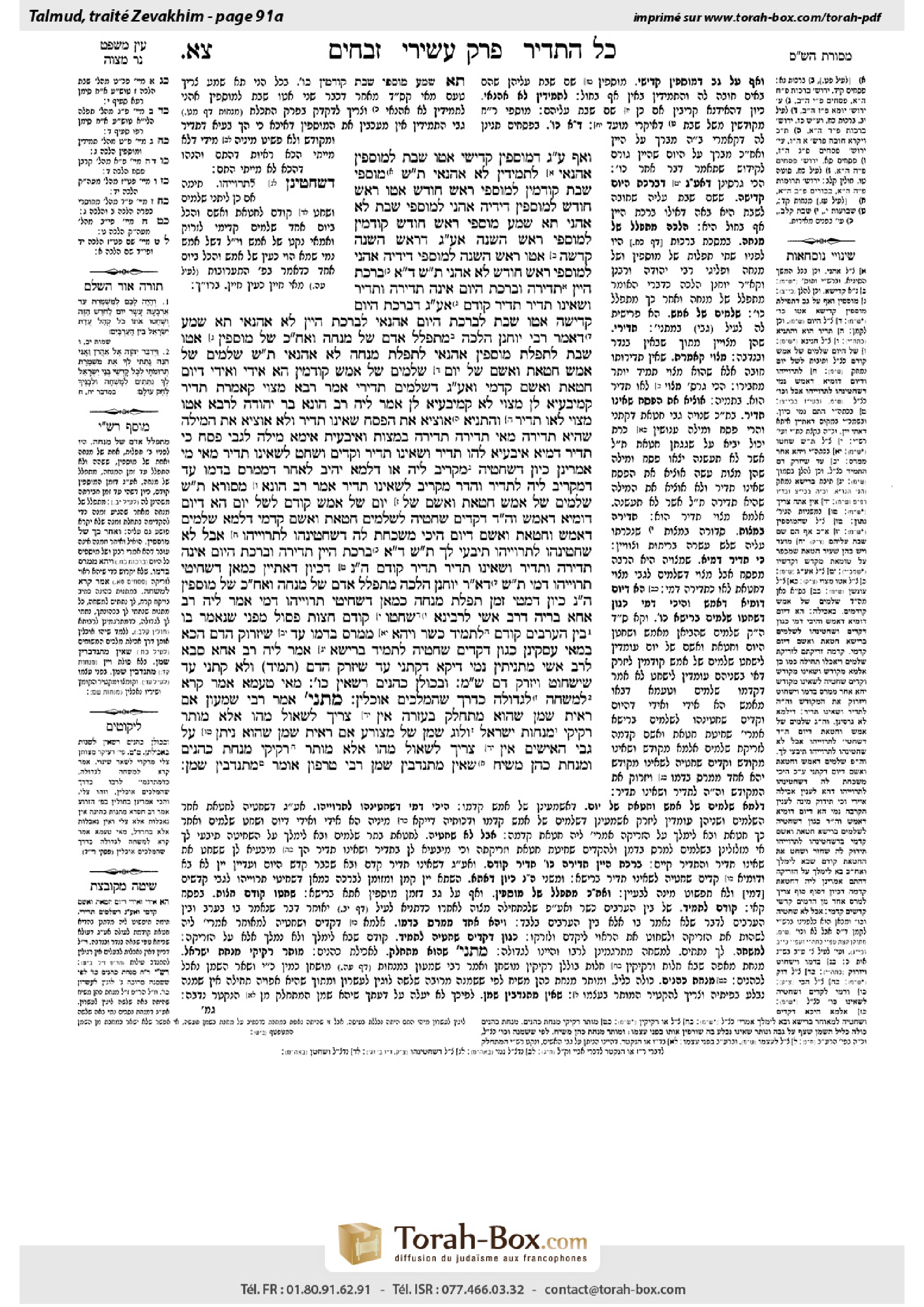
Zevachim 91a: Talmud study for Daf Yomi
Daf Yomi is the daily study of one Talmud folio. Explore 37 tractates with scans, Hebrew text, Sefaria English and AI-generated French translations where annotated.
Passage selection and English or AI-generated French translation are available where the scan has annotations. Daf Study is independent of Torah-Box and Sefaria.
Browse Zevachim · זבחים · All tractatesZevachim 91a text and translations
This page of Zevachim includes the Aramaic text, an English translation and an AI-generated French translation, alongside the scan above.
זבחים צ״א א · Aramaic and Hebrew text
וְאַף עַל גַּב דְּמוּסָפִין קַדִּישִׁי! אַטּוּ שַׁבָּת לְמוּסָפִין אַהֲנַאי, לִתְמִידִין לָא אַהֲנַאי?!
תָּא שְׁמַע: מוּסְפֵי שַׁבָּת קוֹדְמִין לְמוּסְפֵי רֹאשׁ חוֹדֶשׁ! אַטּוּ רֹאשׁ חוֹדֶשׁ לְמוּסָפִין דִּידֵיהּ אַהֲנִי, לְמוּסְפֵי שַׁבָּת לָא אַהֲנִי?!
תָּא שְׁמַע: מוּסְפֵי רֹאשׁ חוֹדֶשׁ קוֹדְמִין לְמוּסְפֵי רֹאשׁ הַשָּׁנָה. אַף עַל גַּב דְּרֹאשׁ הַשָּׁנָה קַדִּשָׁה! אַטּוּ רֹאשׁ הַשָּׁנָה לְמוּסְפֵי דִּידֵיהּ אַהֲנִי, לְמוּסְפֵי רֹאשׁ חוֹדֶשׁ לָא אַהֲנִי?!
תָּא שְׁמַע: דָּבָר אַחֵר – בִּרְכַּת הַיַּיִן תְּדִירָה וּבִרְכַּת הַיּוֹם אֵינָהּ תְּדִירָה, וְתָדִיר וְשֶׁאֵינוֹ תָּדִיר – תָּדִיר קוֹדֵם. אַף עַל גַּב דְּבִרְכַּת הַיּוֹם קַדִּישָׁה! אַטּוּ שַׁבָּת לְבִרְכַּת הַיּוֹם אַהֲנַאי, לְבִרְכַּת הַיַּיִן לָא אַהֲנַאי?!
תָּא שְׁמַע, דְּאָמַר רַבִּי יוֹחָנָן: הֲלָכָה – מִתְפַּלֵּל אָדָם שֶׁל מִנְחָה, וְאַחַר כָּךְ שֶׁל מוּסָפִין! אַטּוּ שַׁבָּת לִתְפִלַּת מוּסָפִין אַהֲנַאי, לִתְפִלַּת מִנְחָה לָא אַהֲנַאי?!
תָּא שְׁמַע: שְׁלָמִים שֶׁל אֶמֶשׁ, חַטָּאת וְאָשָׁם שֶׁל יוֹם – שְׁלָמִים שֶׁל אֶמֶשׁ קוֹדְמִין. הָא אִידֵּי וְאִידֵּי דְּיוֹם – חַטָּאת וְאָשָׁם קָדְמִי, וְאַף עַל גַּב דִּשְׁלָמִים תְּדִירִי!
אָמַר רָבָא: מָצוּי קָאָמְרַתְּ?! תָּדִיר קָמִיבַּעְיָא לַן, מָצוּי לָא קָמִיבַּעְיָא לַן.
אֲמַר לֵיהּ רַב הוּנָא בַּר יְהוּדָה לְרָבָא: אַטּוּ מָצוּי לָאו תָּדִיר?! וְהָתַנְיָא: אוֹצִיא אֶת הַפֶּסַח שֶׁאֵינוֹ תָּדִיר, וְלֹא אוֹצִיא אֶת הַמִּילָה שֶׁהִיא תְּדִירָה!
מַאי תְּדִירָה – תְּדִירָה בְּמִצְוֹת. וְאִיבָּעֵית אֵימָא: מִילָה לְגַבֵּי פֶּסַח – כִּי תָדִיר דָּמְיָא.
אִיבַּעְיָא לְהוּ: תָּדִיר וְשֶׁאֵינוֹ תָּדִיר, וּקְדֵים וּשְׁחַט לְשֶׁאֵינוֹ תָּדִיר, מַאי? מִי אָמְרִינַן: כֵּיוָן דְּשַׁחְטֵיהּ – מַקְרֵיב לֵיהּ; אוֹ דִלְמָא, יָהֵיב לְאַחֵר דִּמְמָרֵס בְּדָמוֹ עַד דְּמַקְרֵיב לֵיהּ לְתָדִיר, וַהֲדַר מַקְרֵיב לְשֶׁאֵינוֹ תָּדִיר?
אָמַר רַב הוּנָא מִסּוּרָא, תָּא שְׁמַע: שְׁלָמִים שֶׁל אֶמֶשׁ, חַטָּאת וְאָשָׁם שֶׁל יוֹם – שֶׁל אֶמֶשׁ קוֹדֵם לְשֶׁל יוֹם. הָא דְּיוֹם דּוּמְיָא דְּאֶמֶשׁ –
וְהֵיכִי דָּמֵי, דִּקְדֵים שַׁחְטֵיהּ לִשְׁלָמִים – חַטָּאת וְאָשָׁם קָדְמִי!
דִּלְמָא שְׁלָמִים דְּאֶמֶשׁ וְחַטָּאת וְאָשָׁם דְּיוֹם הֵיכִי מַשְׁכַּחַתְּ לַהּ – דְּשַׁחְטִינְהוּ לְתַרְוַיְיהוּ; אֲבָל לָא שַׁחְטִינְהוּ לְתַרְוַיְיהוּ – תִּיבְּעֵי לָךְ.
תָּא שְׁמַע: דָּבָר אַחֵר – בִּרְכַּת הַיַּיִן תְּדִירָה וּבִרְכַּת הַיּוֹם אֵינָהּ תְּדִירָה, וְתָדִיר וְשֶׁאֵינוֹ תָּדִיר – תָּדִיר קוֹדֵם!
הָכָא נָמֵי, דְּכֵיוָן (דְּאָתְיָין) [דַּאֲתָא יַיִן] – כְּמַאן דִּשְׁחִיטִי תַּרְוַיְיהוּ דָּמֵי.
תָּא שְׁמַע, דְּאָמַר רַבִּי יוֹחָנָן: הֲלָכָה, מִתְפַּלֵּל אָדָם שֶׁל מִנְחָה וְאַחַר כָּךְ שֶׁל מוּסָפִין! הָכָא נָמֵי, כֵּיוָן דְּמָטֵי זְמַן תְּפִלַּת מִנְחָה – כְּמַאן דִּשְׁחִיטִי תַּרְוַיְיהוּ דָּמֵי.
אֲמַר לֵיהּ רַב אַחָא בְּרֵיהּ דְּרַב אָשֵׁי לְרָבִינָא: שְׁחָטוֹ קוֹדֶם חֲצוֹת – פָּסוּל, מִפְּנֵי שֶׁנֶּאֱמַר בּוֹ ״בֵּין הָעַרְבָּיִם״. קוֹדֶם לַתָּמִיד – כָּשֵׁר, וִיהֵא מְמָרֵס בְּדָמוֹ עַד שֶׁיִּזְרוֹק הַדָּם!
הָכָא בְּמַאי עָסְקִינַן, כְּגוֹן דִּקְדֵים שַׁחְטֵיהּ לְתָמִיד בְּרֵישָׁא. אֲמַר לֵיהּ רַב אַחָא סָבָא לְרַב אָשֵׁי: מַתְנִיתִין נָמֵי דַּיְקָא – דְּקָתָנֵי ״עַד שֶׁיִּזָּרֵק הַדָּם״ (תָּמִיד), וְלָא קָתָנֵי ״עַד שֶׁיִּשְׁחוֹט וְיִזְרֹק דָּם״. שְׁמַע מִינַּהּ.
וּבְכוּלָּן כֹּהֲנִים רַשָּׁאִין כּוּ׳. מַאי טַעְמָא? אָמַר קְרָא ״לְמׇשְׁחָה״ – לִגְדוּלָּה, כְּדֶרֶךְ שֶׁהַמְּלָכִים אוֹכְלִין.
מַתְנִי׳ אָמַר רַבִּי שִׁמְעוֹן: אִם רָאִיתָ שֶׁמֶן שֶׁהוּא מִתְחַלֵּק בַּעֲזָרָה – אֵין צָרִיךְ לִשְׁאוֹל מַהוּ; אֶלָּא מוֹתַר רְקִיקֵי מְנָחוֹת יִשְׂרָאֵל, וְלוֹג שֶׁמֶן שֶׁל מְצוֹרָע.
אִם רָאִיתָ שֶׁמֶן שֶׁהוּא נִיתָּן עַל גַּבֵּי הָאִישִּׁים – אֵין צָרִיךְ לִשְׁאוֹל מַהוּ; אֶלָּא מוֹתַר רְקִיקֵי מִנְחַת כֹּהֲנִים וּמִנְחַת כֹּהֵן מָשִׁיחַ, שֶׁאֵין מִתְנַדְּבִין שֶׁמֶן. רַבִּי טַרְפוֹן אוֹמֵר: מִתְנַדְּבִין שֶׁמֶן.
Zevachim 91a · English translation
And even though the additional offerings are of greater sanctity, as they are sacrificed due to the sanctity of Shabbat, the frequent offering precedes the offering of greater sanctity. The Gemara rejects this proof: Is that to say that the sanctity of Shabbat affects the sanctity of the additional offerings but does not affect the daily offerings brought on Shabbat? Rather, the sanctity of Shabbat elevates the sanctity of the daily offerings as well, and as both are of equal sanctity, the frequent daily offering precedes the additional offerings.
The Gemara cites another proof: Come and hear the continuation of this mishna: The additional Shabbat offerings precede the additional New Moon offerings because they are more frequent, despite the fact that the New Moon elevates the sanctity of its additional offerings. The Gemara rejects this proof in a similar manner: Is that to say that the sanctity of the New Moon affects the sanctity of its additional offerings but does not affect the additional offerings of Shabbat? These additional offerings are also imbued with the sanctity of the New Moon.
The Gemara cites another proof: Come and hear the continuation of this mishna: The additional New Moon offerings precede the additional New Year offerings because they are more frequent, even though the New Year is of greater sanctity. The Gemara rejects this proof as well: Is that to say that the sanctity of the New Year affects the sanctity of its additional offerings but does not affect the additional offerings of the New Moon?
The Gemara cites another proof: Come and hear a baraita (Tosefta, Berakhot 5:25) that discusses the dispute between Beit Shammai and Beit Hillel with regard to the order of blessings in kiddush. After stating one reason for the opinion of Beit Hillel that one recites the blessing on the wine before the blessing of the sanctity of the day, the Tosefta adds: Alternatively, Beit Hillel say: The blessing over wine is recited frequently, and the blessing over the day is not recited frequently, and there is a principle: When a frequent practice and an infrequent practice clash, the frequent practice takes precedence over the infrequent practice. This applies even though the blessing of the day is of greater sanctity, as it is recited due to the sanctity of Shabbat. The Gemara rejects this proof as well: Is that to say that the sanctity of Shabbat affects the sanctity of the blessing of the day but does not affect the sanctity of the blessing on the wine?
The Gemara cites another proof: Come and hear, as Rabbi Yoḥanan says: If one did not recite the additional prayer on Shabbat until the time of the afternoon prayer arrived, the halakha is that a person prays the afternoon prayer and afterward the additional prayer, as the afternoon prayer is more frequent. This ruling applies despite the fact that the additional prayer is of greater sanctity. Once again the Gemara rejects the proof: Is that to say that the sanctity of Shabbat affects the sanctity of the additional prayer but does not affect the sanctity of the afternoon prayer?
The Gemara cites yet another proof. Come and hear the mishna: If one has a peace offering from yesterday and a sin offering or a guilt offering from today, the peace offering from yesterday precedes the others; this is the statement of Rabbi Meir. One can infer from this that if both this offering and that offering are from today, the sin offering or guilt offering takes precedence, and this is the halakha even though the peace offering is more frequent, as people sacrifice voluntary peace offerings more often than sin offerings or guilt offerings.
Rava said in response: Are you speaking of a common offering? Although peace offerings are sacrificed more often than sin offerings, there is no obligation to sacrifice them at any particular frequency. We raise the dilemma only with regard to a clash between a frequent offering and one of greater sanctity, but we do not raise the dilemma with regard to a common offering.
Rav Huna bar Yehuda said to Rava: Is that to say that a common obligation is not considered tantamount to a frequent obligation? But isn’t it taught in a baraita with regard to positive mitzvot whose intentional neglect results in the punishment of karet but whose unwitting transgression does not entail the sacrifice of a sin offering: I should exclude the neglect of the Paschal offering from the obligation to sacrifice a sin offering, as it is not frequent, and I should not exclude the neglect of the mitzva of circumcision, as it is frequent? Circumcision is considered a frequent mitzva, as it is performed more often than the Paschal offering, despite the fact that there is no obligation to perform circumcisions at any particular frequency.
Rava answers: What is the meaning of frequent in that context? It means that circumcision is frequent in terms of the numerous mitzvot commanded with regard to its fulfillment. And if you wish, say instead that circumcision in relation to the Paschal offering is considered like a frequent obligation, as it occurs far more often, whereas peace offerings are brought only somewhat more often than sin offerings. In sum, one cannot infer from the mishna that an offering of greater sanctity precedes a frequent offering.
§ An additional dilemma with regard to precedence was raised before the Sages: If the priest had two offerings to sacrifice, a frequent offering and an infrequent offering, and although he should have initially sacrificed the frequent offering he slaughtered the infrequent offering first, what is the halakha? Do we say that since he already slaughtered the infrequent offering he also proceeds to sacrifice it? Or perhaps he does not yet sacrifice it but gives it to another priest, who stirs its blood to prevent it from congealing, until he sacrifices the frequent offering; and then he sacrifices the infrequent offering.
Rav Huna from Sura said: Come and hear an answer from the mishna: If one has a peace offering from yesterday and a sin offering or a guilt offering from today, the peace offering from yesterday precedes the sin offering from today. It can be assumed that the mishna is not discussing a case where none of the offerings have been slaughtered, as the peace offering would not take precedence in this situation. Rather, it is discussing a peace offering from yesterday that was slaughtered but its blood has not yet been presented. One can infer from this that only a peace offering from yesterday takes precedence in this situation, but in the case of a peace offering from today that is similar in other aspects to a peace offering from yesterday, the peace offering does not take precedence.
The Gemara explains: And what are the circumstances of this case? This is a situation where one first slaughtered the peace offering from today. In this case the sin offering or guilt offering takes precedence, although the peace offering is already slaughtered, as both of them are of greater sanctity. The same should apply to an infrequent offering that was slaughtered before a frequent offering: The frequent offering is slaughtered before the blood of the infrequent offering is presented.
The Gemara rejects this answer: Perhaps when the mishna makes reference to a peace offering from yesterday and a sin offering or a guilt offering from today, the circumstances should be understood differently. How can you find these other circumstances? The mishna discusses a case where the priest already slaughtered both of them, the peace offering and the sin or guilt offering, and the blood of both awaits presentation on the altar. But had he not yet slaughtered both of them, but only the peace offering, you can still raise the dilemma of whether the priest should set aside the blood of the peace offering in order to slaughter the sin offering first, due to its greater sanctity.
The Gemara cites another proof: Come and hear the aforementioned baraita: Alternatively, Beit Hillel say: With regard to the order of blessings in kiddush, the blessing on wine is recited frequently and the blessing of the day is not recited frequently, and there is a principle: When a frequent practice and an infrequent practice clash, the frequent practice takes precedence over the infrequent practice. The obligation to recite the blessing of the day is due to the sanctity of Shabbat and applies at the start of Shabbat, before wine is placed on the table. Nevertheless, the blessing on the wine takes precedence due to its frequency. So too, the slaughtering of the frequent offering should take precedence, even if the priest had already commenced the sacrificial rites of the infrequent offering.
The Gemara rejects this proof: Here too, with regard to kiddush, the circumstances are different, since wine is available when one recites kiddush, and therefore the obligation of both blessings come together. This means that it is comparable to a situation where one already slaughtered both animals.
The Gemara cites yet another proof: Come and hear, as Rabbi Yoḥanan says: The halakha is that a person prays the afternoon prayer and afterward the additional prayer, despite the fact that the obligation of the additional prayer applies first, which is similar to an offering slaughtered first. The Gemara rejects this proof: Here too, since the time of the afternoon prayer has now arrived, one is obligated in both prayers, and again this is comparable to a situation where one already slaughtered both animals.
Rav Aḥa, son of Rav Ashi, said to Ravina that an answer to this dilemma can be found in a mishna (Pesaḥim 61a): If one slaughtered the Paschal offering before midday it is disqualified, because it is stated in its regard: “In the afternoon” (Exodus 12:6). If he slaughtered it before the daily afternoon offering was slaughtered it is valid, even though the daily offering should be sacrificed first, but someone should stir its blood to prevent it from congealing until he slaughters and sprinkles the blood of the daily offering. Although the infrequent Paschal offering is already slaughtered, the priest first slaughters the frequent daily offering and then sprinkles the blood of the Paschal offering.
The Gemara rejects this proof as well: Here we are dealing with a case where he gave precedence to the daily offering and slaughtered it first, and then slaughtered the Paschal offering before sprinkling the blood of the daily offering. Since the blood of both offerings requires sprinkling on the altar, the blood of the daily offering takes precedence. Rav Aḥa the Elder said to Rav Ashi that the wording of the mishna is also precise, as it teaches: Until the blood of the daily offering is sprinkled, and does not teach: Until he slaughters and sprinkles the blood. This indicates that the daily afternoon offering has already been slaughtered. The Gemara affirms: Conclude from its wording that this is the meaning of the mishna.
§ The mishna teaches: And with regard to all of the offerings that are eaten, the priests are permitted to alter the manner of their consumption and eat them as they choose. The Gemara asks: What is the reason for this halakha? The Gemara answers: The verse states, with regard to the gifts of the priesthood: “Of all the consecrated items of the children of Israel to you have I given them lemoshḥa” (Numbers 18:8). Targum Onkelos renders this term as: For greatness, indicating that the flesh of the offerings should be eaten in the manner that kings eat their food, i.e., prepared in any way they want.
MISHNA: Rabbi Shimon said: If you saw oil that is being distributed in the Temple courtyard for consumption by the priests and you seek to ascertain its nature, you do not need to ask what it is. Rather, it is left over from the oil of the wafers of the meal offerings of Israelites after they smeared a bit of oil on them, or it is left over from the log of oil of a leper after a small amount of the oil was placed on him.
If you saw oil that is placed on the flames of the altar in the manner of an offering, you do not need to ask what it is. Rather, it is left over from the oil of the wafers of the meal offering of priests, or it is the leftover oil from the meal offering of the anointed priest, which requires a great deal of oil and which is burned in its entirety on the altar. The mishna adds: One cannot say that the oil distributed to priests or burned on the altar was brought as a gift offering, as one may not contribute oil as a gift offering. Rabbi Tarfon says: One may contribute oil as a gift offering.
Zevachim 91a · Traduction française (IA)
Et bien que les offrandes supplémentaires aient une sainteté supérieure, puisqu’elles sont offertes en raison de la sainteté du Chabbat, l’offrande fréquente précède l’offrande de plus grande sainteté. La Guemara rejette cette preuve : cela signifie-t-il que la sainteté du Chabbat influe sur la sainteté des offrandes supplémentaires, mais non sur celle des offrandes quotidiennes offertes le Chabbat ? Au contraire, la sainteté du Chabbat élève également celle des offrandes quotidiennes ; les deux ayant une sainteté égale, l’offrande quotidienne fréquente précède les offrandes supplémentaires.
La Guemara cite une autre preuve : viens et entends la suite de cette Michna : les offrandes supplémentaires du Chabbat précèdent celles de la Nouvelle Lune parce qu’elles sont plus fréquentes, bien que la Nouvelle Lune élève la sainteté de ses offrandes supplémentaires. La Guemara rejette cette preuve de la même manière : cela signifie-t-il que la sainteté de la Nouvelle Lune influe sur la sainteté de ses offrandes supplémentaires, mais non sur celle des offrandes supplémentaires du Chabbat ? Ces dernières sont elles aussi imprégnées de la sainteté de la Nouvelle Lune.
La Guemara cite une autre preuve : viens et entends la suite de cette Michna : les offrandes supplémentaires de la Nouvelle Lune précèdent celles du Nouvel An parce qu’elles sont plus fréquentes, bien que le Nouvel An ait une sainteté supérieure. La Guemara rejette également cette preuve : cela signifie-t-il que la sainteté du Nouvel An influe sur la sainteté de ses offrandes supplémentaires, mais non sur celle des offrandes supplémentaires de la Nouvelle Lune ?
La Guemara cite une autre preuve : viens et entends une baraïta (Tosefta, Berakhot 5:25) qui traite du désaccord entre Beit Shammaï et Beit Hillel concernant l’ordre des bénédictions du kiddouch. Après avoir donné une raison à l’opinion de Beit Hillel, selon laquelle on récite la bénédiction sur le vin avant celle qui porte sur la sainteté du jour, la Tosefta ajoute : Beit Hillel disent aussi que la bénédiction sur le vin est récitée fréquemment, tandis que celle sur le jour ne l’est pas, et qu’il existe un principe : lorsqu’une pratique fréquente et une pratique peu fréquente entrent en conflit, la pratique fréquente a priorité sur la pratique peu fréquente. Cela s’applique même si la bénédiction du jour a une sainteté supérieure, puisqu’elle est récitée en raison de la sainteté du Chabbat. La Guemara rejette également cette preuve : cela signifie-t-il que la sainteté du Chabbat influe sur celle de la bénédiction du jour, mais non sur celle de la bénédiction sur le vin ?
La Guemara cite une autre preuve : viens et entends ce que dit Rabbi Yoḥanan : si quelqu’un n’a pas récité la prière supplémentaire du Chabbat avant l’arrivée de l’heure de la prière de l’après-midi, la halakha est qu’il prie d’abord la prière de l’après-midi, puis la prière supplémentaire, car la prière de l’après-midi est plus fréquente. Cette décision s’applique bien que la prière supplémentaire ait une sainteté supérieure. Une fois encore, la Guemara rejette la preuve : cela signifie-t-il que la sainteté du Chabbat influe sur celle de la prière supplémentaire, mais non sur celle de la prière de l’après-midi ?
La Guemara cite encore une autre preuve. Viens et entends la Michna : si quelqu’un a un sacrifice de paix datant de la veille et un sacrifice expiatoire ou un sacrifice de culpabilité datant de ce jour, le sacrifice de paix de la veille précède les autres ; telle est l’opinion de Rabbi Meïr. On peut en déduire que si les deux sacrifices datent de ce jour, le sacrifice expiatoire ou le sacrifice de culpabilité a priorité. Telle est la halakha, bien que le sacrifice de paix soit plus fréquent, car les gens offrent plus souvent des sacrifices de paix volontaires que des sacrifices expiatoires ou des sacrifices de culpabilité.
Rava répondit : Parlez-vous d’une offrande courante ? Bien que les sacrifices de paix soient offerts plus souvent que les sacrifices expiatoires, il n’y a aucune obligation de les offrir à une fréquence déterminée. Nous ne posons le dilemme que lorsqu’une offrande fréquente entre en conflit avec une offrande de plus grande sainteté ; nous ne posons pas de dilemme au sujet d’une offrande courante.
Rav Huna bar Yehuda dit à Rava : Cela signifie-t-il qu’une obligation courante n’est pas considérée comme équivalente à une obligation fréquente ? N’est-il pas enseigné dans une baraïta, au sujet des mitsvot positives dont la négligence intentionnelle entraîne la peine de retranchement, mais dont la transgression involontaire n’entraîne pas l’obligation d’offrir un sacrifice expiatoire : « Je devrais exclure la négligence du sacrifice pascal de l’obligation d’offrir un sacrifice expiatoire, puisqu’elle n’est pas fréquente, et ne pas exclure la négligence de la mitsva de la circoncision, puisqu’elle est fréquente » ? La circoncision est considérée comme une mitsva fréquente, car elle est pratiquée plus souvent que le sacrifice pascal, bien qu’il n’y ait aucune obligation de pratiquer les circoncisions à une fréquence déterminée.
Rava répond : Que signifie « fréquente » dans ce contexte ? Cela signifie que la circoncision est fréquente en raison des nombreuses mitsvot prescrites à son sujet. Ou, si tu préfères, dis plutôt que, par rapport au sacrifice pascal, la circoncision est considérée comme une obligation fréquente, car elle a lieu bien plus souvent, tandis que les sacrifices de paix ne sont offerts que légèrement plus souvent que les sacrifices expiatoires. En somme, on ne peut pas déduire de la Michna qu’une offrande de plus grande sainteté précède une offrande fréquente.
§ Les Sages soulevèrent un autre dilemme au sujet de l’ordre de priorité : si le prêtre avait deux offrandes à sacrifier, une offrande fréquente et une offrande peu fréquente, et que, bien qu’il aurait dû sacrifier d’abord l’offrande fréquente, il a abattu l’offrande peu fréquente en premier, quelle est la halakha ? Dit-on que, puisqu’il a déjà abattu l’offrande peu fréquente, il procède également à son sacrifice ? Ou peut-être ne la sacrifie-t-il pas encore, mais la confie à un autre prêtre, qui remue son sang pour l’empêcher de coaguler, jusqu’à ce qu’il sacrifie l’offrande fréquente ; puis il sacrifie l’offrande peu fréquente.
Rav Huna de Sura dit : Viens et entends une réponse tirée de la Michna : si quelqu’un a un sacrifice de paix datant de la veille et un sacrifice expiatoire ou un sacrifice de culpabilité datant de ce jour, le sacrifice de paix de la veille précède le sacrifice expiatoire de ce jour. On peut supposer que la Michna ne traite pas d’un cas où aucune des offrandes n’a été abattue, car le sacrifice de paix n’aurait alors pas priorité. Elle traite plutôt d’un sacrifice de paix de la veille qui a été abattu, mais dont le sang n’a pas encore été présenté. On peut en déduire que, dans cette situation, seul un sacrifice de paix datant de la veille a priorité ; en revanche, dans le cas d’un sacrifice de paix datant de ce jour, semblable à celui de la veille à tous les autres égards, le sacrifice de paix n’a pas priorité.
La Guemara explique : dans quelles circonstances se présente ce cas ? Il s’agit d’une situation où l’on a d’abord abattu le sacrifice de paix de ce jour. Dans ce cas, le sacrifice expiatoire ou le sacrifice de culpabilité a priorité, bien que le sacrifice de paix ait déjà été abattu, car tous deux ont une sainteté supérieure. Il devrait en aller de même pour une offrande peu fréquente abattue avant une offrande fréquente : l’offrande fréquente est sacrifiée avant que le sang de l’offrande peu fréquente soit présenté.
La Guemara rejette cette réponse : peut-être faut-il comprendre autrement les circonstances lorsque la Michna fait référence à un sacrifice de paix de la veille et à un sacrifice expiatoire ou un sacrifice de culpabilité de ce jour. Comment peut-on envisager ces autres circonstances ? La Michna traite d’un cas où le prêtre a déjà abattu les deux, le sacrifice de paix et le sacrifice expiatoire ou de culpabilité, et où le sang des deux attend d’être présenté sur l’autel. Mais s’il n’avait pas encore abattu les deux et n’avait abattu que le sacrifice de paix, on peut encore poser le dilemme : le prêtre doit-il mettre de côté le sang du sacrifice de paix afin d’abattre d’abord le sacrifice expiatoire, en raison de sa sainteté supérieure ?
La Guemara cite une autre preuve : viens et entends la baraïta déjà mentionnée : Beit Hillel disent aussi qu’en ce qui concerne l’ordre des bénédictions du kiddouch, la bénédiction sur le vin est récitée fréquemment, tandis que celle sur le jour ne l’est pas, et qu’il existe un principe : lorsqu’une pratique fréquente et une pratique peu fréquente entrent en conflit, la pratique fréquente a priorité sur la pratique peu fréquente. L’obligation de réciter la bénédiction du jour découle de la sainteté du Chabbat et s’applique dès le début du Chabbat, avant que le vin soit posé sur la table. Néanmoins, la bénédiction sur le vin a priorité en raison de sa fréquence. De même, l’abattage de l’offrande fréquente devrait avoir priorité, même si le prêtre avait déjà commencé les rites sacrificiels de l’offrande peu fréquente.
La Guemara rejette cette preuve : ici aussi, dans le cas du kiddouch, les circonstances sont différentes, puisque le vin est disponible au moment où l’on récite le kiddouch ; l’obligation de réciter les deux bénédictions survient donc simultanément. Cela équivaut à une situation où l’on a déjà abattu les deux animaux.
La Guemara cite encore une autre preuve : viens et entends ce que dit Rabbi Yoḥanan : la halakha est qu’on prie d’abord la prière de l’après-midi, puis la prière supplémentaire, bien que l’obligation de la prière supplémentaire s’applique en premier, ce qui est comparable à une offrande abattue en premier. La Guemara rejette cette preuve : ici aussi, puisque l’heure de la prière de l’après-midi est désormais arrivée, on est tenu de réciter les deux prières ; cela équivaut de nouveau à une situation où l’on a déjà abattu les deux animaux.
Rav Aḥa, fils de Rav Ashi, dit à Ravina qu’on peut trouver une réponse à ce dilemme dans une Michna (Pesaḥim 61a) : si l’on a abattu le sacrifice pascal avant midi, il est invalide, car il est dit à son sujet : « L’après-midi » (Exode 12:6). Si on l’a abattu avant que le sacrifice quotidien de l’après-midi ait été abattu, il est valide, bien que le sacrifice quotidien doive être sacrifié en premier ; mais quelqu’un doit remuer son sang pour l’empêcher de coaguler, jusqu’à ce que l’on abatte le sacrifice quotidien et que l’on en asperge le sang. Bien que le sacrifice pascal, peu fréquent, ait déjà été abattu, le prêtre abat d’abord l’offrande quotidienne, fréquente, puis asperge le sang du sacrifice pascal.
La Guemara rejette également cette preuve : nous avons ici affaire à un cas où il a donné priorité à l’offrande quotidienne et l’a abattue en premier, puis a abattu le sacrifice pascal avant d’asperger le sang de l’offrande quotidienne. Puisque le sang des deux offrandes doit être aspergé sur l’autel, le sang de l’offrande quotidienne a priorité. Rav Aḥa l’Ancien dit à Rav Ashi que la formulation de la Michna est elle aussi précise, car elle enseigne : « Jusqu’à ce que le sang de l’offrande quotidienne soit aspergé », et non : « Jusqu’à ce qu’il abatte et asperge le sang ». Cela indique que l’offrande quotidienne de l’après-midi a déjà été abattue. La Guemara confirme : conclus de sa formulation que tel est le sens de la Michna.
§ La Michna enseigne : pour toutes les offrandes dont la chair est consommée, les prêtres sont autorisés à modifier leur mode de consommation et à les manger comme ils le souhaitent. La Guemara demande : quelle est la raison de cette halakha ? La Guemara répond : au sujet des dons sacerdotaux, le verset dit : « De toutes les choses consacrées des enfants d’Israël, je te les ai données lemoshḥa » (Nombres 18:8). Le Targum Onkelos rend ce terme par « pour la grandeur », ce qui indique que la chair des offrandes doit être mangée comme les rois mangent leurs aliments, c’est-à-dire préparée de la manière qu’ils souhaitent.
MICHNA : Rabbi Shimon dit : si tu vois de l’huile distribuée dans la cour du Temple pour être consommée par les prêtres et que tu cherches à savoir de quelle huile il s’agit, tu n’as pas besoin de le demander. Il s’agit soit du reste de l’huile des galettes des offrandes de farine des Israélites, après qu’ils en ont enduit celles-ci d’un peu d’huile, soit du reste du log d’huile du lépreux, après qu’une petite quantité d’huile lui a été appliquée.
Si tu vois de l’huile placée sur les flammes de l’autel à la manière d’une offrande, tu n’as pas besoin de demander de quelle huile il s’agit. Il s’agit soit du reste de l’huile des galettes de l’offrande de farine des prêtres, soit du reste de l’huile de l’offrande de farine du prêtre oint, qui nécessite une grande quantité d’huile et qui est entièrement brûlée sur l’autel. La Michna ajoute : on ne peut pas dire que l’huile distribuée aux prêtres ou brûlée sur l’autel ait été apportée comme offrande volontaire, car on ne peut pas offrir d’huile en offrande volontaire. Rabbi Tarfon dit : on peut offrir de l’huile en offrande volontaire.
Traduction française générée par IA à partir de l’édition anglaise de Sefaria. Vérifie toujours un passage avec le texte source.
Text from Sefaria: William Davidson Edition - Vocalized Aramaic (CC BY NC); William Davidson Edition - English (CC BY NC).