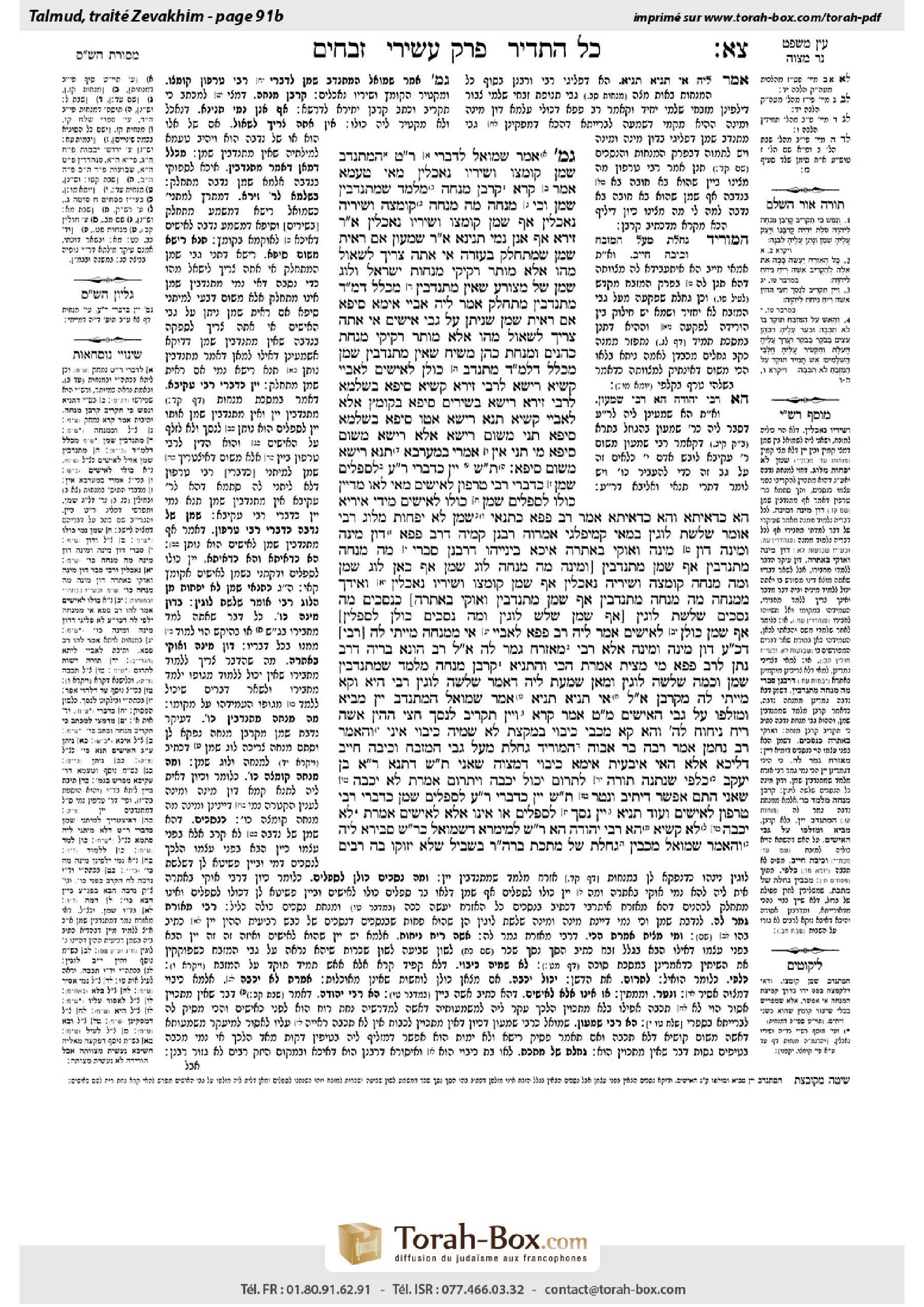
Zevachim 91b: Talmud study for Daf Yomi
Daf Yomi is the daily study of one Talmud folio. Explore 37 tractates with scans, Hebrew text, Sefaria English and AI-generated French translations where annotated.
Passage selection and English or AI-generated French translation are available where the scan has annotations. Daf Study is independent of Torah-Box and Sefaria.
Browse Zevachim · זבחים · All tractatesZevachim 91b text and translations
This page of Zevachim includes the Aramaic text, an English translation and an AI-generated French translation, alongside the scan above.
זבחים צ״א ב · Aramaic and Hebrew text
גְּמָ׳ אָמַר שְׁמוּאֵל: לְדִבְרֵי רַבִּי טַרְפוֹן, הַמִּתְנַדֵּב שֶׁמֶן – קוֹמְצוֹ וּשְׁיָרָיו נֶאֱכָלִין. מַאי טַעְמָא? אָמַר קְרָא: ״קׇרְבַּן מִנְחָה״ – מְלַמֵּד שֶׁמִּתְנַדְּבִין שֶׁמֶן; וְכִי מִנְחָה – מָה מִנְחָה קוֹמְצָהּ וּשְׁיָרֶיהָ נֶאֱכָלִין, אַף שֶׁמֶן קוֹמְצוֹ וּשְׁיָרָיו נֶאֱכָלִין.
אָמַר רַבִּי זֵירָא: אַף אֲנַן נָמֵי תְּנֵינָא, אָמַר רַבִּי שִׁמְעוֹן: אִם רָאִיתָ שֶׁמֶן שֶׁמִּתְחַלֵּק בַּעֲזָרָה – אִי אַתָּה צָרִיךְ לִשְׁאוֹל מַהוּ; אֶלָּא מוֹתַר רְקִיקֵי מִנְחוֹת יִשְׂרָאֵל וְלוֹג שֶׁמֶן שֶׁל מְצוֹרָע, שֶׁאֵין מִתְנַדְּבִין. מִכְּלָל דְּמַאן דְּאָמַר מִתְנַדְּבִין – מִתְחַלֵּק.
אֲמַר לֵיהּ אַבָּיֵי, אֵימָא סֵיפָא: אִם רָאִיתָ שֶׁמֶן שֶׁנִּיתָּן עַל גַּבֵּי אִישִּׁים – אִי אַתָּה צָרִיךְ לִשְׁאוֹל מַהוּ; אֶלָּא מוֹתַר רְקִיקֵי מִנְחַת כֹּהֲנִים וּמִנְחַת כֹּהֵן מָשִׁיחַ, שֶׁאֵין מִתְנַדְּבִין שֶׁמֶן. מִכְּלָל דִּלְמַאן דְּאָמַר מִתְנַדֵּב – כּוּלָּן לָאִישִּׁים. לְאַבָּיֵי קַשְׁיָא רֵישָׁא, לְרַבִּי זֵירָא קַשְׁיָא סֵיפָא!
בִּשְׁלָמָא לְרַבִּי זֵירָא – רֵישָׁא בְּשִׁירַיִם, סֵיפָא בְּקוֹמֶץ. אֶלָּא לְאַבָּיֵי – קַשְׁיָא! תְּנָא רֵישָׁא אַטּוּ סֵיפָא.
בִּשְׁלָמָא סֵיפָא – תָּנֵי מִשּׁוּם רֵישָׁא; אֶלָּא רֵישָׁא מִשּׁוּם סֵיפָא מִי תָּנֵי?! אִין; אָמְרִי בְּמַעְרְבָא: תְּנָא רֵישָׁא מִשּׁוּם סֵיפָא.
תָּא שְׁמַע: יַיִן כְּדִבְרֵי רַבִּי עֲקִיבָא – לַסְּפָלִים, שֶׁמֶן כְּדִבְרֵי רַבִּי טַרְפוֹן – לָאִישִּׁים. מַאי, לָאו מִדְּיַיִן כּוּלּוֹ לַסְּפָלִים, שֶׁמֶן כּוּלּוֹ לָאִישִּׁים? מִידֵּי אִירְיָא? הָא כִּדְאִיתַהּ וְהָא כִּדְאִיתַהּ.
אָמַר רַב פָּפָּא, כְּתַנָּאֵי: שֶׁמֶן לֹא יִפְחוֹת מִלּוֹג. רַבִּי אוֹמֵר: שְׁלֹשֶׁת לוּגִּין. בְּמַאי קָמִיפַּלְגִי? אַמְרוּהָ רַבָּנַן קַמֵּיהּ דְּרַב פָּפָּא: דּוּן מִינַּהּ וּמִינַּהּ דּוּן מִינַּהּ וְאוֹקֵי בְּאַתְרַהּ אִיכָּא בֵּינַיְיהוּ.
דְּרַבָּנַן סָבְרִי: מָה מִנְחָה מִתְנַדְּבִין, אַף שֶׁמֶן מִתְנַדְּבִין [וּמִינַּהּ – מָה מִנְחָה לוֹג שֶׁמֶן, אַף כָּאן לוֹג שֶׁמֶן. וּמָה מִנְחָה קוֹמְצָהּ וּשְׁיָרֶיהָ נֶאֱכָלִין, אַף שֶׁמֶן קוֹמְצוֹ וּשְׁיָרָיו נֶאֱכָלִין].
וְאִידַּךְ – מִמִּנְחָה: מָה מִנְחָה מִתְנַדְּבִין, אַף שֶׁמֶן מִתְנַדְּבִין; וְאוֹקֵי בְּאַתְרַהּ – כִּנְסָכִים: מָה נְסָכִים שְׁלֹשֶׁת לוּגִּין [אַף שֶׁמֶן (שלש) [שְׁלֹשָׁה] לוּגִּין, וּמָה נְסָכִים כּוּלָּן לַסְּפָלִין] – אַף שֶׁמֶן (כּוּלָּן) [כּוּלּוֹ] לָאִישִּׁים.
אֲמַר לֵיהּ רַב פָּפָּא לְאַבָּיֵי: אִי מִמִּנְחָה מַיְיתֵי לַהּ [רַבִּי], דְּכוּלֵּי עָלְמָא דּוּן מִינַּהּ וּמִינַּהּ! אֶלָּא רַבִּי מֵ״אֶזְרָח״ גָּמַר לַהּ.
אֲמַר לֵיהּ רַב הוּנָא בְּרֵיהּ דְּרַב נָתָן לְרַב פָּפָּא: מִי מָצֵית אָמְרַתְּ הָכִי?! וְהָתַנְיָא: ״קׇרְבַּן מִנְחָה״ – מְלַמֵּד שֶׁמִּתְנַדְּבִין שֶׁמֶן. וְכַמָּה? שְׁלֹשָׁה לוּגִּין. וּמַאן שָׁמְעַתְּ לֵיהּ דְּאָמַר שְׁלֹשָׁה לוּגִּין – רַבִּי הִיא; וְקָא מַיְיתֵי לַהּ מִ״קׇּרְבָּן״! אֲמַר לֵיהּ: אִי תַּנְיָא תַּנְיָא.
אָמַר שְׁמוּאֵל: הַמִּתְנַדֵּב יַיִן, מֵבִיא וּמְזַלְּפוֹ עַל גַּבֵּי הָאִישִּׁים. מַאי טַעְמָא? אָמַר קְרָא: ״וְיַיִן תַּקְרִיב לַנֶּסֶךְ חֲצִי הַהִין אִשֵּׁה רֵיחַ נִיחֹחַ לַה׳״. וְהָא קָא מְכַבֵּי! כִּיבּוּי בְּמִקְצָת לָא שְׁמֵיהּ כִּיבּוּי.
אִינִי?! וְהָאָמַר רַב נַחְמָן אָמַר רַבָּה בַּר אֲבוּהּ: הַמּוֹרִיד גַּחֶלֶת מֵעַל גַּבֵּי הַמִּזְבֵּחַ וְכִיבָּהּ – חַיָּיב, דְּלֵיכָּא אֶלָּא הַאי! אִיבָּעֵית אֵימָא: כִּיבּוּי דְּמִצְוָה שָׁאנֵי.
תָּא שְׁמַע, דְּתָנָא רַבִּי אֱלִיעֶזֶר בֶּן יַעֲקֹב: כְּלַפֵּי שֶׁנִּתְּנָה תּוֹרָה לִתְרוֹם, יָכוֹל יְכַבֶּה וְיִתְרוֹם? אָמְרַתְּ: לֹא יְכַבֶּה! שָׁאנֵי הָתָם, אֶפְשָׁר דְּיָתֵיב וְנָטַר.
תָּא שְׁמַע: יַיִן כְּדִבְרֵי רַבִּי עֲקִיבָא – לַסְּפָלִים, שֶׁמֶן כְּדִבְרֵי רַבִּי טַרְפוֹן – לָאִישִּׁים! וְעוֹד תַּנְיָא: יַיִן (נסך) – [לְנַסֵּךְ] לַסְּפָלִים. אוֹ אֵינוֹ אֶלָּא לָאִישִּׁים? אָמַרְתָּ: לֹא יְכַבֶּה!
לָא קַשְׁיָא; הָא רַבִּי יְהוּדָה, הָא רַבִּי שִׁמְעוֹן. לְמֵימְרָא דִּשְׁמוּאֵל כְּרַבִּי שִׁמְעוֹן סְבִירָא לֵיהּ?! וְהָאָמַר שְׁמוּאֵל: מְכַבִּין גַּחֶלֶת שֶׁל מַתֶּכֶת בִּרְשׁוּת הָרַבִּים, בִּשְׁבִיל שֶׁלֹּא יִזּוֹקוּ בָּהּ רַבִּים.
Zevachim 91b · English translation
GEMARA: Shmuel says: According to the statement of Rabbi Tarfon that oil may be sacrificed as a gift offering, in the case of one who contributes oil, a priest removes a handful of the oil and sacrifices it on the altar, and its remainder is eaten by the priests. What is the reason for the ruling of Shmuel? The verse states: “And when one brings a meal offering [korban minḥa]” (Leviticus 2:1). The superfluous word korban teaches that one may contribute oil, and its status is like that of a meal offering: Just as with regard to a meal offering the priest removes a handful and its remainder is eaten, so too with regard to oil, the priest removes a handful and its remainder is eaten.
Rabbi Zeira said that we learn this halakha in the mishna as well: Rabbi Shimon said: If you saw oil that is being distributed in the Temple courtyard, you do not need to ask what it is; rather, it is left over from the oil of the wafers of the meal offerings of Israelites, or it is left over from the log of oil of a leper, as one does not contribute oil as a gift offering. Rabbi Zeira learns by inference from the mishna that according to the one who says that one may contribute oil, it is distributed to the priests for consumption and it is not sacrificed entirely.
Abaye said to Rabbi Zeira: Say the last clause of the mishna: If you saw oil that is placed on the flames of the altar, you do not need to ask what it is; rather, it is left over from the oil of the wafers of the meal offering of priests or it is left over from the meal offering of the anointed priest, as one does not contribute oil as a gift offering. Abaye learns by inference from the mishna that according to the one who says that one may contribute oil, it is burned in its entirety in the flames on the altar. This contradicts Shmuel’s statement that according to Rabbi Tarfon only a handful of the oil is burned on the altar. The Gemara comments: For Abaye the inference from the first clause of the mishna is difficult, while for Rabbi Zeira the inference from the last clause is difficult.
The Gemara continues: Granted, according to Rabbi Zeira, the inference from the first clause that the oil is distributed for consumption by the priests can be explained as referring to the remainder of the oil, whereas the inference from the last clause that the oil is burned on the altar is referring to the handful removed from the oil. But according to Abaye, the contradictory inferences pose a difficulty. The Gemara answers: One cannot infer anything from the first clause, as the mishna taught the first clause due to the last clause. That is, as the tanna of the mishna wishes to teach the last clause in a certain manner, he teaches the first clause in a similar style, despite the fact that one might come to an erroneous conclusion from the wording of the first clause.
The Gemara asks: Granted, a tanna may teach the last clause of a mishna due to the first clause, i.e., a tanna might teach in a similar formulation to one he had already used. But would a tanna teach the first clause of a mishna due to the last clause? The Gemara answers: Yes; they say in the West, Eretz Yisrael, that a tanna taught the first clause due to the last clause.
The Gemara cites a proof: Come and hear a baraita: If one contributes wine, according to the statement of Rabbi Akiva that one may contribute wine, it is poured into the basins adjacent to the corner of the altar. If one contributes oil, according to the statement of Rabbi Tarfon that one may contribute oil, it is burned in the flames of the altar. What, is it not possible to infer from the fact that the wine is poured in its entirety into the basins that the oil is likewise burned in its entirety in the flames of the altar, contrary to Shmuel’s statement? The Gemara rejects this proof: Are the cases comparable? This case is as it is and that case is as it is, i.e., the donations of wine and the oil are separate cases, and the two statements of the baraita need not accord with each other.
Rav Pappa said: Shmuel’s statement is like one side of a dispute between tanna’im, as it is taught in a baraita: One who contributes oil should not bring less than a log. Rabbi Yehuda HaNasi says: Three log. The Gemara asks: With regard to what principle do the first tanna and Rabbi Yehuda HaNasi disagree? The Sages said this before Rav Pappa: They disagree with regard to the nature of an inference by means of verbal analogy or juxtaposition: Is the secondary case equated to the primary case in all aspects, in accordance with the exegetical principle: Infer from it and again from it; or does the comparison extend only to one specific issue derived from the primary case, in accordance with the principle: Infer from it but interpret the halakha according to its own place, i.e., in all other aspects the cases are not equated?
The Gemara explains that this is the difference between them, as the Rabbis hold by the principle: Infer from it and again from it. The Gemara explains the application of this principle: Just as a meal offering is contributed, so too, oil is contributed, as inferred from the verse addressing the meal offering. And again one infers from this source: Just as a meal offering requires a log of oil, so too here, an offering of oil alone must be a log of oil. And just as with regard to a meal offering the priest removes a handful and its remainder is eaten, so too with regard to oil, the priest removes a handful and its remainder is eaten.
And the other, Rabbi Yehuda HaNasi, holds by the principle: Infer from it but interpret the halakha according to its own place. The Gemara explains that here too, one infers from the case of a meal offering: Just as a meal offering is contributed, so too, oil is contributed. But with regard to all other aspects of this halakha, interpret the halakha according to its own place, and its status is like that of wine libations, which are similar to oil in that they are also poured onto the altar: Just as one contributes libations of three log, so too, when one contributes oil one contributes three log; and just as libations are poured in their entirety into the basins, so too, the oil is burned in its entirety in the flames of the altar.
Rav Pappa said to Abaye: If Rabbi Yehuda HaNasi cited the source of the gift offering of oil from the verse addressing the meal offering he would not disagree with the Rabbis, as everyone employs the principle of: Infer from it and again from it. Rather, Rabbi Yehuda HaNasi derives the gift offering of oil from a verse that deals with libations: “All that are homeborn shall do these things after this manner, in presenting an offering made by fire” (Numbers 15:13). Rabbi Yehuda HaNasi derives from here that just as one may contribute wine libations, so too, one may contribute oil. Therefore, Rabbi Yehuda HaNasi compares oil to wine libations: Just as one contributes libations of three log, so too, one contributes three log of oil.
Rav Huna, son of Rav Natan, said to Rav Pappa: How can you say that, i.e., that according to Rabbi Yehuda HaNasi the source of the gift offering of oil is not from the meal offering? But isn’t it taught in a baraita with regard to the verse: “And when one brings a meal offering [korban minḥa]” (Leviticus 2:1), that the superfluous word korban teaches that one may contribute oil? The baraita continues: And how much must one contribute? Three log. The Gemara explains the question: And whom did you hear who says the gift offering of oil is three log? This is the opinion of Rabbi Yehuda HaNasi, and yet he cites the source of the gift offering of oil from the word korban, which is referring to a meal offering. Rav Pappa said to him: If this baraita is taught, it is taught; and I cannot take issue with it.
§ Shmuel says: One who contributes wine brings it and sprinkles it on the flames of the altar. What is the reason for this? The verse states: “And you shall present for the libation half a hin of wine, for an offering made by fire, of a pleasing aroma to the Lord” (Numbers 15:10). The verse indicates that there is a type of wine libation which is an offering made by fire. The Gemara challenges: But he thereby extinguishes the fire on the altar, and the Torah states: “A perpetual fire shall be kept burning on the altar, it shall not go out” (Leviticus 6:6). The Gemara explains: Extinguishing in a partial manner is not called extinguishing; in other words, this act is not included in the prohibition.
The Gemara asks: Is that so? But doesn’t Rav Naḥman say that Rabba bar Avuh says: One who takes down a coal from upon the altar and extinguishes it is liable for violating the prohibition: “It shall not go out”? The Gemara answers: This statement is referring to a situation where there is only this coal on the altar, and therefore the fire is entirely extinguished. If you wish, say instead that even if partial extinguishing is prohibited, extinguishing for the sake of a mitzva, as in the case of sprinkling wine on the altar, is different, and is permitted.
The Gemara challenges: Come and hear a baraita that Rabbi Eliezer ben Ya’akov teaches: Since the Torah gave a mitzva to remove the ashes of the offerings from the altar, one might have thought that it is permitted to extinguish the coals so that they become ashes and then to remove them. Therefore, you say: He shall not extinguish, in accordance with the verse: “It shall not go out.” Although this is a case of extinguishing for the sake of a mitzva, the baraita deems it prohibited. The Gemara explains: It is different there, as it is possible for the priest to sit and wait until some of the coals become ashes, and then remove them. By contrast, with regard to wine, there is no alternative to sprinkling the wine on the fire, and therefore it is permitted.
The Gemara challenges: Come and hear a baraita that prohibits sprinkling wine on the fire of the altar: If one contributes wine, according to the statement of Rabbi Akiva that one may contribute wine, it is poured into the basins on the altar. If one contributes oil, according to the statement of Rabbi Tarfon that one may contribute oil, it is poured onto the flames of the altar. And it is furthermore taught in a baraita: The wine libation is poured into the basins. The baraita suggests: Or perhaps it is not so; rather, it is poured onto the flames. Therefore, you say: He shall not extinguish.
The Gemara answers: This is not difficult, as that baraita is in accordance with the opinion of Rabbi Yehuda, who holds that even an unintentional action, i.e., a permitted action from which a prohibited action inadvertently ensues, is prohibited; and this statement of Shmuel is in accordance with the opinion of Rabbi Shimon, who maintains that a permitted action from which a prohibited action inadvertently ensues is permitted. The Gemara asks: Is this to say that Shmuel holds in accordance with the opinion of Rabbi Shimon? But doesn’t Shmuel say: One may extinguish a piece of white-hot metal in a public thoroughfare on Shabbat so that the masses will not be injured by it;
Zevachim 91b · Traduction française (IA)
GUEMARA : Chmouel dit : Selon l’opinion de Rabbi Tarfon, qui affirme qu’on peut offrir de l’huile en offrande volontaire, si quelqu’un offre de l’huile, un prêtre en prélève une poignée et la fait brûler sur l’autel, tandis que le reste est consommé par les prêtres. Quelle est la raison de la règle énoncée par Chmouel ? Le verset dit : « Lorsqu’un homme apporte une offrande [korban minḥa] » (Lévitique 2, 1). Le mot korban, qui est superflu, enseigne qu’on peut offrir de l’huile et que son statut est semblable à celui d’une offrande de farine : de même que, pour une offrande de farine, le prêtre en prélève une poignée et le reste est consommé, de même, pour l’huile, le prêtre en prélève une poignée et le reste est consommé.
Rabbi Zeïra dit que nous apprenons aussi cette halakha de la Michna : Rabbi Chimon a dit : Si tu vois de l’huile distribuée dans la cour du Temple, il n’est pas nécessaire de demander ce que c’est : il s’agit du reste de l’huile des galettes des offrandes de farine des Israélites, ou du reste du log d’huile du lépreux, car on n’offre pas d’huile en offrande volontaire. Rabbi Zeïra déduit de la Michna que, selon celui qui affirme qu’on peut offrir de l’huile, celle-ci est distribuée aux prêtres pour être consommée et n’est pas entièrement brûlée.
Abayé dit à Rabbi Zeïra : Considère la dernière clause de la Michna : si tu vois de l’huile placée sur les flammes de l’autel, il n’est pas nécessaire de demander ce que c’est : il s’agit du reste de l’huile des galettes de l’offrande de farine des prêtres ou du reste de l’offrande de farine du prêtre oint, car on n’offre pas d’huile en offrande volontaire. Abayé déduit de la Michna que, selon celui qui affirme qu’on peut offrir de l’huile, celle-ci est entièrement brûlée dans les flammes de l’autel. Cela contredit la déclaration de Chmouel, selon laquelle, d’après Rabbi Tarfon, seule une poignée d’huile est brûlée sur l’autel. La Guemara fait remarquer que, pour Abayé, la déduction tirée de la première clause de la Michna pose difficulté, tandis que, pour Rabbi Zeïra, c’est la déduction tirée de la dernière clause qui pose difficulté.
La Guemara poursuit : Il est compréhensible que, selon Rabbi Zeïra, la déduction tirée de la première clause, selon laquelle l’huile est distribuée pour être consommée par les prêtres, puisse désigner le reste de l’huile, tandis que la déduction tirée de la dernière clause, selon laquelle l’huile est brûlée sur l’autel, désigne la poignée prélevée sur l’huile. Mais, selon Abayé, les déductions contradictoires posent difficulté. La Guemara répond : On ne peut rien déduire de la première clause, car la Michna l’a enseignée en raison de la dernière clause. Autrement dit, comme le tanna de la Michna souhaite enseigner la dernière clause sous une certaine forme, il enseigne la première clause dans un style semblable, même si sa formulation pourrait conduire à une conclusion erronée.
La Guemara demande : Il est compréhensible qu’un tanna enseigne la dernière clause d’une Michna en raison de la première, c’est-à-dire qu’il adopte une formulation semblable à celle qu’il a déjà employée. Mais un tanna enseignerait-il la première clause d’une Michna en raison de la dernière ? La Guemara répond : Oui ; en Terre d’Israël, on dit qu’un tanna a enseigné la première clause en raison de la dernière.
La Guemara apporte une preuve : Viens et entends une baraïta : si quelqu’un offre du vin, selon l’opinion de Rabbi Akiva, qui affirme qu’on peut offrir du vin, celui-ci est versé dans les bassins situés près de l’angle de l’autel. Si quelqu’un offre de l’huile, selon l’opinion de Rabbi Tarfon, qui affirme qu’on peut offrir de l’huile, celle-ci est brûlée dans les flammes de l’autel. Ne peut-on pas déduire du fait que le vin est entièrement versé dans les bassins que l’huile est, elle aussi, entièrement brûlée dans les flammes de l’autel, ce qui contredirait la déclaration de Chmouel ? La Guemara rejette cette preuve : Peut-on comparer ces cas ? Chaque cas est distinct : les offrandes de vin et d’huile sont deux cas séparés, et les deux affirmations de la baraïta ne sont pas nécessairement concordantes.
Rav Pappa dit : La déclaration de Chmouel correspond à l’un des avis dans une controverse entre tannaim, comme on l’enseigne dans une baraïta : Celui qui offre de l’huile ne doit pas en apporter moins d’un log. Rabbi Yehouda HaNassi dit : trois log. La Guemara demande : Sur quel principe le premier tanna et Rabbi Yehouda HaNassi sont-ils en désaccord ? Les Sages dirent à Rav Pappa : Ils sont en désaccord sur la nature d’une déduction par analogie verbale ou par juxtaposition : le cas secondaire est-il assimilé au cas principal sous tous ses aspects, conformément au principe exégétique « déduis-en, puis déduis-en encore », ou bien la comparaison ne porte-t-elle que sur une question précise déduite du cas principal, conformément au principe « déduis-en, mais interprète la halakha selon son propre contexte », c’est-à-dire que les cas ne sont pas assimilés sous tous les autres aspects ?
La Guemara explique que telle est leur divergence : les Rabbins suivent le principe « déduis-en, puis déduis-en encore ». La Guemara explique l’application de ce principe : de même qu’on offre une offrande de farine, de même offre-t-on de l’huile, comme on le déduit du verset concernant l’offrande de farine. Puis on déduit encore de cette source : de même qu’une offrande de farine nécessite un log d’huile, de même, ici, une offrande d’huile seule doit être d’un log. Et de même que, pour une offrande de farine, le prêtre en prélève une poignée et le reste est consommé, de même, pour l’huile, le prêtre en prélève une poignée et le reste est consommé.
L’autre avis, celui de Rabbi Yehouda HaNassi, suit le principe « déduis-en, mais interprète la halakha selon son propre contexte ». La Guemara explique qu’ici aussi, on déduit du cas de l’offrande de farine : de même qu’on offre une offrande de farine, de même offre-t-on de l’huile. Mais, pour tous les autres aspects de cette halakha, on l’interprète selon son propre contexte, et son statut est semblable à celui des libations de vin, qui ressemblent à l’huile en ce qu’elles sont également versées sur l’autel : de même qu’on offre des libations de trois log, de même, lorsqu’on offre de l’huile, on en offre trois log ; et de même que les libations sont entièrement versées dans les bassins, de même l’huile est entièrement brûlée dans les flammes de l’autel.
Rav Pappa dit à Abayé : Si Rabbi Yehouda HaNassi tirait du verset concernant l’offrande de farine la source de l’offrande volontaire d’huile, il ne serait pas en désaccord avec les Rabbins, car tous appliquent le principe « déduis-en, puis déduis-en encore ». Rabbi Yehouda HaNassi tire plutôt la source de l’offrande volontaire d’huile d’un verset qui traite des libations : « Tous ceux qui sont nés dans le pays feront ces choses de la même manière, en présentant une offrande consumée par le feu » (Nombres 15, 13). Rabbi Yehouda HaNassi en déduit que, de même qu’on peut offrir des libations de vin, de même peut-on offrir de l’huile. Il compare donc l’huile aux libations de vin : de même qu’on offre des libations de trois log, de même offre-t-on trois log d’huile.
Rav Houna, fils de Rav Natan, dit à Rav Pappa : Comment peux-tu dire cela, c’est-à-dire que, selon Rabbi Yehouda HaNassi, la source de l’offrande volontaire d’huile ne se trouve pas dans l’offrande de farine ? N’enseigne-t-on pas dans une baraïta, à propos du verset « Lorsqu’un homme apporte une offrande [korban minḥa] » (Lévitique 2, 1), que le mot korban, qui est superflu, enseigne qu’on peut offrir de l’huile ? La baraïta poursuit : Quelle quantité faut-il en offrir ? Trois log. La Guemara précise la question : Qui as-tu donc entendu affirmer que l’offrande volontaire d’huile doit être de trois log ? C’est l’avis de Rabbi Yehouda HaNassi, et pourtant il tire la source de l’offrande volontaire d’huile du mot korban, qui se rapporte à une offrande de farine. Rav Pappa lui dit : Si cette baraïta a été enseignée, elle l’a été ; je ne peux pas la contester.
§ Chmouel dit : Celui qui offre du vin l’apporte et le répand sur les flammes de l’autel. Pour quelle raison ? Le verset dit : « Et tu présenteras, pour la libation, un demi-hîn de vin, en offrande consumée par le feu, d’une odeur agréable à l’Éternel » (Nombres 15, 10). Le verset indique qu’il existe une sorte de libation de vin qui est une offrande consumée par le feu. La Guemara objecte : Mais il éteint ainsi le feu de l’autel, alors que la Torah dit : « Un feu perpétuel brûlera sur l’autel, il ne s’éteindra pas » (Lévitique 6, 6). La Guemara explique : Une extinction partielle n’est pas appelée extinction ; autrement dit, cet acte n’est pas compris dans l’interdiction.
La Guemara demande : Est-ce bien le cas ? Rav Naḥman ne dit-il pas que Rabba bar Avouha dit : Celui qui prend une braise de l’autel et l’éteint est passible d’avoir enfreint l’interdiction « il ne s’éteindra pas » ? La Guemara répond : Cette déclaration concerne une situation où cette braise est la seule qui se trouve sur l’autel, de sorte que le feu est entièrement éteint. Si tu le souhaites, dis plutôt que, même si une extinction partielle est interdite, une extinction effectuée pour les besoins d’une mitsva, comme lorsqu’on répand du vin sur l’autel, constitue un cas différent et est permise.
La Guemara objecte : Viens et entends une baraïta enseignée par Rabbi Eliezer ben Yaakov : Puisque la Torah prescrit d’enlever de l’autel les cendres des offrandes, on aurait pu penser qu’il est permis d’éteindre les braises afin qu’elles deviennent des cendres, puis de les enlever. C’est pourquoi il est dit : « Il ne s’éteindra pas. » Bien qu’il s’agisse d’une extinction effectuée pour les besoins d’une mitsva, la baraïta la juge interdite. La Guemara explique : Ce cas est différent, car le prêtre peut s’asseoir et attendre que certaines braises deviennent des cendres, puis les enlever. En revanche, pour le vin, il n’y a pas d’autre possibilité que de le répandre sur le feu ; c’est pourquoi cela est permis.
La Guemara objecte : Viens et entends une baraïta qui interdit de répandre du vin sur le feu de l’autel : si quelqu’un offre du vin, selon l’opinion de Rabbi Akiva, qui affirme qu’on peut offrir du vin, celui-ci est versé dans les bassins de l’autel. Si quelqu’un offre de l’huile, selon l’opinion de Rabbi Tarfon, qui affirme qu’on peut offrir de l’huile, celle-ci est répandue sur les flammes de l’autel. On enseigne en outre dans une baraïta : La libation de vin est versée dans les bassins. La baraïta suggère : Ou peut-être n’en est-il pas ainsi ; peut-être est-elle plutôt versée sur les flammes. C’est pourquoi il est dit : « Il ne s’éteindra pas. »
La Guemara répond : Il n’y a pas de difficulté : cette baraïta suit l’opinion de Rabbi Yehouda, qui estime qu’une action involontaire, c’est-à-dire une action permise dont découle fortuitement une action interdite, est elle aussi interdite ; la déclaration de Chmouel suit, quant à elle, l’opinion de Rabbi Chimon, qui estime qu’une action permise dont découle fortuitement une action interdite est permise. La Guemara demande : Faut-il en conclure que Chmouel suit l’opinion de Rabbi Chimon ? Mais Chmouel ne dit-il pas : On peut éteindre un morceau de métal chauffé à blanc sur la voie publique pendant Chabbat, afin que les passants ne se blessent pas ?
Traduction française générée par IA à partir de l’édition anglaise de Sefaria. Vérifie toujours un passage avec le texte source.
Text from Sefaria: William Davidson Edition - Vocalized Aramaic (CC BY NC); William Davidson Edition - English (CC BY NC).