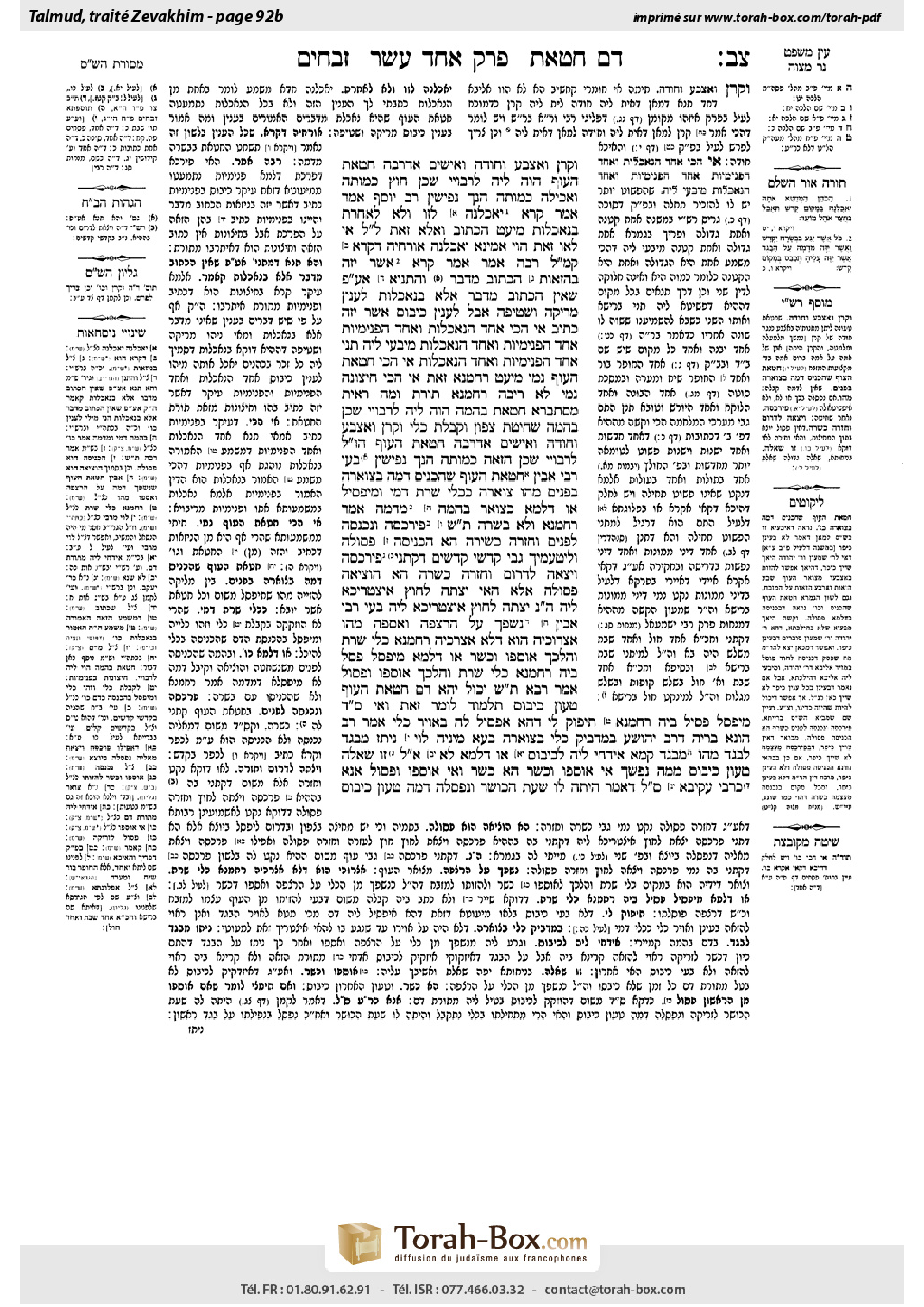
Zevachim 92b: Talmud study for Daf Yomi
Daf Yomi is the daily study of one Talmud folio. Explore 37 tractates with scans, Hebrew text, Sefaria English and AI-generated French translations where annotated.
Passage selection and English or AI-generated French translation are available where the scan has annotations. Daf Study is independent of Torah-Box and Sefaria.
Browse Zevachim · זבחים · All tractatesZevachim 92b text and translations
This page of Zevachim includes the Aramaic text, an English translation and an AI-generated French translation, alongside the scan above.
זבחים צ״ב ב · Aramaic and Hebrew text
וְקֶרֶן, וְאֶצְבַּע, וְחוּדָּהּ, וְאִישִּׁים.
אַדְּרַבָּה, חַטַּאת הָעוֹף הֲוָה לֵיהּ לְרַבּוֹיֵי – שֶׁכֵּן חוּץ כְּמוֹתָהּ, וַאֲכִילָה כְּמוֹתָהּ! הָנָךְ נְפִישִׁין.
רַב יוֹסֵף אָמַר, אָמַר קְרָא: ״יֹאכְלֶנָּה״ – לָזוֹ וְלֹא לְאַחֶרֶת; בְּנֶאֱכָלוֹת מִיעֵט הַכָּתוּב.
וְאֶלָּא ״זֹאת״ לְמָה לִי? אִי לָאו ״זֹאת״, הָוֵי אָמֵינָא: ״יֹאכְלֶנָּה״ – אוֹרְחֵיהּ דִּקְרָא; קָא מַשְׁמַע לַן.
רַבָּה אָמַר, אָמַר קְרָא: ״אֲשֶׁר יִזֶּה״ – בְּהַזָּאוֹת הַכָּתוּב מְדַבֵּר.
וְהָתַנְיָא: אַף עַל פִּי שֶׁאֵין הַכָּתוּב מְדַבֵּר אֶלָּא בְּנֶאֱכָלוֹת! לְעִנְיַן מְרִיקָה וּשְׁטִיפָה, אֲבָל לְעִנְיַן כִּיבּוּס – ״אֲשֶׁר יִזֶּה״ כְּתִיב.
אִי הָכִי, ״אֶחָד הַנֶּאֱכָלוֹת וְאֶחָד הַפְּנִימִיּוֹת״?! ״אֶחָד הַפְּנִימִיּוֹת וְאֶחָד הַנֶּאֱכָלוֹת״ מִיבְּעֵי לֵיהּ! תְּנִי: ״אֶחָד הַפְּנִימִיּוֹת וְאֶחָד הַנֶּאֱכָלוֹת״.
אִי הָכִי, חַטַּאת הָעוֹף נָמֵי! מַיעֵט רַחֲמָנָא ״זֹאת״. אִי הָכִי, חִיצוֹנָה נָמֵי לָא! רַבִּי רַחֲמָנָא ״תּוֹרַת״.
וּמָה רָאִיתָ? מִסְתַּבְּרָא חַטַּאת בְּהֵמָה הֲוָה לֵיהּ לְרַבּוֹיֵי – שֶׁכֵּן בְּהֵמָה, שְׁחִיטַת צָפוֹן, וְקַבָּלַת כְּלִי, וְקֶרֶן, וְאֶצְבַּע, וְחוּדָּהּ, וְאִישִּׁים.
אַדְּרַבָּה, חַטַּאת הָעוֹף הֲוָה לֵיהּ לְרַבּוֹיֵי – שֶׁכֵּן הַזָּאָה כְּמוֹתָהּ! הָנָךְ נְפִישִׁין.
בָּעֵי רַבִּי אָבִין: חַטַּאת הָעוֹף שֶׁהִכְנִיס דָּמָהּ בְּצַוָּארָהּ בִּפְנִים, מַהוּ? צַוָּארָהּ כִּכְלִי שָׁרֵת דָּמֵי, וּמִיפְּסִיל;
אוֹ דִלְמָא כְּצַוַּאר בְּהֵמָה – ״מִדָּמָהּ״ אָמַר רַחֲמָנָא, וְלָא בְּשָׂרָהּ? תָּא שְׁמַע: פִּירְכְּסָה וְנִכְנְסָה לִפְנִים וְחָזְרָה – כְּשֵׁירָה. הָא הִכְנִיסָהּ – פְּסוּלָה!
וְלִיטַעְמָיךְ, גַּבֵּי קׇדְשֵׁי קָדָשִׁים דְּקָתָנֵי: פִּירְכְּסָה וְיָצְאָה לַדָּרוֹם וְחָזְרָה – כְּשֵׁרָה; הָא הוֹצִיאָהּ – פְּסוּלָה?!
אֶלָּא הַאי יָצְתָה לַחוּץ אִיצְטְרִיכָא לֵיהּ; הָכָא נָמֵי יָצְתָה לַחוּץ אִיצְטְרִיכָא לֵיהּ.
בָּעֵי רַבִּי אָבִין: נִשְׁפַּךְ עַל הָרִצְפָּה וַאֲסָפָהּ, מַהוּ?
אַצְרוֹכֵיה הוּא דְּלָא אַצְרְכֵיהּ רַחֲמָנָא כְּלִי שָׁרֵת, וְהִלְכָּךְ אוֹסְפוֹ וְכָשֵׁר; אוֹ דִלְמָא מִיפְסָל פְּסַל בֵּיהּ רַחֲמָנָא כְּלֵי שָׁרֵת, וְהִלְכָּךְ אוֹסְפוֹ וּפָסוּל?
אָמַר רָבָא, תָּא שְׁמַע: יָכוֹל יְהֵא דַּם חַטַּאת הָעוֹף טָעוּן כִּיבּוּס? תַּלְמוּד לוֹמַר: ״זֹאת״. וְאִי סָלְקָא דַעְתָּךְ מִיפְסָל פָּסֵיל בֵּיהּ רַחֲמָנָא, תִּיפּוֹק לִי דְּהָא אִפְּסִיל לֵהּ בַּאֲוִיר כְּלִי!
אָמַר רַב הוּנָא בְּרֵיהּ דְּרַב יְהוֹשֻׁעַ: בְּמַדְבִּיק כְּלִי בְּצַוָּארָהּ.
בְּעָא מִינֵּיהּ לֵוִי: נִיתַּז מִבֶּגֶד לְבֶגֶד, מַהוּ? מִבֶּגֶד קַמָּא אִידְּחִי לֵיהּ לְכִיבּוּס, אוֹ דִלְמָא לָא?
אֲמַר לֵיהּ: זוֹ שְׁאֵלָה! טָעוּן כִּיבּוּס. מִמָּה נַפְשָׁךְ; אִי אוֹסְפוֹ וְכָשֵׁר – הָא כָּשֵׁר. וְאִי אוֹסְפוֹ וּפָסוּל – אֲנָא כְּרַבִּי עֲקִיבָא סְבִירָא לִי, דְּאָמַר: הָיְתָה (לוֹ) [לָהּ] שְׁעַת הַכּוֹשֶׁר וְנִפְסְלָה – דָּמָהּ טָעוּן כִּיבּוּס.
Zevachim 92b · English translation
and their blood is placed on the corner of the altar; and the blood is placed with a priest’s finger; and the blood is placed on the edge of the corner of the altar; and parts of each are consumed in flames upon the altar. None of these apply to bird sin offerings.
The Gemara raises an objection: On the contrary, the bird sin offering should have been included and likened to the eaten animal sin offerings, as the blood of bird sin offerings is presented on the outer altar like an animal sin offering that is eaten, and the bird sin offering has portions set aside for eating, like it. The Gemara rejects the reasoning for including bird offerings: Those features that are common to internal sin offerings and eaten animal sin offerings are more numerous than the features common to bird sin offerings and eaten animal sin offerings.
Rav Yosef said: There is another way to prove that the blood of a bird sin offering is not required to be laundered out if it is sprayed on a garment. With regard to laundering, the verse states: “The priest that offers it for sin shall eat it” (Leviticus 6:19); the obligation described applies to it, i.e., the eaten animal sin offering, and not to another similar sin offering. Consequently, the verse is excluding a case within the broad category of eaten sin offerings, and one is not required to launder out the blood of a bird sin offering.
The Gemara asks: But if the exclusion of bird offerings is derived from this verse, then why do I need the derivation from the verse: “This is the law of the sin offering”? The Gemara answers: If not for the derivation from “this,” I would say that the term “shall eat it” is simply the manner of speech of the verse, so that it does not indicate any exclusion. Therefore, the word “this” teaches us that a sin offering is excluded, and the term “shall eat it,” demonstrates that the excluded sin offering is one that is eaten.
Rabba said that there is a different explanation. Internal sin offerings cannot be excluded from the requirement of laundering sprayed garments, as the verse speaks specifically of internal sin offerings, as the verse states: “It shall be sprinkled” (Leviticus 6:20). The verse is speaking of sin offerings that require sprinklings, and sprinkling is mentioned specifically with regard to internal sin offerings (see Leviticus 4:6), unlike eaten animal sin offerings, with regard to which the Torah uses a term of placing to describe the presenting of its blood (see Leviticus 4:25).
The Gemara raises a difficulty: Can one say that the passage about laundering applies specifically to internal sin offerings? But isn’t it taught in the mishna: Although the verse is speaking only of sin offerings that are eaten, indicating that the passage certainly applies to sin offerings that are eaten? The Gemara answers: The mishna’s statement pertains to the matter of scouring and rinsing copper vessels in which a sin offering was cooked (see Leviticus 6:21), which is relevant only to sin offerings that are eaten. But in the matter of laundering: “You shall launder that on which it shall be sprinkled” (Leviticus 6:20) is written, and the term “it shall be sprinkled” indicates only internal sin offerings. By contrast, eaten sin offerings are included only through the amplification in the verse: “The law of the sin offering” (Leviticus 6:18).
The Gemara asks: If so, that the verses prescribing laundering are primarily discussing internal sin offerings, and eaten sin offerings are included only through a derivation, then with regard to the statement in the mishna: Both the sin offerings that are eaten and the internal sin offerings, is this statement not misleading? Rather, the tanna should have stated: Both the internal sin offerings and the sin offerings that are eaten, first mentioning the offerings most clearly indicated in the verse. The Gemara answers: Teach it as: Both the internal sin offerings and the sin offerings that are eaten.
If so, that the requirement of laundering applies to those sin offerings with regard to which the Torah uses the term sprinkling, the blood of a bird sin offering should require laundering as well, as sprinkling is also mentioned with regard to it (see Leviticus 5:9). The Gemara answers: The Merciful One excludes bird offerings by stating: “This is the law of the sin offering.” The Gemara challenges: If so, that the function of this verse is to be understood as a restriction, an external sin offering also should not require laundering. The Gemara responds: The Merciful One amplified the halakha to include external sin offerings by stating: “The law of.”
The Gemara asks: And what did you see that convinced you to exclude bird offerings and include external sin offerings? The Gemara answers: It stands to reason that the eaten animal sin offering should have been included, as the eaten animal sin offering resembles the internal sin offering in several respects: Each is a large animal; each is subject to slaughter on the north side of the courtyard; and the blood of each requires collection in a vessel; and their blood is placed on the corner of the altar; and the blood is placed with a priest’s finger; and the blood is placed on the edge of the corner of the altar; and parts of each are consumed in flames upon the altar. None of these apply to bird sin offerings.
The Gemara raises an objection: On the contrary, the bird sin offering should have been included in the requirement for laundering, as the offering of the blood of the bird sin offering is termed sprinkling, just like it is in the case of the internal sin offering. The Gemara answers: Those features common to internal sin offerings and eaten animal sin offerings are more numerous than the features common to internal sin offerings and bird sin offerings.
§ The Gemara indicated that the blood of the bird sin offering is not received in a vessel, unlike that of animal sin offerings. With regard to this halakha, Rabbi Avin asks: When the blood of an eaten animal sin offering is brought into the Sanctuary in a vessel, this disqualifies it. In the case of a bird sin offering, which is killed by pinching the nape of its neck, whose blood a priest brought inside the Sanctuary in its neck, what is the halakha? Is its neck comparable to a service vessel, since it is from its neck that the blood is presented, and therefore it is disqualified if brought into the Sanctuary this way?
Or perhaps is its neck comparable to the neck of a large animal offering, about which the Merciful One states in the Torah: “Of whose blood is brought into the Tent of Meeting” (Leviticus 6:23), which teaches that its blood is disqualified when brought inside in a service vessel, but the blood is not disqualified when the animal’s flesh is brought inside. What is the status of the bird’s neck? The Gemara suggests: Come and hear a baraita: If, after its nape is pinched, a bird sin offering convulsed and consequently entered inside the Sanctuary and then it returned to the courtyard, it remains valid; its blood may be sprinkled and its meat eaten. It can be inferred that the bird offering remains valid if it has entered on its own, but if a priest has brought it in, it is disqualified because of the blood in its neck.
The Gemara rejects the proof: But according to your reasoning, one might draw a faulty inference from the halakha of a convulsing offering, as follows. With regard to an animal offering of the most sacred order, about which it is taught in a baraita: If, after being slaughtered appropriately on the north side of the courtyard, the animal convulsed, and consequently it went out to the south side of the courtyard and then returned to the north side, it remains valid; should it be inferred: But if a priest took it out to the south side it becomes disqualified? The sacrifice is certainly not disqualified by being taken to the south side of the courtyard, and the inference is incorrect.
Rather, it must be assumed that this halakha, that of the convulsing animal that moved from the northern side to the southern side, is taught for another purpose. It was necessary for the baraita to teach this halakha in order to establish a contrast with an animal that went out to the outside beyond the courtyard, which is disqualified even if it goes out by itself. Here, too, with regard to the bird sin offering, the halakha of the convulsing animal that moved into the Sanctuary is taught for another purpose. This halakha was necessary for establishing a contrast with a bird offering that went out to the outside beyond the courtyard, which is disqualified even if it goes out by itself. Accordingly, this may not be used to resolve Rabbi Avin’s dilemma.
§ Rabbi Avin asks another question about the blood of a bird offering, which is sprinkled directly from the body of the bird and not collected in a service vessel. With regard to the blood of a large animal, which spills on the floor before it is received in a service vessel, it becomes disqualified for presentation (see 25a), but if it spills after it is received in a vessel, it may be collected from the floor and presented (see 32a). If the blood of a bird offering spilled onto the floor and the priest collected it from the floor in order to sprinkle it, what is the halakha?
Is it simply that the Merciful One did not require a service vessel for the collection of the bird’s blood, and therefore a priest may collect it from the floor and it remains fit for sprinkling on the altar? Or perhaps the Merciful One rendered a service vessel unfit for sprinkling it in any case, and the blood must be sprinkled directly from the bird’s body, and therefore, if it spills on the floor and the priest collects it, it is unfit for sprinkling.
Rava said: Come and hear a proof, deduced from a baraita: One might have thought that the blood of a bird sin offering would require laundering if sprayed on a garment. Therefore, the verse states: “This is the law of the sin offering” (Leviticus 6:18), which excludes the bird sin offering. But if it enters your mind that the Merciful One rendered a vessel unfit for sprinkling the blood of a bird, this interpretation is unnecessary. I will deduce the halakha that a bird’s blood does not require laundering because the blood becomes disqualified even by merely passing into the airspace of a vessel. Consequently, the blood is disqualified when coming into the airspace of the garment, which is considered a vessel, and, as disqualified blood, it does not subsequently require laundering.
Rav Huna, son of Rav Yehoshua, said: The baraita provides no decisive proof, as even if a bird’s blood is disqualified by passing into the airspace of a vessel, the word “this” must still be interpreted to exclude the blood of a bird sin offering from the requirement of laundering. The interpretation of the verse accounts for cases in which the blood reaches the vessel without first passing into its airspace, as in a case when the priest affixes a vessel to the bird’s neck. Consequently, no resolution can be derived for Rav Avin’s question.
§ The Gemara returns to the primary subject of the mishna, the requirement of laundering garments from the sprayed blood of a sin offering. Levi asked Rabbi Yehuda HaNasi: If the blood of an offering sprayed from one garment to another garment, what is the halakha? By contact with the first garment, is the blood thereby dismissed with regard to the requirement of laundering, such that a subsequent garment would not require laundering? Or perhaps not.
Rabbi Yehuda HaNasi said to him: This is an excellent question; and the answer is: The garment requires laundering whichever way you look at it. If the halakha is that with regard to blood that sprayed onto a garment the priest may collect it and it is still fit for presentation on the altar, then this blood is also fit. Consequently, even the second garment must be laundered. And if you say that with regard to blood that sprayed onto a garment if he collects it, it is unfit for presentation, I hold in accordance with the opinion of Rabbi Akiva, who says: If the offering had a period of fitness and then was disqualified, its blood requires laundering. Accordingly, since the blood upon the second garment was initially collected in a service vessel, it too had a period of fitness.
Zevachim 92b · Traduction française (IA)
et leur sang est appliqué sur l’angle de l’autel ; le sang est appliqué avec le doigt d’un prêtre ; le sang est appliqué sur le rebord de l’angle de l’autel ; et des parties de chacun sont consumées par le feu sur l’autel. Aucun de ces éléments ne s’applique aux sacrifices expiatoires d’oiseaux.
La Guemara soulève une objection : au contraire, le sacrifice expiatoire d’oiseau aurait dû être inclus et assimilé aux sacrifices expiatoires d’animaux dont on mange la chair, puisque le sang des sacrifices expiatoires d’oiseaux est présenté sur l’autel extérieur, comme celui d’un sacrifice expiatoire d’animal dont on mange la chair, et que le sacrifice expiatoire d’oiseau comporte des parties réservées à la consommation, comme ce dernier. La Guemara rejette le raisonnement en faveur de l’inclusion des sacrifices d’oiseaux : les caractéristiques communes aux sacrifices expiatoires intérieurs et aux sacrifices expiatoires d’animaux dont on mange la chair sont plus nombreuses que celles communes aux sacrifices expiatoires d’oiseaux et aux sacrifices expiatoires d’animaux dont on mange la chair.
Rav Yosef dit : il existe une autre manière de prouver que le sang d’un sacrifice expiatoire d’oiseau n’a pas à être lavé s’il est projeté sur un vêtement. Au sujet du lavage, le verset dit : « Le prêtre qui l’offre comme sacrifice expiatoire en mangera » (Lévitique 6:19) ; l’obligation décrite s’applique à lui, c’est-à-dire au sacrifice expiatoire d’animal dont on mange la chair, et non à un autre sacrifice expiatoire similaire. Par conséquent, le verset exclut un cas de la vaste catégorie des sacrifices expiatoires dont on mange la chair, et l’on n’est pas tenu de laver le sang d’un sacrifice expiatoire d’oiseau.
La Guemara demande : mais si l’exclusion des sacrifices d’oiseaux est déduite de ce verset, pourquoi faut-il la déduction tirée du verset : « Voici la loi du sacrifice expiatoire » ? La Guemara répond : sans la déduction tirée de « voici », j’aurais dit que l’expression « en mangera » n’est qu’une tournure du verset et n’indique donc aucune exclusion. Le mot « voici » nous enseigne donc qu’un sacrifice expiatoire est exclu, et l’expression « en mangera » montre que le sacrifice expiatoire exclu est un sacrifice dont on mange la chair.
Rabba dit qu’il existe une autre explication. Les sacrifices expiatoires intérieurs ne peuvent être exclus de l’obligation de laver les vêtements sur lesquels le sang a été projeté, car le verset traite précisément des sacrifices expiatoires intérieurs, comme le dit le verset : « Il sera aspergé » (Lévitique 6:20). Le verset parle de sacrifices expiatoires qui nécessitent des aspersions, et l’aspersion est mentionnée spécifiquement à propos des sacrifices expiatoires intérieurs (voir Lévitique 4:6), contrairement aux sacrifices expiatoires d’animaux dont on mange la chair, pour lesquels la Torah emploie un terme signifiant « appliquer » afin de décrire la présentation de leur sang (voir Lévitique 4:25).
La Guemara soulève une difficulté : peut-on dire que le passage sur le lavage s’applique spécifiquement aux sacrifices expiatoires intérieurs ? Pourtant, n’est-il pas enseigné dans la Michna que le verset ne parle que des sacrifices expiatoires dont on mange la chair, ce qui indique que le passage s’applique assurément à ces sacrifices ? La Guemara répond : la déclaration de la Michna concerne le récurage et le rinçage des ustensiles de cuivre dans lesquels un sacrifice expiatoire a été cuit (voir Lévitique 6:21), ce qui ne concerne que les sacrifices expiatoires dont on mange la chair. Mais, pour ce qui est du lavage, il est écrit : « Tu laveras ce sur quoi il aura été aspergé » (Lévitique 6:20), et l’expression « il aura été aspergé » ne désigne que les sacrifices expiatoires intérieurs. En revanche, les sacrifices expiatoires dont on mange la chair ne sont inclus que par l’élargissement exprimé dans le verset : « La loi du sacrifice expiatoire » (Lévitique 6:18).
La Guemara demande : si tel est le cas, si les versets prescrivant le lavage concernent principalement les sacrifices expiatoires intérieurs et que les sacrifices expiatoires dont on mange la chair ne sont inclus que par déduction, la déclaration de la Michna — les sacrifices expiatoires dont on mange la chair et les sacrifices expiatoires intérieurs — n’est-elle pas trompeuse ? Le tanna aurait plutôt dû dire : les sacrifices expiatoires intérieurs et les sacrifices expiatoires dont on mange la chair, en mentionnant d’abord les sacrifices les plus clairement désignés par le verset. La Guemara répond : enseigne la formulation suivante : les sacrifices expiatoires intérieurs et les sacrifices expiatoires dont on mange la chair.
Si tel est le cas, si l’obligation de lavage s’applique aux sacrifices expiatoires pour lesquels la Torah emploie le terme « aspersion », le sang d’un sacrifice expiatoire d’oiseau devrait lui aussi devoir être lavé, puisque l’aspersion est également mentionnée à son propos (voir Lévitique 5:9). La Guemara répond : le Miséricordieux exclut les sacrifices d’oiseaux en disant : « Voici la loi du sacrifice expiatoire ». La Guemara objecte : si la fonction de ce verset doit être comprise comme une restriction, un sacrifice expiatoire extérieur ne devrait, lui non plus, pas devoir être lavé. La Guemara répond : le Miséricordieux a élargi la halakha pour inclure les sacrifices expiatoires extérieurs en disant : « La loi de ».
La Guemara demande : et qu’as-tu vu qui t’a convaincu d’exclure les sacrifices d’oiseaux et d’inclure les sacrifices expiatoires extérieurs ? La Guemara répond : il est logique d’inclure le sacrifice expiatoire d’animal dont on mange la chair, car celui-ci ressemble au sacrifice expiatoire intérieur à plusieurs égards : chacun est un grand animal ; chacun doit être abattu du côté nord de la cour ; le sang de chacun doit être recueilli dans un récipient ; leur sang est appliqué sur l’angle de l’autel ; le sang est appliqué avec le doigt d’un prêtre ; le sang est appliqué sur le rebord de l’angle de l’autel ; et des parties de chacun sont consumées par le feu sur l’autel. Aucun de ces éléments ne s’applique aux sacrifices expiatoires d’oiseaux.
La Guemara soulève une objection : au contraire, le sacrifice expiatoire d’oiseau aurait dû être inclus dans l’obligation de lavage, puisque la présentation de son sang est appelée « aspersion », comme dans le cas du sacrifice expiatoire intérieur. La Guemara répond : les caractéristiques communes aux sacrifices expiatoires intérieurs et aux sacrifices expiatoires d’animaux dont on mange la chair sont plus nombreuses que celles communes aux sacrifices expiatoires intérieurs et aux sacrifices expiatoires d’oiseaux.
§ La Guemara a indiqué que le sang du sacrifice expiatoire d’oiseau n’est pas recueilli dans un récipient, contrairement au sang des sacrifices expiatoires d’animaux. À propos de cette halakha, Rabbi Avin demande : lorsque le sang d’un sacrifice expiatoire d’animal dont on mange la chair est introduit dans le Sanctuaire dans un récipient, cela le rend impropre. Dans le cas d’un sacrifice expiatoire d’oiseau, mis à mort par pincement de la nuque, quelle est la halakha si un prêtre introduit son sang dans le Sanctuaire dans son cou ? Son cou est-il comparable à un ustensile de service, puisque le sang est présenté depuis son cou, de sorte que le sacrifice est rendu impropre si on l’introduit ainsi dans le Sanctuaire ?
Ou peut-être son cou est-il comparable à celui d’un grand animal offert en sacrifice, au sujet duquel le Miséricordieux dit dans la Torah : « dont le sang est apporté dans la Tente de la Rencontre » (Lévitique 6:23), ce qui enseigne que son sang est rendu impropre lorsqu’il est introduit dans un ustensile de service, mais que la chair de l’animal n’est pas rendue impropre lorsqu’elle est introduite. Quel est le statut du cou de l’oiseau ? La Guemara suggère : viens et écoute une baraïta : si, après qu’on lui a pincé la nuque, un sacrifice expiatoire d’oiseau a convulsé et est ainsi entré dans le Sanctuaire, puis en est ressorti et est revenu dans la cour, il reste valide ; son sang peut être aspergé et sa chair mangée. On peut en déduire que le sacrifice d’oiseau reste valide s’il est entré de lui-même, mais que si un prêtre l’a fait entrer, il est rendu impropre à cause du sang dans son cou.
La Guemara rejette cette preuve : mais, selon ton raisonnement, on pourrait tirer une conclusion erronée de la halakha concernant un sacrifice qui convulse, comme suit. À propos d’un sacrifice animal de sainteté suprême, au sujet duquel une baraïta enseigne : si, après avoir été abattu comme il convient du côté nord de la cour, l’animal a convulsé, est ainsi passé du côté sud de la cour, puis est revenu du côté nord, il reste valide ; faudrait-il en déduire que s’il a été emmené du côté sud par un prêtre, il devient impropre ? Le sacrifice n’est certainement pas rendu impropre parce qu’il a été emmené du côté sud de la cour, et cette déduction est erronée.
Il faut plutôt supposer que cette halakha, celle de l’animal qui convulse et passe du côté nord au côté sud, est enseignée dans un autre but. Il était nécessaire que la baraïta enseigne cette halakha afin d’établir un contraste avec un animal qui est sorti au-dehors, au-delà de la cour, et qui est rendu impropre même s’il sort de lui-même. Ici aussi, à propos du sacrifice expiatoire d’oiseau, la halakha de l’animal qui convulse et entre dans le Sanctuaire est enseignée dans un autre but. Cette halakha était nécessaire pour établir un contraste avec un sacrifice d’oiseau qui est sorti au-dehors, au-delà de la cour, et qui est rendu impropre même s’il sort de lui-même. Par conséquent, on ne peut pas s’appuyer sur cela pour résoudre le dilemme de Rabbi Avin.
§ Rabbi Avin pose une autre question au sujet du sang d’un sacrifice d’oiseau, qui est aspergé directement depuis le corps de l’oiseau et n’est pas recueilli dans un ustensile de service. Le sang d’un grand animal, s’il se répand sur le sol avant d’être recueilli dans un ustensile de service, devient impropre à la présentation (voir 25a), mais s’il se répand après avoir été recueilli dans un récipient, il peut être ramassé sur le sol et présenté (voir 32a). Si le sang d’un sacrifice d’oiseau s’est répandu sur le sol et que le prêtre l’a ramassé afin de l’asperger, quelle est la halakha ?
Est-ce simplement que le Miséricordieux n’a pas exigé d’ustensile de service pour recueillir le sang de l’oiseau, et qu’un prêtre peut donc le ramasser sur le sol, où il reste apte à être aspergé sur l’autel ? Ou peut-être le Miséricordieux a-t-il rendu l’ustensile de service impropre à recevoir le sang pour l’aspersion dans tous les cas, et le sang doit-il être aspergé directement depuis le corps de l’oiseau, de sorte que, s’il se répand sur le sol et que le prêtre le ramasse, il est impropre à l’aspersion ?
Rava dit : viens et écoute une preuve tirée d’une baraïta : on aurait pu penser que le sang d’un sacrifice expiatoire d’oiseau doit être lavé s’il est projeté sur un vêtement. Le verset dit donc : « Voici la loi du sacrifice expiatoire » (Lévitique 6:18), ce qui exclut le sacrifice expiatoire d’oiseau. Mais si tu pensais que le Miséricordieux a rendu un ustensile impropre à recevoir le sang d’un oiseau pour l’aspersion, cette interprétation serait inutile. Je déduirais que le sang d’un oiseau n’a pas à être lavé, car il devient impropre dès qu’il passe dans l’espace intérieur d’un ustensile. Par conséquent, le sang est rendu impropre lorsqu’il pénètre dans l’espace intérieur du vêtement, qui est considéré comme un ustensile, et, étant du sang impropre, il n’a pas ensuite à être lavé.
Rav Houna, fils de Rav Yehoshoua, dit : la baraïta n’apporte aucune preuve décisive, car même si le sang d’un oiseau est rendu impropre en passant dans l’espace intérieur d’un ustensile, le mot « voici » doit tout de même être interprété comme excluant le sang d’un sacrifice expiatoire d’oiseau de l’obligation de lavage. L’interprétation du verset tient compte des cas où le sang atteint l’ustensile sans passer d’abord par son espace intérieur, comme lorsque le prêtre applique un ustensile au cou de l’oiseau. Par conséquent, on ne peut tirer aucune conclusion pour résoudre la question de Rav Avin.
§ La Guemara revient au sujet principal de la Michna : l’obligation de laver les vêtements souillés par le sang d’un sacrifice expiatoire qui y a été projeté. Levi demanda à Rabbi Yehouda HaNassi : si le sang d’un sacrifice a été projeté d’un vêtement sur un autre, quelle est la halakha ? Le contact avec le premier vêtement libère-t-il le sang de l’obligation de lavage, de sorte que le vêtement suivant n’a pas à être lavé ? Ou peut-être pas.
Rabbi Yehouda HaNassi lui dit : c’est une excellente question ; voici la réponse : le vêtement doit être lavé quelle que soit l’issue. Si la halakha est que, lorsque du sang a été projeté sur un vêtement, le prêtre peut le ramasser et qu’il reste apte à être présenté sur l’autel, alors ce sang aussi est apte. Par conséquent, le second vêtement doit lui aussi être lavé. Et si tu dis que, lorsque du sang a été projeté sur un vêtement, le prêtre peut le ramasser mais qu’il est alors impropre à la présentation, je suis l’opinion de Rabbi Akiva, qui dit : si un sacrifice a connu une période où il était apte, puis a été rendu impropre, son sang doit être lavé. En conséquence, puisque le sang sur le second vêtement a d’abord été recueilli dans un ustensile de service, lui aussi a connu une période où il était apte.
Traduction française générée par IA à partir de l’édition anglaise de Sefaria. Vérifie toujours un passage avec le texte source.
Text from Sefaria: William Davidson Edition - Vocalized Aramaic (CC BY NC); William Davidson Edition - English (CC BY NC).