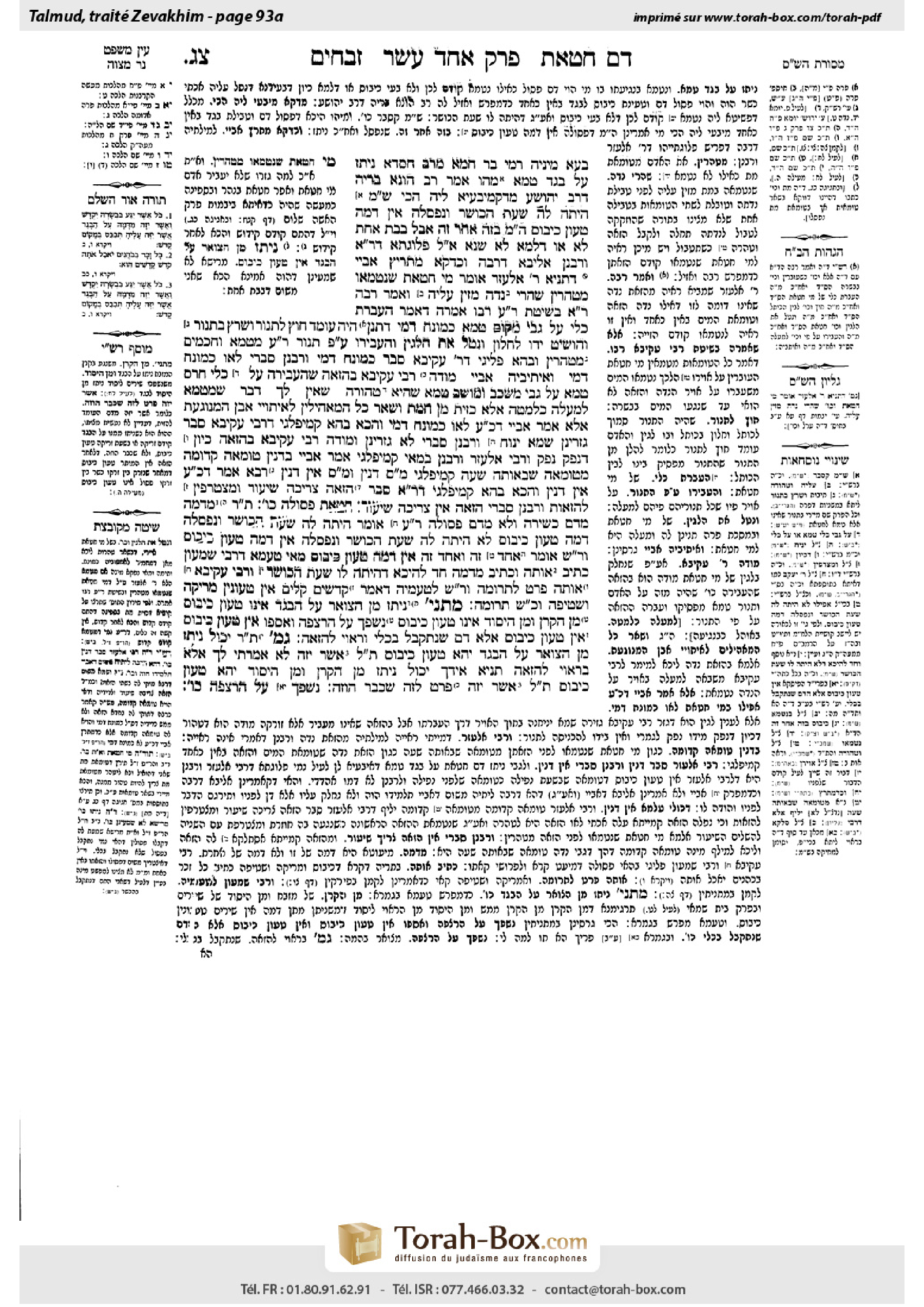
Zevachim 93a: Talmud study for Daf Yomi
Daf Yomi is the daily study of one Talmud folio. Explore 37 tractates with scans, Hebrew text, Sefaria English and AI-generated French translations where annotated.
Passage selection and English or AI-generated French translation are available where the scan has annotations. Daf Study is independent of Torah-Box and Sefaria.
Browse Zevachim · זבחים · All tractatesZevachim 93a text and translations
This page of Zevachim includes the Aramaic text, an English translation and an AI-generated French translation, alongside the scan above.
זבחים צ״ג א · Aramaic and Hebrew text
בְּעָא מִינֵּיהּ רָמֵי בַּר חָמָא מֵרַב חִסְדָּא: נִיתַּז עַל בֶּגֶד טָמֵא, מַהוּ? אָמַר רַב הוּנָא בְּרֵיהּ דְּרַב יְהוֹשֻׁעַ: מִדְּקָמִיבַּעְיָא לֵיהּ הָכִי, שְׁמַע מִינַּהּ: הָיְתָה לָהּ שְׁעַת הַכּוֹשֶׁר וְנִפְסְלָה – אֵין דָּמָהּ טָעוּן כִּיבּוּס.
הָנֵי מִילֵּי בְּזֶה אַחַר זֶה, אֲבָל בְּבַת אַחַת לָא; אוֹ דִלְמָא לָא שְׁנָא? אֲמַר לֵיהּ: פְּלוּגְתָּא דְּרַבִּי אֶלְעָזָר וְרַבָּנַן אַלִּיבָּא דְרַבָּה, וְכִדְקָא מְתָרֵיץ אַבָּיֵי.
דְּתַנְיָא, רַבִּי אֶלְעָזָר אוֹמֵר: מֵי חַטָּאת שֶׁנִּטְמְאוּ – מְטַהֲרִין, שֶׁהֲרֵי נִדָּה מַזִּין עָלֶיהָ.
וְאָמַר רַבָּה: רַבִּי אֶלְעָזָר בְּשִׁיטַת רַבִּי עֲקִיבָא רַבּוֹ אֲמָרָהּ, דְּאָמַר: הַעֲבָרַת כְּלִי עַל גַּבֵּי מָקוֹם טָמֵא – כְּמוּנָּח דָּמֵי.
דִּתְנַן: הָיָה עוֹמֵד חוּץ לַתַּנּוּר וְשֶׁרֶץ בַּתַּנּוּר, וְהוֹשִׁיט יָדוֹ לַחַלּוֹן וְנָטַל אֶת הַלָּגִין וְהֶעֱבִירוֹ עַל פִּי תַנּוּר – רַבִּי עֲקִיבָא מְטַמֵּא וַחֲכָמִים מְטַהֲרִין. וּבְהָא פְּלִיגִי – דְּרַבִּי עֲקִיבָא סָבַר: כְּמוּנָּח דָּמֵי, וְרַבָּנַן סָבְרִי: לָאו כְּמוּנָּח דָּמֵי.
וְאֵיתִיבֵיהּ אַבָּיֵי: מוֹדֶה רַבִּי עֲקִיבָא בְּהַזָּאָה שֶׁהֶעֱבִירָהּ עַל כְּלֵי חֶרֶס טָמֵא עַל גַּבֵּי מִשְׁכָּב וּמוֹשָׁב טָמֵא – שֶׁהִיא טְהוֹרָה; שֶׁאֵין לְךָ דָּבָר שֶׁמְּטַמֵּא לְמַעְלָה כִּלְמַטָּה, אֶלָּא כְּזַיִת מִן הַמֵּת וּשְׁאָר כׇּל הַמַּאֲהִילִין. לְאֵיתוֹיֵי אֶבֶן הַמְנוּגַּעַת!
אֶלָּא אָמַר אַבָּיֵי: דְּכוּלֵּי עָלְמָא – לָאו כְּמוּנָּח דָּמֵי; וְהָכָא בְּהָא קָמִיפַּלְגִי: דְּרַבִּי עֲקִיבָא סָבַר גָּזְרִינַן שֶׁמָּא יָנוּחַ, וְרַבָּנַן סָבְרִי לָא גָּזְרִינַן. וּמוֹדֶה רַבִּי עֲקִיבָא בְּהַזָּאָה – כֵּיוָן דִּנְפַק נְפַק.
וְרַבִּי אֶלְעָזָר וְרַבָּנַן בְּמַאי קָמִיפַּלְגִי? אָמַר אַבָּיֵי: בְּדָנִין טוּמְאָה קְדוּמָה מִטּוּמְאָה שֶׁבְּאוֹתָהּ שָׁעָה קָמִיפַּלְגִי –
מָר סָבַר דָּנִין, וּמַר סָבַר אֵין דָּנִין.
רָבָא אֲמַר: דְּכוּלֵּי עָלְמָא אֵין דָּנִין;
וְהָכָא בְּהָא קָמִיפַּלְגִי – דְּרַבִּי אֶלְעָזָר סָבַר: הַזָּאָה צְרִיכָה שִׁיעוּר, וּמִצְטָרְפִין לְהַזָּאוֹת; וְרַבָּנַן סָבְרִי: הַזָּאָה אֵין צְרִיכָה שִׁיעוּר.
חַטָּאת פְּסוּלָה כּוּ׳. תָּנוּ רַבָּנַן: ״מִדָּמָהּ״ – מִדַּם כְּשֵׁירָה וְלֹא מִדַּם פְּסוּלָה. רַבִּי עֲקִיבָא אוֹמֵר: הָיְתָה לָהּ שְׁעַת הַכּוֹשֶׁר וְנִפְסְלָה – דָּמָהּ טָעוּן כִּיבּוּס, לֹא הָיְתָה לָהּ שְׁעַת הַכּוֹשֶׁר וְנִפְסְלָה – אֵין דָּמָהּ טָעוּן כִּיבּוּס.
וְרַבִּי שִׁמְעוֹן אוֹמֵר: אֶחָד זֶה וְאֶחָד זֶה, אֵין דָּמָהּ טָעוּן כִּיבּוּס. מַאי טַעְמָא דְּרַבִּי שִׁמְעוֹן? כְּתִיב ״אֹתָהּ״, וּכְתִיב ״מִדָּמָהּ״ – חַד לְהֵיכָא דְּהָיְתָה לוֹ שְׁעַת הַכּוֹשֶׁר.
וְרַבִּי עֲקִיבָא – ״אֹתָהּ״ פְּרָט לִתְרוּמָה. וְרַבִּי שִׁמְעוֹן לְטַעְמֵיהּ, דְּאָמַר: קָדָשִׁים קַלִּים אֵין טְעוּנִין מְרִיקָה וּשְׁטִיפָה – וְכׇל שֶׁכֵּן תְּרוּמָה.
מַתְנִי׳ נִיתַּז מִן הַצַּוָּאר עַל הַבֶּגֶד – אֵינוֹ טָעוּן כִּיבּוּס. מִן הַקֶּרֶן וּמִן הַיְסוֹד – אֵינוֹ טָעוּן כִּיבּוּס. נִשְׁפַּךְ עַל הָרִצְפָּה וַאֲסָפוֹ – אֵין טָעוּן כִּיבּוּס. אֵין טָעוּן כִּיבּוּס אֶלָּא דָּם שֶׁנִּתְקַבֵּל בִּכְלִי, וְרָאוּי לְהַזָּאָה.
גְּמָ׳ תָּנוּ רַבָּנַן: יָכוֹל נִיתַּז מִן הַצַּוָּאר עַל הַבֶּגֶד – יְהֵא טָעוּן כִּיבּוּס? תַּלְמוּד לוֹמַר: ״אֲשֶׁר יִזֶּה״ – לֹא אָמַרְתִּי לָךְ אֶלָּא בְּרָאוּי לְהַזָּאָה. תַּנְיָא אִידַּךְ: יָכוֹל נִיתַּז מִן הַקֶּרֶן וּמִן הַיְסוֹד יְהֵא טָעוּן כִּיבּוּס? תַּלְמוּד לוֹמַר: ״אֲשֶׁר יִזֶּה״ – פְּרָט לָזֶה שֶׁכְּבָר הוּזָּה.
נִשְׁפַּךְ עַל הָרִצְפָּה כּוּ׳.
Zevachim 93a · English translation
§ In a related matter, Rami bar Ḥama asked of Rav Ḥisda: If the blood of a sin offering sprayed onto a ritually impure garment, so that the blood became impure and unfit for presentation, what is the halakha? Does the garment require laundering? Rav Huna, son of Rav Yehoshua, said: From the fact that Rami bar Ḥama asked the question in this manner, with regard to ritually pure blood that sprayed onto an impure garment, and not with regard to blood that was already impure that sprayed onto a garment, conclude from it that he holds that even if the sin offering had a period of fitness and then was disqualified, a garment onto which its blood sprayed does not require laundering.
His question, therefore, is: Does this statement apply only when one event, the spraying of the blood, occurs after the other event, i.e., the disqualification of the blood? But if the spraying and the disqualification occur simultaneously, as in this case, perhaps the principle does not apply, and the garment must be laundered. Or, perhaps there is no difference whether the events occur this way or that way, and even if the offering becomes unfit only as the blood touches the garment, it still does not require laundering? Rav Ḥisda said to Rami bar Ḥama: The matter is subject to the dispute between Rabbi Elazar and the Rabbis, in accordance with the explanation of Rabba, and as Abaye resolves it.
The Gemara elaborates: As it is taught in a baraita: Rabbi Elazar says: With regard to water of purification, which has been sanctified by the ashes of the red heifer, even if the water is rendered impure it nevertheless performs its function and purifies a person from the ritual impurity imparted by a corpse. This is evident because those performing the rite would sprinkle water of purification even on a menstruating woman who has been rendered impure by a corpse. Although her menstruation impurity renders the water of purification impure when it touches her, it is effective in removing the ritual impurity imparted by a corpse. Rabbi Elazar’s opinion is in opposition to that of the Rabbis.
And concerning this dispute, Rabba says: Although it would seem that the water of purification applied to a menstruating woman does not become impure until it touches her, the case may still provide precedent for all water of purification that has become impure, as follows: Rabbi Elazar stated his opinion in accordance with the opinion of his teacher Rabbi Akiva, who says that passing a vessel containing water of purification over the place where a ritually impure item is renders the vessel considered as if resting there, so that the water becomes impure. Consequently, just as the water of purification is effective for the menstruating woman although it has become impure when hovering above her, water of purification always remains effective after having contracted ritual impurity.
That is Rabbi Akiva’s opinion, as we learned in a mishna (Para 10:5): There is a dispute with regard to the case of a ritually pure person who was standing beyond an oven, which stood between him and the wall, and a carcass of a creeping animal, which imparts impurity, was in the oven; and the person stretched out his hand to the window and took the jug [halagin] containing water of purification and passed it over the opening of the oven. Rabbi Akiva deems the water of purification impure, although the jug has merely passed over the oven’s opening and has not come to rest on it, and the Rabbis deem the water pure. And according to Rabba, in this manner do they disagree: That Rabbi Akiva holds that the jug is considered as if resting on the opening of the oven, and the Rabbis hold that the jug is not considered as if resting there.
And Abaye raised an objection to Rabba’s interpretation from a baraita (Tosefta, Para 10:6): Although he deems the water of purification impure in the previous case, Rabbi Akiva concedes that in the act of sprinkling, in which the person passed the water of purification over an impure earthenware vessel or over an impure item designated for lying or sitting, the water remains pure. This is so because there is nothing that renders impure all that is in the airspace directly above it, like anything below that touches it, other than an olive-bulk from a corpse and all other items which impart ritual impurity to those items which overlie them, including a stone marked with leprosy. Such a stone also imparts overlying impurity, rendering impure anything under the same roof or, if there is no roof, in the airspace directly above it up to the sky.
Rather, Abaye said: Everyone agrees that a vessel containing water of purification passing over an item that is ritually impure is not considered as if it is resting on it. And here, with regard to the jug being taken over the oven, they disagree about this: Rabbi Akiva holds that we decree that the vessel contracts impurity by rabbinic law, since perhaps a vessel carried above an impure item will come to rest directly on that impure item. And the Rabbis hold: We do not decree that the vessel contracts impurity in such a case. And Rabbi Akiva concedes that in the act of sprinkling, while the water passes over an impure item, once it has set forth into the air, it has set forth. Since the water has left the person’s hand, the person cannot leave it to rest upon an impure item.
The Gemara asks: If so, Rabbi Akiva and the Rabbis would agree that the water of purification does not become impure before touching a menstruating woman. And, if so, then Rabbi Elazar and the Rabbis, who disagree as to whether impure water of purification renders one pure, with regard to what case do they disagree? Abaye said: They disagree with regard to whether one may derive the halakha of impurity rendered earlier, before sprinkling the water of purification, from the halakha of impurity rendered at that very moment that the purification occurs, as in the case of the menstruating woman.
One Sage, Rabbi Elazar, holds: One derives the halakha in this manner, and, therefore, the water effects purification even if the water has become impure first. And one Sage, the Rabbis, holds that one does not derive this halakha. Therefore, Rav Ḥisda’s answer to Rami bar Hama is that, according to the opinion of Rabbi Elazar, if the impurity occurs in the moment that the sin offering’s blood touches the impure garment, the halakha is the same as it is when the blood has become impure before reaching the garment. In both cases, the garment is exempt from laundering. According to the opinion of the Rabbis, the halakha is not the same in both cases: If the blood becomes impure at the very moment it reaches the garment, laundering is required.
Rava said: The case of sprinkling water of purification upon a menstruating woman has no bearing upon the case of the sprayed garment, as everyone holds that one does not derive the halakha of impurity incurred earlier from the halakha of impurity incurred at that very moment.
Rava continues: But here, with regard to the precedent of the menstruating woman, they disagree about this: Rabbi Elazar holds that sprinkling the water of purification requires a specific measure of the water, but sprinklings of small quantities combine to constitute sprinklings of the required measure. Therefore, if the initial sprinkling on the woman does not contain a sufficient measure of water, the small quantity of water of purification first becomes impure, but it later combines with the subsequent sprinkling to purify her. Consequently, water of purification that has already become impure may effect purification. But the Rabbis hold that sprinkling of the water does not require a measure. Accordingly, the woman is purified by the initial sprinkling, although the purification water becomes impure at the very moment that it reaches her; and this does not have any bearing on a case in which the purification water is impure before it touches the person upon whom it is sprinkled.
§ The mishna teaches: With regard to a disqualified sin offering, a garment on which its blood is sprayed does not require laundering, whether the offering had a moment of qualification when its blood was fit for sprinkling or whether it did not have a moment of qualification. The Sages taught in a baraita: With regard to a garment on which the blood of a sin offering sprayed, the verse states: “And when any of its blood shall be sprinkled on a garment” (Leviticus 6:20), teaching that laundering is required when some of the blood of a fit sin offering is sprayed on the garment, but this is not so in the case of the blood of a disqualified sin offering. Rabbi Akiva says: If the sin offering had a period of fitness and then was disqualified, a garment onto which its blood sprayed still requires laundering. If it did not have a period of fitness at all and was then disqualified, a garment onto which its blood sprayed does not require laundering.
And Rabbi Shimon says: With regard to both this sin offering that had a period of fitness and that sin offering that did not, a garment onto which its blood sprayed does not require laundering. What is the reasoning of Rabbi Shimon? The Gemara answers: It is written in the Torah with regard to laundering the blood of a sin offering: “Every male among the priests may eat it” (Leviticus 6:22), and only it. And it is written earlier in that same section: “Of its blood” (Leviticus 6:20), but not all its blood. Therefore, there are two exclusionary terms; one excludes laundering for the situation where the unfit offering had a period of fitness, and the other excludes a situation in which the offering did not have a period of fitness.
The Gemara asks: And how does Rabbi Akiva interpret these verses? From the term “of its blood” he derives that the offering that has no period of fitness is excluded. The exclusion indicated by the word “it” teaches that the requirement for scouring and rinsing a copper vessel in which sacred food was cooked excludes teruma, i.e., scouring and rinsing is not required for a vessel in which teruma was cooked. And rejecting Rabbi Akiva’s understanding, Rabbi Shimon conforms to his line of reasoning, as he says: Offerings of lesser sanctity do not require scouring and rinsing as explained on 96b, and all the more so does teruma not require this. Consequently, Rabbi Shimon does not need a verse to exclude teruma, and he interprets the verse to exclude both a sin offering that had a period of fitness and a sin offering that did not have a period of fitness.
MISHNA: If the blood of a sin offering sprayed from the neck of the animal onto a garment, the garment does not require laundering. If the blood was collected in a vessel and sprinkled on the altar and sprayed from the corner or from the base of the altar onto the garment, the garment does not require laundering, as the blood was already sprinkled and its mitzva was fulfilled. If the blood spilled from the neck onto the floor before it was collected in a vessel, and the priest collected the blood and it sprayed on a garment, the garment does not require laundering. It is only with regard to blood that was received in a sacred vessel and is fit for sprinkling that the garment requires laundering.
GEMARA: The Gemara cites sources for the halakhot mentioned in the mishna. The Sages taught in a baraita: One might have thought that if blood sprayed from the neck of the animal onto a garment, the garment should require laundering. Therefore, the verse states: “On which it shall be sprinkled” (Leviticus 6:20), which teaches: I told you that a garment requires laundering only with regard to blood which is fit for sprinkling, which must be collected in a vessel directly from the neck of the animal. It is taught in another baraita: One might have thought that if blood sprayed from the corner or from the base of the altar, the garment should require laundering. Therefore, the verse states: “On which it shall be sprinkled,” excluding that blood that was already sprinkled.
§ The mishna teaches: If the blood spilled from the neck onto the floor before it was collected in a vessel, and the priest collected the blood and it sprayed on a garment, the garment does not require laundering. It is only with regard to blood that was received in a sacred vessel and is fit for sprinkling that the garment requires laundering.
Zevachim 93a · Traduction française (IA)
§ À propos d’un sujet connexe, Rami bar Ḥama demanda à Rav Ḥisda : Si le sang d’un sacrifice expiatoire a giclé sur un vêtement rituellement impur, de sorte que le sang est devenu impur et impropre à être présenté, quelle est la halakha ? Le vêtement doit-il être lavé ? Rav Houna, fils de Rav Yehoshoua, dit : Puisque Rami bar Ḥama a posé la question de cette manière, au sujet de sang rituellement pur qui a giclé sur un vêtement impur, et non au sujet de sang déjà impur qui aurait giclé sur un vêtement, déduis-en qu’il considère que même si le sacrifice expiatoire a été apte pendant un certain temps, puis a été disqualifié, un vêtement sur lequel son sang a giclé ne doit pas être lavé.
Sa question est donc la suivante : Cette règle ne s’applique-t-elle que lorsqu’un événement — le jaillissement du sang — survient après l’autre événement, c’est-à-dire la disqualification du sang ? Mais si le jaillissement et la disqualification surviennent simultanément, comme dans ce cas, peut-être le principe ne s’applique-t-il pas et le vêtement doit-il être lavé. Ou peut-être n’y a-t-il pas de différence selon l’ordre des événements, et même si le sacrifice devient impropre au moment même où le sang touche le vêtement, celui-ci ne doit-il toujours pas être lavé ? Rav Ḥisda dit à Rami bar Ḥama : La question dépend de la controverse entre Rabbi Elazar et les Rabbins, selon l’explication de Rabba et la résolution proposée par Abayé.
La Guemara développe : Comme il est enseigné dans une baraïta : Rabbi Elazar dit : En ce qui concerne l’eau de purification, sanctifiée par les cendres de la vache rousse, même si elle est rendue impure, elle remplit néanmoins sa fonction et purifie une personne de l’impureté rituelle transmise par un cadavre. Cela ressort du fait que ceux qui accomplissaient le rite aspergeaient d’eau de purification même une femme en période de menstruation qui avait été rendue impure par un cadavre. Bien que l’impureté due à ses menstruations rende l’eau de purification impure à son contact, celle-ci reste efficace pour éliminer l’impureté rituelle transmise par un cadavre. L’opinion de Rabbi Elazar s’oppose à celle des Rabbins.
Au sujet de cette controverse, Rabba dit : Bien qu’il puisse sembler que l’eau de purification appliquée à une femme en période de menstruation ne devienne impure qu’au moment où elle la touche, ce cas peut néanmoins servir de référence pour toute eau de purification devenue impure, comme suit : Rabbi Elazar a formulé son opinion conformément à celle de son maître, Rabbi Akiva, qui dit que faire passer un récipient contenant de l’eau de purification au-dessus de l’endroit où se trouve un objet rituellement impur revient à considérer que le récipient y repose, si bien que l’eau devient impure. Par conséquent, de même que l’eau de purification est efficace pour la femme en période de menstruation bien qu’elle soit devenue impure alors qu’elle se trouvait au-dessus d’elle, l’eau de purification reste efficace après avoir contracté l’impureté rituelle.
Telle est l’opinion de Rabbi Akiva, comme nous l’avons appris dans une Michna (Para 10:5) : Il y a une controverse au sujet du cas d’une personne rituellement pure qui se tenait derrière un four, placé entre elle et le mur, et dans lequel se trouvait une carcasse de reptile rampant, qui transmet l’impureté ; cette personne tendit la main vers la fenêtre, prit la cruche [halagin] contenant de l’eau de purification et la fit passer au-dessus de l’ouverture du four. Rabbi Akiva déclare l’eau de purification impure, bien que la cruche soit simplement passée au-dessus de l’ouverture du four sans s’y poser ; les Rabbins déclarent l’eau pure. Selon Rabba, voici en quoi consiste leur controverse : Rabbi Akiva considère que la cruche est réputée s’être posée sur l’ouverture du four, tandis que les Rabbins considèrent qu’elle n’est pas réputée s’y être posée.
Abayé soulève une objection à l’interprétation de Rabba à partir d’une baraïta (Tosefta, Para 10:6) : Bien qu’il déclare l’eau de purification impure dans le cas précédent, Rabbi Akiva reconnaît que, lors de l’aspersion — lorsque la personne fait passer l’eau de purification au-dessus d’un récipient en terre cuite impur ou d’un objet impur destiné à servir de couche ou de siège —, l’eau reste pure. En effet, rien ne rend impur tout ce qui se trouve dans l’espace directement au-dessus de lui, comme le serait un objet situé plus bas qui le touche, à l’exception d’un volume d’olive provenant d’un cadavre et de tous les autres éléments qui transmettent l’impureté rituelle aux objets qui les recouvrent, notamment une pierre marquée par la lèpre. Une telle pierre transmet également l’impureté par recouvrement : elle rend impur tout ce qui se trouve sous le même toit ou, en l’absence de toit, dans l’espace directement au-dessus d’elle, jusqu’au ciel.
Abayé dit plutôt : Tous conviennent qu’un récipient contenant de l’eau de purification qui passe au-dessus d’un objet rituellement impur n’est pas réputé s’être posé dessus. Dans le cas de la cruche passée au-dessus du four, leur désaccord porte sur ceci : Rabbi Akiva considère que nous décrétons que le récipient contracte l’impureté par décret rabbinique, car un récipient transporté au-dessus d’un objet impur pourrait se poser directement sur celui-ci. Les Rabbins, eux, considèrent que nous ne décrétons pas que le récipient contracte l’impureté dans un tel cas. Rabbi Akiva reconnaît que, lors de l’aspersion, tandis que l’eau passe au-dessus d’un objet impur, dès lors qu’elle s’est élancée dans l’air, elle s’est élancée. Puisque l’eau a quitté la main de la personne, celle-ci ne peut pas la laisser se poser sur un objet impur.
La Guemara demande : Si tel est le cas, Rabbi Akiva et les Rabbins conviendraient que l’eau de purification ne devient pas impure avant de toucher une femme en période de menstruation. Dès lors, sur quel cas Rabbi Elazar et les Rabbins sont-ils en désaccord lorsqu’ils discutent pour savoir si une eau de purification impure rend quelqu’un pur ? Abayé dit : Ils sont en désaccord sur la question de savoir si l’on peut déduire la halakha de l’impureté contractée auparavant, avant l’aspersion de l’eau de purification, de celle de l’impureté contractée à l’instant même où la purification a lieu, comme dans le cas de la femme en période de menstruation.
Un Sage, Rabbi Elazar, considère qu’on peut déduire la halakha de cette manière ; par conséquent, l’eau produit la purification même si elle est d’abord devenue impure. L’autre Sage, les Rabbins, considère qu’on ne peut pas tirer cette déduction. La réponse de Rav Ḥisda à Rami bar Ḥama est donc que, selon l’opinion de Rabbi Elazar, si l’impureté survient au moment où le sang du sacrifice expiatoire touche le vêtement impur, la halakha est la même que lorsque le sang est devenu impur avant d’atteindre le vêtement. Dans les deux cas, le vêtement n’a pas à être lavé. Selon l’opinion des Rabbins, la halakha diffère dans les deux cas : si le sang devient impur au moment même où il atteint le vêtement, celui-ci doit être lavé.
Rava dit : Le cas de l’aspersion d’eau de purification sur une femme en période de menstruation n’a aucun rapport avec celui du vêtement atteint par des éclaboussures, car tous conviennent qu’on ne déduit pas la halakha de l’impureté contractée auparavant de celle de l’impureté contractée à l’instant même.
Rava poursuit : Mais, dans le cas de référence de la femme en période de menstruation, leur désaccord porte sur ceci : Rabbi Elazar considère que l’aspersion de l’eau de purification requiert une mesure déterminée d’eau, mais que plusieurs aspersions de petites quantités peuvent s’additionner pour constituer la mesure requise. Par conséquent, si la première aspersion sur la femme ne contient pas une quantité d’eau suffisante, la petite quantité d’eau de purification devient d’abord impure, puis s’additionne à l’aspersion suivante pour la purifier. Ainsi, l’eau de purification déjà devenue impure peut produire la purification. Les Rabbins, eux, considèrent que l’aspersion d’eau n’exige aucune mesure. La femme est donc purifiée par la première aspersion, bien que l’eau de purification devienne impure au moment même où elle l’atteint ; cela n’a aucun rapport avec le cas où l’eau de purification est impure avant de toucher la personne sur laquelle elle est aspergée.
§ La Michna enseigne : En ce qui concerne un sacrifice expiatoire disqualifié, un vêtement sur lequel son sang a giclé ne doit pas être lavé, que le sacrifice ait connu un moment où il était apte et où son sang pouvait être aspergé, ou qu’il n’ait jamais été apte. Les Sages enseignent dans une baraïta : Au sujet d’un vêtement sur lequel a giclé le sang d’un sacrifice expiatoire, le verset dit : « Et si une partie de son sang est aspergée sur un vêtement » (Lévitique 6:20), ce qui enseigne qu’il faut laver le vêtement lorsqu’une partie du sang d’un sacrifice expiatoire apte y est aspergée ; mais il n’en va pas de même du sang d’un sacrifice expiatoire disqualifié. Rabbi Akiva dit : Si le sacrifice expiatoire a été apte pendant un certain temps, puis a été disqualifié, un vêtement sur lequel son sang a giclé doit néanmoins être lavé. S’il n’a jamais été apte et qu’il a été disqualifié, un vêtement sur lequel son sang a giclé ne doit pas être lavé.
Et Rabbi Shimon dit : Qu’il s’agisse de ce sacrifice expiatoire qui a été apte pendant un certain temps ou de cet autre qui ne l’a pas été, un vêtement sur lequel son sang a giclé ne doit pas être lavé. Quel est le raisonnement de Rabbi Shimon ? La Guemara répond : Il est écrit dans la Torah, au sujet du lavage du sang d’un sacrifice expiatoire : « Tout mâle parmi les prêtres en mangera » (Lévitique 6:22) — lui seul. Et il est écrit plus tôt dans la même section : « De son sang » (Lévitique 6:20), mais pas de tout son sang. Il y a donc deux termes restrictifs : l’un exclut l’obligation de laver le vêtement lorsque le sacrifice disqualifié a été apte pendant un certain temps, et l’autre l’exclut lorsque le sacrifice n’a jamais été apte.
La Guemara demande : Comment Rabbi Akiva interprète-t-il ces versets ? Du terme « de son sang », il déduit que le sacrifice qui n’a jamais été apte est exclu. L’exclusion indiquée par le mot « lui » enseigne que l’obligation de récurer et de rincer un récipient de cuivre dans lequel un aliment consacré a été cuit ne concerne pas la terouma ; autrement dit, il n’est pas nécessaire de récurer et de rincer un récipient dans lequel de la terouma a été cuite. Rejetant l’interprétation de Rabbi Akiva, Rabbi Shimon reste fidèle à sa propre logique : il dit que les sacrifices de moindre sainteté ne requièrent ni récurage ni rinçage, comme cela est expliqué en 96b ; à plus forte raison la terouma ne les requiert-elle pas. Par conséquent, Rabbi Shimon n’a pas besoin d’un verset pour exclure la terouma, et il interprète le verset comme excluant aussi bien un sacrifice expiatoire qui a été apte pendant un certain temps qu’un sacrifice expiatoire qui ne l’a jamais été.
MICHNA : Si le sang d’un sacrifice expiatoire a giclé du cou de l’animal sur un vêtement, celui-ci ne doit pas être lavé. Si le sang a été recueilli dans un récipient, aspergé sur l’autel, puis a giclé du coin ou de la base de l’autel sur le vêtement, celui-ci ne doit pas être lavé, car le sang a déjà été aspergé et sa mitsva a été accomplie. Si le sang a coulé du cou sur le sol avant d’être recueilli dans un récipient, et que le prêtre l’a recueilli puis qu’il a giclé sur un vêtement, celui-ci ne doit pas être lavé. Seul un vêtement atteint par du sang reçu dans un récipient consacré et apte à être aspergé doit être lavé.
GUEMARA : La Guemara cite les sources des halakhot mentionnées dans la Michna. Les Sages enseignent dans une baraïta : On aurait pu penser que si le sang a giclé du cou de l’animal sur un vêtement, celui-ci doit être lavé. Le verset dit donc : « Sur lequel il sera aspergé » (Lévitique 6:20), ce qui enseigne : Je t’ai dit qu’un vêtement ne doit être lavé que lorsqu’il est atteint par du sang apte à être aspergé, lequel doit être recueilli dans un récipient directement depuis le cou de l’animal. Une autre baraïta enseigne : On aurait pu penser que si le sang a giclé du coin ou de la base de l’autel, le vêtement doit être lavé. Le verset dit donc : « Sur lequel il sera aspergé », excluant le sang qui a déjà été aspergé.
§ La Michna enseigne : Si le sang a coulé du cou sur le sol avant d’être recueilli dans un récipient, et que le prêtre l’a recueilli puis qu’il a giclé sur un vêtement, celui-ci ne doit pas être lavé. Seul un vêtement atteint par du sang reçu dans un récipient consacré et apte à être aspergé doit être lavé.
Traduction française générée par IA à partir de l’édition anglaise de Sefaria. Vérifie toujours un passage avec le texte source.
Text from Sefaria: William Davidson Edition - Vocalized Aramaic (CC BY NC); William Davidson Edition - English (CC BY NC).