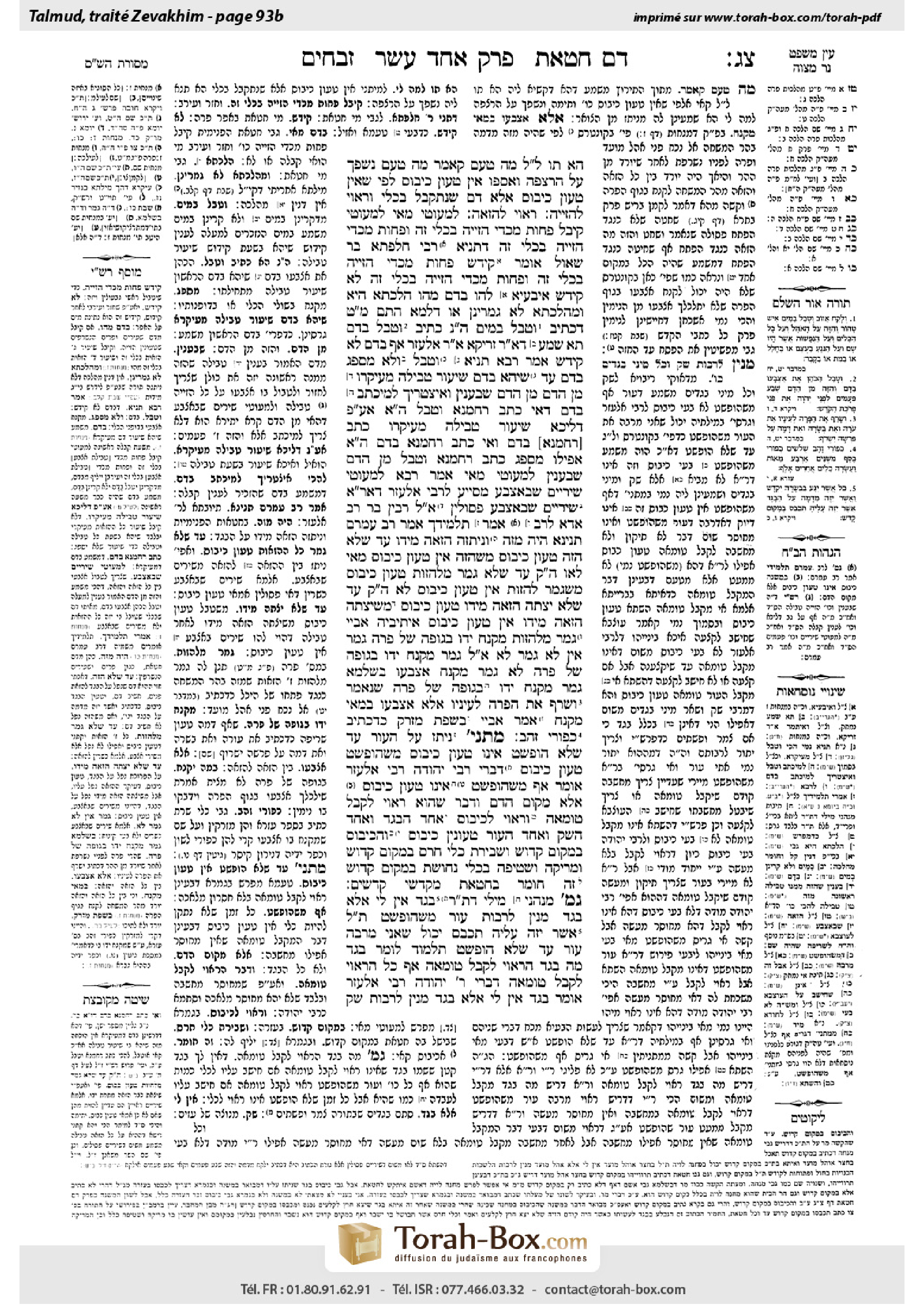
Zevachim 93b: Talmud study for Daf Yomi
Daf Yomi is the daily study of one Talmud folio. Explore 37 tractates with scans, Hebrew text, Sefaria English and AI-generated French translations where annotated.
Passage selection and English or AI-generated French translation are available where the scan has annotations. Daf Study is independent of Torah-Box and Sefaria.
Browse Zevachim · זבחים · All tractatesZevachim 93b text and translations
This page of Zevachim includes the Aramaic text, an English translation and an AI-generated French translation, alongside the scan above.
זבחים צ״ג ב · Aramaic and Hebrew text
הָא תּוּ לְמָה לִי? מָה טַעַם קָאָמַר: מָה טַעַם נִשְׁפַּךְ עַל הָרִצְפָּה וַאֲסָפוֹ אֵין טָעוּן כִּיבּוּס – לְפִי שֶׁאֵין טָעוּן כִּיבּוּס אֶלָּא דָּם שֶׁנִּתְקַבֵּל בִּכְלִי וְרָאוּי לְהַזָּיָיה.
רָאוּי לְהַזָּאָה – לְמַעוֹטֵי מַאי? לְמַעוֹטֵי קִיבֵּל פָּחוֹת מִכְּדֵי הַזָּיָיה בִּכְלִי זֶה וּפָחוֹת מִכְּדֵי הַזָּיָיה בִּכְלִי זֶה.
דְּתַנְיָא, רַבִּי חֲלַפְתָּא בַּר שָׁאוּל אוֹמֵר: קִידֵּשׁ פָּחוֹת מִכְּדֵי הַזָּיָיה בִּכְלִי זֶה וּפָחוֹת מִכְּדֵי הַזָּיָיה בִּכְלִי זֶה – לֹא קִידֵּשׁ.
אִיבַּעְיָא לְהוּ: בְּדָם מַהוּ? הִלְכְתָא הִיא, וּמֵהִלְכְתָא לָא גָּמְרִינַן;
אוֹ דִלְמָא, הָתָם מַאי טַעְמָא – דִּכְתִיב ״וְטָבַל בַּמַּיִם״, הָכָא נָמֵי כְּתִיב ״וְטָבַל בַּדָּם״.
תָּא שְׁמַע, דְּאָמַר רַבִּי זְרִיקָא אָמַר רַבִּי אֶלְעָזָר: אַף בְּדָם – לֹא קִידֵּשׁ.
אָמַר רָבָא, תַּנְיָא: ״וְטָבַל״ – וְלֹא מְסַפֵּג. ״בַּדָּם״ – עַד שֶׁיְּהֵא בַּדָּם שִׁיעוּר טְבִילָה מֵעִיקָּרוֹ. ״מִן הַדָּם״ – מִן הַדָּם שֶׁבָּעִנְיָן.
וְאִיצְטְרִיךְ לְמִיכְתַּב ״בַּדָּם״; דְּאִי כְּתַב רַחֲמָנָא ״וְטָבַל״, הֲוָה אָמֵינָא אַף עַל פִּי דְּלֵיכָּא שִׁיעוּר טְבִילָה מֵעִיקָּרוֹ; כְּתַב [רַחֲמָנָא] ״בַּדָּם״.
וְאִי כְּתַב רַחֲמָנָא ״בַּדָּם״, הֲוָה אָמֵינָא אֲפִילּוּ מְסַפֵּג; כְּתַב רַחֲמָנָא ״וְטָבַל״.
מִן הַדָּם שֶׁבְּעִנְיָן – לְמַעוֹטֵי מַאי? אָמַר רָבָא: לְמַעוֹטֵי שִׁירַיִים שֶׁבָּאֶצְבַּע. מְסַיַּיע לְרַבִּי אֶלְעָזָר, דְּאָמַר רַבִּי אֶלְעָזָר: שִׁירַיִים שֶׁבָּאֶצְבַּע – פְּסוּלִין.
אֲמַר לֵיהּ רָבִין בַּר רַב אַדָּא לְרַב: אָמַר תַּלְמִידְךָ, אָמַר רַב עַמְרָם, תְּנֵינָא: הָיָה מַזֶּה וְנִיתְּזָה הַזָּאָה מִיָּדוֹ – עַד שֶׁלֹּא הִזָּה, טָעוּן כִּיבּוּס. מִשֶּׁהִזָּה, אֵין טָעוּן כִּיבּוּס.
מַאי, לָאו הָכִי קָאָמַר: עַד שֶׁלֹּא גָּמַר מִלְּהַזּוֹת – טָעוּן כִּיבּוּס, מִשֶּׁגָּמַר לְהַזּוֹת – אֵין טָעוּן כִּיבּוּס? לָא; הָכִי קָאָמַר: עַד שֶׁלֹּא יָצְתָה הַזָּאָה מִיָּדוֹ – טָעוּן כִּיבּוּס, מִשֶּׁיָּצְתָה הַזָּאָה מִיָּדוֹ – אֵין טָעוּן כִּיבּוּס.
אֵיתִיבֵיהּ אַבָּיֵי: גָּמַר מִלְּהַזּוֹת – מְקַנֵּחַ יָדוֹ בְּגוּפָהּ שֶׁל פָּרָה. גָּמַר אִין, לֹא גָּמַר לָא! אֲמַר לֵיהּ: גָּמַר – מְקַנֵּחַ יָדוֹ בְּגוּפָהּ שֶׁל פָּרָה, לֹא גָּמַר – מְקַנֵּחַ אֶצְבָּעוֹ.
בִּשְׁלָמָא גָּמַר – מְקַנֵּחַ יָדוֹ בְּגוּפָהּ שֶׁל פָּרָה, שֶׁנֶּאֱמַר: ״וְשָׂרַף אֶת הַפָּרָה לְעֵינָיו״. אֶלָּא אֶצְבָּעוֹ – בְּמַאי מְקַנֵּחַ? אָמַר אַבָּיֵי: בִּשְׂפַת מִזְרָק, כְּדִכְתִיב: ״כְּפוֹרֵי זָהָב״.
מַתְנִי׳ נִיתַּז עַל הָעוֹר עַד שֶׁלֹּא הוּפְשַׁט – אֵינוֹ טָעוּן כִּיבּוּס, מִשֶּׁהוּפְשַׁט – טָעוּן כִּיבּוּס. דִּבְרֵי רַבִּי יְהוּדָה.
רַבִּי אֶלְעָזָר אוֹמֵר: אַף מִשֶּׁהוּפְשַׁט; אֵינוֹ טָעוּן כִּיבּוּס אֶלָּא מְקוֹם הַדָּם, וְדָבָר שֶׁהוּא רָאוּי לְקַבֵּל טוּמְאָה, וְרָאוּי לְכִיבּוּס.
אֶחָד הַבֶּגֶד וְאֶחָד הַשַּׂק וְאֶחָד הָעוֹר – טְעוּנִין כִּיבּוּס; וְהַכִּיבּוּס בְּמָקוֹם קָדוֹשׁ, וּשְׁבִירַת כְּלִי חֶרֶס בְּמָקוֹם קָדוֹשׁ, וּמְרִיקָה וּשְׁטִיפָה בִּכְלִי נְחוֹשֶׁת בִּמְקוֹם קָדוֹשׁ. זֶה חוֹמֶר בְּחַטָּאת מִקׇּדְשֵׁי קָדָשִׁים.
גְּמָ׳ מְנָהָנֵי מִילֵּי? דְּתָנוּ רַבָּנַן: ״בֶּגֶד״ – אֵין לִי אֶלָּא בֶּגֶד, מִנַּיִן לְרַבּוֹת עוֹר מִשֶּׁהוּפְשַׁט? תַּלְמוּד לוֹמַר: ״אֲשֶׁר יִזֶּה עָלֶיהָ תְּכַבֵּס״.
יָכוֹל שֶׁאֲנִי מְרַבֶּה עוֹר עַד שֶׁלֹּא הוּפְשַׁט? תַּלְמוּד לוֹמַר ״בֶּגֶד״ – מָה בֶּגֶד הָרָאוּי לְקַבֵּל טוּמְאָה, אַף כֹּל הָרָאוּי לְקַבֵּל טוּמְאָה. דִּבְרֵי רַבִּי יְהוּדָה.
רַבִּי אֶלְעָזָר אוֹמֵר: ״בֶּגֶד״ – אֵין לִי אֶלָּא בֶּגֶד, מִנַּיִן לְרַבּוֹת שַׂק
Zevachim 93b · English translation
With regard to the statement that only blood that was collected in a vessel and is fit for sprinkling requires the laundering of the garment on which it sprayed, the Gemara asks: Why do I also need this? After all, it was already taught that if blood spilled from the neck onto the floor before it was collected in a vessel, and it sprayed on a garment, the garment does not require laundering. The Gemara answers: This is not an additional halakha, but rather the mishna is saying: What is the reason? What is the reason that if the blood spilled from the neck onto the floor before it was collected in a vessel, and the priest collected it and it sprayed on a garment, the garment does not require laundering? This is because it is only with regard to blood that was received in a sacred vessel and is fit for sprinkling that the garment requires laundering.
§ The mishna teaches: It is only with regard to blood that was received in a sacred vessel and is fit for sprinkling that the garment requires laundering. The Gemara asks: As it was already taught that when disqualified blood is sprayed on a garment, it does not require laundering, this reiteration serves to exclude what? The Gemara answers: It serves to exclude the case where a priest received less blood than is sufficient for sprinkling in this vessel, and less than is sufficient for sprinkling in that vessel, and then he mixed together the blood from the two vessels. In such a case, even though the combined amount is now enough for sprinkling, the blood did not become fit for sprinkling.
This is as it is taught in a baraita: With regard to the sanctification of water of purification, Rabbi Ḥalafta bar Shaul says: If a priest sanctified less than is sufficient for sprinkling in this vessel and less than is sufficient for sprinkling in that vessel, and he then mixed together the water from the two vessels, he has not sanctified it to become water of purification.
In a related issue, a dilemma was raised before the Sages: If a priest did this for the blood of an internal sin offering, collecting less than is sufficient for sprinkling in each vessel and then mixing all the blood together, what is the halakha? Is Rabbi Ḥalafta’s statement about the water of purification a halakha transmitted to Moses from Sinai, and we do not learn from such a halakha an application to a different matter?
Or, perhaps: What is the reason there, that the combined water of purification is not fit for sprinkling? It may be because it is written about sprinkling the water: “And dip it in the water” (Numbers 19:18), stressing that it is to be dipped in precisely the same water that was first placed in the vessel. This indicates that from the outset there must be an amount sufficient for sprinkling. If so, then here also there is comparable language employed with regard to the blood of a sin offering. It is written: “And the priest shall dip his finger in the blood, and sprinkle of the blood” (Leviticus 4:6). Does this prove that from the outset there must be sufficient blood for sprinkling?
The Gemara suggests: Come and hear a proof, as Rabbi Zerika says that Rabbi Elazar says: Even in the case of the blood of a sin offering, if one collected two insufficient amounts and then mixed them together, he did not sanctify the blood to make it fit for sprinkling on the altar, and therefore, if it sprays on a garment, one is not required to launder the garment.
§ Rava says: It is taught in a baraita with regard to the internal sin offering, whose blood is sprinkled in the Sanctuary: The verse states: “And the priest shall dip his finger in the blood, and sprinkle of the blood” (Leviticus 4:6); and there must be enough blood in the vessel for the priest to dip his finger in it so that he does not need to wipe blood from the sides or the bottom of the vessel onto his finger. The verse states: “In the blood,” teaching that the blood is unfit for sprinkling unless there is a measure of the blood fit for dipping in the vessel from the outset, and the blood is disqualified if more blood is added to a vessel that initially contained less than the required measure. The verse states: “Sprinkle of the blood,” which teaches that he must sprinkle of the blood that is mentioned in this matter, which is the blood in the vessel.
And it was necessary for the Torah to write the term: “In the blood,” as well as the term: “And the priest shall dip.” As, had the Merciful One written only: “And the priest shall dip,” I would say that if there is sufficient blood at the time of dipping, even though there was not a measure of blood fit for dipping in the vessel from the beginning, it is nevertheless fit for dipping. Therefore, the Merciful One writes: “In the blood,” to teach that there must be sufficient blood from the beginning.
And if the Merciful One had written only: “In the blood,” I would say that if at the beginning there was an appropriate measure of blood, it is not necessary for the vessel to retain a measure of enough blood throughout the whole rite, and even if he eventually wipes blood off of the vessel onto his finger, it is sufficient for sprinkling. Therefore, the Merciful One writes: “And the priest shall dip,” to teach that there must remain enough blood to dip his finger each time.
The cited baraita states: The verse states: “Sprinkle of the blood,” which teaches that he must sprinkle of the blood that is mentioned in this matter, which is the blood in the vessel. The Gemara asks: In order to exclude what was this mentioned? Rava said: This serves to exclude the remainder of the blood that is on the priest’s finger after sprinkling, which may not be used for further sprinkling, as he must dip his finger in the blood again for each sprinkle. Rava continues: This supports the opinion of Rabbi Elazar, as Rabbi Elazar says: The remainder of the blood that is on the priest’s finger after sprinkling is unfit for further sprinkling.
Ravin bar Rav Adda said to Rav, i.e., Rava: Your student says that Rav Amram says: We already learn a baraita opposing Rabbi Elazar’s opinion: If a priest was sprinkling the blood of an internal sin offering, and a sprinkle sprayed from his hand onto a garment, the halakha depends on the circumstances. If it sprayed before he sprinkled, the garment requires laundering, but if it sprayed once he has sprinkled, it does not require laundering.
Ravin bar Rav Adda explains: What, is it not this that the baraita is saying: If the blood sprayed on a garment before the priest concluded sprinkling, the garment requires laundering, even if it sprayed from the remainder on his finger; but if it sprayed once the priest has concluded sprinkling, it does not require laundering? This indicates that blood sprayed from the remainder on his finger requires laundering, so it must be fit for sprinkling. Rava replied: No, this is what the baraita is saying: If the blood sprayed on a garment before the sprinkling has left his hand, it requires laundering, but if it sprayed once the sprinkling has left his hand, the remainder on his finger does not require laundering if it then sprays onto a garment.
Abaye raised an objection to Rabbi Elazar’s opinion from what is taught about sprinkling the blood of the red heifer in a mishna (Para 3:9): When the priest has concluded sprinkling the blood, he wipes his hand on the body of the red heifer. Evidently, if he concluded sprinkling, yes, he does wipe his hand; but if he did not conclude sprinkling, he does not wipe his hand, even though a remainder is left on his finger. Evidently, this remainder is fit for sprinkling. Rava said to him: The mishna is to be understood otherwise: If he concluded sprinkling, he wipes his entire hand on the body of the red heifer; but if he has not concluded sprinkling, he wipes only his finger after each sprinkling.
The Gemara asks: Granted, if he concluded sprinkling, he wipes his hand on the body of the red heifer, as it is stated: “And the heifer shall be burned in his sight; its skin, and its flesh, and its blood” (Numbers 19:5), indicating that the remaining blood must be incinerated together with the flesh. But on what does he wipe his finger after each sprinkling, since he must not wipe it on the body of the heifer, which might cause hair to stick to his finger, interfering with the sprinkling? Abaye said: He wipes his finger on the lip of the bowl holding the blood for sprinkling, as it is written: “Atoning bowls [keforei] of gold” (Ezra 1:10). The atoning bowls are so named because the priest wipes his finger on them, and the word keforei indicates cleansing by way of wiping (see Ḥullin 8b).
MISHNA: Apropos laundering the blood of a sin offering from garments onto which it sprayed, the mishna discusses what is considered a garment. If the blood of a sin offering sprayed onto the hide of an animal before it was flayed from the animal, the hide does not require laundering, because its status is not that of a garment, which is susceptible to ritual impurity. If the blood sprayed onto the hide after it was flayed, it requires laundering; this is the statement of Rabbi Yehuda.
Rabbi Elazar says: Even if the blood sprayed onto the hide after it was flayed, it does not require laundering until it is crafted into a vessel or garment that is actually susceptible to ritual impurity. This is the principle with regard to laundering: A garment must be laundered only in the place where the blood was sprayed, and only if it is an item that is fit to become ritually impure, and only if it is an item fit for laundering.
With regard to the garment mentioned explicitly in the Torah, and the sackcloth, and the hide, all of these require laundering. And the laundering must be performed in a sacred place, the Temple courtyard, and the breaking of an earthenware vessel in which a sin offering was cooked must be performed in a sacred place, and scouring and rinsing of a copper vessel in which a sin offering was cooked must be performed in a sacred place. With regard to this matter, a stringency applies to a sin offering more than it applies to offerings of the most sacred order.
GEMARA: With regard to blood sprayed on a flayed hide, from where are these matters, i.e., the divergent opinions of Rabbi Yehuda and Rabbi Elazar, derived? The Gemara explains: They are derived as the Sages taught in a baraita: It is stated with regard to laundering: “And when any of its blood shall be sprinkled on a garment” (Leviticus 6:20). I have derived only a garment; from where do I include an animal’s hide after it was flayed? The same verse states: “You shall launder that on which it shall be sprinkled,” to include any item on which the blood sprayed.
One might have thought that I would include a hide even before it was flayed. To counter this, the verse states: “Garment.” Consequently, just as any manner of garment is an item fit to become ritually impure if one intends to use it, e.g., making it a patch for his clothing, so too the requirement of laundering applies to any item that becomes fit to become ritually impure when one intends to use it as is. A hide is fit to become ritually impure after it has been flayed, when one intends to use it for a rug or the like; this is the statement of Rabbi Yehuda.
Rabbi Elazar holds that, even after it is flayed, the hide does not require laundering. In interpreting the verse, he says: The verse states: “Garment,” and from this I have derived only a garment; from where do I include sackcloth
Zevachim 93b · Traduction française (IA)
À propos de l’énoncé selon lequel seul le sang recueilli dans un récipient et apte à être aspergé impose le lavage du vêtement sur lequel il a giclé, la Guemara demande : Pourquoi faut-il également enseigner cela ? On a déjà enseigné que si le sang s’est écoulé du cou sur le sol avant d’être recueilli dans un récipient et qu’il a giclé sur un vêtement, celui-ci n’a pas à être lavé. La Guemara répond : Il ne s’agit pas d’une halakha supplémentaire ; la Michna indique plutôt la raison. Pourquoi, si le sang s’est écoulé du cou sur le sol avant d’être recueilli dans un récipient, puis que le prêtre l’a recueilli et qu’il a giclé sur un vêtement, celui-ci n’a-t-il pas à être lavé ? Parce que seul le sang reçu dans un récipient sacré et apte à être aspergé impose le lavage du vêtement.
§ La Michna enseigne : Seul le sang reçu dans un récipient sacré et apte à être aspergé impose le lavage du vêtement. La Guemara demande : Puisqu’on a déjà enseigné que le sang disqualifié qui gicle sur un vêtement n’impose pas son lavage, qu’est-ce que cette répétition vient exclure ? La Guemara répond : Elle exclut le cas où un prêtre a recueilli dans un récipient une quantité de sang insuffisante pour une aspersion, et dans un autre récipient une quantité également insuffisante, puis a mélangé le sang des deux récipients. Dans ce cas, même si la quantité totale suffit désormais pour une aspersion, le sang n’est pas devenu apte à être aspergé.
C’est ce qui est enseigné dans une baraïta : au sujet de la sanctification de l’eau de purification, Rabbi Ḥalafta bar Shaul dit : Si un prêtre a sanctifié dans un récipient une quantité insuffisante pour une aspersion, et dans un autre récipient une quantité également insuffisante, puis a mélangé l’eau des deux récipients, il ne l’a pas sanctifiée pour qu’elle devienne de l’eau de purification.
À propos d’une question connexe, les Sages soulevèrent un dilemme : quelle est la halakha si un prêtre a procédé ainsi avec le sang d’un sacrifice expiatoire intérieur, en recueillant dans chaque récipient une quantité insuffisante pour une aspersion, puis en mélangeant tout le sang ? L’énoncé de Rabbi Ḥalafta au sujet de l’eau de purification est-il une halakha transmise à Moïse au Sinaï, dont nous ne tirons pas d’application à une autre question ?
Ou peut-être la raison pour laquelle l’eau de purification mélangée n’est pas apte à être aspergée est-elle la suivante : au sujet de l’aspersion de l’eau, il est écrit : « Et tu le tremperas dans l’eau » (Nombres 19:18), ce qui souligne qu’il doit être trempé précisément dans l’eau qui a d’abord été placée dans le récipient. Cela indique que, dès le départ, la quantité doit être suffisante pour une aspersion. Si tel est le cas, une formulation comparable est également employée ici à propos du sang d’un sacrifice expiatoire. Il est écrit : « Le prêtre trempera son doigt dans le sang et aspergera du sang » (Lévitique 4:6). Cela prouve-t-il que, dès le départ, la quantité de sang doit être suffisante pour une aspersion ?
La Guemara propose : Écoute une preuve, car Rabbi Zerika dit au nom de Rabbi Elazar : même dans le cas du sang d’un sacrifice expiatoire, si l’on a recueilli deux quantités insuffisantes puis qu’on les a mélangées, on n’a pas sanctifié le sang pour le rendre apte à être aspergé sur l’autel ; par conséquent, s’il gicle sur un vêtement, celui-ci n’a pas à être lavé.
§ Rava dit : Une baraïta enseigne à propos du sacrifice expiatoire intérieur, dont le sang est aspergé dans le Sanctuaire : le verset dit : « Le prêtre trempera son doigt dans le sang et aspergera du sang » (Lévitique 4:6). Le récipient doit contenir assez de sang pour que le prêtre puisse y tremper son doigt, sans avoir à essuyer le sang sur les parois ou le fond du récipient pour en mettre sur son doigt. Le verset dit : « Dans le sang », ce qui enseigne que le sang n’est pas apte à être aspergé si le récipient ne contient pas, dès le départ, une quantité suffisante pour y tremper le doigt ; le sang est donc disqualifié si l’on en ajoute dans un récipient qui contenait initialement moins que la quantité requise. Le verset dit : « Aspergera du sang », ce qui enseigne qu’il doit asperger du sang mentionné dans ce passage, à savoir celui qui se trouve dans le récipient.
Il était nécessaire que la Torah écrive à la fois « Dans le sang » et « Le prêtre trempera ». En effet, si le Miséricordieux n’avait écrit que « Le prêtre trempera », j’aurais dit que, s’il y a assez de sang au moment où le prêtre trempe son doigt, le sang est néanmoins apte à être aspergé, même si le récipient ne contenait pas dès le départ une quantité suffisante pour y tremper le doigt. C’est pourquoi le Miséricordieux écrit « Dans le sang », pour enseigner que la quantité doit être suffisante dès le départ.
Et si le Miséricordieux n’avait écrit que « Dans le sang », j’aurais dit que, s’il y avait au départ une quantité convenable de sang, le récipient n’a pas besoin de conserver une quantité suffisante pendant toute la cérémonie et que, même si le prêtre finit par essuyer du sang du récipient sur son doigt, cela suffit pour l’aspersion. C’est pourquoi le Miséricordieux écrit « Le prêtre trempera », pour enseigner qu’il doit rester assez de sang pour qu’il puisse y tremper son doigt à chaque fois.
La baraïta citée enseigne : le verset dit : « Aspergera du sang », ce qui signifie qu’il doit asperger du sang mentionné dans ce passage, à savoir celui qui se trouve dans le récipient. La Guemara demande : Qu’est-ce que cette formulation vient exclure ? Rava dit : Elle exclut le sang restant sur le doigt du prêtre après une aspersion, qu’il ne peut pas utiliser pour asperger de nouveau, car il doit tremper à nouveau son doigt dans le sang pour chaque aspersion. Rava poursuit : Cela appuie l’avis de Rabbi Elazar, car Rabbi Elazar dit que le sang restant sur le doigt du prêtre après une aspersion n’est pas apte à être aspergé de nouveau.
Ravin bar Rav Adda dit à Rav, c’est-à-dire Rava : Ton élève rapporte que Rav Amram dit : Nous avons déjà appris une baraïta qui contredit l’avis de Rabbi Elazar. Si un prêtre aspergeait le sang d’un sacrifice expiatoire intérieur et qu’une goutte giclait de sa main sur un vêtement, la halakha dépend des circonstances. Si elle giclait avant qu’il n’asperge, le vêtement doit être lavé ; mais si elle giclait après qu’il a aspergé, le vêtement n’a pas à être lavé.
Ravin bar Rav Adda explique : La baraïta ne dit-elle pas que, si le sang a giclé sur un vêtement avant que le prêtre ait achevé les aspersions, le vêtement doit être lavé, même si le sang provenait du reste sur son doigt ; mais que, s’il a giclé après qu’il a achevé les aspersions, le vêtement n’a pas à être lavé ? Cela indique que le sang provenant du reste sur son doigt impose le lavage ; il doit donc être apte à être aspergé. Rava répondit : Non, voici ce que dit la baraïta : si le sang a giclé sur un vêtement avant que l’aspersion ait quitté sa main, le vêtement doit être lavé ; mais s’il a giclé après que l’aspersion a quitté sa main, le reste sur son doigt n’impose pas le lavage s’il gicle ensuite sur un vêtement.
Abayé objecta à l’avis de Rabbi Elazar en citant ce qui est enseigné au sujet de l’aspersion du sang de la vache rousse dans une Michna (Para 3:9) : lorsque le prêtre a achevé les aspersions du sang, il essuie sa main sur le corps de la vache rousse. De toute évidence, s’il a achevé les aspersions, il essuie sa main ; mais s’il ne les a pas achevées, il n’essuie pas sa main, même s’il reste du sang sur son doigt. De toute évidence, ce reste est apte à être aspergé. Rava lui dit : Il faut comprendre la Michna autrement : s’il a achevé les aspersions, il essuie toute sa main sur le corps de la vache rousse ; mais s’il ne les a pas achevées, il essuie seulement son doigt après chaque aspersion.
La Guemara demande : Il est compréhensible que, s’il a achevé les aspersions, il essuie sa main sur le corps de la vache rousse, car il est écrit : « La vache sera brûlée sous ses yeux ; sa peau, sa chair et son sang » (Nombres 19:5), ce qui indique que le sang restant doit être brûlé avec la chair. Mais sur quoi essuie-t-il son doigt après chaque aspersion, puisqu’il ne doit pas l’essuyer sur le corps de la vache, car des poils pourraient se coller à son doigt et gêner l’aspersion ? Abayé dit : Il essuie son doigt sur le bord du bol contenant le sang destiné à l’aspersion, comme il est écrit : « Des bols d’or [keforei] » (Esdras 1:10). Ces bols sont ainsi appelés parce que le prêtre y essuie son doigt, et le mot keforei indique une purification par essuyage (voir Ḥullin 8b).
MICHNA : À propos du lavage du sang d’un sacrifice expiatoire sur les vêtements qu’il a éclaboussés, la Michna examine ce qui est considéré comme un vêtement. Si le sang d’un sacrifice expiatoire a giclé sur la peau d’un animal avant que celui-ci soit dépouillé, la peau n’a pas à être lavée, car elle n’a pas le statut de vêtement, lequel est susceptible de contracter l’impureté rituelle. Si le sang a giclé sur la peau après qu’elle a été dépouillée, elle doit être lavée ; telle est la déclaration de Rabbi Yehuda.
Rabbi Elazar dit : même si le sang a giclé sur la peau après qu’elle a été dépouillée, celle-ci n’a pas à être lavée tant qu’elle n’a pas été façonnée en un récipient ou en un vêtement effectivement susceptible de contracter l’impureté rituelle. Voici le principe concernant le lavage : un vêtement ne doit être lavé qu’à l’endroit où le sang a giclé, et seulement s’il s’agit d’un objet susceptible de contracter l’impureté rituelle et pouvant être lavé.
Le vêtement expressément mentionné dans la Torah, la toile de sac et la peau doivent tous être lavés. Le lavage doit être effectué dans un lieu sacré, c’est-à-dire dans la cour du Temple ; la brisure du récipient en terre cuite dans lequel un sacrifice expiatoire a été cuit doit également avoir lieu dans un lieu sacré, tout comme le récurage et le rinçage du récipient en cuivre dans lequel un sacrifice expiatoire a été cuit. À cet égard, le sacrifice expiatoire fait l’objet d’une plus grande rigueur que les offrandes de sainteté suprême.
GUEMARA : Au sujet du sang qui a giclé sur une peau dépouillée, de quels versets tire-t-on ces enseignements, c’est-à-dire les avis divergents de Rabbi Yehuda et de Rabbi Elazar ? La Guemara explique : Ils sont tirés de ce que les Sages enseignent dans une baraïta : au sujet du lavage, il est écrit : « Si du sang en éclabousse un vêtement » (Lévitique 6:20). Je n’ai compris que le cas d’un vêtement ; d’où inclure la peau d’un animal après qu’elle a été dépouillée ? Le même verset dit : « Tu laveras ce sur quoi il aura été aspergé », afin d’inclure tout objet sur lequel le sang a giclé.
On aurait pu penser qu’il fallait inclure même une peau avant qu’elle ait été dépouillée. Pour l’exclure, le verset dit : « Vêtement ». Par conséquent, de même que tout type de vêtement est un objet susceptible de contracter l’impureté rituelle si l’on a l’intention de l’utiliser, par exemple pour en faire une pièce rapportée à un vêtement, de même l’obligation de lavage s’applique à tout objet qui devient susceptible de contracter l’impureté rituelle lorsque l’on a l’intention de l’utiliser tel quel. Une peau devient susceptible de contracter l’impureté rituelle après avoir été dépouillée, si l’on a l’intention de l’utiliser comme tapis ou à une fin similaire ; telle est la déclaration de Rabbi Yehuda.
Rabbi Elazar estime que, même après avoir été dépouillée, la peau n’a pas à être lavée. Il interprète le verset ainsi : le verset dit « Vêtement », et de cela je n’ai compris que le cas d’un vêtement ; d’où inclure la toile de sac ?
Traduction française générée par IA à partir de l’édition anglaise de Sefaria. Vérifie toujours un passage avec le texte source.
Text from Sefaria: William Davidson Edition - Vocalized Aramaic (CC BY NC); William Davidson Edition - English (CC BY NC).