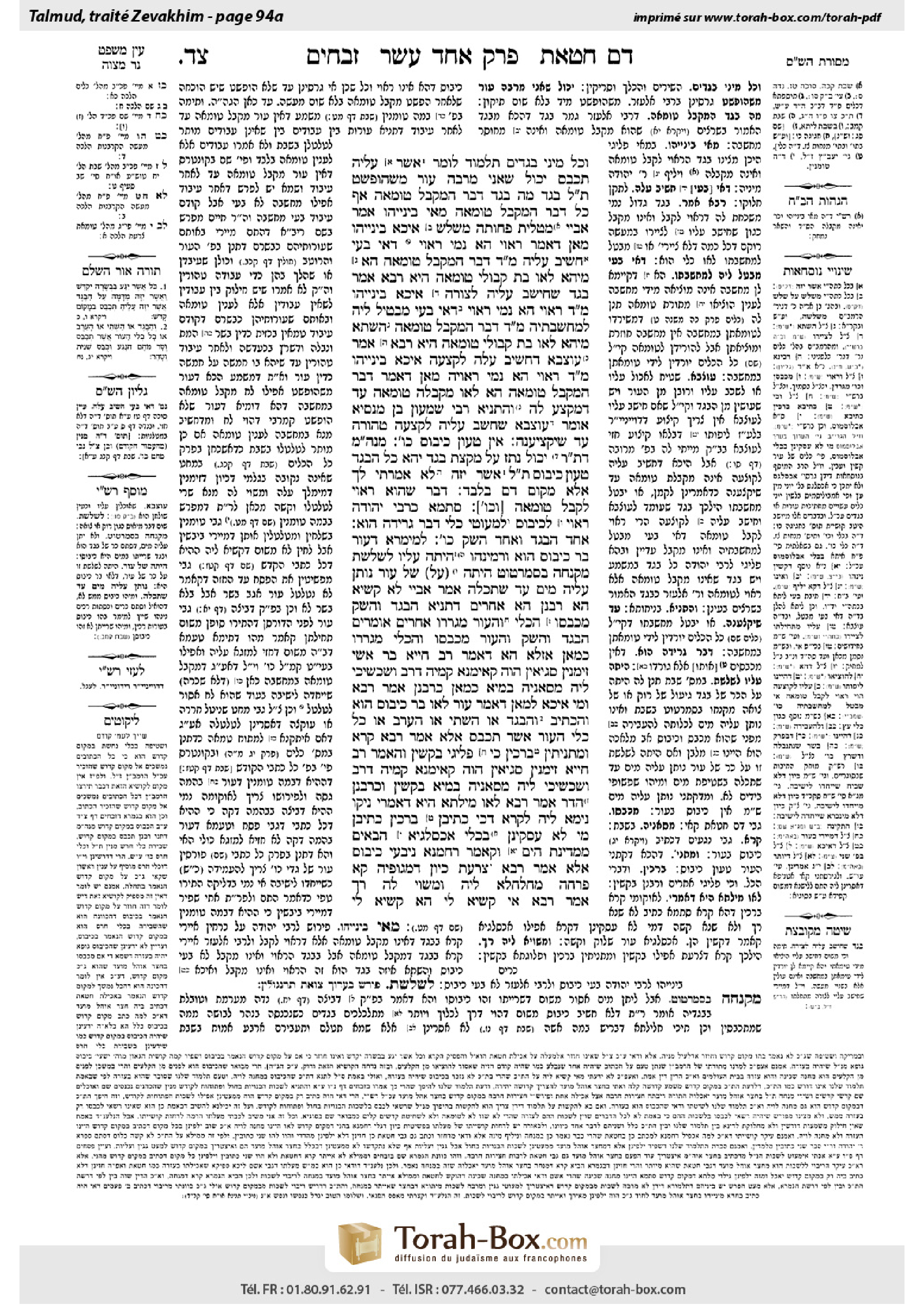
Zevachim 94a: Talmud study for Daf Yomi
Daf Yomi is the daily study of one Talmud folio. Explore 37 tractates with scans, Hebrew text, Sefaria English and AI-generated French translations where annotated.
Passage selection and English or AI-generated French translation are available where the scan has annotations. Daf Study is independent of Torah-Box and Sefaria.
Browse Zevachim · זבחים · All tractatesZevachim 94a text and translations
This page of Zevachim includes the Aramaic text, an English translation and an AI-generated French translation, alongside the scan above.
זבחים צ״ד א · Aramaic and Hebrew text
וְכׇל מִינֵי בְגָדִים? תַּלְמוּד לוֹמַר: ״אֲשֶׁר עָלֶיהָ תְּכַבֵּס״. יָכוֹל שֶׁאֲנִי מְרַבֶּה עוֹר מִשֶּׁהוּפְשַׁט? תַּלְמוּד לוֹמַר ״בֶּגֶד״ – מָה בֶּגֶד דָּבָר הַמְקַבֵּל טוּמְאָה, אַף כֹּל דָּבָר הַמְקַבֵּל טוּמְאָה.
מַאי בֵּינַיְיהוּ? אָמַר אַבָּיֵי: מַטְלֵית פְּחוּתָה מִשָּׁלֹשׁ אִיכָּא בֵּינַיְיהוּ; מַאן דְּאָמַר רָאוּי – הָא נָמֵי רָאוּי, דְּאִי בָּעֵי חַשֵּׁיב עֲלֵיהּ. מַאן דְּאָמַר דָּבָר הַמְקַבֵּל טוּמְאָה – הָא מִיהָא לָאו בַּת קַבּוֹלֵי טוּמְאָה הִיא.
רָבָא אָמַר: בֶּגֶד שֶׁחִישֵּׁב עָלֶיהָ לְצוּרָה אִיכָּא בֵּינַיְיהוּ; מַאן דְּאָמַר רָאוּי – הָא נָמֵי רָאוּי, דְּאִי בָּעֵי מְבַטֵּיל לֵיהּ לְמַחְשַׁבְתֵּיהּ. מַאן דְּאָמַר דָּבָר הַמְקַבֵּל טוּמְאָה – הַשְׁתָּא מִיהָא לָאו בַּת קַבּוֹלֵי טוּמְאָה הִיא.
רָבָא אָמַר: עוּצְבָּא דְּחַשֵּׁיב עֲלַהּ לְקַצְּעָהּ אִיכָּא בֵּינַיְיהוּ; מַאן דְּאָמַר רָאוּי – הָא נָמֵי רְאוּיָה; מַאן דְּאָמַר דָּבָר הַמְקַבֵּל טוּמְאָה – הָא לָאו מְקַבְּלָה טוּמְאָה עַד דִּמְקַצַּע לַהּ. וְהָתַנְיָא, רַבִּי שִׁמְעוֹן בֶּן מְנַסְיָא אוֹמֵר: עוּצְבָּא שֶׁחִשֵּׁב עָלֶיהָ לְקַצְּעָהּ – טְהוֹרָה עַד שֶׁיְּקַצְּעֶנָּה.
אֵין טָעוּן כִּיבּוּס כּוּ׳. מְנָא הָנֵי מִילֵּי? דְּתָנוּ רַבָּנַן: יָכוֹל נִתַּז עַל מִקְצָת בֶּגֶד – יְהֵא כׇּל הַבֶּגֶד טָעוּן כִּיבּוּס? תַּלְמוּד לוֹמַר ״אֲשֶׁר יִזֶּה״ – לֹא אָמַרְתִּי לְךָ אֶלָּא מְקוֹם דָּם בִּלְבַד.
דָּבָר שֶׁהוּא רָאוּי לְקַבֵּל טוּמְאָה [וְכוּ׳]. סְתָמָא כְּרַבִּי יְהוּדָה.
רָאוּי לְכִיבּוּס. לְמַעוֹטֵי כְּלִי, דְּבַר גְּרִידָה הוּא.
אֶחָד הַבֶּגֶד וְאֶחָד הַשַּׂק כּוּ׳. לְמֵימְרָא דְּעוֹר בַּר כִּיבּוּס הוּא?! וּרְמִינְהוּ: הָיְתָה עָלָיו לַשְׁלֶשֶׁת – מְקַנְּחָהּ בִּסְמַרְטוּט. הָיְתָה עַל שֶׁל עוֹר – נוֹתֵן עָלֶיהָ מַיִם עַד שֶׁתִּכְלֶה!
אָמַר אַבָּיֵי: לָא קַשְׁיָא; הָא רַבָּנַן הָא אֲחֵרִים. דְּתַנְיָא: הַבֶּגֶד וְהַשַּׂק – מְכַבְּסוֹ, הַכְּלִי וְהָעוֹר – מְגָרְרוֹ. אֲחֵרִים אוֹמְרִים: הַבֶּגֶד וְהַשַּׂק וְהָעוֹר – מְכַבְּסוֹ, וְהַכְּלִי – מְגָרְרוֹ.
כְּמַאן אָזְלָא הָא דְּאָמַר רַב חִיָּיא בַּר אָשֵׁי: זִימְנִין סַגִּיאִין הֲוָה קָאֵימְנָא קַמֵּיהּ דְּרַב, וְשַׁכְשֵׁיכִי לֵיהּ מְסָאנֵיהּ בְּמַיָּא? כְּמַאן – כְּרַבָּנַן.
אָמַר רָבָא: וּמִי אִיכָּא לְמַאן דְּאָמַר, עוֹר לָאו בַּר כִּיבּוּס הוּא?! וְהָכְתִיב: ״וְהַבֶּגֶד אוֹ הַשְּׁתִי אוֹ הָעֵרֶב אוֹ כׇל כְּלִי הָעוֹר אֲשֶׁר תְּכַבֵּס״! אֶלָּא אָמַר רָבָא: קְרָא וּמַתְנִיתִין – בְּרַכִּין, כִּי פְּלִיגִי – בְּקָשִׁין.
וְהָאָמַר רַב חִיָּיא: זִימְנִין סַגִּיאִין הֲוָה קָאֵימְנָא קַמֵּיהּ דְּרַב, וְשַׁכְשֵׁיכִי לֵיהּ מְסָאנֵיהּ בְּמַיָּא! בְּקָשִׁין, וּכְרַבָּנַן.
הֲדַר אָמַר רָבָא: לָאו מִילְּתָא הִיא דַּאֲמַרִי; נֵיקוּ נֵימָא לֵיהּ לִקְרָא דְּכִי כְתִיבָן בְּרַכִּין כְּתִיבָן?! מִי לָא עָסְקִינַן בִּכְלֵי אֶכְּסָלְגְיָא הַבָּאִים מִמְּדִינַת הַיָּם, וְקָאָמַר רַחֲמָנָא נִיבְעֵי כִּיבּוּס?
אֶלָּא אָמַר רָבָא: צָרַעַת – כֵּיוָן דְּמִגּוּפֵיהּ קָא פָרְחָה, מְחַלְחֲלָא לֵיהּ וּמְשַׁוְּיָא לַהּ רַךְ. אָמַר רָבָא: אִי קַשְׁיָא לִי, הָא קַשְׁיָא לִי:
Zevachim 94a · English translation
and all types of garments made of other materials in the requirement of laundering? The verse states: “You shall launder that on which it shall be sprinkled.” One might have thought that I include an animal’s hide after it was flayed. That verse states: “Garment,” to teach that just as a garment is an item that is susceptible to ritual impurity as is, so too any comparable item that is a ready utensil and therefore susceptible to impurity must be laundered. Accordingly, Rabbi Elazar holds that merely flaying a hide is insufficient to render it an item that must be laundered.
The Gemara asks: What is the practical difference between the opinions of Rabbi Yehuda and Rabbi Elazar? Is there an item that is fit to become ritually impure, but is not actually susceptible to impurity? Abaye said: A patch of cloth less than three by three fingerbreadths presents a practical difference between the two opinions. According to the one who says that any garment fit to become ritually impure must be laundered, this patch of cloth is also fit to become ritually impure, as if the owner wants, he can intend it for a specific use, as in patching his garment. According to the one who says that only an object already susceptible to impurity must be laundered, this patch, in any event, is not yet susceptible to impurity, so it does not require laundering.
Rava said: A garment upon which an individual initially intended to place an image constitutes a practical difference between the two opinions. Since the garment was initially intended to have an adornment, the garment is considered incomplete and not yet susceptible to impurity until the image is added. According to the one who says that any garment fit to become ritually impure requires laundering, this garment is also fit to become ritually impure, as if the owner wants to, he can void his intention to add the image, and the garment will be automatically susceptible to impurity. According to the one who says that only an item already susceptible to impurity requires laundering, now, at least, this garment is not susceptible to impurity and does not require laundering.
According to a different version, Rava said: An unfinished hide [utzeva] that one intended to trim in a precise manner constitutes a practical difference between the two opinions. According to the one who says that any garment-like item fit to become ritually impure must be laundered, this hide must be laundered, since it is also fit to be susceptible to impurity if he voids his intention. According to the one who says that only an item already susceptible to impurity must be laundered, this hide does not require laundering since it is not susceptible to impurity until he trims it. This explanation may be corroborated, as it is taught in a baraita: Rabbi Shimon ben Menasya says: An unfinished hide that one intended to trim is ritually pure until he trims it.
§ The mishna teaches: A garment requires laundering only in the place that the blood was sprayed; but the entire garment does not require laundering. The Gemara asks: From where are these matters derived? They are derived from a verse, as the Sages taught: The verse states: “And when any of its blood shall be sprinkled on a garment.” One might have thought that even if the blood sprayed only on part of a garment, the entire garment should require laundering. To counter this, the same verse states: “That on which it shall be sprinkled.” This is to be understood: I told you that laundering is required only in the place that the blood was sprayed.
The mishna also teaches: A garment must be laundered only if it is an item that is fit to become ritually impure, and only if it is an item fit for laundering. The Gemara observes: Evidently, the unattributed portion of the mishna is taught in accordance with the opinion of Rabbi Yehuda. This statement is unlike the opinion of Rabbi Elazar, who holds that only an item that is presently susceptible to impurity requires laundering.
The mishna also teaches: Only an item fit for laundering must be laundered. The Gemara observes: This qualification serves to exclude a vessel from the requirement of laundering, as it is suitable for scraping blood off of it. Laundering is necessary only for material or fabric into which blood is absorbed.
§ The mishna teaches: With regard to the garment mentioned explicitly in the Torah, and the sackcloth, and the hide, all of these must be laundered. Apparently, that is to say that a hide, i.e., leather, is suitable for laundering. And the Gemara raises a contradiction between that assumption and a mishna that discusses laundering on Shabbat (Shabbat 142b): If there were bird droppings [lishleshet] on the cushion, one wipes it with a dry rag, but one may not rinse it with water because of the prohibition against laundering. If it was on a cushion of leather, he applies water to it until the filthy substance dissolves. Evidently, cleaning leather with water is not considered laundering.
Abaye said: This contradiction is not difficult. That mishna in tractate Shabbat is in accordance with the opinion of the Rabbis, and this mishna is in accordance with the opinion of others. As it is taught in a baraita about the blood of a sin offering: If blood sprays onto a garment or onto sackcloth, he launders it; but if it sprays onto a vessel or onto leather, he scrapes it off. Others say: If it sprays onto a garment, or onto sackcloth, or onto leather, he launders it; but if it sprays onto a vessel, he scrapes it off. According to this baraita, the Rabbis hold that laundering is not applicable to leather, and the opinion attributed to: Others say, holds that it is applicable.
The Gemara asks: In accordance with whose opinion is that which Rav Ḥiyya bar Ashi said: Many times I would stand before Rav on Shabbat and place water on his leather shoes, which he did not consider laundering on Shabbat? In accordance with whose opinion is it? It is in accordance with the opinion of the Rabbis in this baraita.
§ Rava said: And is there anyone who says that leather is not suitable for laundering? But isn’t it written with regard to leprosy: “And the garment, or the warp, or the woof, or any article of leather that you shall wash” (Leviticus 13:58)? Rather, Rava said: The verse that speaks of leprosy and the mishna that speaks of the sin offering are ruling with regard to soft leather, which is considered subject to laundering. In the baraita, when the Rabbis and the others disagree, it is with regard to an item that is made of hard leather; as the Rabbis hold that laundering does not apply to hard leather.
The Gemara challenges Rava’s explanation: But didn’t Rav Ḥiyya bar Ashi say: Many times I would stand before Rav on Shabbat and place water on his leather shoes, which he did not consider laundering on Shabbat? Since shoes are normally made of soft leather, according to Rava’s explanation, this should have constituted laundering on Shabbat. The Gemara resolves the difficulty: It was a case of hard leather shoes, and Rav acted in accordance with the opinion of the Rabbis, that laundering does not apply to hard leather.
Rava then said: That which I said, that the verse about leprosy relates to soft leather, is not correct. Shall we stand and say of the verse that when leather articles are written, it is only of soft leather articles that the Torah writes? A verse cannot be constrained in such a manner. Are we not also dealing with articles of hard leather [aksilgiyya] that come from overseas, and yet the Merciful One says in the verse that they require laundering?
Rather, Rava said: Although the verse also relates to hard leather, this does not mean that all opinions must agree that laundering is always applicable to hard leather. The hard leather in the verse is an exception, because in the case of leprosy, since leprosy sprouts from within the garment itself, it loosens it and renders it soft so that its halakhic status is that of soft leather. Rava said: Nevertheless, if something poses a difficulty for me, according to my opinion that everyone agrees that the halakha with regard to laundering applies to soft leather, this is what poses a difficulty for me:
Zevachim 94a · Traduction française (IA)
et tous les types de vêtements faits d’autres matières, concernant l’obligation de lavage ? Le verset dit : « Vous laverez ce sur quoi elle aura été aspergée. » On aurait pu penser qu’il fallait inclure la peau d’un animal après qu’elle a été dépouillée. Le verset dit : « Vêtement », pour enseigner que, de même qu’un vêtement est un objet susceptible d’impureté rituelle tel quel, de même tout objet comparable qui est un ustensile achevé et, de ce fait, susceptible d’impureté, doit être lavé. Par conséquent, Rabbi Elazar considère que le simple fait de dépouiller une peau ne suffit pas à en faire un objet qui doit être lavé.
La Guemara demande : Quelle est la différence pratique entre les opinions de Rabbi Yehuda et de Rabbi Elazar ? Existe-t-il un objet qui soit apte à devenir impur rituellement, mais qui ne soit pas effectivement susceptible d’impureté ? Abaye dit : Un morceau de tissu de moins de trois sur trois largeurs de doigt constitue une différence pratique entre leurs opinions. Selon celui qui dit que tout vêtement apte à devenir impur rituellement doit être lavé, ce morceau de tissu est lui aussi apte à devenir impur rituellement, car, si son propriétaire le souhaite, il peut le destiner à un usage précis, par exemple à rapiécer son vêtement. Selon celui qui dit que seul un objet déjà susceptible d’impureté doit être lavé, ce morceau n’est, en tout état de cause, pas encore susceptible d’impureté et n’a donc pas besoin d’être lavé.
Rava dit : Un vêtement sur lequel une personne avait initialement l’intention de placer une image constitue une différence pratique entre les opinions. Puisque le vêtement était destiné dès le départ à recevoir un ornement, il est considéré comme inachevé et n’est pas encore susceptible d’impureté tant que l’image n’y a pas été ajoutée. Selon celui qui dit que tout vêtement apte à devenir impur rituellement doit être lavé, ce vêtement est lui aussi apte à devenir impur rituellement, car, si son propriétaire le souhaite, il peut renoncer à son intention d’y ajouter l’image, et le vêtement sera alors automatiquement susceptible d’impureté. Selon celui qui dit que seul un objet déjà susceptible d’impureté doit être lavé, ce vêtement n’est, pour l’instant, pas susceptible d’impureté et n’a donc pas besoin d’être lavé.
Selon une autre version, Rava dit : Une peau inachevée [utzeva] que l’on avait l’intention de tailler avec précision constitue une différence pratique entre les opinions. Selon celui qui dit que tout objet semblable à un vêtement et apte à devenir impur rituellement doit être lavé, cette peau doit être lavée, puisqu’elle est elle aussi apte à devenir susceptible d’impureté si l’on renonce à cette intention. Selon celui qui dit que seul un objet déjà susceptible d’impureté doit être lavé, cette peau n’a pas besoin d’être lavée, puisqu’elle n’est pas susceptible d’impureté avant d’être taillée. Cette explication peut être corroborée par une baraïta : Rabbi Shimon ben Menasya dit : Une peau inachevée que l’on avait l’intention de tailler reste rituellement pure jusqu’à ce qu’on la taille.
§ La Michna enseigne : Un vêtement doit être lavé uniquement à l’endroit où le sang a été aspergé ; il n’est pas nécessaire de laver le vêtement entier. La Guemara demande : D’où déduit-on ces règles ? Elles sont déduites d’un verset, comme l’enseignent les Sages : le verset dit : « Et si une partie de son sang est aspergée sur un vêtement. » On aurait pu penser que, même si le sang n’a été aspergé que sur une partie du vêtement, il faudrait laver le vêtement entier. Pour écarter cette interprétation, le même verset dit : « Ce sur quoi elle aura été aspergée. » Il faut comprendre : je t’ai enseigné que le lavage n’est requis qu’à l’endroit où le sang a été aspergé.
La Michna enseigne également : Un vêtement doit être lavé uniquement s’il est apte à devenir impur rituellement et s’il est apte au lavage. La Guemara fait remarquer : Il apparaît donc que la partie anonyme de la Michna suit l’opinion de Rabbi Yehuda. Cette affirmation est contraire à l’opinion de Rabbi Elazar, qui considère que seul un objet actuellement susceptible d’impureté doit être lavé.
La Michna enseigne également : Seul un objet apte au lavage doit être lavé. La Guemara fait remarquer : Cette précision exclut un récipient de l’obligation de lavage, puisqu’on peut en gratter le sang. Le lavage n’est nécessaire que pour une matière ou un tissu dans lequel le sang est absorbé.
§ La Michna enseigne : Le vêtement explicitement mentionné dans la Torah, ainsi que la toile de sac et la peau, doivent tous être lavés. Il semblerait donc que la peau, c’est-à-dire le cuir, puisse être lavée. La Guemara soulève une contradiction entre cette supposition et une Michna qui traite du lavage pendant Chabbat (Chabbat 142b) : S’il y a des fientes d’oiseau [lishleshet] sur le coussin, on les essuie avec un chiffon sec, mais on ne peut pas le rincer à l’eau, en raison de l’interdiction de laver. Si elles se trouvent sur un coussin en cuir, on y verse de l’eau jusqu’à ce que la salissure se dissolve. Il ressort manifestement que nettoyer du cuir avec de l’eau n’est pas considéré comme un lavage.
Abaye dit : Cette contradiction n’est pas difficile. La Michna du traité Chabbat suit l’opinion des Rabbins, tandis que celle-ci suit l’opinion d’autres maîtres. En effet, une baraïta enseigne au sujet du sang d’un sacrifice expiatoire : Si le sang est aspergé sur un vêtement ou sur de la toile de sac, on le lave ; mais s’il est aspergé sur un récipient ou sur du cuir, on le gratte. D’autres disent : S’il est aspergé sur un vêtement, sur de la toile de sac ou sur du cuir, on le lave ; mais s’il est aspergé sur un récipient, on le gratte. Selon cette baraïta, les Rabbins considèrent que le lavage ne s’applique pas au cuir, tandis que l’opinion désignée par les mots « D’autres disent » considère qu’il s’y applique.
La Guemara demande : Selon l’opinion de qui faut-il comprendre ce que Rav Ḥiyya bar Ashi a dit : « Bien souvent, je me tenais devant Rav, pendant Chabbat, et je mettais de l’eau sur ses chaussures en cuir ; il ne considérait pas cela comme un lavage interdit pendant Chabbat » ? Selon quelle opinion ? Selon celle des Rabbins dans cette baraïta.
§ Rava dit : Y a-t-il donc quelqu’un qui dise que le cuir ne peut pas être lavé ? N’est-il pas écrit au sujet de la lèpre : « Et le vêtement, ou la chaîne, ou la trame, ou tout objet en cuir que tu laveras » (Lévitique 13:58) ? Rava dit plutôt : Le verset qui traite de la lèpre et la Michna qui traite du sacrifice expiatoire statuent au sujet du cuir souple, qui est considéré comme susceptible d’être lavé. Dans la baraïta, le désaccord entre les Rabbins et les autres porte sur un objet fait de cuir rigide ; les Rabbins considèrent que le lavage ne s’applique pas au cuir rigide.
La Guemara conteste l’explication de Rava : Rav Ḥiyya bar Ashi n’a-t-il pas dit : « Bien souvent, je me tenais devant Rav, pendant Chabbat, et je mettais de l’eau sur ses chaussures en cuir ; il ne considérait pas cela comme un lavage interdit pendant Chabbat » ? Puisque les chaussures sont généralement faites de cuir souple, selon l’explication de Rava, cela aurait dû constituer un lavage pendant Chabbat. La Guemara résout la difficulté : il s’agissait de chaussures en cuir rigide, et Rav agissait selon l’opinion des Rabbins, selon lesquels le lavage ne s’applique pas au cuir rigide.
Rava dit alors : Ce que j’ai dit, à savoir que le verset sur la lèpre concerne le cuir souple, n’est pas correct. Allons-nous donc soutenir, à propos du verset qui mentionne des objets en cuir, que la Torah ne parle que d’objets en cuir souple ? On ne peut pas restreindre ainsi la portée d’un verset. Ne traite-t-il pas aussi d’objets en cuir rigide [aksilgiyya] provenant de l’étranger, alors que le Miséricordieux dit dans le verset qu’ils doivent être lavés ?
Rava dit plutôt : Bien que le verset traite aussi du cuir rigide, cela ne signifie pas que toutes les opinions doivent convenir que le lavage s’applique toujours au cuir rigide. Le cuir rigide mentionné dans le verset fait exception, car, dans le cas de la lèpre, puisque celle-ci se développe à l’intérieur même du vêtement, elle l’assouplit et lui confère ainsi le statut halakhique du cuir souple. Rava dit : Néanmoins, si quelque chose me pose une difficulté, compte tenu de mon opinion selon laquelle tous conviennent que la halakha du lavage s’applique au cuir souple, c’est ceci :
Traduction française générée par IA à partir de l’édition anglaise de Sefaria. Vérifie toujours un passage avec le texte source.
Text from Sefaria: William Davidson Edition - Vocalized Aramaic (CC BY NC); William Davidson Edition - English (CC BY NC).