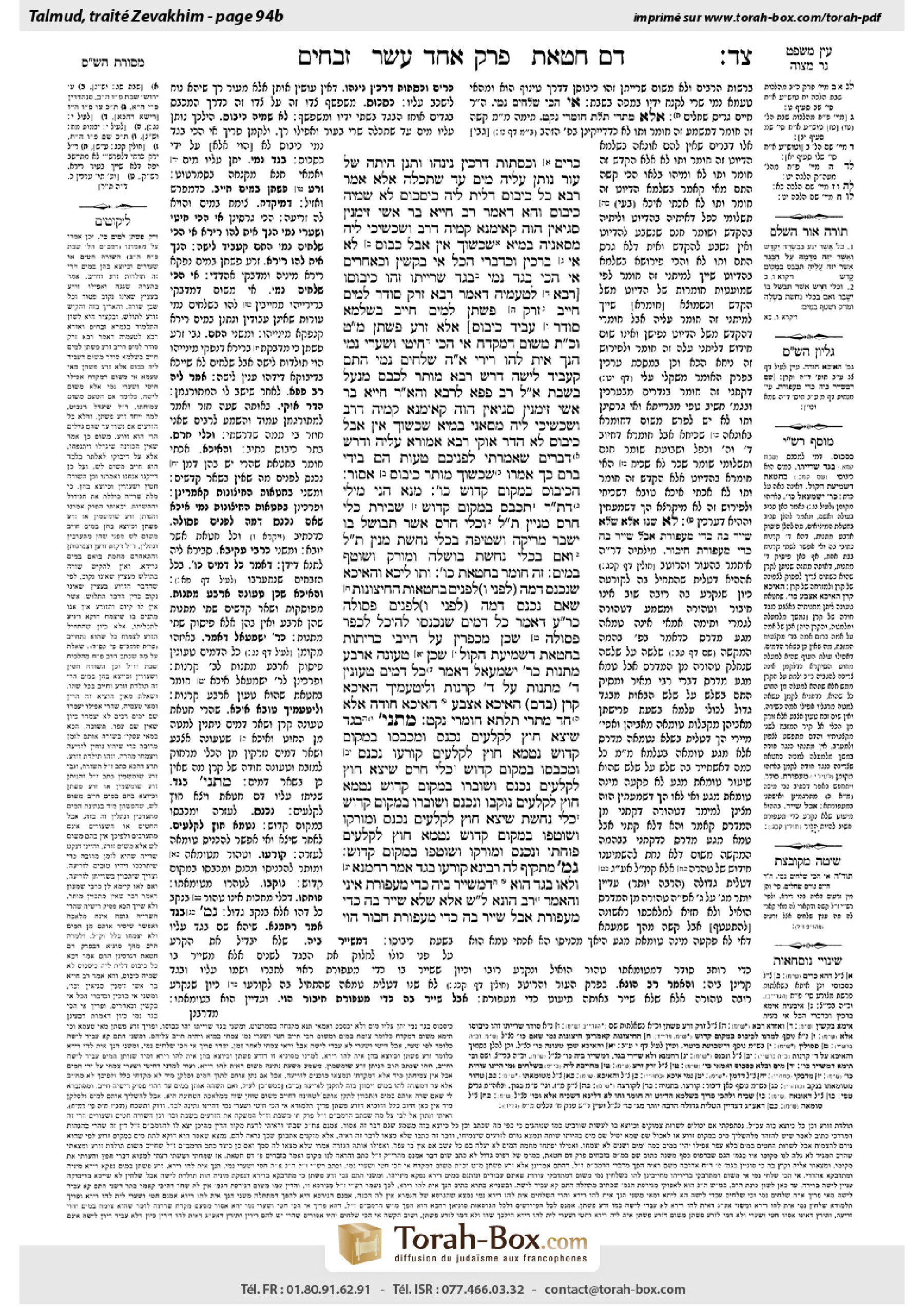
Zevachim 94b: Talmud study for Daf Yomi
Daf Yomi is the daily study of one Talmud folio. Explore 37 tractates with scans, Hebrew text, Sefaria English and AI-generated French translations where annotated.
Passage selection and English or AI-generated French translation are available where the scan has annotations. Daf Study is independent of Torah-Box and Sefaria.
Browse Zevachim · זבחים · All tractatesZevachim 94b text and translations
This page of Zevachim includes the Aramaic text, an English translation and an AI-generated French translation, alongside the scan above.
זבחים צ״ד ב · Aramaic and Hebrew text
כָּרִים וּכְסָתוֹת – דְּרַכִּין נִינְהוּ, וּתְנַן: הָיְתָה שֶׁל עוֹר נוֹתֵן עָלֶיהָ מַיִם עַד שֶׁתִּכְלֶה! אֶלָּא אָמַר רָבָא: כֹּל כִּיבּוּס דְּלֵית לֵיהּ כִּיסְכּוּס, לָא שְׁמֵיהּ כִּיבּוּס.
וְהָא דְּאָמַר רַב חִיָּיא בַּר אָשֵׁי: זִימְנִין סַגִּיאִין הֲוָה קָאֵימְנָא קַמֵּיהּ דְּרַב, וְשַׁכְשֵׁיכִי לֵיהּ מְסָאנֵיהּ בְּמַיָּא; שִׁכְשׁוּךְ אִין, אֲבָל כִּבּוּס לָא – אִי בְּרַכִּין וּכְדִבְרֵי הַכֹּל, אִי בְּקָשִׁין וְכַאֲחֵרִים.
אִי הָכִי, בֶּגֶד נָמֵי! בֶּגֶד – שְׁרִיָּיתוֹ זֶהוּ כִּיבּוּסוֹ.
רָבָא לְטַעְמֵיהּ – דְּאָמַר רָבָא: זָרַק סוּדָר לְמַיִם – חַיָּיב. זָרַק פִּשְׁתָּן לְמַיִם – חַיָּיב. בִּשְׁלָמָא סוּדָר – עָבֵיד כִּיבּוּס; אֶלָּא זֶרַע פִּשְׁתָּן מַאי טַעְמָא?
וְכִי תֵּימָא מִשּׁוּם דְּמִקַדַּח – אִי הָכִי, חִיטֵּי וּשְׂעָרֵי נָמֵי! הָנָךְ אִית לְהוּ רִירֵי. אִי הָכִי, שְׁלָחִים נָמֵי! הָתָם קָעָבֵיד לִישָׁה.
דָּרֵשׁ רָבָא: מוּתָּר לְכַבֵּס מִנְעָל בְּשַׁבָּת. אֲמַר לֵיהּ רַב פָּפָּא לְרָבָא, וְהָא אָמַר רַב חִיָּיא בַּר אָשֵׁי: זִימְנִין סַגִּיאִין הֲוָה קָאֵימְנָא קַמֵּיהּ דְּרַב, וְשַׁכְשֵׁיכִי לֵיהּ מְסָאנֵי בְּמַיָּא; שִׁכְשׁוּךְ אִין, אֲבָל כִּיבּוּס לָא! הֲדַר אוֹקֵי רָבָא אָמוֹרָא עֲלֵיהּ וּדְרַשׁ: דְּבָרִים שֶׁאָמַרְתִּי לִפְנֵיכֶם – טָעוּת הֵם בְּיָדִי; בְּרַם כָּךְ אָמְרוּ: שִׁכְשׁוּךְ מוּתָּר, כִּיבּוּס אָסוּר.
הַכִּיבּוּס בְּמָקוֹם קָדוֹשׁ כּוּ׳. מְנָא הָנֵי מִילֵּי? דְּתָנוּ רַבָּנַן: ״תְּכַבֵּס בְּמָקוֹם קָדֹשׁ״. שְׁבִירַת כְּלִי חֶרֶס מִנַּיִין? תַּלְמוּד לוֹמַר: ״וּכְלִי חֶרֶשׂ אֲשֶׁר תְּבֻשַּׁל בּוֹ יִשָּׁבֵר״. מְרִיקָה וּשְׁטִיפָה בִּכְלִי נְחֹשֶׁת מִנַּיִן? תַּלְמוּד לוֹמַר: ״וְאִם בִּכְלִי נְחֹשֶׁת בֻּשָּׁלָה, וּמֹרַק וְשֻׁטַּף בַּמָּיִם״.
זֶה חוֹמֶר בְּחַטָּאת כּוּ׳. וְתוּ לֵיכָּא?! וְהָאִיכָּא שֶׁנִּכְנַס דָּמָהּ לִפְנַי וְלִפְנִים! בְּחַטָּאוֹת הַחִיצוֹנוֹת.
שֶׁאִם נִכְנַס דָּמָהּ (לִפְנַי וְ)לִפְנִים – פְּסוּלָה! כְּרַבִּי עֲקִיבָא, דְּאָמַר: כׇּל דָּמִים שֶׁנִּכְנְסוּ לַהֵיכָל לְכַפֵּר – פְּסוּלָה.
שֶׁכֵּן מְכַפְּרִין עַל חַיָּיבֵי כָרֵיתוֹת! בְּחַטָּאת דִּשְׁמִיעַת הַקּוֹל.
שֶׁכֵּן טְעוּנָה אַרְבַּע מַתָּנוֹת! כְּרַבִּי יִשְׁמָעֵאל, דְּאָמַר: כׇּל דָּמִים טְעוּנִין אַרְבַּע מַתָּנוֹת עַל אַרְבַּע קְרָנוֹת.
וְלִיטַעְמָיךְ, הָאִיכָּא קֶרֶן! הָאִיכָּא אֶצְבַּע! הָאִיכָּא חוּדָּהּ! אֶלָּא חַד מִתְּרֵי תְּלָתָא חוּמְרֵי נָקֵט.
מַתְנִי׳ בֶּגֶד שֶׁיָּצָא חוּץ לַקְּלָעִים – נִכְנָס וּמְכַבְּסוֹ בְּמָקוֹם קָדוֹשׁ. נִטְמָא חוּץ לַקְּלָעִים – קוֹרְעוֹ, נִכְנָס וּמְכַבְּסוֹ בִּמְקוֹם קָדוֹשׁ. כְּלִי חֶרֶס שֶׁיָּצָא חוּץ לַקְּלָעִים – נִכְנָס וְשׁוֹבְרוֹ בְּמָקוֹם קָדוֹשׁ. נִטְמָא חוּץ לַקְּלָעִים – נוֹקְבוֹ, וְנִכְנָס וְשׁוֹבְרוֹ בְּמָקוֹם קָדוֹשׁ.
כְּלִי נְחֹשֶׁת שֶׁיָּצָא חוּץ לַקְּלָעִים – נִכְנָס וּמוֹרְקוֹ וְשׁוֹטְפוֹ בְּמָקוֹם קָדוֹשׁ. נִטְמָא חוּץ לַקְּלָעִים – פּוֹחֲתוֹ, וְנִכְנָס וּמוֹרְקוֹ וְשׁוֹטְפוֹ בְּמָקוֹם קָדוֹשׁ.
גְּמָ׳ מַתְקֵיף לַהּ רָבִינָא: קוֹרְעוֹ?! ״בֶּגֶד״ אָמַר רַחֲמָנָא, וְלָאו בֶּגֶד הוּא!
דִּמְשַׁיַּיר בֵּיהּ כְּדֵי מַעְפּוֹרֶת. אִינִי?! וְהָאָמַר רַב הוּנָא: לֹא שָׁנוּ אֶלָּא שֶׁלֹּא שִׁיֵּיר בָּהּ כְּדֵי מַעְפּוֹרֶת, אֲבָל שִׁיֵּיר בָּהּ כְּדֵי מַעְפּוֹרֶת – חִבּוּר הָוֵי!
Zevachim 94b · English translation
Cushions and blankets that are of soft leather, and for which the halakha with regard to laundering should be relevant, and yet we learned about them in the mishna (Shabbat 142b): If the filth was on a cushion of leather, he applies water to it until the filth dissolves, which indicates that the halakha with regard to laundering is not applicable even to soft leather. Rather, Rava said: With regard to any laundering that does not include rubbing, it is not considered laundering. Consequently, one may apply water to a soft leather cushion, but soft leather remains subject to laundering, so long as there is rubbing.
And that statement that Rav Ḥiyya bar Ashi said: Many times I would stand before Rav on Shabbat and place water on his leather shoes, may be explained accordingly. With regard to placing water on leather, yes, that is permitted, but with regard to laundering, which includes rubbing, it is not permitted. This may be explained as follows: If Rav Ḥiyya bar Ashi spoke of soft leather shoes, then all agree that only placing water is permitted. And if Rav Ḥiyya bar Ashi spoke of hard leather shoes, the distinction between placing and rubbing accords with the opinion of the others, who hold that the requirement of laundering sprayed blood applies even to hard leather.
The Gemara asks: If that is so, that placing water upon something is not considered laundering so long as one does not also rub the item, then with regard to a non-leather garment as well, one should be allowed to place water upon it on Shabbat. Why does the cited mishna state that one may wipe it only with a dry rag? The Gemara answers: With regard to a garment, its soaking is its laundering, and merely placing water on it is forbidden.
The Gemara comments: Rava conforms to his standard line of reasoning; as Rava says: If one cast a cloth into water on Shabbat, he is liable for laundering on Shabbat, as it is made of fabric like any garment; and if one cast flax seeds into water, he too is liable. The Gemara analyzes this statement: Granted, if he casts a cloth into water, he performs laundering; but with regard to flaxseed, what is the reason that one may not cast it into water on Shabbat?
And if you would say that it is prohibited because it sprouts in the water and constitutes the prohibited act of planting, if so, with regard to wheat and barley, it should also be forbidden to place them into water. The Gemara explains: Casting the flax into the water is not prohibited because of planting but because these flax seeds have discharges when soaked. If so, with regard to hides, it should also be prohibited to place them into water, because they too produce discharges in water. The Gemara answers: There, with regard to flaxseed, it is prohibited because it effects kneading, as the discharges cause the seeds to combine together, which is not true of hides.
The Gemara relates: Rava taught in public: It is permitted to launder a shoe on Shabbat. Rav Pappa said to Rava: But didn’t Rav Ḥiyya bar Ashi say: Many times I would stand before Rav on Shabbat and place water on his leather shoes? Evidently, placing water upon leather, yes, that is permitted, but laundering, which includes rubbing, is not permitted. Rava went back and placed an interpreter before him so that he could tell the public that he had been wrong, and taught in public: The statements that I said before you earlier are my error. Truly, the Sages said like this: Placing water upon shoes is permitted, but laundering them is prohibited.
§ The mishna teaches: The laundering must be performed in a sacred place, and the breaking of an earthenware vessel must be performed in a sacred place, and the scouring and rinsing of a copper vessel must be performed in a sacred place. From where are these matters derived? As the Sages taught in a baraita: Concerning a garment on which blood was sprayed, the verse states: “You shall launder that on which it shall be sprinkled in a sacred place” (Leviticus 6:20). From where is the halakha with regard to the breaking of an earthenware vessel in which a sin offering was cooked derived? The subsequent verse states: “And the earthenware vessel in which it is cooked shall be broken” (Leviticus 6:21). From where is the halakha with regard to the scouring and rinsing of a copper vessel in which a sin offering was cooked derived? The verse states immediately thereafter: “And if it be cooked in a copper vessel, it shall be scoured, and rinsed in water.”
§ The mishna teaches: With regard to this matter, a stringency applies to a sin offering more than it applies to offerings of the most sacred order. The Gemara asks: And are there no more halakhot specific to a sin offering? But there is this halakha: That its blood enters the innermost sanctum to be sprinkled. The Gemara answers: The mishna is dealing with external sin offerings, and this halakha applies only to internal sin offerings.
The Gemara challenges: But there is the stricture that if its blood enters into the Sanctuary it becomes disqualified. The Gemara explains: This mishna is in accordance with the opinion of Rabbi Akiva, who says: Every offering’s blood, not only that of a sin offering, that enters the Sanctuary to atone becomes disqualified; therefore, this is not a halakha specific to a sin offering.
The Gemara challenges: But there is the halakha that external sin offerings atone for those who are liable to receive excision, karet, through unintentional sins. The Gemara explains: The mishna includes an offering that does not have that halakha, as its principles also apply to a sin offering brought for hearing the voice, i.e., for falsely taking an oath that one is unable to testify in another’s case. This transgression is not punishable by karet.
The Gemara challenges: But there is the stricture that the blood of a sin offering requires four placements on the altar, unlike other offerings of the most sacred order. The Gemara explains: This mishna is composed in accordance with the opinion of Rabbi Yishmael, who says that all blood of offerings requires four placements, one upon each of the four corners of the altar; accordingly, this is not a halakha limited to the sin offering.
The Gemara asks: And even according to your reasoning, can it be said that there is only one halakha that applies to a sin offering but does not apply to other offerings? Isn’t there the requirement to place a sin offering’s blood on the corner at the top of the altar? Isn’t there the requirement that a priest place a sin offering’s blood on the altar with his finger? Isn’t there the requirement to place it on the edge of the altar? Therefore, it should not be assumed that this is the only halakha unique to a sin offering, but rather that the mishna simply cited one of two or three stringencies.
MISHNA: With regard to a garment upon which the blood of a sin offering was sprayed that went outside the curtains, i.e., the Temple courtyard, before being laundered, the garment reenters the courtyard and one launders it in a sacred place. If the garment became ritually impure outside the curtains, one tears the garment in order to render it ritually pure, enters the courtyard with it, and launders it in a sacred place. With regard to an earthenware vessel in which a sin offering was cooked that went outside the curtains, the vessel reenters the courtyard and one breaks it in a sacred place. If the vessel became ritually impure outside the curtains, one punctures the vessel to render it ritually pure, and one enters the courtyard with it and breaks it in a sacred place.
With regard to a copper vessel in which a sin offering was cooked that went outside the curtains, the vessel reenters the courtyard, and one scours it and rinses it in a sacred place. If the vessel became ritually impure outside the curtains, one breaks the vessel by boring a large hole in it to render it ritually pure and enters the courtyard with it and scours and rinses it in a sacred place.
GEMARA: The mishna teaches: If the garment became ritually impure outside the curtains, one tears the garment in order to render it ritually pure, enters the courtyard with it, and launders it in a sacred place. Ravina objects to this: How can the mishna say that one tears it? The Merciful One states in the Torah that one must launder “a garment” (Leviticus 6:20), and once this article is torn, this is no longer a garment, but only a scrap of cloth.
The Gemara answers: The mishna describes a scenario when he leaves untorn a fragment of the garment that is size enough for a small cloth. Is that so? If he leaves such a portion intact, is he still permitted to bring the garment back into the courtyard? But doesn’t Rav Huna say: The Sages taught that an impure garment, most of which has been torn, loses its impurity only when one did not leave of it enough for a small cloth, but if he left enough of it untorn for a small cloth, it is considered a joining of the pieces, and the garment remains ritually impure. Accordingly, leaving a piece that size would not serve any purpose with regard to ritual impurity.
Zevachim 94b · Traduction française (IA)
Les coussins et les couvertures en cuir souple devraient être soumis aux règles du lavage. Pourtant, nous avons appris à leur sujet dans la Michna (Chabbat 142b) : « Si la saleté se trouve sur un coussin en cuir, on y applique de l’eau jusqu’à ce que la saleté se dissolve. » Cela montre que les règles du lavage ne s’appliquent même pas au cuir souple. Rava dit plutôt : tout lavage qui ne comporte pas de frottement n’est pas considéré comme un lavage. On peut donc appliquer de l’eau sur un coussin en cuir souple, mais le cuir souple reste soumis aux règles du lavage dès lors qu’il y a frottement.
La déclaration de Rav Ḥiyya bar Ashi — « Bien des fois, le Chabbat, je me tenais devant Rav et j’appliquais de l’eau sur ses chaussures en cuir » — peut s’expliquer de la même manière. Appliquer de l’eau sur du cuir, oui, cela est permis ; mais le laver, ce qui implique de le frotter, ne l’est pas. On peut expliquer cela ainsi : si Rav Ḥiyya bar Ashi parlait de chaussures en cuir souple, tous reconnaissent que seul le fait d’y appliquer de l’eau est permis. Et s’il parlait de chaussures en cuir dur, la distinction entre le fait d’y appliquer de l’eau et celui de les frotter correspond à l’opinion des autres, qui estiment que l’obligation de laver le sang projeté s’applique également au cuir dur.
La Guemara demande : si tel est le cas, si appliquer de l’eau sur un objet n’est pas considéré comme un lavage tant qu’on ne le frotte pas également, alors on devrait aussi être autorisé à appliquer de l’eau sur un vêtement qui n’est pas en cuir pendant Chabbat. Pourquoi la Michna citée dit-elle qu’on ne peut l’essuyer qu’avec un chiffon sec ? La Guemara répond : pour un vêtement, le fait de le tremper constitue son lavage ; même le simple fait d’y appliquer de l’eau est donc interdit.
La Guemara remarque que Rava est cohérent avec sa position habituelle, car Rava dit : « Si quelqu’un plonge un tissu dans l’eau pendant Chabbat, il est passible pour avoir lavé pendant Chabbat, puisqu’il s’agit d’une étoffe comme tout vêtement ; et s’il plonge des graines de lin dans l’eau, il est lui aussi passible. » La Guemara examine cette déclaration : il est compréhensible que plonger un tissu dans l’eau constitue un lavage ; mais, pour ce qui est des graines de lin, pourquoi est-il interdit de les plonger dans l’eau pendant Chabbat ?
Et si tu dis que cela est interdit parce qu’elles germent dans l’eau, ce qui constitue l’acte interdit de planter, alors il devrait également être interdit de mettre du blé et de l’orge dans l’eau. La Guemara explique : plonger les graines de lin dans l’eau n’est pas interdit en raison de l’acte de planter, mais parce que ces graines exsudent lorsqu’elles trempent. Dans ce cas, il devrait également être interdit de mettre des peaux dans l’eau, car elles aussi exsudent dans l’eau. La Guemara répond : dans le cas des graines de lin, cela est interdit parce que cela produit un pétrissage, car les exsudats font s’agglomérer les graines, ce qui ne se produit pas avec les peaux.
La Guemara rapporte que Rava enseigna en public qu’il est permis de laver une chaussure pendant Chabbat. Rav Pappa lui dit : « Mais Rav Ḥiyya bar Ashi n’a-t-il pas dit : “Bien des fois, le Chabbat, je me tenais devant Rav et j’appliquais de l’eau sur ses chaussures en cuir” ? » Il en ressort qu’appliquer de l’eau sur du cuir, oui, cela est permis ; mais le laver, ce qui implique de le frotter, ne l’est pas. Rava fit alors placer un interprète devant lui pour annoncer au public qu’il s’était trompé, et enseigna en public : « Ce que je vous ai dit précédemment était une erreur de ma part. En réalité, les Sages ont dit ceci : appliquer de l’eau sur des chaussures est permis, mais les laver est interdit. »
§ La Michna enseigne : le lavage doit être effectué dans un lieu saint, le bris d’un récipient en terre cuite doit être effectué dans un lieu saint, et le récurage et le rinçage d’un récipient en cuivre doivent être effectués dans un lieu saint. De quoi déduit-on ces règles ? Les Sages ont enseigné dans une baraïta : au sujet d’un vêtement sur lequel du sang a été projeté, le verset dit : « Vous laverez, dans un lieu saint, ce sur quoi il aura été projeté » (Lévitique 6:20). De quoi déduit-on la règle concernant le bris du récipient en terre cuite dans lequel un sacrifice expiatoire a été cuit ? Le verset suivant dit : « Et le récipient en terre cuite dans lequel il aura été cuit sera brisé » (Lévitique 6:21). De quoi déduit-on la règle concernant le récurage et le rinçage du récipient en cuivre dans lequel un sacrifice expiatoire a été cuit ? Le verset dit immédiatement après : « Et s’il est cuit dans un récipient en cuivre, il sera récuré et rincé à l’eau. »
§ La Michna enseigne : sur ce point, le sacrifice expiatoire est soumis à une exigence plus stricte que les offrandes de sainteté suprême. La Guemara demande : n’existe-t-il donc aucune autre halakha propre au sacrifice expiatoire ? Il y a pourtant cette halakha : son sang est introduit dans le sanctuaire le plus intérieur pour y être aspergé. La Guemara répond : la Michna traite des sacrifices expiatoires extérieurs, tandis que cette halakha ne s’applique qu’aux sacrifices expiatoires intérieurs.
La Guemara objecte : il y a pourtant cette rigueur, selon laquelle le sang d’un sacrifice expiatoire est invalidé s’il pénètre dans le Sanctuaire. La Guemara explique : cette Michna suit l’opinion de Rabbi Akiva, qui dit que le sang de toute offrande, et pas seulement celui d’un sacrifice expiatoire, est invalidé s’il pénètre dans le Sanctuaire pour servir à l’expiation. Cette halakha n’est donc pas propre au sacrifice expiatoire.
La Guemara objecte : il y a pourtant cette halakha, selon laquelle les sacrifices expiatoires extérieurs expient pour ceux qui encourent le retranchement, karet, à la suite de fautes involontaires. La Guemara explique : la Michna inclut une offrande à laquelle cette halakha ne s’applique pas, car les principes qu’elle énonce s’appliquent également à un sacrifice expiatoire apporté pour avoir entendu une voix, c’est-à-dire pour avoir faussement prêté serment qu’on était incapable de témoigner dans l’affaire d’autrui. Cette transgression n’est pas passible de karet.
La Guemara objecte : il y a pourtant cette rigueur, selon laquelle le sang d’un sacrifice expiatoire doit être appliqué quatre fois sur l’autel, contrairement au sang des autres offrandes de sainteté suprême. La Guemara explique : cette Michna est rédigée conformément à l’opinion de Rabbi Yishmael, qui dit que le sang de toutes les offrandes doit être appliqué quatre fois, une fois sur chacun des quatre angles de l’autel ; cette halakha ne se limite donc pas au sacrifice expiatoire.
La Guemara demande : même selon votre raisonnement, peut-on dire qu’il n’existe qu’une seule halakha qui s’applique au sacrifice expiatoire, mais pas aux autres offrandes ? N’y a-t-il pas l’obligation d’appliquer le sang d’un sacrifice expiatoire sur la corne, au sommet de l’autel ? N’y a-t-il pas l’obligation pour un prêtre d’appliquer le sang d’un sacrifice expiatoire sur l’autel avec son doigt ? N’y a-t-il pas l’obligation de l’appliquer sur le rebord de l’autel ? Il ne faut donc pas supposer qu’il s’agit de la seule halakha propre au sacrifice expiatoire ; la Michna a simplement cité l’une de deux ou trois exigences plus strictes.
MICHNA : si un vêtement sur lequel a été projeté le sang d’un sacrifice expiatoire sort de l’enceinte, c’est-à-dire de la cour du Temple, avant d’avoir été lavé, on le rapporte dans la cour et on le lave dans un lieu saint. Si le vêtement est devenu rituellement impur à l’extérieur de l’enceinte, on le déchire afin de le rendre rituellement pur, on le fait entrer dans la cour et on le lave dans un lieu saint. Si un récipient en terre cuite dans lequel un sacrifice expiatoire a été cuit sort de l’enceinte, on le rapporte dans la cour et on le brise dans un lieu saint. Si le récipient est devenu rituellement impur à l’extérieur de l’enceinte, on le perce afin de le rendre rituellement pur, puis on le fait entrer dans la cour et on le brise dans un lieu saint.
Si un récipient en cuivre dans lequel un sacrifice expiatoire a été cuit sort de l’enceinte, on le rapporte dans la cour, puis on le récure et on le rince dans un lieu saint. Si le récipient est devenu rituellement impur à l’extérieur de l’enceinte, on le brise en y perçant un grand trou afin de le rendre rituellement pur, puis on le fait entrer dans la cour, on le récure et on le rince dans un lieu saint.
GUEMARA : la Michna enseigne que si le vêtement est devenu rituellement impur à l’extérieur de l’enceinte, on le déchire afin de le rendre rituellement pur, on le fait entrer dans la cour et on le lave dans un lieu saint. Ravina objecte : comment la Michna peut-elle dire qu’on le déchire ? Le Miséricordieux dit dans la Torah qu’il faut laver « un vêtement » (Lévitique 6:20) ; or, une fois cet objet déchiré, ce n’est plus un vêtement, mais seulement un morceau d’étoffe.
La Guemara répond : la Michna décrit un cas où l’on laisse intact un fragment du vêtement assez grand pour constituer un petit morceau d’étoffe. En est-il ainsi ? Si l’on en laisse une telle partie intacte, est-il encore permis de rapporter le vêtement dans la cour ? Rav Huna ne dit-il pas que les Sages ont enseigné qu’un vêtement impur dont la majeure partie a été déchirée ne perd son impureté que si l’on n’en a pas laissé un morceau assez grand pour constituer un petit morceau d’étoffe ; mais si l’on en a laissé intact un morceau de cette taille, il est considéré comme reliant les morceaux, et le vêtement demeure rituellement impur. Par conséquent, laisser un morceau de cette taille ne servirait à rien pour ce qui est de l’impureté rituelle.
Traduction française générée par IA à partir de l’édition anglaise de Sefaria. Vérifie toujours un passage avec le texte source.
Text from Sefaria: William Davidson Edition - Vocalized Aramaic (CC BY NC); William Davidson Edition - English (CC BY NC).