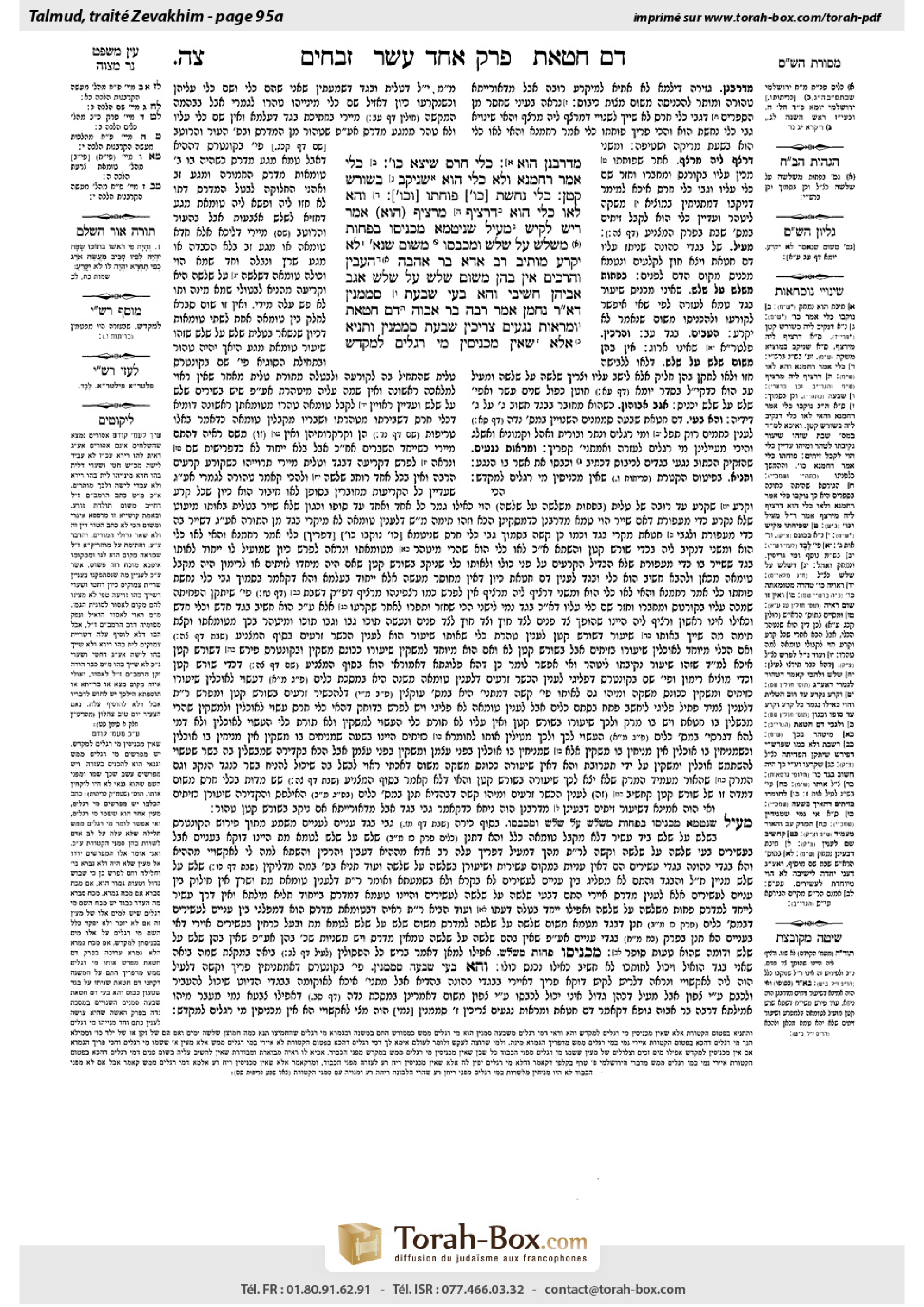
Zevachim 95a: Talmud study for Daf Yomi
Daf Yomi is the daily study of one Talmud folio. Explore 37 tractates with scans, Hebrew text, Sefaria English and AI-generated French translations where annotated.
Passage selection and English or AI-generated French translation are available where the scan has annotations. Daf Study is independent of Torah-Box and Sefaria.
Browse Zevachim · זבחים · All tractatesZevachim 95a text and translations
This page of Zevachim includes the Aramaic text, an English translation and an AI-generated French translation, alongside the scan above.
זבחים צ״ה א · Aramaic and Hebrew text
מִדְּרַבָּנַן הוּא.
כְּלִי חֶרֶס שֶׁיָּצָא כּוּ׳. ״כְּלִי״ אָמַר רַחֲמָנָא, וְלֹא כְּלִי הוּא! שֶׁנִּיקַּב בְּשׁוֹרֶשׁ קָטָן.
כְּלִי נְחֹשֶׁת [כּוּ׳]. פּוֹחֲתוֹ [וְכוּ׳]. וְהָא לָאו כְּלִי הוּא! דְּרָצֵיף [לֵיהּ] מִרְצָיף (הוּא).
אָמַר רֵישׁ לָקִישׁ: מְעִיל שֶׁנִּיטְמָא – מַכְנִיסוֹ בְּפָחוֹת מִשָּׁלֹשׁ עַל שָׁלֹשׁ וּמְכַבְּסוֹ, מִשּׁוּם שֶׁנֶּאֱמַר: ״לֹא יִקָּרֵעַ״.
מוֹתֵיב רַב אַדָּא בַּר אַהֲבָה: הֶעָבִין וְהָרַכִּים, אֵין בָּהֶן מִשּׁוּם שָׁלֹשׁ עַל שָׁלֹשׁ!
אַגַּב אֲבִיהֶן חֲשִׁיבִי.
וְהָא בָּעֵי שִׁבְעַת סַמְמָנִין, דְּאָמַר רַב נַחְמָן אָמַר רַבָּה בַּר אֲבוּהּ: דַּם חַטָּאת וּמַרְאוֹת נְגָעִים, צְרִיכִין שִׁבְעַת סַמְמָנִין; וְתַנְיָא: אֶלָּא שֶׁאֵין מַכְנִיסִין מֵי רַגְלַיִם לַמִּקְדָּשׁ!
Zevachim 95a · English translation
The Gemara answers that Rav Huna’s statement means that it is ritually impure by rabbinic law, since the Sages decreed the small cloth impure lest one fail to tear a garment enough to render it truly pure. By Torah law, this small cloth is torn enough to be ritually pure, so that one may bring it back into the Temple courtyard to launder it.
§ The mishna teaches: With regard to an earthenware vessel in which a sin offering was cooked that went outside the curtains and became ritually impure outside the curtains, one punctures the vessel to render it ritually pure, brings the vessel back into the courtyard, and breaks it there. The Gemara asks: Why is there a need to break the earthenware vessel after puncturing it? The Merciful One states: “The earthenware vessel…shall be broken” (Leviticus 6:21), and, once it is punctured, it is not a vessel. The Gemara explains: When it is punctured with a hole only the size of a small root, the earthenware vessel is purified from the ritual impurity it contracted, but it remains a vessel for other purposes, such as holding fruit.
The mishna teaches: With regard to a copper vessel in which a sin offering was cooked that went outside the curtains and became ritually impure outside the curtains, one breaks the vessel by boring a large hole in it to render it ritually pure, brings the vessel back into the courtyard, and scours and rinses it there. The Gemara asks: Why should the copper vessel be scoured and rinsed? After all, once the hole is bored, this is not a vessel anymore. The Gemara explains: When he hammers it and refashions it into a vessel, he must scour and rinse it.
§ Earlier (94b–95a), the Gemara discusses a garment upon which the blood of a sin offering has sprayed; if it has contracted ritual impurity outside of the Temple courtyard, it must be torn before it is brought back into the courtyard to be laundered. Reish Lakish says: If the robe of the High Priest upon which the blood of a sin offering has sprayed has contracted ritual impurity outside of the Temple courtyard, one does not tear it; rather, he brings it in to the courtyard gradually, in portions less than the measure of a garment susceptible to impurity, which is three by three fingerbreadths, and he launders it section by section as the robe crosses the threshold. The ritually impure robe must be brought into the courtyard in this manner because it is stated with regard to the High Priest’s robe: “It shall not be torn” (Exodus 28:32).
Rav Adda bar Ahava raises an objection based upon a mishna (Kelim 28:8): The particularly thick garments and the soft garments are not subject to the standard measure of three by three fingerbreadths, with regard to determining their susceptibility to becoming ritually impure. Because of their particular qualities, such garments are useful only when they are larger and are not considered significant items when they measure three by three. Since the High Priest’s robe is a thick garment, why must one bring it into the courtyard only in portions of less than three by three?
The Gemara answers: With regard to the whole robe of the High Priest, which is a garment of particular significance, even the small portions of the robe are significant due to their source garment, and are susceptible to impurity in portions measuring three by three fingerbreadths.
§ The Gemara asks a fundamental question with regard to the procedure for laundering a garment upon which the blood of a sin offering has sprayed: But isn’t it so that laundering requires seven abrasive substances? As Rav Naḥman says that Rabba bar Avuh says: Blood of a sin offering that has sprayed on a garment, and shades of leprous marks on garments, which are subject to laundering (see Leviticus 13:54), require the seven abrasive substances used as laundering agents; and these substances include urine (Nidda 61b). And it is taught in a baraita: But urine is not brought into the Temple, because it is inappropriate for the Temple, although urine is theoretically suitable for use in the preparation of the incense spices. Accordingly, how is a garment laundered in the Temple?
Zevachim 95a · Traduction française (IA)
La Guemara répond que, selon Rav Houna, le tissu est impur selon le droit rabbinique, car les Sages ont décrété que le petit morceau de tissu était impur, de peur que l’on ne déchire pas suffisamment le vêtement pour qu’il soit réellement pur. Selon la Torah, ce petit morceau est déchiré suffisamment pour être rituellement pur ; on peut donc le rapporter dans la cour du Temple pour le laver.
§ La Michna enseigne : si un récipient en terre cuite dans lequel a été cuit un sacrifice expiatoire est sorti au-delà des tentures et a contracté l’impureté rituelle à l’extérieur, on le perce pour le rendre rituellement pur, on le rapporte dans la cour, puis on l’y brise. La Guemara demande : pourquoi faut-il briser le récipient en terre cuite après l’avoir percé ? Le Miséricordieux dit : « Le récipient en terre cuite… sera brisé » (Lévitique 6,21) ; or, une fois percé, ce n’est plus un récipient. La Guemara explique : si on le perce d’un trou de la taille d’une petite racine seulement, le récipient en terre cuite est purifié de l’impureté rituelle qu’il a contractée, mais il reste un récipient à d’autres fins, par exemple pour contenir des fruits.
La Michna enseigne : si un récipient en cuivre dans lequel a été cuit un sacrifice expiatoire est sorti au-delà des tentures et a contracté l’impureté rituelle à l’extérieur, on le met hors d’usage en y perçant un grand trou pour le rendre rituellement pur, on le rapporte dans la cour, puis on l’y récure et le rince. La Guemara demande : pourquoi faut-il récurer et rincer le récipient en cuivre ? Après tout, une fois le trou percé, ce n’est plus un récipient. La Guemara explique : lorsqu’on le martèle et qu’on lui redonne la forme d’un récipient, il faut le récurer et le rincer.
§ Plus haut (94b–95a), la Guemara traite d’un vêtement sur lequel a giclé le sang d’un sacrifice expiatoire : s’il a contracté l’impureté rituelle à l’extérieur de la cour du Temple, il faut le déchirer avant de le rapporter dans la cour pour le laver. Rech Lakich dit : si le manteau du grand prêtre sur lequel a giclé le sang d’un sacrifice expiatoire a contracté l’impureté rituelle à l’extérieur de la cour du Temple, on ne le déchire pas ; on le fait plutôt entrer progressivement dans la cour, par morceaux de moins de trois doigts sur trois, mesure requise pour qu’un vêtement soit susceptible de contracter l’impureté, et on le lave section par section à mesure que le manteau franchit le seuil. Le manteau rituellement impur doit être introduit dans la cour de cette manière, car il est dit à propos du manteau du grand prêtre : « Il ne sera pas déchiré » (Exode 28,32).
Rav Adda bar Ahava soulève une objection fondée sur une Michna (Kelim 28,8) : les vêtements particulièrement épais et les vêtements souples ne sont pas soumis à la mesure standard de trois doigts sur trois pour déterminer s’ils sont susceptibles de contracter l’impureté rituelle. En raison de leurs caractéristiques particulières, de tels vêtements ne sont utiles qu’en grande taille et ne sont pas considérés comme des objets importants lorsqu’ils mesurent trois doigts sur trois. Puisque le manteau du grand prêtre est un vêtement épais, pourquoi faut-il le faire entrer dans la cour uniquement par morceaux de moins de trois doigts sur trois ?
La Guemara répond : s’agissant du manteau entier du grand prêtre, qui est un vêtement d’une importance particulière, même ses petits morceaux sont importants en raison du vêtement dont ils proviennent et sont susceptibles de contracter l’impureté dès lors qu’ils mesurent trois doigts sur trois.
§ La Guemara pose une question fondamentale concernant la procédure de lavage d’un vêtement sur lequel a giclé le sang d’un sacrifice expiatoire : le lavage ne requiert-il pas sept substances abrasives ? En effet, Rav Naḥman dit au nom de Rabba bar Avouha : le sang d’un sacrifice expiatoire qui a giclé sur un vêtement, ainsi que les nuances des marques lépreuses sur les vêtements, qui doivent être lavées (voir Lévitique 13,54), nécessitent les sept substances abrasives utilisées pour le lavage ; parmi elles figure l’urine (Nidda 61b). Or, il est enseigné dans une baraïta que l’on ne fait pas entrer d’urine dans le Temple, car elle ne convient pas au Temple, bien qu’en théorie elle puisse servir à la préparation des aromates de l’encens. Dès lors, comment lave-t-on un vêtement dans le Temple ?
Traduction française générée par IA à partir de l’édition anglaise de Sefaria. Vérifie toujours un passage avec le texte source.
Text from Sefaria: William Davidson Edition - Vocalized Aramaic (CC BY NC); William Davidson Edition - English (CC BY NC).