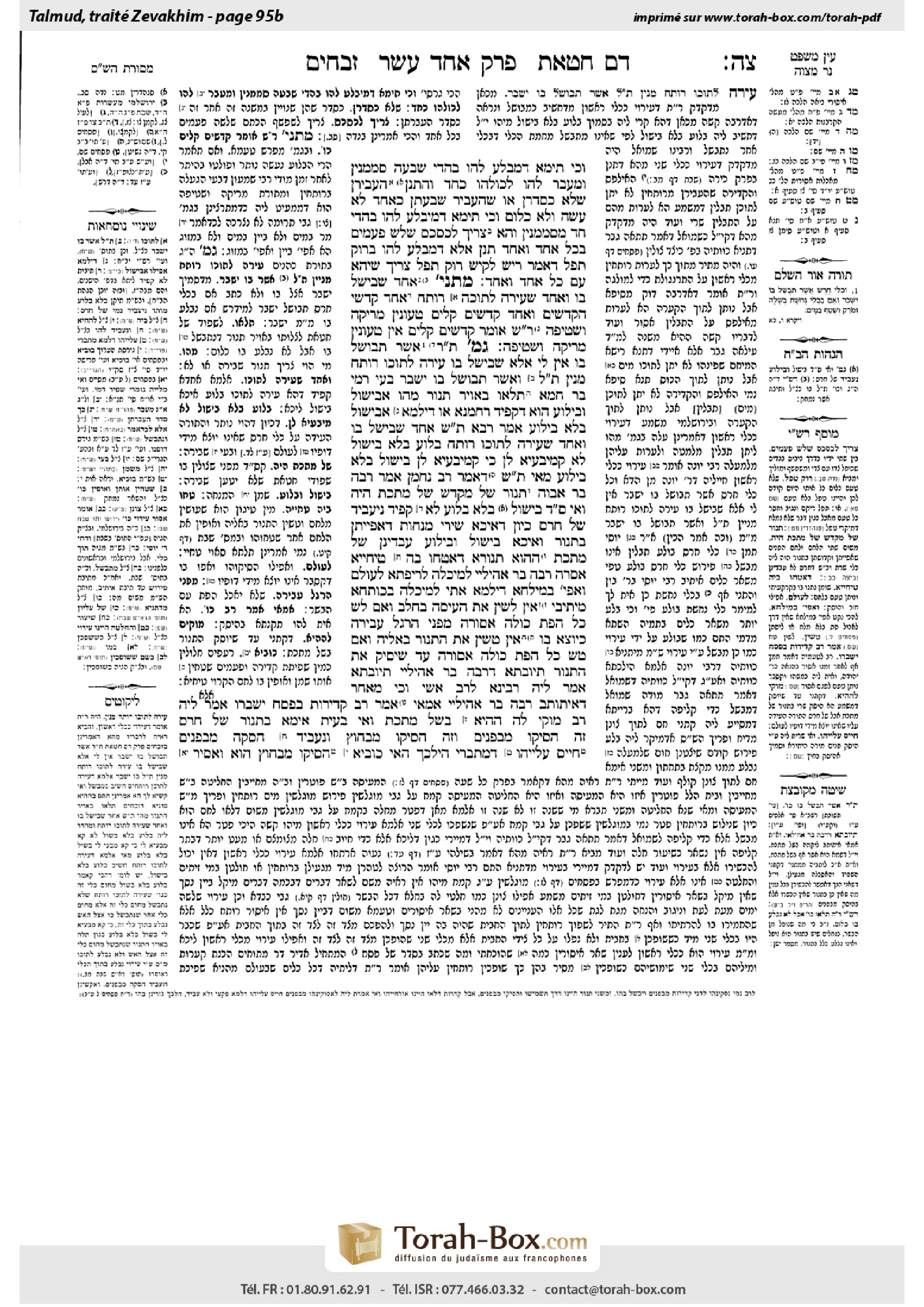
Zevachim 95b: Talmud study for Daf Yomi
Daf Yomi is the daily study of one Talmud folio. Explore 37 tractates with scans, Hebrew text, Sefaria English and AI-generated French translations where annotated.
Passage selection and English or AI-generated French translation are available where the scan has annotations. Daf Study is independent of Torah-Box and Sefaria.
Browse Zevachim · זבחים · All tractatesZevachim 95b text and translations
This page of Zevachim includes the Aramaic text, an English translation and an AI-generated French translation, alongside the scan above.
זבחים צ״ה ב · Aramaic and Hebrew text
וְכִי תֵּימָא דְּמַבְלַע לְהוּ בַּהֲדֵי שִׁבְעָה סַמְמָנִין, וּמְעַבַּר לְהוּ לְכוּלְּהוּ כְּחַד; וְהָתְנַן: הֶעֱבִירָן שֶׁלֹּא כְּסִדְרָן אוֹ שֶׁהֶעֱבִיר שִׁבְעָתָן כְּאֶחָד – לֹא עָשָׂה וְלֹא כְלוּם!
וְכִי תֵּימָא דְּמַיבְלַע לְהוּ בַּהֲדֵי חַד מִסַּמְמָנִין – וְהָא צָרִיךְ לְכַסְכֵּס שָׁלֹשׁ פְּעָמִים בְּכׇל אֶחָד וְאֶחָד תְּנַן! אֶלָּא דְּמַבְלַע לְהוּ בְּרוֹק תָּפֵל. דְּאָמַר רֵישׁ לָקִישׁ: רוֹק תָּפֵל צָרִיךְ שֶׁיְּהֵא עִם כׇּל אֶחָד וְאֶחָד.
מַתְנִי׳ אֶחָד שֶׁבִּישֵּׁל בּוֹ וְאֶחָד שֶׁעֵירָה לְתוֹכוֹ רוֹתֵחַ, אֶחָד קׇדְשֵׁי (הקדשים) [קֳּדָשִׁים] וְאֶחָד קָדָשִׁים קַלִּים – טְעוּנִין מְרִיקָה וּשְׁטִיפָה. רַבִּי שִׁמְעוֹן אוֹמֵר: קָדָשִׁים קַלִּים אֵין טְעוּנִין מְרִיקָה וּשְׁטִיפָה.
גְּמָ׳ תָּנוּ רַבָּנַן: ״אֲשֶׁר תְּבֻשַּׁל בּוֹ״ – אֵין לִי אֶלָּא שֶׁבִּישֵּׁל בּוֹ; עֵירָה לְתוֹכוֹ רוֹתֵחַ מִנַּיִן? תַּלְמוּד לוֹמַר: ״וַאֲשֶׁר תְּבֻשַּׁל בּוֹ יִשָּׁבֵר״.
בָּעֵי רָמֵי בַּר חָמָא: תְּלָאוֹ בַּאֲוִיר תַּנּוּר, מַהוּ? אַבִּישּׁוּל וּבִילּוּעַ הוּא דְּקָפֵיד רַחֲמָנָא, אוֹ דִילְמָא אַבִּישּׁוּל בְּלֹא בִּילּוּעַ?
אָמַר רָבָא, תָּא שְׁמַע: אֶחָד שֶׁבִּישֵּׁל בּוֹ וְאֶחָד שֶׁעֵירָה לְתוֹכוֹ רוֹתֵחַ.
בִּלּוּעַ בְּלֹא בִּישּׁוּל – לָא קָמִיבַּעְיָא לַן. כִּי קָמִיבַּעְיָא לַן – בִּישּׁוּל בְּלֹא בִּילּוּעַ, מַאי?
תָּא שְׁמַע, דְּאָמַר רַב נַחְמָן אָמַר רַבָּה בַּר אֲבוּהּ: תַּנּוּר שֶׁל מִקְדָּשׁ – שֶׁל מַתֶּכֶת הָיָה. וְאִי סָלְקָא דַעְתָּךְ בִּישּׁוּל בְּלֹא בִּלּוּעַ לָא קָפֵיד, נֶיעְבֵּיד שֶׁל חֶרֶס! כֵּיוָן דְּאִיכָּא שְׁיָרֵי מְנָחוֹת דַּאֲפִיָּיתָן בַּתַּנּוּר, וְאִיכָּא בִּישּׁוּל וּבִילּוּעַ, עָבְדִינַן שֶׁל מַתֶּכֶת.
הָהוּא תַּנּוּרָא דִּאטְחוֹ בֵּהּ טִיחְיָיא, אַסְרַהּ רַבָּה בַּר אֲהִילַיי לְמֵיכְלַהּ לְרִיפְתָּא לְעוֹלָם וַאֲפִילּוּ בְּמִילְחָא, דִּילְמָא אָתֵי לְמֵיכְלַהּ בְּכוּתָּחָא.
מֵיתִיבִי: אֵין לָשִׁין אֶת הָעִיסָּה בְּחָלָב, וְאִם לָשׁ – כׇּל הַפַּת כּוּלָּהּ אֲסוּרָה, מִפְּנֵי הֶרְגֵּל עֲבֵירָה.
כְּיוֹצֵא בּוֹ – אֵין טָשִׁין אֶת הַתַּנּוּר בְּאַלְיָה, וְאִם טָשׁ – כׇּל הַפַּת כּוּלָּהּ אֲסוּרָה, עַד שֶׁיַּסִּיק אֶת הַתַּנּוּר. תְּיוּבְתָּא דְּרַבָּה בַּר אֲהִילַיי! תְּיוּבְתָּא.
אֲמַר לֵיהּ רָבִינָא לְרַב אָשֵׁי: וְכִי מֵאַחַר דְּאִיתּוֹתַב רַבָּה בַּר אֲהִילַיי, אַמַּאי אָמַר רַב: קְדֵירוֹת בְּפֶסַח יִשָּׁבְרוּ? אֲמַר לֵיהּ: רַב מוֹקֵי לַהּ הָהִיא בְּשֶׁל מַתֶּכֶת.
וְאִי בָּעֵית אֵימָא: בְּתַנּוּר שֶׁל חֶרֶס; זֶה הֶסֵּיקוֹ מִבִּפְנִים, וְזֶה הֶסֵּיקוֹ מִבַּחוּץ.
וְנַעְבֵּיד הֶסֵּקָה מִבִּפְנִים! חָיֵיס עֲלַיְיהוּ, דְּמִתַּבְרִי. הִילְכָּךְ, הַאי כּוּבְיָא – הֶסֵּיקוֹ מִבַּחוּץ הוּא, וַאֲסִיר.
Zevachim 95b · English translation
The Gemara rejects a solution: And if you would say that the urine is absorbed together with the rest of the seven abrasive substances used as laundering agents, and one applies all of them at once to the garment, such that the urine is not discernable separately, that is difficult: But didn’t we learn in a mishna that this method is invalid? The mishna states (Nidda 62a): If one applied them not according to their prescribed order, or if one applied all seven substances simultaneously, he has done nothing, and the laundering has not been effective.
The Gemara rejects another solution: And if you would say that the urine is absorbed together with only one of the cleansing substances, that is difficult: But didn’t we learn in that mishna: One must rub the garment three times with each and every one of those substances independently? The Gemara resolves: Rather, it must be explained that the urine is absorbed in tasteless saliva, which comes from one who has not eaten since waking; as Reish Lakish says: Tasteless saliva must accompany each and every one of the substances applied to the garment.
MISHNA: Whether with regard to a copper vessel in which one cooked the meat of an offering or whether with regard to one into which one poured the boiling meat of an offering, whether the meat is from offerings of the most sacred order or whether it is from offerings of lesser sanctity, such vessels require scouring and rinsing. Rabbi Shimon says: Vessels in which offerings of lesser sanctity were cooked or poured do not require scouring and rinsing.
GEMARA: Concerning the statement in the mishna that these halakhot also apply to a vessel into which a boiling cooked dish was poured, the Gemara notes that the Sages taught in a baraita: With regard to a sin offering, the verse states: “In which it is cooked” (Leviticus 6:21). I have derived only that this applies to a vessel in which one cooked the sin offering. From where do I derive that it applies also to a vessel into which one poured a boiling cooked dish? The verse states more fully: “But the earthenware vessel in which it is cooked shall be broken.” Since the verse employs the phrase: “In which it is…shall be broken,” that teaches that if the hot meat is in the vessel, whether cooked or poured into the vessel, these halakhot apply to it, and if it is an earthenware vessel it must be broken.
§ Rami bar Ḥama raises a dilemma: If one suspended the meat of a sin offering in the airspace of an earthenware oven in order to roast it, what is the halakha? When the verse requires the breaking of the earthenware vessel, is it only with regard to both cooking and the resultant absorption of the offering’s flavor into the vessel that the Merciful One is particular? If so, an oven would not need to be broken simply because an offering has been roasted within its airspace. Or perhaps, is the Merciful One particular even about cooking in the vessel without absorption of the flavor, and therefore, if meat is roasted while suspended in this oven, the vessel must still be broken?
Rava said: Come and hear a proof, deduced from the mishna: Whether with regard to a copper vessel in which one cooked the meat of an offering or whether with regard to one into which one poured the boiling meat of an offering, the earthenware vessel must be broken. Therefore, the vessel must be broken even if the meat was not cooked in it but only absorbed in its walls, indicating that even if cooking and absorption do not occur together, just one of the two should suffice to require the breaking of the vessel.
The Gemara rejects the proof: The halakha in a case of the absorption of flavor into an earthenware vessel without cooking the meat in that vessel, as in the case of pouring, was not raised as a dilemma to us. If the boiling offering has been poured into a vessel, the vessel certainly must be broken, since earthenware never fully emits all that it absorbed. When a scenario was raised as a dilemma to us, it was with regard to cooking meat in the vessel without absorption of the flavor by that vessel, as in the case of roasting suspended meat. In such a case, what is the halakha?
The Gemara suggests: Come and hear a proof, deduced from that which Rav Naḥman says that Rabba bar Avuh says: The oven of the Temple was fashioned of metal. And if it enters your mind that with regard to cooking in a vessel without absorption, the Merciful One is not particular and does not require the breaking of a vessel used in such a fashion, then the oven should be made of earthenware. The Gemara rejects this proof: Since there are the remainders of meal offerings, whose baking is performed in the oven, and there is both cooking and absorption into the oven, as the remains of the meal offerings would be baked directly on the walls of the oven, for this reason alone the oven would have to be broken if it were fashioned of earthenware. Consequently, we fashion it of metal.
§ The Gemara relates: There was a certain oven that was smeared with animal fat all over its walls and floor. Rabba bar Ahilai prohibited eating bread baked in that oven forever, and he prohibited even eating the bread with salt alone, lest one come to eat it with kutaḥ, a dish made from milk, water, salt, and bread crumbs. According to Rabba bar Ahilai, the oven will never fully eliminate the fat.
The Gemara raises an objection to this from a baraita: With regard to baking bread, one may not knead the dough with milk, and if one nevertheless kneaded the dough with milk, all of the bread made from that dough is forbidden, because one might become accustomed to sin. As one habitually eats bread with meat, he might also eat this bread with meat and unwittingly transgress the prohibition against eating meat with milk.
The baraita continues: Similarly, one may not smear [tashin] the inside of an oven with the fat of a sheep’s tail, because the fat of the tail has the halakha of meat. And if one nevertheless smeared the oven with the fat of the tail, all of the bread baked in it is forbidden, until one kindles the oven and burns off this fat. Evidently, the bread baked after the oven is kindled again is permitted, because the oven is considered cleansed of the meat fat. Therefore, the refutation of the opinion of Rava bar Ahilai, who says that the oven never fully eliminates the fat, is indeed a conclusive refutation.
Ravina said to Rav Ashi: Since the statement of Rava bar Ahilai was conclusively refuted, why does Rav say that pots that were used for leavened bread must be broken before Passover? Presumably, the leavened bread could be burned out of them through kindling instead. Rav Ashi said to him: Rav construes that ruling of the baraita, according to which the fat can be burned out of the oven, as referring to an oven fashioned of metal, which cleanses the fat when kindled. In the case of earthenware vessels, additional kindling is insufficient, because the flavor absorbed within it cannot be cleansed by fire.
Or if you wish, say instead that the baraita is also referring to an earthenware oven, and there is another distinction. This oven is kindled from the inside, and a fire kindled inside the oven suffices to cleanse absorbed flavor. But that pot is kindled from the outside while it rests on the stove, and the heat absorbed in that manner is insufficient to cleanse absorbed flavor.
The Gemara suggests: And let us also perform the kindling of the pot from the inside, in order to cleanse that which has been absorbed. The Gemara answers: This solution is not feasible; the owners of such pots might be concerned for them, as they are apt to break if the heat becomes too great. Consequently, the owners will not apply sufficient heat to ensure that the absorbed flavor will be completely cleansed. The Gemara concludes: Therefore, with regard to this earthenware tile [kuvya], which is used on the fire as a baking pan and its kindling is from the outside, it becomes prohibited for subsequent use by the flavors absorbed within, which cannot be cleansed.
Zevachim 95b · Traduction française (IA)
La Guemara écarte une solution : et si tu disais que l’urine est absorbée avec les autres des sept substances abrasives utilisées pour la lessive, et qu’on les applique toutes en même temps au vêtement, de sorte que l’urine ne soit pas discernable séparément, cela pose difficulté. N’avons-nous pas appris dans une Michna que cette méthode est invalide ? La Michna enseigne (Nidda 62a) : si quelqu’un les applique sans respecter l’ordre prescrit, ou s’il applique les sept substances simultanément, il n’a rien fait et le lavage n’a pas été efficace.
La Guemara écarte une autre solution : et si tu disais que l’urine est absorbée avec une seule des substances nettoyantes, cela pose difficulté. N’avons-nous pas appris dans cette Michna qu’il faut frotter le vêtement trois fois avec chacune de ces substances, séparément ? La Guemara résout la difficulté : il faut plutôt expliquer que l’urine est absorbée dans de la salive sans goût, provenant de quelqu’un qui n’a rien mangé depuis son réveil. Car Reish Lakish dit : la salive sans goût doit accompagner chacune des substances appliquées au vêtement.
MICHNA : Qu’il s’agisse d’un ustensile de cuivre dans lequel on a fait cuire la viande d’une offrande, ou d’un ustensile dans lequel on a versé la viande bouillante d’une offrande, que la viande provienne d’offrandes de sainteté éminente ou d’offrandes de moindre sainteté, ces ustensiles doivent être récurés et rincés. Rabbi Shimon dit : les ustensiles dans lesquels des offrandes de moindre sainteté ont été cuites ou versées ne doivent pas être récurés ni rincés.
GUEMARA : À propos de l’énoncé de la Michna selon lequel ces halakhot s’appliquent aussi à un ustensile dans lequel on a versé un mets cuit bouillant, la Guemara relève que les Sages ont enseigné dans une baraïta : au sujet du sacrifice expiatoire, le verset dit : « dans lequel il est cuit » (Lévitique 6:21). J’en ai déduit seulement que cela s’applique à un ustensile dans lequel on a fait cuire le sacrifice expiatoire. D’où déduis-je que cela s’applique aussi à un ustensile dans lequel on a versé un mets cuit bouillant ? Le verset dit plus complètement : « Mais le récipient de terre dans lequel il est cuit sera brisé. » Puisque le verset emploie l’expression « dans lequel il est… sera brisé », cela enseigne que ces halakhot s’appliquent lorsque la viande chaude se trouve dans l’ustensile, qu’elle y ait été cuite ou qu’elle y ait été versée ; et si l’ustensile est en terre, il doit être brisé.
§ Rami bar Ḥama soulève une question : si l’on a suspendu la viande d’un sacrifice expiatoire dans l’espace intérieur d’un four en terre afin de la faire rôtir, quelle est la halakha ? Lorsque le verset exige que le récipient en terre soit brisé, le Miséricordieux ne l’exige-t-il qu’en cas de cuisson accompagnée de l’absorption, par le récipient, de la saveur de l’offrande ? Si tel est le cas, il ne serait pas nécessaire de briser un four simplement parce qu’une offrande y a été rôtie dans son espace intérieur. Ou peut-être le Miséricordieux exige-t-il cette mesure même lorsque la viande est cuite dans le récipient sans que celui-ci en absorbe la saveur ; par conséquent, si la viande est rôtie alors qu’elle est suspendue dans ce four, le récipient doit-il malgré tout être brisé ?
Rava dit : viens et entends une preuve tirée de la Michna : qu’il s’agisse d’un ustensile de cuivre dans lequel on a fait cuire la viande d’une offrande, ou d’un ustensile dans lequel on a versé la viande bouillante d’une offrande, le récipient en terre doit être brisé. Par conséquent, le récipient doit être brisé même si la viande n’y a pas été cuite, mais a seulement imprégné ses parois. Cela indique que, même lorsque cuisson et absorption ne se produisent pas ensemble, l’une ou l’autre suffit à imposer la brisure du récipient.
La Guemara rejette cette preuve : le cas de l’absorption de la saveur par un récipient en terre sans que la viande y ait été cuite, comme lorsqu’on y verse la viande bouillante, n’était pas l’objet de notre question. Si l’offrande bouillante a été versée dans un récipient, celui-ci doit certainement être brisé, car la terre ne restitue jamais entièrement ce qu’elle a absorbé. Notre question portait sur le cas où la viande est cuite dans le récipient sans que celui-ci en absorbe la saveur, comme lorsqu’on fait rôtir de la viande suspendue. Quelle est la halakha dans un tel cas ?
La Guemara propose : viens et entends une preuve tirée de ce que Rav Naḥman dit au nom de Rabba bar Avuh : le four du Temple était fait de métal. Et s’il te vient à l’esprit que, lorsque la cuisson se fait dans un récipient sans absorption, le Miséricordieux n’exige pas la brisure du récipient utilisé de cette manière, alors le four devrait être fait de terre. La Guemara rejette cette preuve : il y a les restes des offrandes de farine, qui sont cuits au four ; il s’y produit à la fois une cuisson et une absorption dans le four, puisque les restes des offrandes de farine seraient cuits directement sur ses parois. Pour cette seule raison, le four devrait être brisé s’il était fait de terre. C’est pourquoi on le fabrique en métal.
§ La Guemara rapporte : il y avait un four dont les parois et le fond avaient été entièrement enduits de graisse animale. Rabba bar Ahilai interdit à jamais de manger le pain cuit dans ce four ; il interdit même de manger ce pain avec du sel seulement, de crainte qu’on en vienne à le manger avec du kutaḥ, un mets préparé avec du lait, de l’eau, du sel et des miettes de pain. Selon Rabba bar Ahilai, le four ne se débarrassera jamais entièrement de la graisse.
La Guemara soulève une objection à partir d’une baraïta : pour faire du pain, on ne doit pas pétrir la pâte avec du lait ; si, malgré tout, on l’a pétrie avec du lait, tout le pain fait avec cette pâte est interdit, car on pourrait s’habituer à fauter. Comme on a l’habitude de manger du pain avec de la viande, on pourrait également manger ce pain avec de la viande et transgresser ainsi sans le savoir l’interdiction de manger de la viande avec du lait.
La baraïta poursuit : de même, on ne doit pas enduire [tashin] l’intérieur d’un four avec la graisse de la queue d’un mouton, car cette graisse a le statut de viande. Si, malgré tout, on a enduit le four avec cette graisse, tout le pain qui y est cuit est interdit, jusqu’à ce qu’on allume le four et qu’on brûle cette graisse. Il ressort que le pain cuit après avoir rallumé le four est permis, car le four est considéré comme débarrassé de la graisse de viande. La réfutation de l’opinion de Rava bar Ahilai, qui affirme que le four ne se débarrasse jamais entièrement de la graisse, est donc concluante.
Ravina dit à Rav Ashi : puisque l’affirmation de Rava bar Ahilai a été réfutée de manière concluante, pourquoi Rav dit-il que les marmites qui ont servi à du pain levé doivent être brisées avant Pessaḥ ? On pourrait sans doute brûler les restes de pain levé qu’elles contiennent en les chauffant. Rav Ashi lui répond : Rav interprète cette règle de la baraïta, selon laquelle la graisse peut être brûlée dans le four, comme s’appliquant à un four en métal, qui se débarrasse de la graisse lorsqu’on le chauffe. Dans le cas des récipients en terre, une chauffe supplémentaire ne suffit pas, car le feu ne peut éliminer la saveur absorbée à l’intérieur.
Ou, si tu le souhaites, dis plutôt que la baraïta parle également d’un four en terre, mais qu’il existe une autre distinction. Ce four est chauffé de l’intérieur, et le feu allumé à l’intérieur suffit à éliminer la saveur absorbée. Mais cette marmite est chauffée de l’extérieur, alors qu’elle repose sur le foyer, et la chaleur absorbée de cette manière ne suffit pas à éliminer la saveur absorbée.
La Guemara propose : chauffons aussi la marmite de l’intérieur afin d’éliminer ce qui y a été absorbé. La Guemara répond : cette solution n’est pas réalisable ; les propriétaires de telles marmites pourraient craindre qu’elles se brisent si la chaleur devient trop forte. Par conséquent, ils ne les chaufferaient pas suffisamment pour garantir l’élimination complète de la saveur absorbée. La Guemara conclut : c’est pourquoi cette tuile en terre [kuvya], utilisée sur le feu comme plaque de cuisson et chauffée de l’extérieur, devient impropre à tout usage ultérieur en raison des saveurs absorbées, qui ne peuvent être éliminées.
Traduction française générée par IA à partir de l’édition anglaise de Sefaria. Vérifie toujours un passage avec le texte source.
Text from Sefaria: William Davidson Edition - Vocalized Aramaic (CC BY NC); William Davidson Edition - English (CC BY NC).