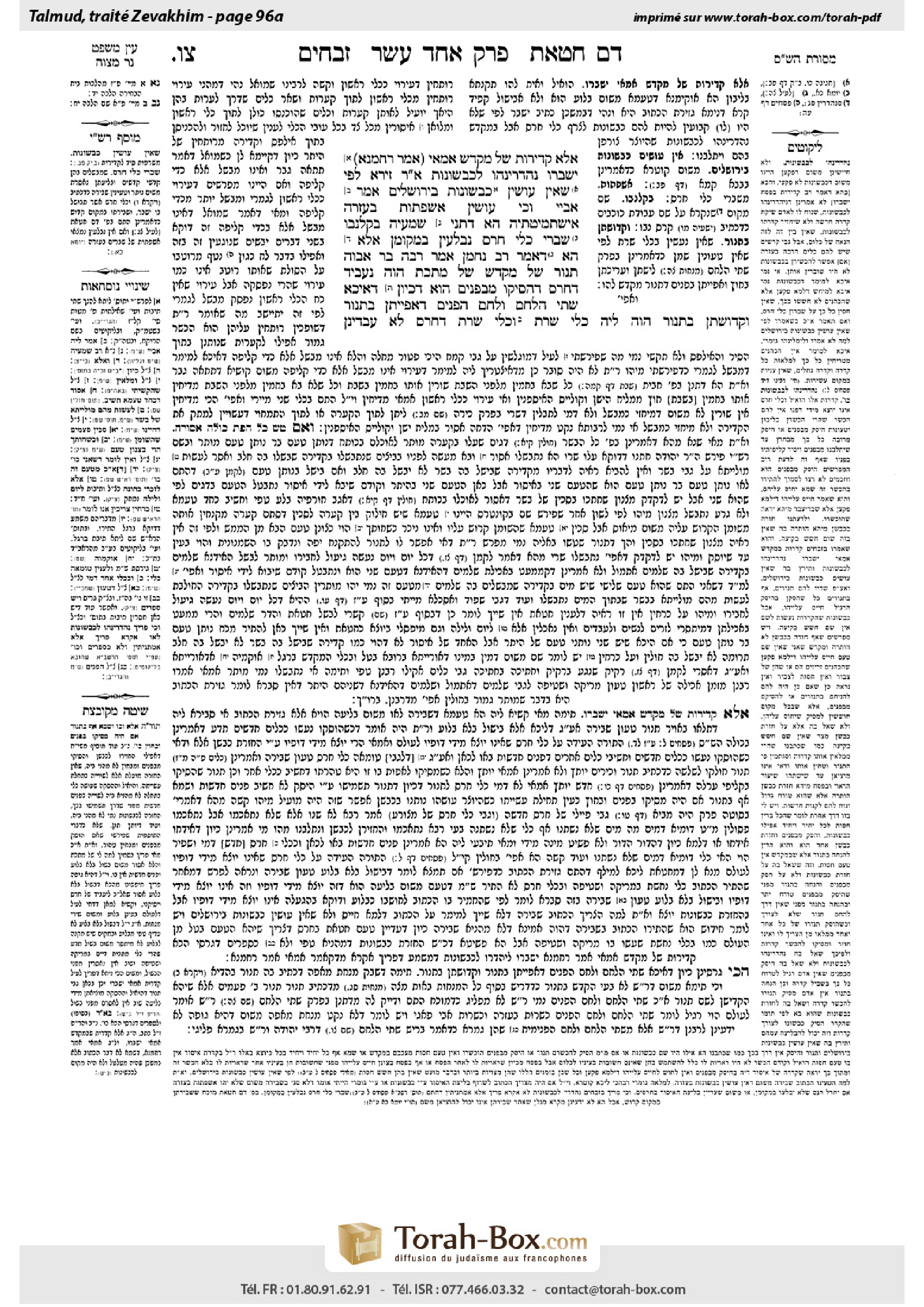
Zevachim 96a: Talmud study for Daf Yomi
Daf Yomi is the daily study of one Talmud folio. Explore 37 tractates with scans, Hebrew text, Sefaria English and AI-generated French translations where annotated.
Passage selection and English or AI-generated French translation are available where the scan has annotations. Daf Study is independent of Torah-Box and Sefaria.
Browse Zevachim · זבחים · All tractatesZevachim 96a text and translations
This page of Zevachim includes the Aramaic text, an English translation and an AI-generated French translation, alongside the scan above.
זבחים צ״ו א · Aramaic and Hebrew text
אֶלָּא קְדֵירוֹת שֶׁל מִקְדָּשׁ, אַמַּאי אָמַר רַחֲמָנָא יִשָּׁבְרוּ? נַהְדְּרִינְהוּ לְכִבְשׁוֹנוֹת! אָמַר רַבִּי זֵירָא: לְפִי שֶׁאֵין עוֹשִׂין כִּבְשׁוֹנוֹת בִּירוּשָׁלַיִם.
אָמַר אַבָּיֵי: וְכִי עוֹשִׂין אַשְׁפַּתּוֹת בָּעֲזָרָה?! אִישְׁתְּמִיטְתֵּיהּ הָא דְּתָנֵי שְׁמַעְיָה בְּקַלְנְבוֹ: שִׁבְרֵי כְּלֵי חֶרֶס נִבְלָעִין בִּמְקוֹמָן.
אֶלָּא הָא דְּאָמַר רַב נַחְמָן אָמַר רַבָּה בַּר אֲבוּהּ: תַּנּוּר שֶׁל מִקְדָּשׁ שֶׁל מַתֶּכֶת הֲוָה – נֶעְבֵּיד דְּחֶרֶס, דְּהֶסֵּיקוֹ מִבְּפָנִים הוּא!
דְּכֵיוָן דְּאִיכָּא שְׁתֵּי הַלֶּחֶם וְלֶחֶם הַפָּנִים – דַּאֲפִיָּיתָן בְּתַנּוּר וּקְדוּשָּׁתָן בְּתַנּוּר; הָוֵה לֵיהּ כְּלִי שָׁרֵת, וּכְלִי שָׁרֵת דְּחֶרֶס לָא עָבְדִינַן.
Zevachim 96a · English translation
The Gemara challenges: But according to the opinion that earthenware vessels can be cleansed of their absorbed substances by the process of kindling, with regard to pots used in the Temple, why does the Merciful One state in the Torah that they should be broken? Let us simply return them to the kilns in which pots are made to be sure that the pots will be cleansed by the extreme heat of the kilns. Rabbi Zeira said: The pots cannot be returned to kilns because, as taught in a baraita (see Bava Kamma 82b), kilns are not built in Jerusalem because of the great quantity of smoke they produce.
The Gemara presents an objection to Rabbi Zeira’s answer. Abaye said: But if, as the baraita teaches, there are no kilns in Jerusalem, are scrap heaps of earthenware assembled in the Temple courtyard? The same baraita also teaches that there are no scrap heaps in Jerusalem. What, then, is done with the shards of earthenware vessels that must be broken in the courtyard? The Gemara dismisses the question: Abaye raised that objection only because that which Shemaya taught in Kalnevo escaped him; Shemaya taught there: In the Temple, shards of earthenware vessels were miraculously absorbed in their place.
The Gemara returns to the topic of kindling earthenware vessels and asks: But if kindling from within cleanses everything absorbed in an earthenware oven, what is the reason for that which Rav Naḥman says that Rabba bar Avuh says: The oven in the Temple was fashioned of metal? Let us fashion it of earthenware, as an oven’s kindling is from the inside, and, accordingly, it would be possible to cleanse it?
The Gemara answers: The reason the oven must be fashioned of metal is because there are the two loaves, i.e., the public offering on Shavuot of two loaves from the new wheat, and the shewbread, i.e., the bread baked each week in a special form and displayed for the duration of one whole week on the table in the Sanctuary, whose baking is done in the oven, and also whose sanctification occurs in the oven. Because these offerings are not kneaded in a service vessel, they are sanctified only by being placed in the oven, and therefore the oven is a service vessel; and we do not make a service vessel of earthenware.
Zevachim 96a · Traduction française (IA)
La Guemara objecte : Mais, selon l’opinion selon laquelle les récipients en terre cuite peuvent être débarrassés des substances qu’ils ont absorbées par le flambage, pourquoi le Miséricordieux dit-il dans la Torah, au sujet des marmites utilisées dans le Temple, qu’il faut les briser ? Il suffirait de les remettre dans les fours où l’on fabrique les récipients, afin de s’assurer qu’elles soient purifiées par la chaleur extrême des fours. Rabbi Zeira dit : On ne peut pas remettre les marmites dans des fours, car, comme l’enseigne une baraïta (voir Baba Kama 82b), les fours ne sont pas construits à Jérusalem, en raison de la grande quantité de fumée qu’ils produisent.
La Guemara objecte à la réponse de Rabbi Zeira. Abaye dit : Mais si, comme l’enseigne la baraïta, il n’y a pas de fours à Jérusalem, y a-t-il des tas de tessons dans le parvis du Temple ? La même baraïta enseigne également qu’il n’y a pas de tas de tessons à Jérusalem. Que fait-on donc des tessons des récipients en terre cuite qu’il faut briser dans le parvis ? La Guemara écarte la question : Abaye n’a soulevé cette objection que parce que lui avait échappé ce que Shemaya enseignait à Kalnevo. Shemaya enseignait là-bas : Dans le Temple, les tessons des récipients en terre cuite étaient miraculeusement absorbés sur place.
La Guemara revient au sujet du flambage des récipients en terre cuite et demande : Mais si le flambage de l’intérieur débarrasse de tout ce qui a été absorbé dans un four en terre cuite, pourquoi Rav Naḥman dit-il que Rabba bar Avuh dit que le four du Temple était en métal ? Faisons-le en terre cuite, puisque le flambage d’un four se fait de l’intérieur et qu’il serait donc possible de le purifier.
La Guemara répond : Le four doit être en métal à cause des deux pains, c’est-à-dire l’offrande publique de Chavouot composée de deux pains faits avec le blé nouveau, et du pain de proposition, c’est-à-dire le pain cuit chaque semaine dans un moule spécial et exposé pendant toute une semaine sur la table du Sanctuaire : leur cuisson se fait dans le four, et leur sanctification également. Comme ces offrandes ne sont pas pétries dans un ustensile de service, elles ne sont sanctifiées qu’une fois placées dans le four. Le four est donc un ustensile de service, et un ustensile de service ne se fait pas en terre cuite.
Traduction française générée par IA à partir de l’édition anglaise de Sefaria. Vérifie toujours un passage avec le texte source.
Text from Sefaria: William Davidson Edition - Vocalized Aramaic (CC BY NC); William Davidson Edition - English (CC BY NC).