Zevachim 96b: Talmud study for Daf Yomi
Daf Yomi is the daily study of one Talmud folio. Explore 37 tractates with scans, Hebrew text, Sefaria English and AI-generated French translations where annotated.
Passage selection and English or AI-generated French translation are available where the scan has annotations. Daf Study is independent of Torah-Box and Sefaria.
Browse Zevachim · זבחים · All tractatesZevachim 96b text and translations
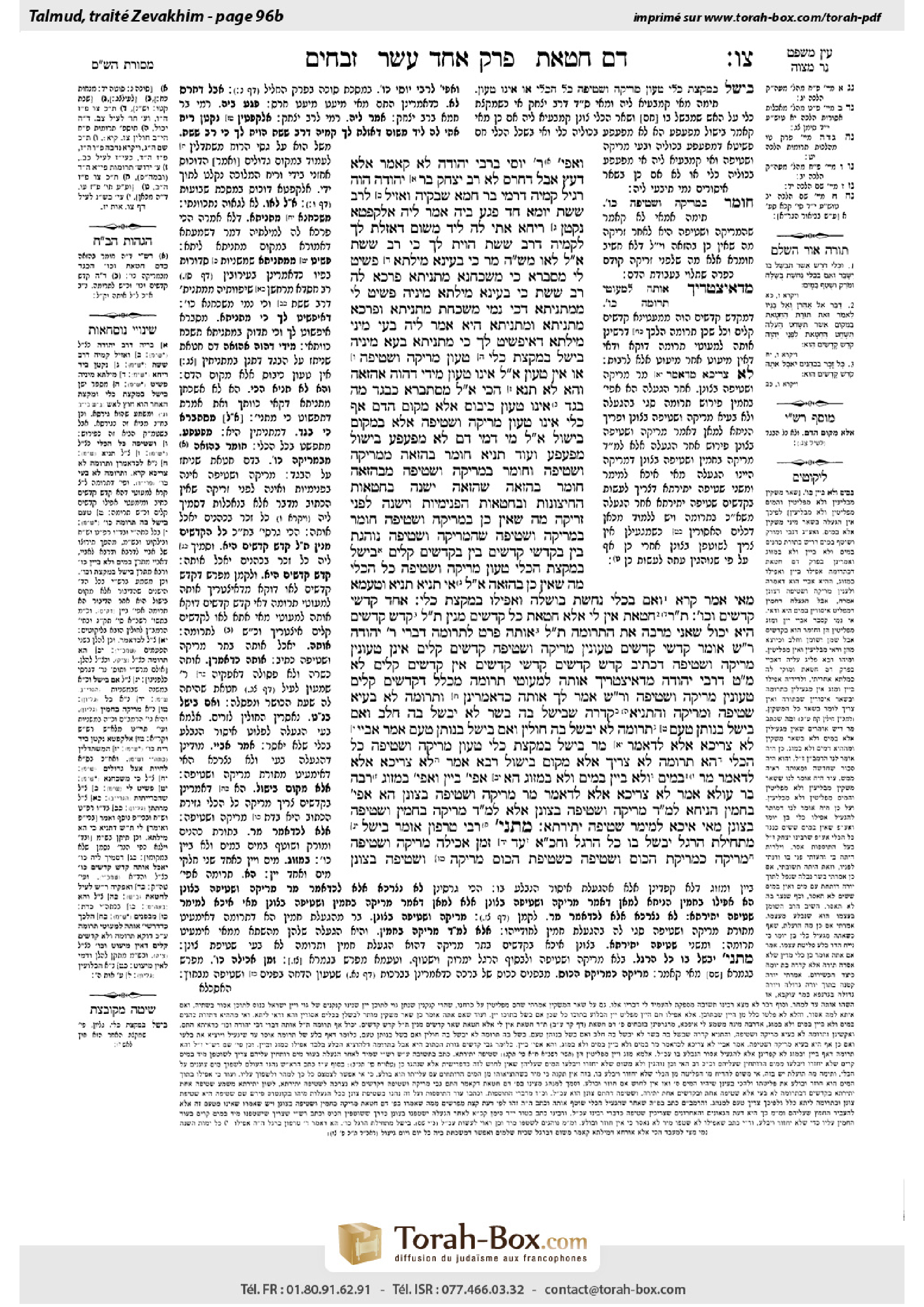
This page of Zevachim includes the Aramaic text, an English translation and an AI-generated French translation, alongside the scan above.
זבחים צ״ו ב · Aramaic and Hebrew text
וַאֲפִילּוּ רַבִּי יוֹסֵי בְּרַבִּי יְהוּדָה לָא קָאָמַר אֶלָּא דְּעֵץ, אֲבָל דְּחֶרֶס לָא.
רַב יִצְחָק בַּר יְהוּדָה הֲוָה רְגִיל קַמֵּיהּ דְּרָמֵי בַּר חָמָא, שַׁבְקֵיהּ וַאֲזַל לְרַב שֵׁשֶׁת. יוֹמָא חַד פְּגַע בֵּיהּ, אֲמַר לֵיהּ: אַלְקַפְטָא נַקְטַן, רֵיחָא אָתֵי לַהּ לְיָד?! מִשּׁוּם דְּאָזְלַתְּ לָךְ לְקַמֵּיהּ דְּרַב שֵׁשֶׁת, הָוֵית לָךְ כִּי רַב שֵׁשֶׁת?!
אֲמַר לֵיהּ: לָאו מִשּׁוּם הָכִי; מָר – כִּי בָּעֵינָא מִילְּתָא, פָּשֵׁיט לִי מִסְּבָרָא; כִּי מַשְׁכַּחְנָא מַתְנִיתָא – פָּרְכָא לַהּ. רַב שֵׁשֶׁת – כִּי בָּעֵינָא מִילְּתָא מִינֵּיהּ, פָּשֵׁיט לִי מִמַּתְנִיתָא; דְּכִי נָמֵי מַשְׁכַּחַתְּ מַתְנִיתָא וּפָרְכָא – מַתְנִיתָא וּמַתְנִיתָא הִיא.
אֲמַר לֵיהּ: בְּעִי מִינַּי מִילְּתָא, דְּאִיפְשִׁיט לָךְ כִּי מַתְנִיתָא. בְּעָא מִינֵּיהּ: בִּישֵּׁל בְּמִקְצָת כְּלִי – טָעוּן מְרִיקָה וּשְׁטִיפָה, אוֹ אֵין טָעוּן? אֲמַר לֵיהּ: אֵינוֹ טָעוּן, מִידֵּי דְּהָוֵה אַהַזָּאָה.
וְהָא לָא תְּנָא הָכִי! אֲמַר לֵיהּ: מִסְתַּבְּרָא כְּבֶגֶד – מָה בֶּגֶד אֵינוֹ טָעוּן כִּיבּוּס אֶלָּא מְקוֹם הַדָּם, אַף כְּלִי אֵינוֹ טָעוּן מְרִיקָה וּשְׁטִיפָה אֶלָּא בִּמְקוֹם בִּישּׁוּל.
אֲמַר לֵיהּ: מִי דָּמֵי?! דָּם לָא מְפַעְפַּע, בִּישּׁוּל מְפַעְפַּע! וְעוֹד, תַּנְיָא: חוֹמֶר בְּהַזָּאָה מִמְּרִיקָה וּשְׁטִיפָה, וְחוֹמֶר בִּמְרִיקָה וּשְׁטִיפָה מִבְּהַזָּאָה:
חוֹמֶר בְּהַזָּאָה – שֶׁהַזָּאָה יֶשְׁנָהּ בְּחַטָּאוֹת הַחִיצוֹנוֹת וּבְחַטָּאוֹת הַפְּנִימִיּוֹת, וְיֶשְׁנָהּ לִפְנֵי זְרִיקָה; מַה שֶּׁאֵין כֵּן בִּמְרִיקָה וּשְׁטִיפָה.
חוֹמֶר בִּמְרִיקָה וּשְׁטִיפָה – שֶׁהַמְּרִיקָה וּשְׁטִיפָה נוֹהֶגֶת בֵּין בְּקׇדְשֵׁי קָדָשִׁים בֵּין בְּקָדָשִׁים קַלִּים, בִּישֵּׁל בְּמִקְצָת הַכְּלִי – טָעוּן מְרִיקָה וּשְׁטִיפָה כָּל הַכְּלִי; מַה שֶּׁאֵין כֵּן בְּהַזָּאָה.
אֲמַר לֵיהּ: אִי תַּנְיָא תַּנְיָא. וְטַעְמָא מַאי? אָמַר קְרָא: ״וְאִם בִּכְלִי נְחֹשֶׁת בֻּשָּׁלָה״ – וַאֲפִילּוּ בְּמִקְצָת כְּלִי.
אֶחָד קׇדְשֵׁי קֳדָשִׁים וְכוּ׳. תָּנוּ רַבָּנַן: ״חַטָּאת״ – אֵין לִי אֶלָּא חַטָּאת, כׇּל קָדָשִׁים מִנַּיִן? תַּלְמוּד לוֹמַר: ״קֹדֶשׁ קָדָשִׁים הִיא״.
יָכוֹל שֶׁאֲנִי מְרַבֶּה אֶת הַתְּרוּמָה? תַּלְמוּד לוֹמַר: ״אוֹתָהּ״ – פְּרָט לִתְרוּמָה. דִּבְרֵי רַבִּי יְהוּדָה. רַבִּי שִׁמְעוֹן אוֹמֵר: קׇדְשֵׁי קָדָשִׁים טְעוּנִין מְרִיקָה וּשְׁטִיפָה, קָדָשִׁים קַלִּים אֵינָן טְעוּנִין מְרִיקָה וּשְׁטִיפָה. דִּכְתִיב: ״קֹדֶשׁ קָדָשִׁים״ – קׇדְשֵׁי קָדָשִׁים אֵין, קָדָשִׁים קַלִּים לָא.
מַאי טַעְמָא דְּרַבִּי יְהוּדָה? מִדְּאִיצְטְרִיךְ ״אוֹתָהּ״ לְמַעוֹטֵי תְּרוּמָה, מִכְּלָל דְּקָדָשִׁים קַלִּים טְעוּנִין מְרִיקָה וּשְׁטִיפָה. וְרַבִּי שִׁמְעוֹן אָמַר לָךְ: ״אוֹתָהּ״ כִּדְאָמְרִינַן.
וּתְרוּמָה לָא בָּעֲיָא שְׁטִיפָה וּמְרִיקָה?! וְהָתַנְיָא: קְדֵרָה שֶׁבִּישֵּׁל בָּהּ בָּשָׂר לֹא יְבַשֵּׁל בָּהּ חָלָב, וְאִם בִּישֵּׁל – בְּנוֹתֵן טַעַם. תְּרוּמָה לֹא יְבַשֵּׁל בָּהּ חוּלִּין, וְאִם בִּישֵּׁל – בְּנוֹתֵן טַעַם!
אָמַר אַבָּיֵי, לָא צְרִיכָא אֶלָּא לִדְאָמַר מָר: בִּישֵּׁל בְּמִקְצָת כְּלִי – טָעוּן מְרִיקָה וּשְׁטִיפָה כָּל הַכְּלִי. הָא תְּרוּמָה – לָא צְרִיךְ אֶלָּא מְקוֹם בִּישּׁוּל.
רָבָא אָמַר, לָא צְרִיכָא אֶלָּא לִדְאָמַר מָר: ״בַּמָּיִם״ – וְלֹא בְּיַיִן, ״בַּמָּיִם״ – וְלֹא בְּמָזוּג. הָא – אֲפִילּוּ בְּיַיִן וַאֲפִילּוּ בְּמָזוּג.
רַבָּה בַּר עוּלָּא אָמַר, לָא צְרִיכָא אֶלָּא לִדְאָמַר מָר: מְרִיקָה וּשְׁטִיפָה בְּצוֹנֵן. הָא – אֲפִילּוּ בְּחַמִּין.
הָנִיחָא לְמַאן דְּאָמַר: מְרִיקָה וּשְׁטִיפָה בְּצוֹנֵן; אֶלָּא לְמַאן דְּאָמַר: מְרִיקָה בְּחַמִּין וּשְׁטִיפָה בְּצוֹנֵן – מַאי אִיכָּא לְמֵימַר? שְׁטִיפָה יַתִּירְתָּא.
מַתְנִי׳ רַבִּי טַרְפוֹן אוֹמֵר: בִּישֵּׁל מִתְּחִילַּת הָרֶגֶל – יְבַשֵּׁל בּוֹ כָּל הָרֶגֶל. וַחֲכָמִים אוֹמְרִים: עַד זְמַן אֲכִילָה. מְרִיקָה וּשְׁטִיפָה – מְרִיקָה כִּמְרִיקַת הַכּוֹס, וּשְׁטִיפָה כִּשְׁטִיפַת הַכּוֹס. מְרִיקָה וּשְׁטִיפָה בְּצוֹנֵן.
Zevachim 96b · English translation
And even Rabbi Yosei, son of Rabbi Yehuda, says only that a service vessel may be fashioned of wood, which is a somewhat significant material, but with regard to a service vessel fashioned of earthenware, he holds that this is not valid.
§ The Gemara relates an incident related to the halakha of scouring and rinsing. Rav Yitzḥak bar Yehuda was initially accustomed to study Torah before Rami bar Ḥama. After some time, he left him and went to study before Rav Sheshet. One day Rami bar Ḥama met him and said to him colloquially: Did you assume, as many do, that when the chief of taxes [alkafta] grasped me by the hand, the fragrance of his hand came to my hand? Do you think that because you went away from me in order to study before Rav Sheshet, have you become like Rav Sheshet merely by association?
Rav Yitzḥak bar Yehuda said to him: It is not due to that reason that I went to study before Rav Sheshet, but for another reason. As for you, Master, when I ask with regard to any matter, Master resolves the question for me through reasoning. Consequently, when I find a mishna that opposes that reasoning, it refutes Master’s proposed resolution. As for Rav Sheshet, when I ask of him a question concerning any matter, he resolves the question for me by citing a mishna. Consequently, when I also find a mishna, and that mishna refutes the proposed resolution, it is a dispute between one mishna and another mishna, which does not necessarily refute the mishna that he cited.
Rami bar Ḥama said to him: Ask me about a matter, which I will resolve for you in accordance with a mishna. Rav Yitzḥak bar Yehuda asked him: If one cooked a sin offering in only part of a vessel, does the entire vessel require scouring and rinsing, or does it not require scouring and rinsing? Rami bar Ḥama said to him: The entire vessel does not require scouring and rinsing, just as it is taught concerning sprinkling the blood of a sin offering upon a garment. In the latter case, the mishna teaches (93b) that one must launder only the part of the garment on which the blood sprayed.
Rav Yitzḥak bar Yehuda replied: But the tanna does not teach this explicitly. Rami bar Ḥama said to him: Nevertheless, it stands to reason that the scouring and rinsing of a vessel in which sacred meat was cooked should be like the laundering of a garment, as follows: Just as a garment requires laundering only in the place where the blood was sprayed, so too, it must be that a vessel requires scouring and rinsing only in the place where the meat underwent the process of cooking.
Rav Yitzḥak bar Yehuda said to him: Are the situations comparable? Blood does not spread and penetrate all parts of the garment, but in the case of cooking, the flavor of the meat spreads throughout the entire vessel. Additionally, your reasoning opposes that which is taught in a baraita (Tosefta 10:15): A certain stringency applies to sprinkling more than it applies to scouring and rinsing; and a certain stringency applies to scouring and rinsing more than it applies to sprinkling.
The baraita continues: The stringency that applies to sprinkling is that the halakha of the sprinkling of blood on a garment applies to external sin offerings, brought on the altar in the Temple courtyard, and to internal sin offerings, whose blood is sprinkled on the altar in the Sanctuary; and the halakha of blood sprayed onto a garment applies if it sprays before the required sprinkling of the offering’s blood on the altar; which is not so in the case of scouring and rinsing. Scouring and rinsing are required only for external sin offerings, whose meat is eaten and therefore cooked; and it applies only after the sprinkling of blood on the altar, after which the meat may be eaten.
The baraita continues: The stringency that applies to scouring and rinsing is that the scouring and rinsing of vessels is practiced both for offerings of the most sacred order and for offerings of lesser sanctity; and even if one cooked in only part of the vessel, the entire vessel requires scouring and rinsing, which is not so in the case of errantly sprinkling blood onto a garment, for which one must launder only the place on which the blood sprayed.
Rami bar Ḥama said to him: If this baraita is taught, it is taught, and I cannot take issue with it. The Gemara then clarifies: And what is the reason that an entire vessel requires scouring and rinsing even if one cooked the meat of an offering in only part of the vessel? The reason is that the verse states: “And if it be cooked in a copper vessel, it shall be scoured and rinsed in water” (Leviticus 6:21). From the phrase “in a copper vessel” it is derived that even if the meat is cooked in only part of a vessel, the entire vessel must be scoured and rinsed.
§ The mishna teaches: Whether the meat is from offerings of the most sacred order or whether it is from offerings of lesser sanctity, the vessels in which it is cooked must be scoured and rinsed. The Gemara cites a related baraita: The Sages taught: The Torah introduces the mitzva of scouring and rinsing with the qualifying statement: “This is the law of the sin offering” (Leviticus 6:18). From this verse I have derived only that the halakha with regard to scouring and rinsing applies to vessels in which a sin offering was cooked. From where do I derive that this halakha applies to vessels used for all sacrificial meat? The verse states: “Every male among the priests may eat of it; it is most sacred” (Leviticus 6:22), to teach that this halakha applies to vessels used for all of the sacrificial meat that the priests eat.
The baraita continues: One might have thought that I should include vessels used for cooking teruma, the portion of the produce designated for the priest, as well, as it is also sacred and may be eaten only by a priest (see Leviticus 22:14). To counter this, the verse states: “Every male among the priests may eat of it; it is most sacred” (Leviticus 6:22). The emphatic qualifier “of it” excludes teruma; this is the statement of Rabbi Yehuda. Rabbi Shimon says: Offerings of the most sacred order require scouring and rinsing, but offerings of lesser sanctity do not require scouring and rinsing, as it is written: “Most sacred.” Accordingly, with regard to offerings of the most sacred order, yes, scouring and rinsing is required; but for offerings of lesser sanctity, no, it is not required.
The Gemara asks: The baraita explains Rabbi Shimon’s reasoning; what is the reasoning of Rabbi Yehuda? The Gemara answers: Since the qualifying term “of it” was necessary to exclude teruma, by inference, it must be that vessels used for offerings of lesser sanctity require scouring and rinsing. If even offerings of lesser sanctity are excluded from the halakha of scouring and rinsing, it would be self-evident that the vessel used for teruma is exempt from scouring and rinsing. Accordingly, the direct exclusion of teruma indicates that the vessels used for offerings of lesser sanctity are not excluded. And Rabbi Shimon could have said to you: The term “of it” teaches a different halakha and excludes a disqualified sin offering from the halakha of scouring and rinsing, as we say earlier in this chapter (93a).
The Gemara asks: And is it correct that with regard to a copper vessel used to cook teruma, it does not require rinsing and scouring? But isn’t it taught in a baraita (Tosefta, Terumot 8:16): With regard to a pot in which one cooked meat, one may not cook milk in it; and if one cooked milk in it, the meat absorbed in the pot renders the milk forbidden if it imparts flavor to it. Similarly, if one cooked teruma in a pot, one may not cook non-sacred food in it; and if one cooked non-sacred food in it, the absorbed teruma renders the mixture sacred if it imparts flavor to it. Therefore, a pot requires purging with boiling liquid in order to expel the flavor of teruma from it.
Three amora’im address the apparent inconsistency that while the Torah excludes vessels used for teruma from the halakha of scouring and rinsing, the baraita teaches that these vessels must be purged. Abaye said: When the verse excludes teruma from the halakha of scouring and rinsing, this is necessary only for that which the Master said: If one cooked in only part of the vessel, the entire vessel requires scouring and rinsing. By contrast, in this case, if teruma was cooked in only part of a vessel, one must perform scouring and rinsing only in the place of the cooking, and not in the whole vessel.
Rava said: When the verse excludes teruma from the halakha of scouring and rinsing, that is necessary only for that which the Master said: The verse specifies: “It shall be scoured and rinsed in water” (Leviticus 6:21), but the vessel is not to be scoured and rinsed in wine. It must be scoured and rinsed “in water,” but not in diluted wine. By contrast, in this case, i.e., the vessel in which teruma was cooked, it may be scoured and rinsed even in wine, and even in diluted wine.
Rabba bar Ulla said: When the verse excludes teruma from the halakha of scouring and rinsing, this is necessary only for that which the Master said: One must perform scouring and rinsing with cold water, in addition to purging a vessel of its absorbed flavors with boiling water. By contrast, in this case, i.e., with regard to the vessel in which teruma was cooked, one may cleanse the vessel even by performing only the purging with boiling water, which removes the residue of the forbidden food, and omitting the cold water processes entirely.
The Gemara asks: This works out well according to the one who says that scouring and rinsing are performed with cold water; but according to the one who says that scouring is done by purging with hot water, and rinsing is a different procedure performed with cold water, what can be said? According to this opinion, the verse is also referring to purging; and if the verse excludes vessels used for teruma, how does the baraita teach that such vessels must be purged? The Gemara answers: According to the opinion that differentiates scouring, which is done with boiling water, from rinsing, which is done with cold water, the Torah excludes vessels used for teruma only from the additional rinsing that the Torah requires after the scouring.
MISHNA: Rabbi Tarfon says: If one cooked a sin offering in a copper vessel from the beginning of the pilgrimage Festival, one may cook in it for the entire pilgrimage Festival; he need not scour and rinse the vessel after every use. And the Rabbis say: One may not continue using it in this manner; rather, one must perform scouring and rinsing before the end of the period during which partaking of the particular cooked offering is permitted. Scouring is like the scouring of the inside of a cup, the cleaning done when wine sticks to the cup, and rinsing is like the rinsing of the outside of a cup. Scouring and rinsing are both performed with cold water.
Zevachim 96b · Traduction française (IA)
Et même Rabbi Yosei, fils de Rabbi Yehuda, affirme seulement qu’un ustensile de service peut être fabriqué en bois, une matière relativement consistante ; mais, selon lui, un ustensile de service en terre cuite n’est pas valide.
§ La Guemara rapporte un incident lié à la halakha du récurage et du rinçage. Rav Yitzḥak bar Yehuda avait d’abord l’habitude d’étudier la Torah auprès de Rami bar Ḥama. Quelque temps plus tard, il le quitta et alla étudier auprès de Rav Sheshet. Un jour, Rami bar Ḥama le rencontra et lui dit familièrement : « As-tu cru, comme beaucoup, que lorsque le chef des impôts [alkafta] m’a pris par la main, le parfum de sa main est passé sur la mienne ? Penses-tu que parce que tu m’as quitté pour étudier auprès de Rav Sheshet, tu es devenu comme Rav Sheshet par simple association ? »
Rav Yitzḥak bar Yehuda lui répondit : « Ce n’est pas pour cette raison que je suis allé étudier auprès de Rav Sheshet, mais pour une autre raison. Lorsque je te pose une question sur un sujet quelconque, Maître, tu la résous par un raisonnement. Par conséquent, quand je trouve une Michna qui contredit ce raisonnement, elle réfute la solution que tu as proposée. Quant à Rav Sheshet, lorsque je lui pose une question sur un sujet quelconque, il la résout en citant une Michna. Par conséquent, si je trouve moi aussi une Michna qui réfute la solution proposée, il s’agit d’un désaccord entre deux Michnayot, ce qui ne réfute pas nécessairement la Michna qu’il a citée. »
Rami bar Ḥama lui dit : « Pose-moi une question ; je la résoudrai pour toi conformément à une Michna. » Rav Yitzḥak bar Yehuda lui demanda : « Si l’on a fait cuire un sacrifice expiatoire dans une partie seulement d’un récipient, faut-il récurer et rincer le récipient entier, ou non ? » Rami bar Ḥama lui répondit : « Il n’est pas nécessaire de récurer et de rincer le récipient entier, comme on l’enseigne au sujet de l’aspersion du sang d’un sacrifice expiatoire sur un vêtement. Dans ce cas, la Michna enseigne (93b) qu’il faut laver uniquement la partie du vêtement sur laquelle le sang a giclé. »
Rav Yitzḥak bar Yehuda répondit : « Mais le tanna ne l’enseigne pas explicitement. » Rami bar Ḥama lui dit : « Néanmoins, il est logique que le récurage et le rinçage d’un récipient dans lequel de la viande consacrée a cuit soient comparables au lavage d’un vêtement, comme suit : de même qu’il faut laver un vêtement uniquement à l’endroit où le sang a giclé, de même, il faut récurer et rincer un récipient uniquement à l’endroit où la viande a cuit. »
Rav Yitzḥak bar Yehuda lui dit : « Ces situations sont-elles comparables ? Le sang ne se répand pas et ne pénètre pas dans toutes les parties du vêtement, tandis que, lors de la cuisson, la saveur de la viande se répand dans tout le récipient. De plus, ton raisonnement contredit ce qui est enseigné dans une baraïta (Tosefta 10:15) : une certaine rigueur s’applique à l’aspersion plus qu’au récurage et au rinçage, et une certaine rigueur s’applique au récurage et au rinçage plus qu’à l’aspersion. »
La baraïta poursuit : la rigueur propre à l’aspersion est que la halakha de l’aspersion du sang sur un vêtement s’applique aux sacrifices expiatoires extérieurs, apportés sur l’autel dans la cour du Temple, ainsi qu’aux sacrifices expiatoires intérieurs, dont le sang est aspergé sur l’autel du Sanctuaire. De plus, la halakha du sang ayant giclé sur un vêtement s’applique même si le sang a giclé avant l’aspersion requise du sang du sacrifice sur l’autel. Il n’en va pas ainsi du récurage et du rinçage. Ceux-ci ne sont requis que pour les sacrifices expiatoires extérieurs, dont la viande est consommée et donc cuite ; ils ne s’appliquent qu’après l’aspersion du sang sur l’autel, après laquelle la viande peut être consommée.
La baraïta poursuit : la rigueur propre au récurage et au rinçage est que ces opérations s’appliquent aux sacrifices de sainteté suprême comme aux sacrifices de moindre sainteté ; et même si l’on n’a fait cuire la viande que dans une partie du récipient, celui-ci doit être récuré et rincé en entier. Il n’en va pas ainsi lorsqu’on asperge par erreur du sang sur un vêtement : il faut alors laver uniquement l’endroit où le sang a giclé.
Rami bar Ḥama lui dit : « Si cette baraïta est enseignée, elle l’est, et je ne peux pas la contester. » La Guemara précise alors : pourquoi faut-il récurer et rincer un récipient entier, même si l’on n’a fait cuire la viande du sacrifice que dans une partie de celui-ci ? C’est parce que le verset dit : « Et si elle est cuite dans un récipient de cuivre, il sera récuré et rincé dans l’eau » (Lévitique 6:21). De l’expression « dans un récipient de cuivre », on déduit que même si la viande n’a cuit que dans une partie du récipient, celui-ci doit être récuré et rincé en entier.
§ La Michna enseigne : que la viande provienne de sacrifices de sainteté suprême ou de sacrifices de moindre sainteté, les récipients dans lesquels elle a cuit doivent être récurés et rincés. La Guemara cite une baraïta à ce sujet : les Sages ont enseigné que la Torah introduit la mitsva du récurage et du rinçage par cette précision : « Telle est la loi du sacrifice expiatoire » (Lévitique 6:18). De ce verset, je déduis seulement que la halakha du récurage et du rinçage s’applique aux récipients dans lesquels un sacrifice expiatoire a cuit. D’où déduis-je qu’elle s’applique aux récipients utilisés pour toute viande sacrificielle ? Le verset dit : « Tout mâle parmi les prêtres en mangera ; elle est de sainteté suprême » (Lévitique 6:22), pour enseigner que cette halakha s’applique aux récipients utilisés pour toute la viande sacrificielle que les prêtres consomment.
La baraïta poursuit : on aurait pu penser qu’il fallait aussi inclure les récipients utilisés pour faire cuire de la terouma, la part des produits agricoles réservée au prêtre, puisqu’elle est elle aussi sacrée et ne peut être consommée que par un prêtre (voir Lévitique 22:14). Pour écarter cette possibilité, le verset dit : « Tout mâle parmi les prêtres en mangera ; elle est de sainteté suprême » (Lévitique 6:22). La précision « en mangera » exclut la terouma ; telle est la déclaration de Rabbi Yehuda. Rabbi Shimon dit : les sacrifices de sainteté suprême doivent être récurés et rincés, mais ceux de moindre sainteté n’ont pas à l’être, comme il est écrit : « de sainteté suprême ». Ainsi, pour les sacrifices de sainteté suprême, le récurage et le rinçage sont requis ; mais pour ceux de moindre sainteté, ils ne le sont pas.
La Guemara demande : la baraïta explique le raisonnement de Rabbi Shimon ; quel est celui de Rabbi Yehuda ? La Guemara répond : puisque la précision « en mangera » était nécessaire pour exclure la terouma, on en déduit que les récipients utilisés pour les sacrifices de moindre sainteté doivent être récurés et rincés. Si même les sacrifices de moindre sainteté étaient exclus de la halakha du récurage et du rinçage, il serait évident que le récipient utilisé pour la terouma en est exempt. Ainsi, l’exclusion explicite de la terouma indique que les récipients utilisés pour les sacrifices de moindre sainteté ne sont pas exclus. Rabbi Shimon aurait pu te répondre : le terme « en mangera » enseigne une autre halakha et exclut de la halakha du récurage et du rinçage un sacrifice expiatoire disqualifié, comme nous l’avons dit plus tôt dans ce chapitre (93a).
La Guemara demande : est-il exact qu’un récipient de cuivre utilisé pour faire cuire de la terouma n’a pas besoin d’être rincé et récuré ? N’est-il pas enseigné dans une baraïta (Tosefta, Terumot 8:16) : si l’on a fait cuire de la viande dans une marmite, on ne peut pas y faire cuire du lait ; et si l’on y a fait cuire du lait, la viande absorbée par la marmite interdit le lait si elle lui en transmet le goût. De même, si l’on a fait cuire de la terouma dans une marmite, on ne peut pas y faire cuire des aliments non sacrés ; et si l’on y en a fait cuire, la terouma absorbée rend le mélange sacré si elle lui en transmet le goût. Par conséquent, il faut purger la marmite avec un liquide bouillant afin d’en expulser la saveur de la terouma.
Trois amoraïm répondent à l’apparente contradiction entre, d’une part, l’exclusion par la Torah des récipients utilisés pour la terouma de la halakha du récurage et du rinçage et, d’autre part, l’enseignement de la baraïta selon lequel ces récipients doivent être purgés. Abaye dit : lorsque le verset exclut la terouma de la halakha du récurage et du rinçage, cela ne concerne que la règle énoncée par le Maître : si l’on a fait cuire dans une partie seulement du récipient, il faut récurer et rincer le récipient entier. En revanche, dans le cas présent, si la terouma n’a cuit que dans une partie du récipient, il faut récurer et rincer uniquement l’endroit où elle a cuit, et non le récipient entier.
Rava dit : lorsque le verset exclut la terouma de la halakha du récurage et du rinçage, cela ne concerne que la règle énoncée par le Maître : le verset précise « il sera récuré et rincé dans l’eau » (Lévitique 6:21), et non dans du vin. Le récipient doit être récuré et rincé « dans l’eau », mais pas dans du vin dilué. En revanche, dans le cas présent, c’est-à-dire pour le récipient dans lequel on a fait cuire de la terouma, on peut le récurer et le rincer même dans du vin, voire dans du vin dilué.
Rabba bar Ulla dit : lorsque le verset exclut la terouma de la halakha du récurage et du rinçage, cela ne concerne que la règle énoncée par le Maître : il faut procéder au récurage et au rinçage à l’eau froide, en plus de purger à l’eau bouillante un récipient de ses saveurs absorbées. En revanche, dans le cas présent, c’est-à-dire pour le récipient dans lequel on a fait cuire de la terouma, on peut le nettoyer en le purgeant uniquement à l’eau bouillante, qui élimine les résidus de l’aliment interdit, sans procéder aux opérations à l’eau froide.
La Guemara demande : cela convient selon celui qui dit que le récurage et le rinçage s’effectuent à l’eau froide ; mais que répondre selon celui qui dit que le récurage consiste à purger à l’eau chaude, tandis que le rinçage est une opération distincte, effectuée à l’eau froide ? Selon cette opinion, le verset fait également référence à la purge ; et si le verset exclut les récipients utilisés pour la terouma, comment la baraïta peut-elle enseigner que ces récipients doivent être purgés ? La Guemara répond : selon l’opinion qui distingue le récurage, effectué à l’eau bouillante, du rinçage, effectué à l’eau froide, la Torah exclut les récipients utilisés pour la terouma uniquement du rinçage supplémentaire exigé par la Torah après le récurage.
Michna : Rabbi Tarfon dit : si l’on a fait cuire un sacrifice expiatoire dans un récipient de cuivre au début de la fête de pèlerinage, on peut y faire cuire des aliments pendant toute la durée de cette fête ; il n’est pas nécessaire de récurer et de rincer le récipient après chaque utilisation. Les Sages disent : on ne peut pas continuer à l’utiliser de cette manière ; il faut plutôt le récurer et le rincer avant la fin de la période pendant laquelle il est permis de consommer le sacrifice cuit en question. Le récurage consiste à nettoyer l’intérieur d’une coupe, comme lorsqu’on enlève le vin qui y adhère, et le rinçage consiste à rincer l’extérieur d’une coupe. Le récurage et le rinçage s’effectuent tous deux à l’eau froide.
Traduction française générée par IA à partir de l’édition anglaise de Sefaria. Vérifie toujours un passage avec le texte source.
Text from Sefaria: William Davidson Edition - Vocalized Aramaic (CC BY NC); William Davidson Edition - English (CC BY NC).