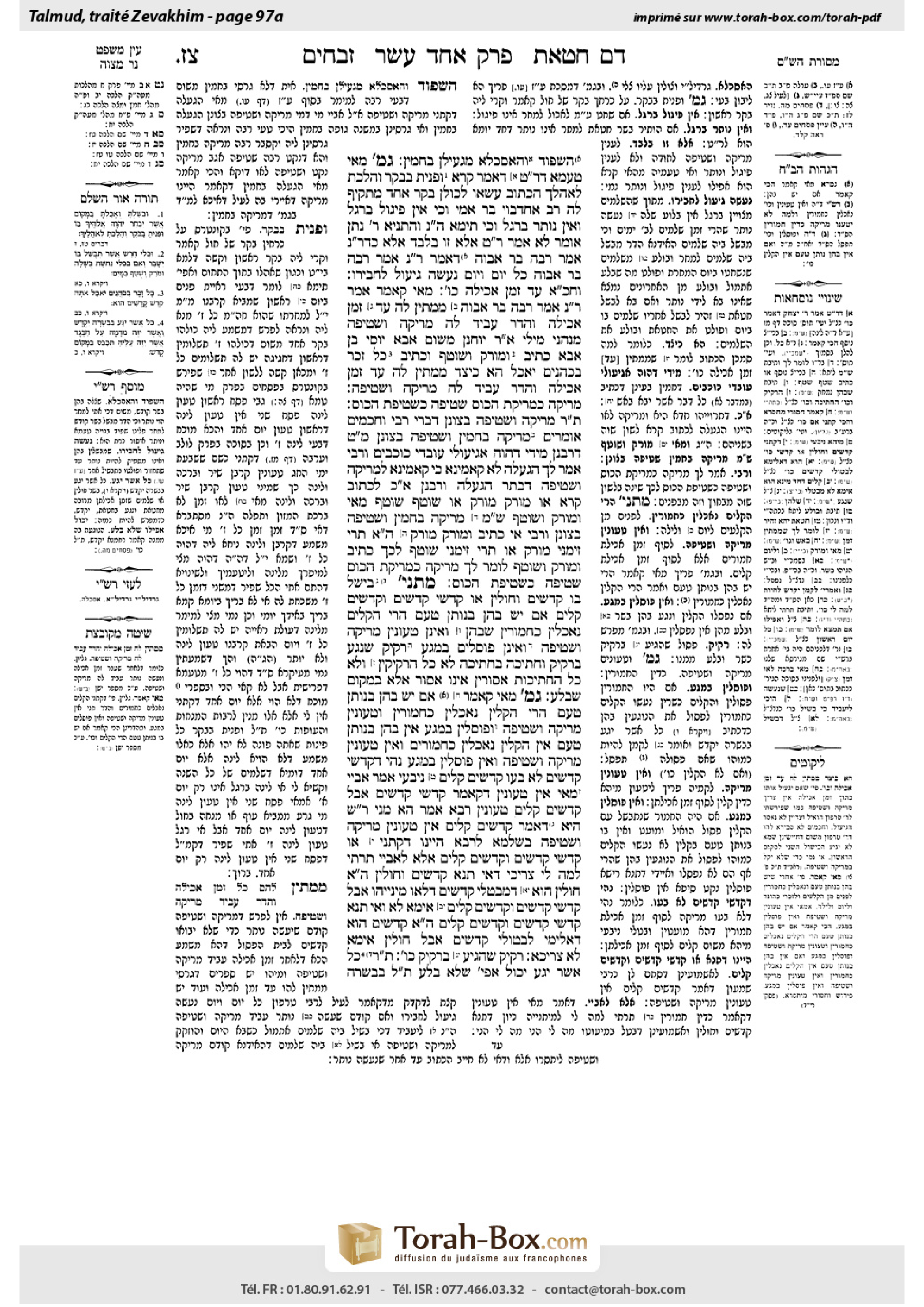
Zevachim 97a: Talmud study for Daf Yomi
Daf Yomi is the daily study of one Talmud folio. Explore 37 tractates with scans, Hebrew text, Sefaria English and AI-generated French translations where annotated.
Passage selection and English or AI-generated French translation are available where the scan has annotations. Daf Study is independent of Torah-Box and Sefaria.
Browse Zevachim · זבחים · All tractatesZevachim 97a text and translations
This page of Zevachim includes the Aramaic text, an English translation and an AI-generated French translation, alongside the scan above.
זבחים צ״ז א · Aramaic and Hebrew text
הַשַּׁפּוּד וְהָאַסְכָּלָא – מַגְעִילָן בְּחַמִּין.
גְּמָ׳ מַאי טַעְמָא דְּרַבִּי טַרְפוֹן? דְּאָמַר קְרָא: ״וּפָנִיתָ בַבֹּקֶר וְהָלַכְתָּ לְאֹהָלֶךָ״ – הַכָּתוּב עֲשָׂאָן לְכוּלָּן בֹּקֶר אֶחָד.
מַתְקֵיף לַהּ רַב אַחָדְבוּי בַּר אַמֵּי: וְכִי אֵין פִּיגּוּל בָּרֶגֶל, וְאֵין נוֹתָר בָּרֶגֶל?!
וְכִי תֵּימָא הָכִי נָמֵי; וְהָתַנְיָא, רַבִּי נָתָן אוֹמֵר: לֹא אָמַר רַבִּי טַרְפוֹן אֶלָּא זוֹ בִּלְבַד!
אֶלָּא כִּדְרַב נַחְמָן אָמַר רַבָּה בַּר אֲבוּהּ – דְּאָמַר רַב נַחְמָן אָמַר רַבָּה בַּר אֲבוּהּ: כׇּל יוֹם וָיוֹם נַעֲשֶׂה גִּיעוּל לַחֲבֵירוֹ.
וַחֲכָמִים אוֹמְרִים: עַד זְמַן אֲכִילָה כּוּ׳. מַאי קָאָמַר? אָמַר רַב נַחְמָן אָמַר רַבָּה בַּר אֲבוּהּ: מַמְתִּין לָהּ עַד זְמַן אֲכִילָה, וַהֲדַר עָבֵיד לַהּ מְרִיקָה וּשְׁטִיפָה.
מְנָהָנֵי מִילֵּי? אָמַר רַבִּי יוֹחָנָן מִשּׁוּם אַבָּא יוֹסֵי בֶּן אַבָּא: כְּתִיב ״וּמֹרַק וְשֻׁטַּף״, וּכְתִיב ״כׇּל זָכָר בַּכֹּהֲנִים יֹאכַל״. הָא כֵּיצַד? מַמְתִּין לָהּ עַד זְמַן אֲכִילָה, וַהֲדַר עָבֵיד לַהּ מְרִיקָה וּשְׁטִיפָה.
מְרִיקָה כִּמְרִיקַת הַכּוֹס, שְׁטִיפָה כִּשְׁטִיפַת הַכּוֹס. תָּנוּ רַבָּנַן: מְרִיקָה וּשְׁטִיפָה – בְּצוֹנֵן. דִּבְרֵי רַבִּי. וַחֲכָמִים אוֹמְרִים: מְרִיקָה בְּחַמִּין, וּשְׁטִיפָה בְּצוֹנֵן.
מַאי טַעְמָא דְּרַבָּנַן? מִידֵּי דְּהָוֵה אַגִּיעוּלֵי גוֹיִם. וְרַבִּי אָמַר לָךְ: הַגְעָלָה לָא קָאָמֵינָא; כִּי קָאָמֵינָא – לִמְרִיקָה וּשְׁטִיפָה דְּבָתַר הַגְעָלָה.
וְרַבָּנַן – אִם כֵּן, לִכְתּוֹב קְרָא אוֹ ״מֹרַק מֹרַק״ אוֹ ״שֻׁטַּף שֻׁטַּף״; מַאי ״וּמֹרַק וְשֻׁטַּף״? שְׁמַע מִינַּהּ: מְרִיקָה בְּחַמִּין, וּשְׁטִיפָה בְּצוֹנֵן.
וְרַבִּי – אִי כְּתִיב ״וּמֹרַק מֹרַק״, הֲוָה אָמֵינָא: תְּרֵי זִימְנֵי ״מֹרַק״, אוֹ תְּרֵי זִימְנֵי ״שֻׁטַּף״; לְכָךְ כְּתִיב ״וּמֹרַק וְשֻׁטַּף״, לוֹמַר לָךְ: מְרִיקָה – כִּמְרִיקַת הַכּוֹס, שְׁטִיפָה – כִּשְׁטִיפַת הַכּוֹס.
מַתְנִי׳ בִּישֵּׁל בּוֹ קָדָשִׁים וְחוּלִּין, אוֹ קׇדְשֵׁי קָדָשִׁים וְקָדָשִׁים קַלִּים; אִם יֵשׁ בָּהֶן בְּנוֹתֵן טַעַם – הֲרֵי הַקַּלִּים נֶאֱכָלִין כַּחֲמוּרִין שֶׁבָּהֶן, וְאֵינָן טְעוּנִין מְרִיקָה וּשְׁטִיפָה, וְאֵינָן פּוֹסְלִים בְּמַגָּע.
רָקִיק שֶׁנָּגַע בְּרָקִיק, וַחֲתִיכָה בַּחֲתִיכָה – לֹא כׇּל הָרְקִיקִין וְלֹא כׇּל הַחֲתִיכוֹת אֲסוּרִין; אֵינוֹ אָסוּר אֶלָּא בִּמְקוֹם שֶׁבָּלַע.
גְּמָ׳ מַאי קָאָמַר? אִם יֵשׁ בָּהֶן בְּנוֹתֵן טַעַם – הֲרֵי הַקַּלִּין נֶאֱכָלִין כַּחֲמוּרִין, וּטְעוּנִין מְרִיקָה וּשְׁטִיפָה, וּפוֹסְלִין בְּמַגָּע;
אֵין בָּהֶן בְּנוֹתֵן טַעַם – אֵין הַקַּלִּין נֶאֱכָלִין כַּחֲמוּרִים, וְאֵין טְעוּנִין מְרִיקָה וּשְׁטִיפָה, וְאֵין פּוֹסְלִין בְּמַגָּע.
נְהִי דְּקׇדְשֵׁי קָדָשִׁים לָא בָּעוּ, קָדָשִׁים קַלִּים נִיבְעֵי!
אָמַר אַבָּיֵי: מַאי ״אֵין טְעוּנִין״ דְּקָאָמַר? קׇדְשֵׁי קָדָשִׁים. אֲבָל קָדָשִׁים קַלִּים – טְעוּנִין. רָבָא אָמַר: הָא מַנִּי – רַבִּי שִׁמְעוֹן הִיא, דְּאָמַר: קָדָשִׁים קַלִּים אֵין טְעוּנִין מְרִיקָה וּשְׁטִיפָה.
בִּשְׁלָמָא לְרָבָא, הַיְינוּ דְּקָתָנֵי: אוֹ קׇדְשֵׁי קָדָשִׁים וְקָדָשִׁים קַלִּים. אֶלָּא לְאַבָּיֵי, תַּרְתֵּי לְמָה לִי?
צְרִיכִי; דְּאִי תְּנָא קָדָשִׁים וְחוּלִּין, הֲוָה אָמֵינָא: חוּלִּין הוּא דִּמְבַטְּלִי קָדָשִׁים, דְּלָאו מִינַּיְיהוּ; אֲבָל קׇדְשֵׁי קָדָשִׁים וְקָדָשִׁים קַלִּים – אֵימָא לָא.
וְאִי תְּנָא קׇדְשֵׁי קָדָשִׁים וְקָדָשִׁים קַלִּים, הֲוָה אָמֵינָא: קָדָשִׁים הוּא דְּאַלִּימִי לְבַטּוֹלֵי קָדָשִׁים, אֲבָל חוּלִּין – אֵימָא לָא; צְרִיכָא.
רָקִיק שֶׁהִגִּיעַ בְּרָקִיק כּוּ׳. תָּנוּ רַבָּנַן: ״כֹּל אֲשֶׁר יִגַּע״ – יָכוֹל אֲפִילּוּ שֶׁלֹּא בָּלַע? תַּלְמוּד לוֹמַר: ״בִּבְשָׂרָהּ״ –
Zevachim 97a · English translation
With regard to the spit and the metal grill [askela], one purges them in hot water.
GEMARA: The mishna teaches that Rabbi Tarfon says: If one cooked a sin offering in a vessel from the beginning of the Festival, one may cook in it for the entire Festival without scouring and rinsing the vessel after every use and without being concerned that he is eating forbidden leftover meat. The Gemara asks: What is the reasoning of Rabbi Tarfon? The Gemara answers: It is as the verse states with regard to the Paschal offering: “And you shall roast and eat it in the place that the Lord your God shall choose; and you shall turn in the morning, and go to your tents” (Deuteronomy 16:7). Although one does not leave Jerusalem on the first morning of Passover, the verse has rendered all of those days over which one remains there equal to one morning.
Rav Aḥadvoi bar Ami objects to this: Can it be that all of the days of the Festival are considered a single day? But is there no prohibition against bringing an offering that was sacrificed with the intent to consume it after its appointed time [piggul] during a pilgrimage Festival? And is there no prohibition of notar, consuming sacrificial meat beyond its appointed time, during a pilgrimage Festival? Both these prohibitions are based on the premise that each offering may be eaten over a limited time far less than the duration of the entire Festival.
And if you would say: Indeed, neither piggul nor notar apply during a Festival, that is difficult: But it is taught in a baraita that Rabbi Natan says: Rabbi Tarfon said that an entire Festival is considered a single day only with regard to this, the halakhot of scouring and rinsing, alone, and not with regard to other halakhot, including piggul and notar. Evidently, his opinion is not based on the cited verse.
The Gemara continues: Rather, one must explain that Rabbi Tarfon’s opinion accords with that which Rav Naḥman says citing Rabba bar Avuh. As Rav Naḥman says that Rabba bar Avuh says: Scouring and rinsing does not need to be done every day in order to avoid eating the taste of forbidden leftover meat, because while the vessels are used for repeatedly cooking various types of sacrificial meat, the meat of each and every day becomes a purging agent for the other food, that which is already absorbed in the vessel from the prior day. Therefore, only after the Festival, when the vessel is not being used, must the pot be scoured and rinsed.
§ The mishna teaches: And the Rabbis say: One may not continue using it in this manner; rather, one must perform scouring and rinsing before the end of the period during which partaking of the particular cooked offering is permitted. What is the mishna saying? Rav Naḥman said that Rabba bar Avuh said: One waits for the copper vessel so long as it remains the period of partaking, and then he performs scouring and rinsing on it.
From where are these matters derived? Rabbi Yoḥanan says in the name of Abba Yosei bar Abba: It is written about a copper vessel in which a sin offering was cooked: “It shall be scoured and rinsed in water” (Leviticus 6:21); and it is written in the following verse: “Every male among the priests may eat it.” How so, i.e., what are the verses teaching through this juxtaposition? One waits with it until the end of the period of partaking and then performs scouring and rinsing on it.
§ The mishna teaches: Scouring is like the scouring of a cup, and rinsing is like the rinsing of a cup; and scouring and rinsing are both performed with cold water. The Sages taught in a baraita: Scouring and rinsing are both performed with cold water; this is the statement of Rabbi Yehuda HaNasi. And the Rabbis say: Scouring is performed with hot water, and rinsing is performed with cold water.
What is the reasoning of the Rabbis? They hold that this halakha is just as it is with regard to purging the used vessels acquired from gentiles, for which purging the forbidden absorptions must be performed with hot water. And Rabbi Yehuda HaNasi could have said to you: I do not say this statement about purging, which must certainly be performed with hot water. Rather, when I say my opinion, it is with regard to the mitzva of scouring and rinsing, which is performed after purging.
And the Rabbis could reply: If so, that scouring and rinsing are both performed in the same manner, let the verse write the same verb to describe both processes, namely either: It shall be scoured and scoured in water, or: It shall be rinsed and rinsed in water. What is meant by the formula: “It shall be scoured and rinsed in water”? Conclude from the use of two verbs that scouring is performed with hot water, and rinsing is performed with cold water.
And Rabbi Yehuda HaNasi could reply: If it were written: It shall be scoured and scoured, or: It shall be rinsed and rinsed, I would say that the vessel must be scoured two times, or that it must be rinsed two times. Therefore, it is written: “It shall be scoured and rinsed,” to tell you that even if both are performed with cold water, there are two distinct actions: Scouring is like the scouring of the inside of a cup, and rinsing is like the rinsing of the outside of a cup.
MISHNA: If one cooked in one vessel sacrificial meat and non-sacred meat, or the meat of offerings of the most sacred order and the meat of offerings of lesser sanctity, the status of the food depends upon the taste of the stringent substance. If there is enough of the more sacred meat to impart flavor to the less sacred or non-sacred meat, then the lenient components of the mixtures must be eaten in accordance with the restrictions of the stringent components therein, insofar as who may partake of them, as well as the time when and the place where they may be eaten. And the copper vessels in which the lenient components were cooked do not require scouring and rinsing, and the lenient components do not disqualify pieces of meat through contact. With regard to these principles, the lenient components do not assume the status of the stringent components.
In the case of a fit wafer that touched an unfit wafer or a piece of sacrificial meat that touched an unfit piece of sacrificial meat, neither all the wafers nor all the pieces of meat are forbidden. No part is forbidden other than that which is in the place where the item absorbed taste from the unfit wafers or pieces.
GEMARA: According to the mishna, if the more sacred meat imparts flavor to the less sacred or non-sacred meat, then the lenient meat is to be treated in the same manner as the more sacred meat. Concurrently, their vessels do not require scouring and rinsing, and the lenient components do not disqualify pieces of meat through contact. The Gemara asks: What is the mishna saying? Is this not inconsistent? The Gemara answers: The mishna must be understood otherwise: If there is enough of the more sacred meat to impart flavor to the less sacred or non-sacred meat, then the lenient components of the mixtures must be eaten in accordance with the restrictions of the stringent components. Moreover, the copper vessels in which the lenient components were cooked do require scouring and rinsing, and the lenient components do disqualify pieces of meat through contact.
The Gemara continues: If the more sacred meat is not sufficient to impart flavor to the less sacred or non-sacred meat, then the lenient components of the mixtures are not eaten in accordance with the restrictions of the stringent components. Moreover, the copper vessels in which the lenient components were cooked do not require scouring and rinsing, and the lenient components do not disqualify pieces of meat through contact.
The Gemara asks: If the offerings of the most sacred order do not impart taste to the offerings of lesser sanctity, granted, the vessels do not require scouring and rinsing commensurate with vessels used to cook offerings of the most sacred order. But isn’t it so that the vessels should nevertheless require scouring and rinsing by virtue of having been used for offerings of lesser sanctity?
Abaye said: What is the meaning of: Do not require, which the mishna states? It means only that the vessels do not require scouring and rinsing commensurate with vessels used to cook offerings of the most sacred order, but they do require scouring and rinsing as vessels used to cook offerings of lesser sanctity. Rava said: In accordance with whose opinion is this mishna? It is in accordance with the opinion of Rabbi Shimon, who says: Vessels used to cook offerings of lesser sanctity do not require scouring and rinsing at all.
The Gemara analyzes: Granted, according to the opinion of Rava, this explanation is consistent with that which the mishna teaches: If one cooked in one vessel sacrificial meat and non-sacred meat, or the meat of offerings of the most sacred order and the meat of offerings of lesser sanctity. The mishna provides a second scenario in order to teach that vessels used to cook offerings of lesser sanctity do not require scouring and rinsing, in accordance with the opinion of Rabbi Shimon. But according to Abaye, why do I need two cases to teach the single principle that a substance is nullified if its presence is insufficient to impart flavor?
The Gemara answers: Even according to Abaye, both cases are necessary, in order to teach a halakha with regard to nullification. As, had the mishna taught only the case of sacrificial meat and non-sacred meat, I would say that it is non-sacred meat that can nullify sacrificial meat, as sacrificial meat is not its type. But with regard to offerings of the most sacred order and offerings of lesser sanctity, I would say: The offerings of lesser sanctity do not nullify those other offerings, because they are of the same type.
And had the mishna taught only the case of offerings of the most sacred order and offerings of lesser sanctity, I would say that it is sacrificial meat that is strong enough to nullify other sacrificial meat; but with regard to non-sacred meat, I would say: It is not strong enough to nullify sacrificial meat. Therefore, it is necessary for the mishna to teach both cases.
§ The mishna teaches: In the case of a fit wafer that reached an unfit wafer or a piece of sacrificial meat that touched an unfit piece of sacrificial meat, neither all the wafers nor all the pieces are forbidden. No part is forbidden other than that which is in the place where the item absorbed taste from the unfit wafers or pieces. In relation to this halakha, the Sages taught in a baraita: With regard to a sin offering, the verse states: “Whatever shall touch its flesh shall be sacred” (Leviticus 6:20). One might have thought that this applies to all contact, even if the other piece did not absorb any flavor from the meat of the sin offering. To counter this, the same verse states: “With its flesh [bivsarah]” which can also be translated: In its flesh.
Zevachim 97a · Traduction française (IA)
Pour la broche et le gril métallique [askela], on les ébouillante dans de l’eau chaude.
GUEMARA : La Michna enseigne que Rabbi Tarfon dit : Si l’on a fait cuire un sacrifice expiatoire dans un récipient dès le début de la fête, on peut y faire cuire des aliments pendant toute la fête, sans récurer ni rincer le récipient après chaque utilisation et sans craindre de manger des restes interdits. La Guemara demande : Quel est le raisonnement de Rabbi Tarfon ? La Guemara répond : Il s’appuie sur ce que dit le verset au sujet de l’offrande pascale : « Tu la feras rôtir et tu la mangeras à l’endroit que l’Éternel, ton Dieu, choisira ; puis, au matin, tu retourneras et tu iras dans tes tentes » (Deutéronome 16:7). Bien que l’on ne quitte pas Jérusalem le premier matin de Pessa’h, le verset a rendu équivalents à un seul matin tous les jours pendant lesquels on y demeure.
Rav Aḥadvoi bar Ami objecte : Est-il possible que tous les jours de la fête soient considérés comme un seul jour ? N’est-il pas interdit d’apporter une offrande qui a été sacrifiée avec l’intention d’en consommer la viande après le délai prescrit [piggul] pendant une fête de pèlerinage ? Et n’est-il pas interdit de consommer du notar, c’est-à-dire de la viande sacrificielle au-delà du délai prescrit, pendant une fête de pèlerinage ? Ces deux interdictions reposent sur le principe que chaque offrande ne peut être consommée que pendant une période limitée, bien plus courte que la durée de toute la fête.
Et si l’on disait qu’en effet, ni le piggul ni le notar ne s’appliquent pendant une fête, cela poserait problème : il est pourtant enseigné dans une baraïta que Rabbi Natan dit : Rabbi Tarfon a déclaré que toute une fête est considérée comme un seul jour uniquement pour cette question, celle des halakhot du récurage et du rinçage, et non pour d’autres halakhot, notamment celles du piggul et du notar. Il est donc manifeste que son opinion ne repose pas sur le verset cité.
La Guemara poursuit : Il faut plutôt expliquer que l’opinion de Rabbi Tarfon concorde avec ce que Rav Naḥman dit au nom de Rabba bar Avuh. En effet, Rav Naḥman dit au nom de Rabba bar Avuh : Il n’est pas nécessaire de récurer et de rincer le récipient chaque jour pour éviter de manger le goût de restes interdits, car, lorsque les récipients servent à cuire successivement diverses sortes de viande sacrificielle, la viande de chaque jour purge les aliments déjà absorbés dans le récipient la veille. Par conséquent, la marmite ne doit être récurée et rincée qu’après la fête, lorsqu’on ne s’en sert plus.
§ La Michna enseigne : Et les Sages disent : On ne peut pas continuer à l’utiliser de cette manière ; il faut plutôt le récurer et le rincer avant la fin de la période pendant laquelle il est permis de consommer l’offrande cuite concernée. Que dit la Michna ? Rav Naḥman dit au nom de Rabba bar Avuh : On laisse le récipient de cuivre en service tant que dure la période de consommation, puis on le récure et on le rince.
D’où ces principes sont-ils tirés ? Rabbi Yoḥanan dit au nom d’Abba Yosei bar Abba : Il est écrit au sujet d’un récipient de cuivre dans lequel un sacrifice expiatoire a été cuit : « Il sera récuré et rincé dans l’eau » (Lévitique 6:21) ; et le verset suivant dit : « Tout mâle parmi les prêtres pourra en manger. » Que nous enseignent ces versets par leur juxtaposition ? On attend jusqu’à la fin de la période de consommation, puis on récure et on rince le récipient.
§ La Michna enseigne : Le récurage est comme celui d’une coupe, et le rinçage est comme celui d’une coupe ; le récurage et le rinçage se font tous deux à l’eau froide. Les Sages ont enseigné dans une baraïta : Le récurage et le rinçage se font tous deux à l’eau froide ; telle est l’opinion de Rabbi Yehuda HaNasi. Les Sages, eux, disent : Le récurage se fait à l’eau chaude et le rinçage à l’eau froide.
Quel est le raisonnement des Sages ? Ils estiment que cette halakha est comparable à celle de la purge des ustensiles usagés acquis auprès de non-Juifs, purge qui doit se faire à l’eau chaude afin d’en éliminer les absorptions interdites. Rabbi Yehuda HaNasi aurait pu leur répondre : Je ne parle pas de cette purge, qui doit assurément se faire à l’eau chaude. Lorsque j’exprime mon opinion, je parle plutôt de la mitsva de récurer et de rincer, qui s’accomplit après la purge.
Les Sages pourraient répliquer : Si tel était le cas, et que le récurage et le rinçage s’effectuaient de la même manière, le verset devrait employer le même verbe pour décrire les deux opérations, en disant soit : « Il sera récuré et récuré dans l’eau », soit : « Il sera rincé et rincé dans l’eau ». Que signifie alors la formule : « Il sera récuré et rincé dans l’eau » ? Il faut en déduire, de l’emploi de deux verbes, que le récurage se fait à l’eau chaude et le rinçage à l’eau froide.
Rabbi Yehuda HaNasi pourrait répondre : Si le texte disait « Il sera récuré et récuré » ou « Il sera rincé et rincé », j’aurais pensé qu’il faut récurer le récipient deux fois, ou le rincer deux fois. Le texte dit donc : « Il sera récuré et rincé », pour enseigner que, même si les deux opérations se font à l’eau froide, il s’agit de deux gestes distincts : le récurage est comme celui de l’intérieur d’une coupe, et le rinçage comme celui de l’extérieur d’une coupe.
MICHNA : Si l’on a fait cuire dans un même récipient de la viande sacrificielle et de la viande non consacrée, ou de la viande d’offrandes de sainteté éminente et de la viande d’offrandes de moindre sainteté, le statut des aliments dépend du goût de la substance dont le statut est le plus rigoureux. Si la viande de sainteté supérieure est en quantité suffisante pour donner son goût à la viande de moindre sainteté ou à la viande non consacrée, les éléments moins rigoureux du mélange doivent être consommés selon les restrictions applicables aux éléments les plus rigoureux, tant pour ce qui est des personnes autorisées à les consommer que du moment et du lieu où ils peuvent être consommés. Les récipients de cuivre dans lesquels les éléments moins rigoureux ont été cuits ne nécessitent ni récurage ni rinçage, et ces éléments ne disqualifient pas des morceaux de viande par contact. Selon ces principes, les éléments moins rigoureux ne prennent pas le statut des éléments plus rigoureux.
Dans le cas d’une galette apte à la consommation qui a touché une galette impropre, ou d’un morceau de viande sacrificielle qui a touché un morceau de viande sacrificielle impropre, ni toutes les galettes ni tous les morceaux de viande ne sont interdits. Seule est interdite la partie située à l’endroit où l’aliment a absorbé le goût des galettes ou des morceaux impropres.
GUEMARA : Selon la Michna, si la viande de sainteté supérieure donne son goût à la viande de moindre sainteté ou à la viande non consacrée, la viande moins rigoureuse doit être traitée comme celle de sainteté supérieure. Pourtant, les récipients dans lesquels les éléments moins rigoureux ont été cuits ne nécessitent ni récurage ni rinçage, et ces éléments ne disqualifient pas des morceaux de viande par contact. La Guemara demande : Que dit la Michna ? N’y a-t-il pas là une contradiction ? La Guemara répond : Il faut comprendre la Michna autrement : si la viande de sainteté supérieure est en quantité suffisante pour donner son goût à la viande de moindre sainteté ou à la viande non consacrée, les éléments moins rigoureux du mélange doivent être consommés selon les restrictions applicables aux éléments les plus rigoureux. De plus, les récipients de cuivre dans lesquels les éléments moins rigoureux ont été cuits nécessitent bien un récurage et un rinçage, et les éléments moins rigoureux disqualifient bien des morceaux de viande par contact.
La Guemara poursuit : Si la viande de sainteté supérieure n’est pas en quantité suffisante pour donner son goût à la viande de moindre sainteté ou à la viande non consacrée, les éléments moins rigoureux du mélange ne sont pas soumis aux restrictions applicables aux éléments les plus rigoureux. De plus, les récipients de cuivre dans lesquels les éléments moins rigoureux ont été cuits ne nécessitent ni récurage ni rinçage, et les éléments moins rigoureux ne disqualifient pas des morceaux de viande par contact.
La Guemara demande : Si les offrandes de sainteté éminente ne donnent pas leur goût aux offrandes de moindre sainteté, on peut comprendre que les récipients n’exigent pas le récurage et le rinçage requis pour ceux qui ont servi à cuire des offrandes de sainteté éminente. Mais les récipients ne devraient-ils pas néanmoins nécessiter un récurage et un rinçage du fait qu’ils ont servi à cuire des offrandes de moindre sainteté ?
Abaye dit : Que signifie l’expression « ne nécessitent pas », employée par la Michna ? Elle signifie seulement que les récipients ne nécessitent pas le récurage et le rinçage requis pour ceux qui ont servi à cuire des offrandes de sainteté éminente ; mais ils nécessitent un récurage et un rinçage en tant que récipients ayant servi à cuire des offrandes de moindre sainteté. Rava dit : Selon l’opinion de qui cette Michna est-elle formulée ? Selon celle de Rabbi Shimon, qui dit que les récipients ayant servi à cuire des offrandes de moindre sainteté ne nécessitent absolument ni récurage ni rinçage.
La Guemara analyse : Selon l’opinion de Rava, on comprend que cette explication concorde avec ce qu’enseigne la Michna : Si l’on a fait cuire dans un même récipient de la viande sacrificielle et de la viande non consacrée, ou de la viande d’offrandes de sainteté éminente et de la viande d’offrandes de moindre sainteté. La Michna présente un second cas pour enseigner que les récipients ayant servi à cuire des offrandes de moindre sainteté ne nécessitent ni récurage ni rinçage, conformément à l’opinion de Rabbi Shimon. Mais, selon Abaye, pourquoi faut-il deux cas pour enseigner ce seul principe : une substance est annulée si elle est présente en quantité insuffisante pour donner son goût ?
La Guemara répond : Même selon Abaye, les deux cas sont nécessaires pour enseigner une halakha relative à l’annulation. En effet, si la Michna avait enseigné seulement le cas de la viande sacrificielle et de la viande non consacrée, j’aurais dit que c’est la viande non consacrée qui peut annuler la viande sacrificielle, puisque la viande non consacrée est d’une catégorie différente. Mais, s’agissant des offrandes de sainteté éminente et des offrandes de moindre sainteté, j’aurais dit que les offrandes de moindre sainteté n’annulent pas les autres offrandes, puisqu’elles sont de la même catégorie.
Et si la Michna avait enseigné seulement le cas des offrandes de sainteté éminente et des offrandes de moindre sainteté, j’aurais dit que la viande sacrificielle peut en annuler une autre ; mais, s’agissant de la viande non consacrée, j’aurais dit qu’elle n’est pas assez puissante pour annuler la viande sacrificielle. Il est donc nécessaire que la Michna enseigne les deux cas.
§ La Michna enseigne : Dans le cas d’une galette apte à la consommation qui a touché une galette impropre, ou d’un morceau de viande sacrificielle qui a touché un morceau de viande sacrificielle impropre, ni toutes les galettes ni tous les morceaux ne sont interdits. Seule est interdite la partie située à l’endroit où l’aliment a absorbé le goût des galettes ou des morceaux impropres. À propos de cette halakha, les Sages ont enseigné dans une baraïta : Au sujet d’un sacrifice expiatoire, le verset dit : « Tout ce qui touchera sa chair sera consacré » (Lévitique 6:20). On aurait pu penser que cela s’applique à tout contact, même si l’autre morceau n’a absorbé aucun goût de la viande du sacrifice expiatoire. Pour écarter cette interprétation, le même verset dit : « Avec sa chair [bivsarah] », expression qui peut aussi se traduire par : « Dans sa chair ».
Traduction française générée par IA à partir de l’édition anglaise de Sefaria. Vérifie toujours un passage avec le texte source.
Text from Sefaria: William Davidson Edition - Vocalized Aramaic (CC BY NC); William Davidson Edition - English (CC BY NC).