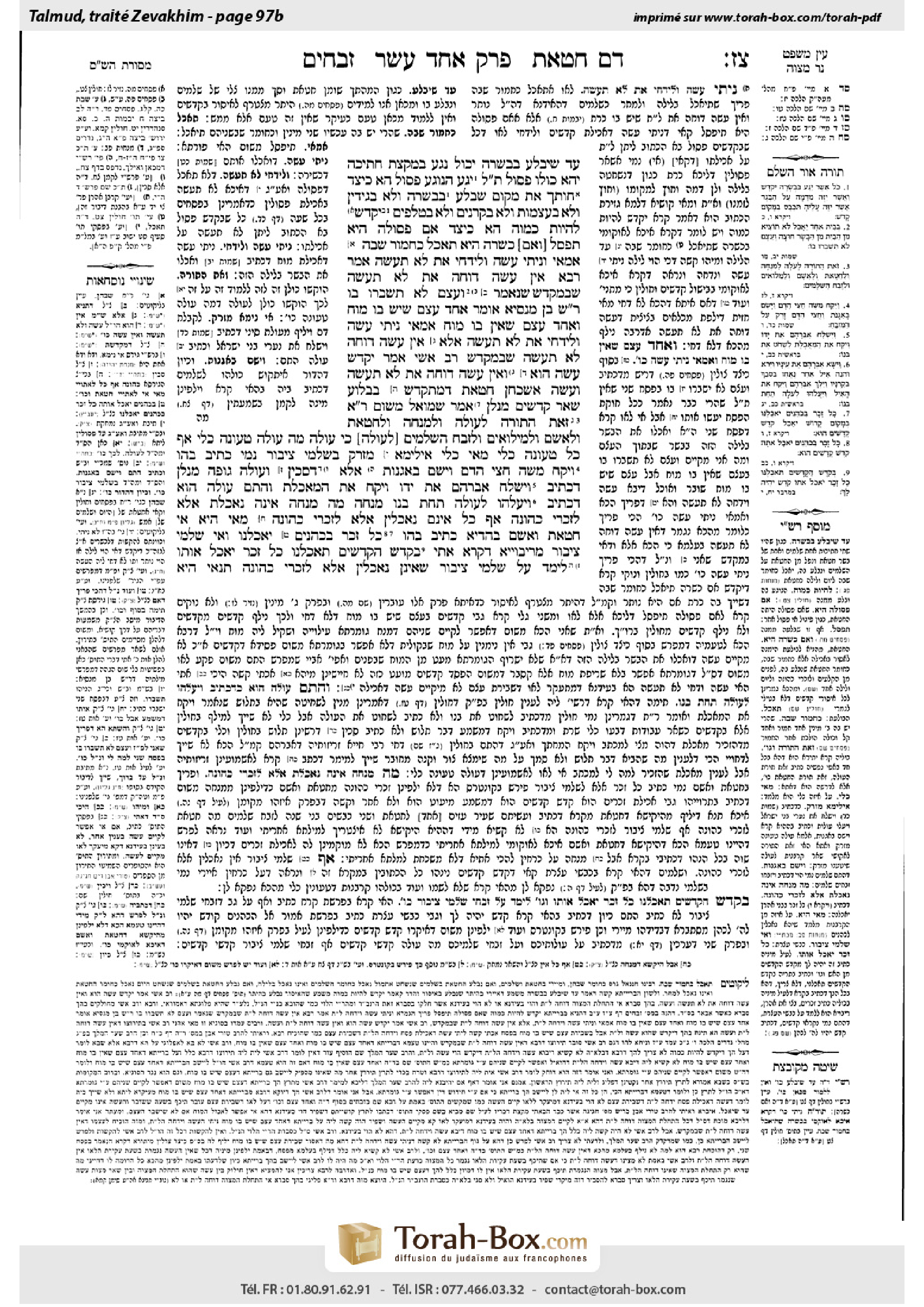
Zevachim 97b: Talmud study for Daf Yomi
Daf Yomi is the daily study of one Talmud folio. Explore 37 tractates with scans, Hebrew text, Sefaria English and AI-generated French translations where annotated.
Passage selection and English or AI-generated French translation are available where the scan has annotations. Daf Study is independent of Torah-Box and Sefaria.
Browse Zevachim · זבחים · All tractatesZevachim 97b text and translations
This page of Zevachim includes the Aramaic text, an English translation and an AI-generated French translation, alongside the scan above.
זבחים צ״ז ב · Aramaic and Hebrew text
עַד שֶׁיִּבָּלַע בִּבְשָׂרָהּ.
יָכוֹל נָגַע בְּמִקְצָת חֲתִיכָה יְהֵא כּוּלּוֹ פָּסוּל? תַּלְמוּד לוֹמַר: ״יִגַּע״ – הַנּוֹגֵעַ פָּסוּל. הָא כֵּיצַד? חוֹתֵךְ אֶת מָקוֹם שֶׁבָּלַע. ״בִּבְשָׂרָהּ״ – וְלֹא בַּגִּידִין, וְלֹא בָּעֲצָמוֹת, וְלֹא בַּקַּרְנַיִם, וְלֹא בַּטְּלָפַיִם.
״יִקְדָּשׁ״ – לִהְיוֹת כָּמוֹהָ. הָא כֵּיצַד? אִם פְּסוּלָה הִיא – תִּפָּסֵל, [וְאִם] כְּשֵׁרָה הִיא – תֵּאָכֵל כֶּחָמוּר שֶׁבָּהּ.
אַמַּאי? וְנֵיתֵי עֲשֵׂה וְלִידְחֵי אֶת לֹא תַעֲשֶׂה! אָמַר רָבָא: אֵין עֲשֵׂה דּוֹחֶה אֶת לֹא תַעֲשֶׂה שֶׁבַּמִּקְדָּשׁ,
שֶׁנֶּאֱמַר: ״וְעֶצֶם לֹא תִשְׁבְּרוּ בוֹ״. רַבִּי שִׁמְעוֹן בֶּן מְנַסְיָא אוֹמֵר: אֶחָד עֶצֶם שֶׁיֵּשׁ בּוֹ מוֹחַ, וְאֶחָד עֶצֶם שֶׁאֵין בּוֹ מוֹחַ. אַמַּאי? נֵיתֵי עֲשֵׂה וְלִידְחֵי אֶת לֹא תַעֲשֶׂה! אֶלָּא אֵין עֲשֵׂה דּוֹחֶה לֹא תַעֲשֶׂה שֶׁבַּמִּקְדָּשׁ.
רַב אָשֵׁי אָמַר: ״יִקְדָּשׁ״ עֲשֵׂה הוּא, וְאֵין עֲשֵׂה דּוֹחֶה אֶת לֹא תַעֲשֶׂה וַעֲשֵׂה.
אַשְׁכְּחַן חַטָּאת דְּמִתְקַדֶּשֶׁת בְּבִלּוּעַ, שְׁאָר קָדָשִׁים מְנָלַן? אָמַר שְׁמוּאֵל מִשּׁוּם רַבִּי אֱלִיעֶזֶר: ״זֹאת הַתּוֹרָה לָעֹלָה וְלַמִּנְחָה וְלַחַטָּאת וְלָאָשָׁם וְלַמִּלּוּאִים וּלְזֶבַח הַשְּׁלָמִים״.
״לָעֹלָה״ – כִּי עוֹלָה; מָה עוֹלָה טְעוּנָה כְּלִי, אַף כֹּל טְעוּנָה כְּלִי. מַאי כְּלִי? אִילֵימָא מִזְרָק – בְּשַׁלְמֵי צִיבּוּר נָמֵי כְּתִיב בְּהוּ: ״וַיִּקַּח מֹשֶׁה חֲצִי הַדָּם וַיָּשֶׂם בָּאַגָּנֹת״!
אֶלָּא דְּסַכִּין. וְעוֹלָה גּוּפַהּ מְנָלַן? דִּכְתִיב: ״וַיִּשְׁלַח אַבְרָהָם אֶת יָדוֹ וַיִּקַּח אֶת הַמַּאֲכֶלֶת״ – וְהָתָם עוֹלָה הוּא, דִּכְתִיב: ״וַיַּעֲלֵהוּ לְעֹלָה תַּחַת בְּנוֹ״.
״מִנְחָה״ – מָה מִנְחָה אֵינָהּ נֶאֱכֶלֶת אֶלָּא לְזִכְרֵי כְהוּנָּה, אַף כֹּל אֵינָם נֶאֱכָלִין אֶלָּא לְזִכְרֵי כְהוּנָּה. מַאי הִיא? אִי חַטָּאת וְאָשָׁם – בְּהֶדְיָא כְּתִיב בְּהוּ: ״כׇּל זָכָר בַּכֹּהֲנִים יֹאכְלֶנּוּ״!
וְאִי שַׁלְמֵי צִיבּוּר – מֵרִיבּוּיָיא דִּקְרָא אָתֵי: ״בְּקֹדֶשׁ הַקֳּדָשִׁים תֹּאכְלֶנּוּ כׇּל זָכָר יֹאכַל אֹתוֹ״ – לִימֵּד עַל שַׁלְמֵי צִיבּוּר שֶׁאֵינָן נֶאֱכָלִין אֶלָּא לְזִכְרֵי כְהוּנָּה!
תַּנָּאֵי הִיא;
Zevachim 97b · English translation
This teaches that this halakha does not apply unless the other food absorbs something of the sin offering into its meat.
One might have thought that if the sin offering touched part of a piece of something that absorbed flavor from the sin offering, the entire piece should become disqualified. To counter this, the verse states: “Whatever shall touch its flesh shall be sacred” (Leviticus 6:20), to teach that only the section that touches the sin offering is disqualified. How so? What can be done with an item when a section of it is disqualified? One slices off the section of the piece that absorbed the disqualified matter. Additionally, the verse states: “Whatever shall touch its flesh,” but an item is not disqualified if it touches the sin offering’s sinews, nor its bones, nor its horns, nor its hooves.
§ The baraita continues to interpret the same verse. “Whatever shall touch its flesh shall be sacred,” teaches: Whatever touches it becomes like it, with regard to its status. How so? If the sin offering is disqualified, due to any disqualification, whatever touches it becomes disqualified. And if it is fit, whatever touches it must be eaten in accordance with the stringent regulations that apply to the sin offering. Therefore, a piece of meat that touches the meat of a sin offering may be eaten only in accordance with the terms of the consumption of a sin offering, e.g., it may be eaten only by male priests, and only for one day and one night.
The Gemara asks: If sacrificial meat touched the meat of a disqualified sin offering, why should the sacrificial meat become forbidden? Should not the positive mitzva of eating the sacrificial meat come and override the prohibition against eating the disqualified substance that was absorbed in it? Rava said: A positive mitzva does not override a prohibition that relates to the Temple.
Rav’s opinion relates to that which is taught in a baraita: As it is stated in a verse concerning the Paschal offering: “Nor shall you break a bone of it” (Exodus 12:46). Rabbi Shimon ben Menasya says: Both a bone that contains marrow and a bone that does not contain marrow are included in the prohibition. This statement is analyzed: If one means to break a bone in order to eat its marrow, why would that be prohibited? Should not the positive mitzva of eating the edible parts of the offering, including the marrow, come and override the prohibition of not breaking a bone of the Paschal offering? Rather, it must be that a positive mitzva does not override a prohibition that relates to the Temple.
Rav Ashi said: If sacrificial meat touches a disqualified sin offering, this is not simply a case of a positive mitzva in conflict with a prohibition. Because the verse states: “Whatever shall touch its flesh shall be sacred” (Leviticus 6:20), treating the item as consecrated is itself a positive mitzva. Consequently, both a positive mitzva and a prohibition stand in opposition to eating that sacrificial meat, and a positive mitzva does not override both a prohibition and a positive mitzva.
§ With regard to a sin offering, the verse states: “Whatever shall touch its flesh shall be sacred.” The Gemara asks: We found a source teaching that with regard to a sin offering, whatever it touches becomes sanctified through that which is absorbed from the sin offering. From where do we derive that this is also the halakha concerning the rest of the sacred offerings? Shmuel says in the name of Rabbi Eliezer: It is stated: “This is the law of the burnt offering, of the meal offering, and of the sin offering, and of the guilt offering, and of the inauguration offering, and of the sacrifice of peace offerings” (Leviticus 7:37). This verse connects all of the specified offerings, such that individual aspects of each offering are applicable to all of the offerings.
The Gemara details these aspects. The verse states “of the burnt offering” to teach that all of the offerings are like a burnt offering in that just as a burnt offering requires a utensil in its preparation, so too do all animal offerings require a utensil. What is the utensil? If we say it is a bowl, a utensil used for collecting the blood, as was used in the burnt offerings that were sacrificed at Mount Sinai, that cannot be correct, since the source for a vessel for collecting blood does not need to be derived from the use of one in a burnt offering. With regard to communal peace offerings it is also written of them: “And they offered burnt offerings, and they sacrificed peace offerings…And Moses took half of the blood, and put it in basins” (Exodus 24:5–6).
Rather, the term: Utensil, must be stated of a knife, as the slaughtering may be performed only with a knife and not with a sharp stone or reed. The Gemara asks: And with regard to a burnt offering itself, from where do we derive that it must be slaughtered with a knife? This is learned from that which is written: “And Abraham stretched forth his hand, and took the knife to slaughter his son” (Genesis 22:10); and there, Abraham was offering a burnt offering, as it is written: “And offered it up for a burnt offering instead of his son” (Genesis 22:13).
The Gemara continues to expound the aforementioned verse (Leviticus 7:37). When the verse mentions a meal offering, it teaches that just as a meal offering is eaten only by males of the priesthood (see Leviticus 6:9–11), so too are all of the offerings mentioned in this verse eaten only by males of the priesthood. The Gemara asks: With regard to what offering is it that this halakha must be derived? If one suggests it is with regard to the sin offering and the guilt offering, this halakha is explicitly written of them. With regard to the sin offering, it is stated: “Every male among the priests may eat it” (Leviticus 6:22); and with regard to the guilt offering, it is stated: “Every male among the priests may eat of it” (Leviticus 7:6).
And if one suggests that the halakha must be derived with regard to communal peace offerings, i.e., the two lambs that were sacrificed as communal offerings on Shavuot together with the offering of the two loaves (see Leviticus 23:19), this halakha is derived from the amplification of the verse that is stated with regard to meal offerings, sin offerings, and guilt offerings. The verse states: “In a most sacred place shall you eat of it; every male may eat it” (Numbers 18:10), and it is taught in a baraita: The verse teaches with regard to communal peace offerings that they are eaten only by males of priestly families.
The Gemara explains: It is a dispute between tanna’im.
Zevachim 97b · Traduction française (IA)
Cela enseigne que cette halakha ne s’applique que si l’autre aliment absorbe dans sa chair une partie de la substance du sacrifice expiatoire.
On aurait pu penser que si le sacrifice expiatoire touche une partie d’un morceau d’un aliment qui a absorbé la saveur du sacrifice expiatoire, le morceau entier devient disqualifié. Pour écarter cette possibilité, le verset dit : « Tout ce qui touchera sa chair sera sacré » (Lévitique 6:20), pour enseigner que seule la partie qui touche le sacrifice expiatoire est disqualifiée. Comment cela ? Que peut-on faire d’un objet dont une partie est disqualifiée ? On découpe la partie du morceau qui a absorbé la substance disqualifiée. En outre, le verset dit : « Tout ce qui touchera sa chair » ; un objet n’est toutefois pas disqualifié s’il touche les tendons du sacrifice expiatoire, ni ses os, ses cornes ou ses sabots.
§ La baraïta poursuit l’interprétation du même verset. « Tout ce qui touchera sa chair sera sacré » enseigne que tout ce qui touche le sacrifice devient semblable à lui quant à son statut. Comment cela ? Si le sacrifice expiatoire est disqualifié pour quelque raison que ce soit, tout ce qui le touche est disqualifié. Et s’il est apte, tout ce qui le touche doit être mangé selon les règles rigoureuses qui s’appliquent au sacrifice expiatoire. Ainsi, un morceau de viande qui touche la viande d’un sacrifice expiatoire ne peut être mangé que conformément aux règles de consommation d’un sacrifice expiatoire : seuls les prêtres de sexe masculin peuvent le manger, et seulement pendant un jour et une nuit.
La Guemara demande : Si de la viande sacrée a touché la viande d’un sacrifice expiatoire disqualifié, pourquoi la viande sacrée devrait-elle être interdite ? La mitsva positive de manger la viande sacrée ne devrait-elle pas l’emporter sur l’interdiction de manger la substance disqualifiée qui y a été absorbée ? Rava dit : Une mitsva positive ne l’emporte pas sur une interdiction qui concerne le Temple.
L’avis de Rav se rapporte à ce qui est enseigné dans une baraïta : il est dit au sujet du sacrifice pascal : « Vous n’en briserez aucun os » (Exode 12:46). Rabbi Shimon ben Menasya dit : L’interdiction s’applique aussi bien à un os qui contient de la moelle qu’à un os qui n’en contient pas. Cette déclaration est examinée : si l’on brise un os afin d’en manger la moelle, pourquoi cela serait-il interdit ? La mitsva positive de manger les parties comestibles du sacrifice, y compris la moelle, ne devrait-elle pas l’emporter sur l’interdiction de briser un os du sacrifice pascal ? Il faut donc conclure qu’une mitsva positive ne l’emporte pas sur une interdiction qui concerne le Temple.
Rav Ashi dit : Si de la viande sacrée touche un sacrifice expiatoire disqualifié, il ne s’agit pas simplement d’un conflit entre une mitsva positive et une interdiction. En effet, le verset dit : « Tout ce qui touchera sa chair sera sacré » (Lévitique 6:20) ; traiter l’objet comme consacré constitue en soi une mitsva positive. Par conséquent, une mitsva positive et une interdiction s’opposent toutes deux à la consommation de cette viande sacrée, et une mitsva positive ne l’emporte pas à la fois sur une interdiction et sur une mitsva positive.
§ Au sujet d’un sacrifice expiatoire, le verset dit : « Tout ce qui touchera sa chair sera sacré. » La Guemara demande : Nous avons trouvé une source enseignant qu’au sujet d’un sacrifice expiatoire, tout ce qu’il touche est sanctifié par la substance absorbée du sacrifice expiatoire. D’où déduisons-nous que cette halakha s’applique également aux autres sacrifices sacrés ? Shmuel dit au nom de Rabbi Eliezer : Il est dit : « Telle est la loi de l’holocauste, de l’offrande de farine, du sacrifice expiatoire, du sacrifice de culpabilité, du sacrifice d’investiture et du sacrifice de paix » (Lévitique 7:37). Ce verset relie tous les sacrifices qui y sont énumérés, de sorte que les aspects propres à chacun d’eux s’appliquent à tous les sacrifices.
La Guemara détaille ces aspects. Le verset dit « de l’holocauste » pour enseigner que tous les sacrifices sont semblables à un holocauste en ce que, de même qu’un holocauste nécessite un ustensile lors de sa préparation, de même tous les sacrifices d’animaux nécessitent un ustensile. De quel ustensile s’agit-il ? Si l’on dit qu’il s’agit d’un bassin servant à recueillir le sang, comme ceux qui furent utilisés pour les holocaustes offerts au mont Sinaï, cela ne peut être exact, car il n’est pas nécessaire de déduire de l’usage d’un tel ustensile pour un holocauste la nécessité d’un récipient pour recueillir le sang. Il est également écrit au sujet des sacrifices de paix communautaires : « Ils offrirent des holocaustes et sacrifièrent des sacrifices de paix… Et Moïse prit la moitié du sang et la mit dans des bassins » (Exode 24:5–6).
Il faut plutôt comprendre que le terme « ustensile » désigne un couteau, car l’abattage ne peut se faire qu’avec un couteau, et non avec une pierre tranchante ou un roseau. La Guemara demande : Et pour l’holocauste lui-même, d’où déduisons-nous qu’il doit être abattu avec un couteau ? On l’apprend de ce qui est écrit : « Abraham tendit la main et prit le couteau pour immoler son fils » (Genèse 22:10) ; et là, Abraham offrait un holocauste, comme il est écrit : « Il l’offrit en holocauste à la place de son fils » (Genèse 22:13).
La Guemara poursuit l’interprétation du verset précité (Lévitique 7:37). Lorsque le verset mentionne l’offrande de farine, il enseigne que, de même qu’une offrande de farine n’est consommée que par les hommes de la prêtrise (voir Lévitique 6:9–11), de même tous les sacrifices mentionnés dans ce verset ne sont consommés que par les hommes de la prêtrise. La Guemara demande : Pour quel sacrifice cette halakha doit-elle être déduite ? Si l’on propose qu’il s’agit du sacrifice expiatoire et du sacrifice de culpabilité, cette halakha est explicitement énoncée à leur sujet. Au sujet du sacrifice expiatoire, il est dit : « Tout mâle parmi les prêtres pourra le manger » (Lévitique 6:22) ; et au sujet du sacrifice de culpabilité, il est dit : « Tout mâle parmi les prêtres pourra en manger » (Lévitique 7:6).
Et si l’on propose qu’il faut déduire cette halakha au sujet des sacrifices de paix communautaires, c’est-à-dire des deux agneaux offerts comme sacrifices communautaires à Chavouot avec l’offrande des deux pains (voir Lévitique 23:19), cette halakha se déduit de l’amplification du verset énoncé au sujet des offrandes de farine, des sacrifices expiatoires et des sacrifices de culpabilité. Le verset dit : « Dans un lieu très saint, tu le mangeras ; tout mâle pourra le manger » (Nombres 18:10), et une baraïta enseigne que ce verset indique que les sacrifices de paix communautaires ne sont consommés que par les hommes des familles sacerdotales.
La Guemara explique : Il s’agit d’une controverse entre tannaïm.
Traduction française générée par IA à partir de l’édition anglaise de Sefaria. Vérifie toujours un passage avec le texte source.
Text from Sefaria: William Davidson Edition - Vocalized Aramaic (CC BY NC); William Davidson Edition - English (CC BY NC).