Arakhin 26b en français · ערכין כ״ו ב
Traduction française du daf 26b du traité Arakhin, avec le texte araméen, l’anglais de Sefaria et le scan de la page, pour étudier le Daf Yomi.
Ouvrir dans le lecteur interactifLire le daf du jour
Traduction française de Arakhin 26b
Les traductions françaises de Daf Study sont générées par IA à partir de l’édition anglaise de Sefaria. Elles peuvent contenir des erreurs : vérifie toujours un passage avec le texte source.
§ Un dilemme fut soumis aux Sages : selon Rabbi Eliezer, si le propriétaire a consacré son champ ancestral et ne l’a pas racheté avant le premier Jubilé, mais l’a racheté au cours du deuxième cycle jubilaire, est-il considéré comme une autre personne qui aurait racheté le champ, auquel cas celui-ci est remis aux prêtres lors du Jubilé suivant, ou non ? Autrement dit, puisque le propriétaire est finalement le premier à avoir racheté le champ, celui-ci reste-t-il en sa possession, comme cela aurait été le cas s’il l’avait racheté au cours du premier cycle jubilaire ?
La Guemara propose : Viens et entends une réponse à ce dilemme dans la baraïta suivante. Puisqu’il est écrit : « Et s’il ne rachète pas le champ, ou s’il vend le champ à un autre homme, il ne pourra plus être racheté » (Lévitique 27,20), on aurait pu penser que cela signifie que le propriétaire ne pourra jamais le racheter, même pour qu’il soit considéré pour lui comme un champ acheté. C’est pourquoi le verset dit : « Plus », indiquant qu’il ne pourra pas être racheté afin de retrouver son statut antérieur, c’est-à-dire celui d’un champ ancestral, mais qu’il peut être racheté pour être considéré pour lui comme un champ acheté.
La Guemara poursuit : De quelle époque, c’est-à-dire de quelle période, le verset parle-t-il selon cette baraïta ? Si nous disons qu’il s’agit d’un rachat intervenant durant le premier cycle jubilaire, au cours duquel le champ a été consacré, pourquoi ne pourrait-il pas être racheté afin de retrouver son statut antérieur ? À ce moment-là, il peut même être racheté comme champ ancestral, puisque, si le propriétaire le rachète alors, il n’est pas retiré de sa possession lors du Jubilé. Il est donc évident que la baraïta interprète le verset comme se rapportant à un rachat intervenant durant le deuxième cycle jubilaire.
Et selon l’opinion de qui cette baraïta est-elle formulée ? Si nous disons qu’elle suit l’opinion de Rabbi Yehouda ou de Rabbi Shimon, cela ne peut être exact, car selon eux le champ sort de la possession du trésor du Temple et est remis aux prêtres lors du premier Jubilé, après quoi il ne peut plus être racheté. N’est-ce pas plutôt conforme à l’opinion de Rabbi Eliezer, qui soutient que le champ reste en la possession du trésor du Temple jusqu’à son rachat, même au cours d’un cycle jubilaire ultérieur ? Par conséquent, on peut conclure de cette baraïta que, selon Rabbi Eliezer, le propriétaire qui rachète son champ ancestral au trésor du Temple durant le deuxième cycle jubilaire est considéré comme une autre personne, puisqu’il ne peut le racheter que pour qu’il soit considéré comme un champ acheté.
La Guemara demande : Mais peut-on comprendre la baraïta de cette façon ? Si tel était le cas, que déduiraient Rabbi Yehouda et Rabbi Shimon du terme « plus » ? De quoi s’agit-il donc ici ? D’un champ ancestral que son propriétaire a consacré sans le racheter, qui est alors sorti de la possession du trésor du Temple et a été remis aux prêtres lors du premier Jubilé ; le prêtre qui a reçu le champ l’a ensuite consacré, puis le propriétaire initial est venu le racheter au trésor du Temple. On aurait pu penser que, puisque le propriétaire ne l’a pas racheté durant le premier cycle jubilaire, il ne pourrait plus jamais le racheter, même pour qu’il soit considéré pour lui comme un champ acheté. C’est pourquoi le verset dit : « Plus », indiquant qu’il ne pourra pas être racheté afin de retrouver son statut antérieur, c’est-à-dire celui d’un champ ancestral, mais qu’il peut être racheté pour être considéré pour lui comme un champ acheté.
Et de même, une baraïta enseigne : Concernant celui qui a consacré un champ acheté puis l’a racheté, puisqu’il est écrit : « Au Jubilé, le champ retournera à celui de qui il a été acheté » (Lévitique 27,24), on aurait pu penser que le champ retournerait au trésorier du Temple, à qui il l’avait acheté lorsqu’il l’a racheté. C’est pourquoi le verset dit : « À celui à qui appartient le droit de possession du pays », c’est-à-dire au propriétaire ancestral.
La baraïta poursuit : Si tel est le cas, pourquoi le verset doit-il dire : « À celui de qui il a été acheté » ? La baraïta répond : Le verset parle d’un champ ancestral qui a été consacré et non racheté et qui, par conséquent, est sorti de la possession du trésor du Temple et a été remis aux prêtres lors du Jubilé. Le prêtre qui a reçu le champ l’a ensuite vendu à quelqu’un d’autre ; l’acheteur l’a alors consacré, puis une autre personne l’a racheté au trésor du Temple. On aurait pu penser qu’à l’arrivée du Jubilé suivant, il retournerait à son propriétaire initial. C’est pourquoi le verset dit : « Au Jubilé, le champ retournera à celui de qui il a été acheté », indiquant que le champ est rendu au prêtre qui l’a vendu.
La Guemara relève qu’il était nécessaire que la Torah écrive : « Il ne pourra pas être racheté », et également : « À celui de qui il a été acheté ». En effet, si le Miséricordieux avait écrit seulement : « Il ne pourra pas être racheté », on aurait pu penser que le champ ne retourne pas à son propriétaire initial uniquement dans le cas où le prêtre consacre le champ et où le propriétaire initial le rachète, car un champ ancestral consacré par son propriétaire et racheté par une autre personne ne lui revient jamais. Mais, dans le cas où le prêtre vend le champ à une autre personne et où l’acheteur le consacre, on aurait pu penser qu’il devrait retourner à son propriétaire initial. C’est pourquoi le Miséricordieux a écrit : « À celui de qui il a été acheté », indiquant qu’il retourne au prêtre.
Et si le Miséricordieux avait écrit seulement : « À celui de qui il a été acheté », on aurait pu penser que le champ ne retourne pas à son propriétaire initial lors du Jubilé uniquement dans le cas où le prêtre l’a vendu et où l’acheteur l’a consacré, puisque le propriétaire n’a rien payé au trésor du Temple pour le champ. Mais ici, lorsque le prêtre a consacré le champ et que son propriétaire initial l’a racheté, comme le propriétaire verse un paiement au trésor du Temple pour le champ, on aurait pu penser que celui-ci devait rester entre ses mains en tant que champ ancestral. C’est pourquoi le Miséricordieux a écrit : « Il ne pourra pas être racheté ».
Et si le Miséricordieux avait écrit seulement : « Il ne pourra pas être racheté », sans écrire « plus », j’aurais dit qu’il ne pourrait jamais être racheté, puisque son propriétaire initial ne l’a pas racheté durant le premier cycle jubilaire. C’est pourquoi le Miséricordieux écrit : « Plus », pour indiquer qu’il ne pourra pas être racheté afin de retrouver son statut antérieur, mais qu’il peut l’être pour être considéré pour lui comme un champ acheté.
La Guemara demande : Puisqu’il a été établi que le terme « plus » est nécessaire selon toutes les opinions, quelle conclusion a-t-on tirée au sujet du dilemme initial : le propriétaire est-il considéré comme une autre personne durant le deuxième cycle jubilaire ? La Guemara répond : Viens et entends une preuve de la baraïta suivante. Rabbi Eliezer dit : Si le propriétaire l’a racheté durant le deuxième cycle jubilaire, le champ sort de la possession du trésor du Temple et est remis aux prêtres lors du Jubilé.
Ravina dit à Rav Ashi : Mais nous n’avons pas appris cette interprétation de l’opinion de Rabbi Eliezer dans la Michna. Au contraire, la Michna rapporte que Rabbi Eliezer dit : Les prêtres ne prennent jamais possession d’un champ consacré lors du Jubilé avant qu’une autre personne ne l’ait d’abord racheté. Cela indique que si le propriétaire, et non une autre personne, est celui qui rachète finalement le champ, celui-ci reste en sa possession, même s’il l’a racheté durant le deuxième cycle jubilaire. Rav Ashi dit à Ravina : Durant le deuxième cycle jubilaire, le propriétaire est considéré comme une autre personne.
Certains rapportent une autre version de la baraïta et de la discussion qui s’ensuit : Rabbi Eliezer dit : Si le propriétaire l’a racheté durant le deuxième cycle jubilaire, le champ ne sort pas de la possession du trésor du Temple et n’est pas remis aux prêtres lors du Jubilé. Ravina dit à Rav Ashi : Pourquoi faut-il apporter une preuve de cette baraïta ? Nous apprenons également dans la Michna que Rabbi Eliezer dit : Les prêtres ne prennent jamais possession d’un champ consacré lors du Jubilé avant qu’une autre personne ne l’ait d’abord racheté. Rav Ashi lui dit : Si l’on s’appuyait seulement sur la Michna, je dirais que, durant le deuxième cycle jubilaire, le propriétaire est considéré comme une autre personne. La baraïta nous enseigne donc que, selon Rabbi Eliezer, le propriétaire n’est pas considéré comme une autre personne et que le champ lui revient comme propriété ancestrale.
MICHNA : Celui qui achète à son père un champ ancestral, puis dont le père meurt, et qui consacre ensuite le champ, celui-ci a le statut halakhique d’un champ ancestral, puisqu’il a hérité des droits ancestraux de son père avant la consécration. Par conséquent, le prix de rachat du champ est calculé sur la base de cinquante séla par beit kor, et, si une autre personne le rachète à la place du fils, il est remis aux prêtres lors du Jubilé. Mais si le fils consacre le champ avant la mort de son père, le champ a le statut halakhique d’un champ acheté, dont le prix de rachat est fondé sur sa valeur monétaire et qui retournera à son propriétaire ancestral, c’est-à-dire au fils, lors du Jubilé ; telle est l’opinion de Rabbi Meïr.
Rabbi Yehouda et Rabbi Shimon disent : Même si le fils a consacré le champ avant la mort de son père, celui-ci a le statut halakhique d’un champ ancestral, comme il est dit à propos d’un champ acheté : « Et si quelqu’un consacre à l’Éternel un champ qu’il a acheté, qui ne fait pas partie de son champ ancestral » (Lévitique 27,22). Cela indique que cette halakha ne s’applique qu’à un champ qui n’est pas destiné à devenir son champ ancestral, ce qui exclut ce champ, destiné à devenir son champ ancestral à la mort de son père.
La Michna poursuit : Un champ acheté qui a été consacré n’est pas retiré de la possession du trésor du Temple pour être remis aux prêtres lors du Jubilé, car l’achat du terrain n’était valide que jusqu’au Jubilé, moment où les champs retournent à leurs propriétaires ancestraux, et une personne ne peut consacrer un bien qui ne lui appartient pas. Les prêtres et les Lévites peuvent toujours consacrer leurs champs ancestraux et les racheter, tant avant qu’après le Jubilé.
GUEMARA : Les Sages ont enseigné dans une baraïta : D’où déduit-on que celui qui achète à son père un champ ancestral, le consacre, puis dont le père meurt, doit le traiter comme un champ ancestral ? Le verset dit : « Et si quelqu’un consacre à l’Éternel un champ qu’il a acheté, qui ne fait pas partie de son champ ancestral » (Lévitique 27,22). Cela indique que cette halakha ne s’applique qu’à un champ qui n’est pas destiné à devenir son champ ancestral, ce qui exclut le champ qu’il a acheté à son père, destiné à devenir son champ ancestral au moment de la consécration ; telle est l’opinion de Rabbi Yehouda et de Rabbi Shimon.
Rabbi Meïr dit : D’où déduit-on que celui qui achète à son père un champ ancestral, puis dont le père meurt, et qui consacre ensuite le champ, doit le traiter comme un champ ancestral ? Le verset dit : « Et si quelqu’un consacre à l’Éternel un champ qu’il a acheté, qui ne fait pas partie de son champ ancestral. » Cela enseigne qu’un champ qui n’est pas un champ ancestral au moment de sa consécration est considéré comme un champ acheté, ce qui exclut ce champ, qui est alors un champ ancestral. Mais, selon Rabbi Meïr, un champ qui, au moment de sa consécration, est seulement destiné à devenir un champ ancestral à l’avenir est considéré comme un champ acheté.
La Guemara propose : Disons qu’ils sont en désaccord sur ce point : Rabbi Meïr, qui exige une déduction du verset pour enseigner que si le fils consacre le champ après la mort de son père, celui-ci n’est pas considéré comme un champ acheté, soutient que l’acquisition d’un bien pour en percevoir les fruits équivaut à l’acquisition du bien lui-même. Ainsi, puisque le fils possédait la parcelle comme champ acheté avant la mort de son père, son droit de propriété est resté inchangé à la mort de celui-ci. Le verset est donc nécessaire pour enseigner qu’à la mort du père, le statut du champ change et devient celui d’un champ ancestral.
À l’inverse, disons que Rabbi Yehouda et Rabbi Shimon soutiennent que l’acquisition d’un bien pour en percevoir les fruits n’équivaut pas à l’acquisition du bien lui-même. Ainsi, il n’a acquis un droit de propriété absolu sur le champ qu’à la mort de son père. Par conséquent, il n’est pas nécessaire de déduire du verset la règle dans ce cas, et la déduction s’applique donc au cas où le fils a consacré le champ avant la mort de son père.
Rav Naḥman bar Yitzḥak dit : En général, selon Rabbi Shimon et Rabbi Yehouda, l’acquisition d’un bien pour en percevoir les fruits équivaut à l’acquisition du bien lui-même. Par conséquent, eux aussi ont besoin de la déduction du verset pour enseigner que si le père est mort avant que le fils ne consacre le champ, celui-ci est considéré comme un champ ancestral et non comme un champ acheté.
Texte source et traduction anglaise
ערכין כ״ו ב · texte araméen et hébreu
אִיבַּעְיָא לְהוּ: בְּעָלִים בְּיוֹבֵל שֵׁנִי, כְּאַחֵר דָּמוּ אוֹ לָא?
תָּא שְׁמַע: ״לֹא יִגָּאֵל״ — יָכוֹל לֹא תְּהֵא נִגְאֶלֶת, שֶׁתְּהֵא לְפָנָיו כִּשְׂדֵה מִקְנָה? תַּלְמוּד לוֹמַר ״עוֹד״ — לִכְמוֹת שֶׁהָיְתָה אֵינָהּ נִגְאֶלֶת, אֲבָל נִגְאֶלֶת שֶׁתְּהֵא לְפָנָיו כִּשְׂדֵה מִקְנָה.
אֵימַת? אִילֵּימָא בְּיוֹבֵל רִאשׁוֹן — אַמַּאי אֵינָהּ נִגְאֶלֶת? אֲחוּזָּה נָמֵי הָוְיָא! אֶלָּא פְּשִׁיטָא בְּיוֹבֵל שֵׁנִי.
וּלְמַאן? אִי לְרַבִּי יְהוּדָה וְרַבִּי שִׁמְעוֹן — לְכֹהֲנִים נָפְקָא! אֶלָּא לָאו לְרַבִּי אֱלִיעֶזֶר, וּשְׁמַע מִינַּהּ: בְּעָלִים בְּיוֹבֵל שֵׁנִי כְּאַחֵר דָּמוּ.
וְתִסְבְּרַאּ?! רַבִּי יְהוּדָה וְרַבִּי שִׁמְעוֹן הַאי ״עוֹד״ מַאי דָּרְשִׁי בֵּיהּ? אֶלָּא, הָכָא בְּמַאי עָסְקִינַן? בְּשָׂדֶה שֶׁיָּצְאָה לַכֹּהֲנִים, וְהִקְדִּישָׁהּ כֹּהֵן, וַאֲתוֹ בְּעָלִים לְמִיפְרְקַהּ. סָלְקָא דַּעְתָּךְ אָמֵינָא: לָא תִּיפְרוֹק, שֶׁתְּהֵא כִּשְׂדֵה מִקְנָה. תַּלְמוּד לוֹמַר: ״עוֹד״ — לִכְמוֹת שֶׁהָיְתָה אֵינָהּ נִגְאֶלֶת, אֲבָל נִגְאֶלֶת שֶׁתְּהֵא לְפָנָיו כִּשְׂדֵה מִקְנָה.
וְהָתַנְיָא: ״יָשׁוּב הַשָּׂדֶה לַאֲשֶׁר קָנָהוּ מֵאִתּוֹ״, יָכוֹל יַחְזוֹר לַגִּזְבָּר שֶׁלְּקָחָהּ הֵימֶנּוּ? תַּלְמוּד לוֹמַר: ״לַאֲשֶׁר לוֹ אֲחֻזַּת הָאָרֶץ״.
מָה תַּלְמוּד לוֹמַר ״לַאֲשֶׁר קָנָהוּ״? שָׂדֶה שֶׁיָּצְאָה לַכֹּהֲנִים, וּמְכָרָהּ כֹּהֵן, וְהִקְדִּישָׁהּ לוֹקֵחַ, וּגְאָלָהּ אַחֵר — יָכוֹל תַּחְזוֹר לַבְּעָלִים הָרִאשׁוֹנִים? תַּלְמוּד לוֹמַר ״לַאֲשֶׁר קָנָהוּ״.
וְאִיצְטְרִיךְ לְמִיכְתַּב ״לֹא יִגָּאֵל״, וְאִיצְטְרִיךְ לְמִיכְתַּב ״לַאֲשֶׁר קָנָהוּ״, דְּאִי כְּתַב רַחֲמָנָא ״לֹא יִגָּאֵל״ דְּלָא קָא הָדְרָא כְּלָל, כְּתַב רַחֲמָנָא ״לַאֲשֶׁר קָנָהוּ״.
וְאִי כְּתַב רַחֲמָנָא ״לַאֲשֶׁר קָנָהוּ״, דְּלָא קָיָהֲבִי בְּעָלִים דְּמֵי, אֲבָל הָכָא, דְּיָהֲבִי בְּעָלִים דְּמֵי, דְּתֵיקוּם בִּידַיְהוּ, כְּתַב רַחֲמָנָא ״לֹא יִגָּאֵל״.
וְאִי כְּתַב רַחֲמָנָא ״לֹא יִגָּאֵל״, וְלָא כְּתַב ״עוֹד״, הֲוָה אָמֵינָא לָא תִּיפְרוֹק כְּלָל, כְּתַב רַחֲמָנָא ״עוֹד״, לִכְמוֹת שֶׁהָיְתָה אֵינָהּ נִגְאֶלֶת, אֲבָל נִגְאֶלֶת שֶׁתְּהֵא לְפָנָיו כִּשְׂדֵה מִקְנָה.
מַאי הָוֵי עֲלַהּ? תָּא שְׁמַע: רַבִּי אֱלִיעֶזֶר אוֹמֵר: גְּאָלָהּ בְּעָלִים בְּיוֹבֵל שֵׁנִי — יוֹצְאָה לַכֹּהֲנִים בַּיּוֹבֵל.
אֲמַר לֵיהּ רָבִינָא לְרַב אָשֵׁי: הָאֲנַן לָא תְּנַן הָכִי, רַבִּי אֱלִיעֶזֶר אוֹמֵר: אֵין הַכֹּהֲנִים נִכְנָסִין לְתוֹכָהּ עַד שֶׁיִּגְאָלֶנָּה אַחֵר! אֲמַר לֵיהּ: בְּעָלִים בְּיוֹבֵל שֵׁנִי כְּאַחֵר דָּמוּ.
אִיכָּא דְּאָמְרִי: רַבִּי אֱלִיעֶזֶר אוֹמֵר: גְּאָלָהּ בְּיוֹבֵל שֵׁנִי — אֵינָהּ יוֹצְאָה לַכֹּהֲנִים בַּיּוֹבֵל. אֲמַר לֵיהּ רָבִינָא לְרַב אָשֵׁי: אַף אֲנַן נָמֵי תְּנֵינָא, רַבִּי אֱלִיעֶזֶר אוֹמֵר: אֵין הַכֹּהֲנִים נִכְנָסִין לְתוֹכָהּ עַד שֶׁיִּגְאָלֶנָּה אַחֵר! אֲמַר לֵיהּ: אִי מִמַּתְנִיתִין הֲוָה אָמֵינָא: בְּעָלִים בְּיוֹבֵל שֵׁנִי כְּאַחֵר דָּמוּ, קָא מַשְׁמַע לַן.
מַתְנִי׳ הַלּוֹקֵחַ שָׂדֶה מֵאָבִיו, וּמֵת אָבִיו, וְאַחַר כָּךְ הִקְדִּישָׁהּ — הֲרֵי הִיא כִּשְׂדֵה אֲחוּזָּה. הִקְדִּישָׁהּ וְאַחַר כָּךְ מֵת אָבִיו — הֲרֵי הִיא כְּשָׂדֶה מִקְנָה, דִּבְרֵי רַבִּי מֵאִיר.
רַבִּי יְהוּדָה וְרַבִּי שִׁמְעוֹן אוֹמְרִים: הֲרֵי הִיא כִּשְׂדֵה אֲחוּזָּה, שֶׁנֶּאֱמַר: ״אִם מִשְּׂדֵה מִקְנָתוֹ אֲשֶׁר לֹא מִשְּׂדֵה אֲחֻזָּתוֹ״, שָׂדֶה שֶׁאֵינָהּ רְאוּיָה לִהְיוֹת שְׂדֵה אֲחוּזָּה, יָצְתָה זוֹ שֶׁהִיא רְאוּיָה לִהְיוֹת שְׂדֵה אֲחוּזָּה.
שְׂדֵה מִקְנָה אֵינָהּ יוֹצְאָה לַכֹּהֲנִים בַּיּוֹבֵל, שֶׁאֵין אָדָם מַקְדִּישׁ דָּבָר שֶׁאֵינוֹ שֶׁלּוֹ. הַכֹּהֲנִים וְהַלְוִיִּם מַקְדִּישִׁין לְעוֹלָם, וְגוֹאֲלִין לְעוֹלָם, בֵּין לִפְנֵי הַיּוֹבֵל בֵּין לְאַחַר הַיּוֹבֵל.
גְּמָ׳ תָּנוּ רַבָּנַן: מִנַּיִן לְלוֹקֵחַ שָׂדֶה מֵאָבִיו וְהִקְדִּישָׁהּ וְאַחַר כָּךְ מֵת אָבִיו, מִנַּיִן שֶׁתְּהֵא לְפָנָיו כִּשְׂדֵה אֲחוּזָּה? תַּלְמוּד לוֹמַר: ״וְאִם מִשְּׂדֵה מִקְנָתוֹ אֲשֶׁר לֹא מִשְּׂדֵה אֲחֻזָּתוֹ״ — שָׂדֶה שֶׁאֵינָהּ רְאוּיָה לִהְיוֹת שְׂדֵה אֲחוּזָּה, יָצְתָה זוֹ, שֶׁרְאוּיָה לִהְיוֹת שְׂדֵה אֲחוּזָּה, דִּבְרֵי רַבִּי יְהוּדָה וְרַבִּי שִׁמְעוֹן.
רַבִּי מֵאִיר אוֹמֵר: מִנַּיִן לְלוֹקֵחַ שָׂדֶה מֵאָבִיו, וּמֵת אָבִיו וְאַחַר כָּךְ הִקְדִּישָׁהּ, מִנַּיִן שֶׁתְּהֵא לְפָנָיו כִּשְׂדֵה אֲחוּזָּה? תַּלְמוּד לוֹמַר: ״וְאִם מִשְּׂדֵה מִקְנָתוֹ אֲשֶׁר לֹא מִשְּׂדֵה אֲחֻזָּתוֹ״ — שָׂדֶה שֶׁאֵינָהּ שְׂדֵה אֲחוּזָּה, יָצָאת זוֹ שֶׁהִיא שְׂדֵה אֲחוּזָּה.
לֵימָא בְּהָא קָא מִיפַּלְגִי, דְּרַבִּי מֵאִיר סָבַר: קִנְיַן פֵּירוֹת כְּקִנְיַן הַגּוּף דָּמֵי.
רַבִּי יְהוּדָה וְרַבִּי שִׁמְעוֹן סָבְרִי: קִנְיַן פֵּירוֹת לָאו כְּקִנְיַן הַגּוּף דָּמֵי.
אָמַר רַב נַחְמָן בַּר יִצְחָק: בְּעָלְמָא לְרַבִּי שִׁמְעוֹן וְרַבִּי יְהוּדָה קִנְיַן פֵּירוֹת כְּקִנְיַן הַגּוּף דָּמֵי,
Arakhin 26b · traduction anglaise de Sefaria
§ A dilemma was raised before the Sages: According to Rabbi Eliezer, if the owner consecrated his ancestral field and failed to redeem it before the first Jubilee Year, but he redeemed it during the second Jubilee cycle, is he considered like another person who redeemed the field, in which case it is given to the priests at the following Jubilee Year, or not, i.e., as the one who ultimately redeemed the field first was the owner, does it remain in his possession as it would have if he had redeemed it during the first Jubilee cycle?
The Gemara suggests: Come and hear a resolution of this dilemma from the following baraita: Since the verse states: “And if he will not redeem the field, or if he sold the field to another man, it shall not be redeemed” (Leviticus 27:20), one might have thought that this means it shall not be redeemed at all by its owner, even for it to be treated for him like a purchased field. Therefore, the verse states: “Anymore,” indicating that it shall not be redeemed in order for it to return to the way it was, i.e., an ancestral field, but it may be redeemed for it to be treated for him like a purchased field.
The Gemara continues: According to this baraita, of when, i.e., about which time period, is the verse speaking? If we say that it is referring to a redemption that occurs during the first Jubilee cycle, in which the field was consecrated, why may it not be redeemed in order for it to return to the way it was? At that point it is even redeemable as an ancestral field, since if the owner redeems it then, it is not removed from his possession during the Jubilee Year. Rather, it is obvious that the baraita interprets the verse as referring to a redemption occurring during the second Jubilee cycle.
And according to whose opinion is this baraita? If we say that it is according to either Rabbi Yehuda or Rabbi Shimon, this cannot be correct, as according to them, the field leaves the possession of the Temple treasury and is given to the priests during the first Jubilee Year, after which it may no longer be redeemed. Rather, is it not in accordance with the opinion of Rabbi Eliezer, who maintains that the field remains in the possession of the Temple treasury until it is redeemed, even during a subsequent Jubilee cycle? And consequently, you can conclude from this baraita that according to Rabbi Eliezer, an owner who redeems his ancestral field from the Temple treasury during the second Jubilee cycle is considered like another, as he may redeem it only for it to be treated like a purchased field.
The Gemara asks: And can you understand the baraita this way? If so, what do Rabbi Yehuda and Rabbi Shimon derive from this term: “Anymore”? Rather, what are we dealing with here? We are dealing with an ancestral field whose owner consecrated it and did not redeem it, which left the possession of the Temple treasury and was given to the priests at the first Jubilee Year; and the priest who received the field subsequently consecrated it, and then the original owner came to redeem it from the Temple treasury. It may enter your mind to say: Since the owner failed to redeem it during the first Jubilee cycle, it shall not be redeemed by him at all, even for it to be treated for him like a purchased field. Therefore, the verse states: “Anymore,” indicating that it shall not be redeemed in order for it to return to the way it was, i.e., an ancestral field, but it may be redeemed for it to be treated for him like a purchased field.
And similarly, it is taught in a baraita: With regard to one who consecrated a purchased field and redeemed it, since the verse states: “In the Jubilee Year the field shall return to the one from whom it was bought” (Leviticus 27:24), one might have thought that the field shall return to the Temple treasurer, from whom he bought it when he redeemed it. Therefore, the verse states: “To the one to whom the possession of the land belongs,” i.e., the ancestral owner.
The baraita continues: If so, why must the verse state: “To the one from whom it was bought”? The baraita answers: The verse is referring to an ancestral field that was consecrated and not redeemed, and which therefore left the possession of the Temple treasury and was given to the priests at the Jubilee Year, and the priest who received the field then sold it to another, and the buyer then consecrated it, and another person redeemed it from the Temple treasury. One might have thought that when the next Jubilee arrives, it shall return to the original owner. Therefore, the verse states: “In the Jubilee Year the field shall return to the one from whom it was bought,” indicating that the field is returned to the priest who sold the field.
The Gemara notes: And it was necessary for the Torah to write: “It shall not be redeemed,” and it was also necessary for it to write: “To the one from whom it was bought,” because if the Merciful One had written merely: “It shall not be redeemed,” one might have thought that the field does not return to the original owner only in a case where the priest consecrates the field and the original owner redeems it, as an ancestral field that is consecrated by its owner and redeemed by another does not return at all. But in a case where the priest sold the field to another and the buyer consecrated it, perhaps it should return to its original owner. Therefore, the Merciful One wrote: “To the one from whom it was bought,” indicating that it returns to the priest.
And if the Merciful One had written merely: “To the one from whom it was bought,” one might think that the field does not return to its original owner at the Jubilee Year only in a case where the priest sold it and the buyer consecrated it, as the owner did not give any payment for the field to the Temple treasury. But here, where the priest consecrated the field and its original owner redeemed it, as the owner gives payment for the field to the Temple treasury, one might have thought that it should remain in his hands, as his ancestral field. Therefore, the Merciful One wrote: “It shall not be redeemed.”
And if the Merciful One had written only: “It shall not be redeemed,” and did not write: “Anymore,” I would say that it shall not be redeemed at all, as its original owner failed to redeem it during the first Jubilee cycle. Therefore, the Merciful One writes: “Anymore,” to indicate that it shall not be redeemed in order for it to return to the way it was, but it may be redeemed for it to be treated for him like a purchased field.
The Gemara asks: Since it has been established that the term “anymore” is necessary according to all opinions, what conclusion was reached about the original dilemma with regard to whether the owner is considered like another person during the second Jubilee cycle? The Gemara answers: Come and hear a proof from the following baraita: Rabbi Eliezer says: If the owner redeemed it during the second Jubilee cycle, it leaves the possession of the Temple treasury and is given to the priests during the Jubilee Year.
Ravina said to Rav Ashi: But we did not learn this interpretation of Rabbi Eliezer’s opinion in the mishna. Instead, the mishna states that Rabbi Eliezer says: The priests never enter into a consecrated field during the Jubilee Year until another person redeems it first. This indicates that if the owner, rather than any other person, is the one who ultimately redeems the field, it remains in his possession even if he did so during the second Jubilee cycle. Rav Ashi said to Ravina: During the second Jubilee cycle, the owner is considered like another person.
Some say a different version of the baraita and ensuing discussion: Rabbi Eliezer says: If the owner redeemed it during the second Jubilee cycle, it does not leave the possession of the Temple treasury and is not given to the priests during the Jubilee Year. Ravina said to Rav Ashi: Why must a proof be brought from this baraita? We learn in the mishna as well that Rabbi Eliezer says: The priests never enter into a consecrated field during the Jubilee Year until another person redeems it first. Rav Ashi said to him: If a proof is learned from the mishna alone I would say that during the second Jubilee cycle the owner is considered like another person. Therefore, the baraita teaches us that according to Rabbi Eliezer the owner is not considered like another person, and the field returns to him as an ancestral possession.
MISHNA: One who purchases an ancestral field from his father, and his father subsequently died and afterward the son consecrated it, its halakhic status is like that of an ancestral field, as he inherited his father’s ancestral rights prior to the consecration. Consequently, the field’s redemption price is calculated on the basis of fifty sela per beit kor, and if another redeems it instead of the son, it is given to the priests during the Jubilee Year. But if the son consecrated the field and afterward his father died, its halakhic status is like that of a purchased field, whose redemption price is based on its monetary value, and which will return to the ancestral owner, i.e., the son, at the Jubilee; this is the statement of Rabbi Meir.
Rabbi Yehuda and Rabbi Shimon say: Even in a case where the son consecrated the field before his father died, its halakhic status is like that of an ancestral field, as it is stated with regard to a purchased field: “And if he will consecrate unto the Lord a field that he has bought, which is not of his ancestral field” (Leviticus 27:22), indicating that this halakha applies only to a field that is not due to become his ancestral field, thereby excluding this field, which at the time of consecration is due to become his ancestral field in the future, when his father dies.
The mishna continues: A purchased field that was consecrated is not removed from the possession of the Temple treasury and given to the priests during the Jubilee Year, as the purchase of the land was valid only until the Jubilee, at which point fields return to their ancestral owners, and a person cannot consecrate an item that is not his. The priests and the Levites may always consecrate their ancestral fields and may always redeem their ancestral fields, both before the Jubilee Year and after the Jubilee Year.
GEMARA: The Sages taught in a baraita: From where is it derived that one who purchases an ancestral field from his father and consecrated it, and afterward his father died, from where is it derived that it shall be treated for him like an ancestral field? The verse states: “And if he will consecrate unto the Lord a field that he has bought, which is not of his ancestral field” (Leviticus 27:22), indicating that this halakha applies only to a field that is not due to become his ancestral field, thereby excluding this field that he purchased from his father, which at the time of consecration is due to become his ancestral field; this is the statement of Rabbi Yehuda and Rabbi Shimon.
Rabbi Meir says: From where is it derived with regard to one who purchases an ancestral field from his father, and his father died and afterward he consecrated the field, from where is it derived that it shall be treated for him like an ancestral field? The verse states: “And if he will consecrate unto the Lord a field that he has bought, which is not of his ancestral field.” This teaches that a field that is not an ancestral field at the time of consecration is deemed a purchased field, thereby excluding this field, which is at this point an ancestral field. But according to Rabbi Meir, a field that at the time of consecration is merely due to become an ancestral field in the future is deemed a purchased field.
The Gemara suggests: Let us say that they disagree about this: That Rabbi Meir, who requires a derivation from the verse to teach the halakha that if the son consecrates the field after his father’s death it is not treated as a purchased field, holds that acquisition of an item for its produce is tantamount to acquisition of the item itself. Accordingly, as the son owned the plot as a purchased field prior to his father’s death, his ownership remained unchanged when his father died. Therefore, the verse is required to teach that upon the father’s death the field’s status changes to that of an ancestral field.
In contrast, let us say that Rabbi Yehuda and Rabbi Shimon hold that acquisition of an item for its produce is not tantamount to acquisition of the item itself. Accordingly, his ownership of the field became absolute only upon his father’s death. Consequently, there is no need for a derivation from the verse for such a case, and the derivation is therefore applied to the case where the son consecrated the field before his father’s death.
Rav Naḥman bar Yitzḥak said: In general, according to Rabbi Shimon and Rabbi Yehuda, acquisition of an item for its produce is tantamount to acquisition of the item itself. Consequently, they also require the derivation from the verse to teach that if the father died before the son consecrated the field, it is treated as an ancestral field and not as a purchased field.
Texte de Sefaria : William Davidson Edition - Vocalized Aramaic (CC BY NC) ; William Davidson Edition - English (CC BY NC).
Scan de Arakhin 26b
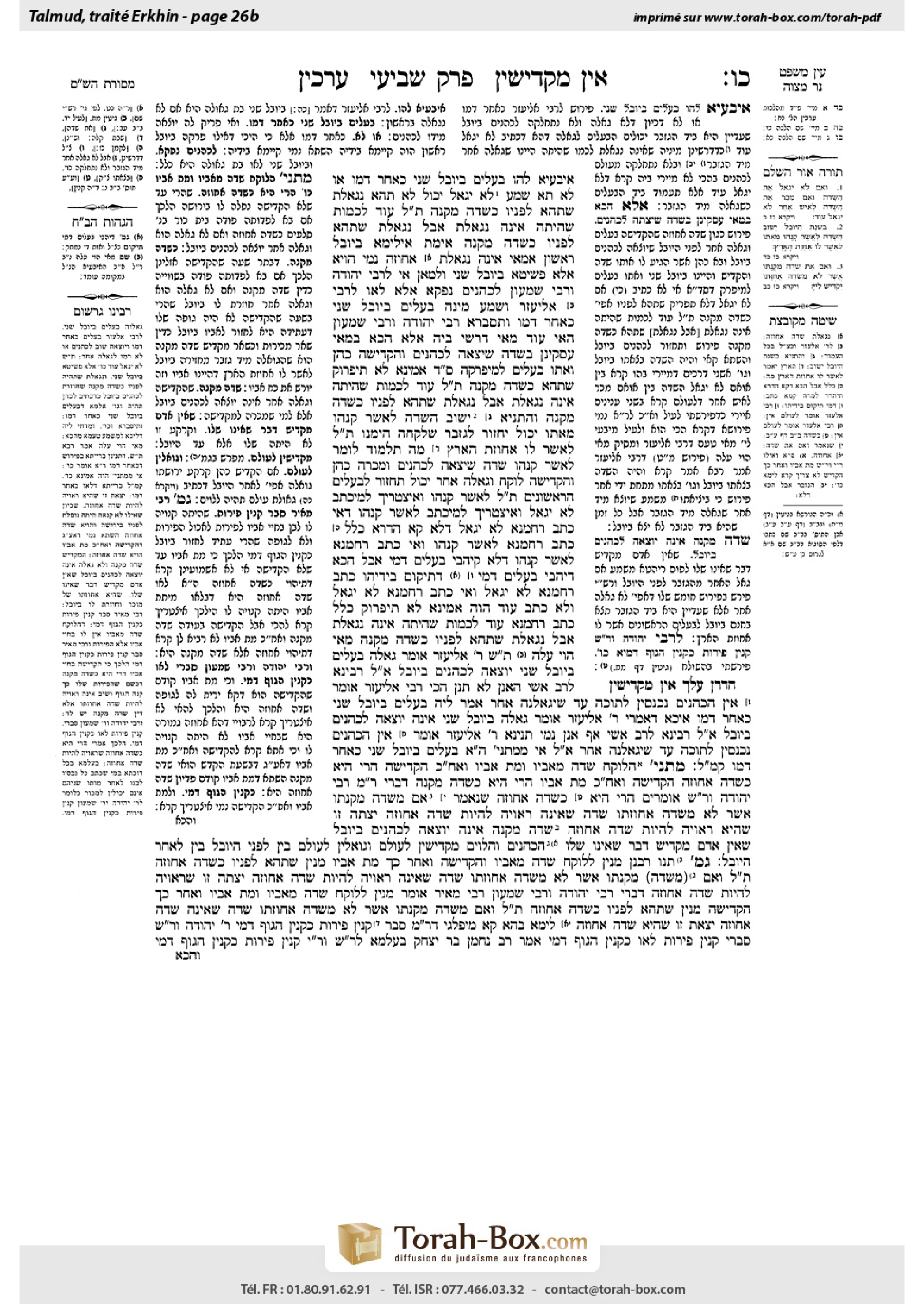
Scan : Torah-Box. Daf Study est un projet indépendant, sans affiliation ni approbation de Torah-Box ou de Sefaria.