Arakhin 5a en français · ערכין ה׳ א
Traduction française du daf 5a du traité Arakhin, avec le texte araméen, l’anglais de Sefaria et le scan de la page, pour étudier le Daf Yomi.
Ouvrir dans le lecteur interactifLire le daf du jour
Traduction française de Arakhin 5a
Les traductions françaises de Daf Study sont générées par IA à partir de l’édition anglaise de Sefaria. Elles peuvent contenir des erreurs : vérifie toujours un passage avec le texte source.
La patte de cet animal est un holocauste ; on aurait pu penser que l’animal entier serait un holocauste. C’est pourquoi le verset dit : « Et si c’est un animal parmi ceux qu’on apporte en offrande au Seigneur, tout ce qu’on en donne au Seigneur sera sacré » (Lévitique 27,9). Le verset indique que la partie qu’on en donne sera sacrée, mais pas l’animal entier.
Un animal profane auquel un membre consacré appartient ne peut pas être sacrifié. On aurait donc pu penser que le membre consacré peut être racheté et ainsi devenir profane. C’est pourquoi le verset dit : « sera », c’est-à-dire qu’il restera tel quel : le membre demeure consacré. Comment cela est-il possible, autrement dit, que faut-il faire dans ce cas ? L’animal doit être vendu pour les besoins des holocaustes, c’est-à-dire à quelqu’un qui sacrifiera l’animal entier comme holocauste ; le paiement reçu pour l’animal sera profane, à l’exception de la somme reçue en échange du membre qui avait été consacré. Telle est l’opinion de Rabbi Meïr.
Rabbi Yehouda, Rabbi Yossi et Rabbi Shimon disent : D’où déduit-on que, si quelqu’un dit : « La patte de cet animal est un holocauste », l’animal entier devient un holocauste ? Le verset dit : « Tout ce qu’un homme donnera ainsi au Seigneur sera sacré » (Lévitique 27,9). Le terme « sera » sert à inclure l’animal entier, indiquant qu’il devient tout entier sacré.
Et même selon Rabbi Meïr, qui dit que si quelqu’un déclare : « La patte de cet animal est un holocauste », l’animal entier n’est pas un holocauste, cela ne s’applique que s’il a consacré une partie dont la vie de l’animal ne dépend pas, par exemple sa patte. Mais s’il a consacré une partie dont sa vie dépend, comme sa tête, l’animal entier est consacré. Cela pose une difficulté à Rava, qui soutient que la baraïta traitant de la consécration de la tête parle de biens consacrés afin d’acheter des offrandes pour l’autel. Pourquoi, alors, l’animal entier n’est-il pas consacré ?
Rava répond : Au contraire, les deux baraïtot parlent de biens consacrés pour l’autel, et pourtant il n’y a pas de difficulté. Cette baraïta, qui indique que si l’on a consacré la tête, l’animal entier est consacré, parle de sainteté intrinsèque, c’est-à-dire du cas où il a consacré la tête pour la sacrifier sur l’autel. L’autre baraïta, qui enseigne que s’il a consacré la tête, seule celle-ci est consacrée, parle d’une sainteté inhérente à sa valeur, autrement dit du cas où il a consacré la tête afin d’acheter des offrandes.
Abayé répond : Mais n’est-ce pas toi, Maître, qui as dit que si quelqu’un consacre un animal mâle en vue de sa valeur, celui-ci acquiert une sainteté intrinsèque et est lui-même sacrifié ? Cela remet en cause la distinction que Rava tente d’établir entre la sainteté intrinsèque et la sainteté inhérente à la valeur.
Rava répond : Il n’y a pas de difficulté. Cette déclaration, selon laquelle un animal consacré en vue de sa valeur acquiert une sainteté intrinsèque, ne s’applique que dans le cas où il a consacré l’animal entier. Dans la baraïta qui traite de la consécration de la tête, il s’agit d’un cas où il n’a consacré qu’un seul membre. Dans ce cas, l’animal n’acquiert pas de sainteté intrinsèque.
Abayé répondit : En réalité, nous avons également soulevé une question au sujet d’un cas où l’on n’a consacré qu’un seul membre. Rabba a en effet soulevé la question suivante : si quelqu’un consacre un membre en vue de sa valeur afin d’apporter une offrande avec le produit de sa vente, quelle est la halakha : l’animal entier est-il consacré ou non ? Si ton interprétation de la baraïta est exacte, Rabba peut résoudre sa question en s’appuyant sur la baraïta et conclure de manière certaine que l’animal entier n’est pas consacré pour l’autel.
Rava répondit : Nous avons soulevé cette question et envisagé la possibilité que l’animal entier soit consacré pour l’autel uniquement dans le cas d’un animal sans défaut, qui peut donc servir d’offrande. Mais ici, la baraïta parle d’un animal atteint d’un défaut, comme dans le cas parallèle de l’âne, qui ne peut pas être sacrifié. Puisque l’animal en question ne peut servir pour l’autel, il est clair que l’animal entier n’est pas consacré.
Abayé répondit : En réalité, nous avons également soulevé une question au sujet d’un cas où l’animal est atteint d’un défaut et ne peut pas être sacrifié. Rabba a en effet soulevé la question suivante : si quelqu’un dit : « Il m’incombe de donner la valeur de ma tête pour acheter des offrandes à sacrifier sur l’autel », quelle est la halakha ? Est-il redevable de sa valeur entière ou non ? Une personne ne peut certainement pas servir d’offrande, et pourtant Rabba ne résout pas sa question en s’appuyant sur la baraïta. Rava répondit : Nous avons soulevé cette question avant d’entendre cette baraïta. Maintenant que nous l’avons entendue, nous ne soulevons plus cette question, car nous avons conclu d’après la baraïta que l’animal entier n’est pas consacré.
§ La Guemara revient sur la question elle-même. Rabba a soulevé cette question : si quelqu’un dit : « Il m’incombe de donner la valeur de ma tête pour acheter des offrandes à sacrifier sur l’autel », quelle est la halakha ? L’évaluation dépend-elle de l’importance de la partie du corps en question, de sorte que, puisqu’il a consacré un organe vital, il est redevable de sa valeur entière ? Ou bien ne dépend-elle pas de l’importance de la partie du corps en question, et seule la tête est-elle consacrée ?
La Guemara explique la question de fond : on peut soutenir que nous n’avons pas trouvé de cas où une évaluation ne dépend pas de l’importance de la partie du corps désignée. Par conséquent, si quelqu’un s’est engagé à donner la valeur d’un organe vital, il devrait devoir payer la valeur entière de la personne. Ou peut-être ne devrait-il être redevable que de la valeur de la tête, car nous n’avons pas trouvé de cas d’un animal sacrifié sur l’autel dont l’évaluation dépend de l’importance de la partie du corps concernée, c’est-à-dire de cas où, si l’on consacre la valeur d’un organe vital, l’animal entier est consacré. La Guemara conclut : la question reste en suspens [teiku], sans réponse.
Rava a soulevé une autre question : si quelqu’un dit : « Il m’incombe de donner ma valeur d’évaluation pour l’autel », plutôt que pour l’entretien du Temple, comme c’est habituellement le cas, quelle est la halakha ? Ce cas est-il déterminé selon ses moyens s’il est pauvre, comme les évaluations ordinaires ? Ou bien n’est-il pas déterminé selon ses moyens, et doit-il donner la valeur d’évaluation entière même s’il est pauvre ?
La Guemara explique les deux aspects de la question : on peut soutenir que nous n’avons pas trouvé de cas d’évaluation qui ne soit pas déterminé selon les moyens de la personne. Le principe de l’évaluation selon les moyens devrait donc s’appliquer même lorsque quelqu’un fait un vœu dans le but de faire sacrifier des offrandes sur l’autel. Ou peut-être ce cas ne doit-il pas être déterminé selon ses moyens, car nous n’avons pas trouvé de bien consacré dans le but de faire sacrifier des offrandes sur l’autel qui soit racheté autrement qu’à sa valeur. La Guemara conclut de nouveau : la question reste sans réponse.
Rav Achi a soulevé une question similaire : si quelqu’un consacre un champ ancestral dans le but de faire sacrifier des offrandes sur l’autel, plutôt que pour l’entretien du Temple, comme c’est habituellement le cas, quelle est la halakha ? Faut-il dire que nous n’avons pas trouvé de cas de champ ancestral racheté autrement qu’au tarif standard établi par la Torah, à savoir qu’une superficie permettant d’ensemencer un ḥomer, soit un kor, d’orge est rachetée pour cinquante sicles d’argent ? Ou bien doit-il être racheté à sa valeur marchande, car nous n’avons pas trouvé de bien consacré dans le but de faire sacrifier des offrandes sur l’autel qui soit racheté autrement qu’à sa valeur ? Une fois encore, la Guemara déclare : la question reste sans réponse.
MICHNA : Un enfant âgé de moins d’un mois fait l’objet d’un vœu d’évaluation si quelqu’un s’engage à donner son évaluation, mais sa valeur fixe ne peut pas être évaluée par vœu, car la Torah n’a établi de valeur pour personne âgé de moins d’un mois.
GUEMARA : Les Sages ont enseigné dans une baraïta : dans le cas de quelqu’un qui fait un vœu d’évaluation concernant un enfant âgé de moins d’un mois, Rabbi Meïr dit : celui qui a fait le vœu est tenu de donner l’évaluation de l’enfant. Les Sages disent : il n’a rien dit, c’est-à-dire qu’il n’est tenu de rien donner.
La Guemara demande : Sur quel principe porte leur désaccord ? Rabbi Meïr estime qu’une personne ne prononce pas une déclaration de consécration en vain. On suppose qu’elle sait qu’il n’existe pas d’évaluation pour un enfant de moins d’un mois ; elle a donc voulu, en prononçant sa déclaration, faire une évaluation, c’est-à-dire qu’elle voulait faire vœu de donner la valeur marchande de l’enfant. Les Sages, eux, estiment qu’une personne peut prononcer une déclaration de consécration en vain. Par conséquent, sa déclaration est prise au pied de la lettre et elle n’est tenue de rien donner.
La Guemara demande : De l’avis de qui est la déclaration de Rav Giddel au nom de Rav, selon laquelle celui qui dit : « Il m’incombe de donner l’évaluation de cet ustensile » est tenu d’en donner la valeur estimée ? Elle est conforme à l’opinion de Rabbi Meïr, qui estime qu’une personne ne prononce pas une déclaration de consécration en vain. Puisque les ustensiles ne font pas l’objet d’une évaluation, il avait vraisemblablement l’intention de s’engager à donner la valeur estimée de l’ustensile. La Guemara demande : N’est-il pas évident que la déclaration de Rav est conforme à l’opinion de Rabbi Meïr ? Pourquoi était-il nécessaire de le préciser ?
La Guemara explique qu’il fallait préciser que la déclaration de Rav est conforme à l’opinion de Rabbi Meïr, de peur qu’on ne dise qu’elle est également conforme à l’opinion des Sages, qui dispensent celui qui fait un vœu d’évaluation concernant un enfant de moins d’un mois. La Guemara développe : on pourrait dire que c’est seulement dans le cas de l’enfant que la personne se trompe et pense que, tout comme il existe une évaluation pour un enfant âgé d’un mois, il en existe aussi une pour un enfant de moins d’un mois. Puisque son vœu reposait sur une erreur, elle n’est tenue de rien payer.
Mais ici, dans le cas de quelqu’un qui fait un vœu d’évaluation concernant un ustensile, où il n’est pas possible de se tromper, on peut soutenir qu’une personne sait certainement qu’un ustensile ne fait pas l’objet d’une évaluation et qu’elle avait donc l’intention, en prononçant sa déclaration, de faire une évaluation, c’est-à-dire qu’elle voulait faire vœu de donner la valeur de l’ustensile. La Guemara nous enseigne donc que la déclaration de Rav est conforme uniquement à l’opinion de Rabbi Meïr, et non à celle des Sages. Selon les Sages, une personne peut prononcer une déclaration de consécration en vain même dans un tel cas ; sa déclaration est donc prise au pied de la lettre.
Texte source et traduction anglaise
ערכין ה׳ א · texte araméen et hébreu
״רַגְלָהּ שֶׁל זוֹ עוֹלָה״ — יָכוֹל תְּהֵא כּוּלָּהּ עוֹלָה? תַּלְמוּד לוֹמַר ״כֹּל אֲשֶׁר יִתֵּן מִמֶּנּוּ לַה׳ יִהְיֶה קֹּדֶשׁ״ — מִמֶּנּוּ קוֹדֶשׁ וְלֹא כּוּלָּהּ קוֹדֶשׁ.
יָכוֹל תֵּצֵא לְחוּלִּין? תַּלְמוּד לוֹמַר: ״יִהְיֶה״ — בַּהֲוָיָיתָהּ תְּהֵא. הָא כֵּיצַד? תִּמָּכֵר לְצוֹרְכֵי עוֹלוֹת, וְדָמֶיהָ חוּלִּין, חוּץ מִדְּמֵי אוֹתוֹ אֵבֶר שֶׁבָּהּ, דִּבְרֵי רַבִּי מֵאִיר.
רַבִּי יְהוּדָה וְרַבִּי יוֹסֵי וְרַבִּי שִׁמְעוֹן אוֹמְרִים: מִנַּיִן לָאוֹמֵר ״רַגְלָהּ שֶׁל זוֹ עוֹלָה״, שֶׁכּוּלָּהּ עוֹלָה? תַּלְמוּד לוֹמַר: ״כֹּל אֲשֶׁר יִתֵּן מִמֶּנּוּ לַה׳ יִהְיֶה קֹּדֶשׁ״, לְרַבּוֹת אֶת כּוּלָּהּ.
וַאֲפִילּוּ לְמַאן דְּאָמַר אֵין כּוּלָּהּ עוֹלָה, הָנֵי מִילֵּי דְּאַקְדֵּישׁ דָּבָר שֶׁאֵין הַנְּשָׁמָה תְּלוּיָה בּוֹ, אֲבָל דָּבָר שֶׁהַנְּשָׁמָה תְּלוּיָה בּוֹ — קָדְשָׁה כּוּלָּהּ.
אֶלָּא, לָא קַשְׁיָא: הָא בִּקְדוּשַּׁת הַגּוּף, הָא בִּקְדוּשַּׁת דָּמִים.
וְהָא מָר הוּא דְּאָמַר: מַקְדִּישׁ זָכָר לְדָמָיו — קָדוֹשׁ קְדוּשַּׁת הַגּוּף!
לָא קַשְׁיָא: הָא דְּאַקְדֵּישׁ כּוּלָּהּ, הָא דְּאַקְדֵּישׁ חַד אֵבֶר.
חַד אֵבֶר נָמֵי אִיבְּעוֹיֵי אִיבַּעְיָא לַן, דְּבָעֵי רַבָּה: הִקְדִּישׁ אֵבֶר לְדָמָיו, מַהוּ?
כִּי אִיבְּעִי לַן בְּתָם, הָכָא בְּבַעַל מוּם, דּוּמְיָא דַּחֲמוֹר.
בַּעַל מוּם נָמֵי אִיבְּעוֹיֵי אִיבַּעְיָא לַן, דְּבָעֵי רַבָּה: ״דְּמֵי רֹאשִׁי לְגַבֵּי מִזְבֵּחַ״ מַהוּ? כִּי אִבַּעְיָא לָן מִקַּמֵּי דְּאֶשְׁמְעַהּ לְהָא מַתְנִיתָא, הַשְׁתָּא דְּשַׁמְעַהּ הָא מַתְנִיתָא — לָא מִיבַּעְיָא לַן.
גּוּפָא, בָּעֵי רַבָּה: ״דְּמֵי רֹאשִׁי לְגַבֵּי מִזְבֵּחַ״ מַהוּ? נִידּוֹן בִּכְבוֹדוֹ, אוֹ אֵינוֹ נִידּוֹן בִּכְבוֹדוֹ?
לָא אַשְׁכְּחַן בְּדָמִים דְּאֵינוֹ נִידּוֹן בִּכְבוֹדוֹ, אוֹ דִלְמָא לָא אַשְׁכְּחַן לְגַבֵּי מִזְבֵּחַ דְּנִידּוֹן בִּכְבוֹדוֹ? תֵּיקוּ.
בָּעֵי רָבָא: ״עֶרְכִּי עָלַי לְגַבֵּי מִזְבֵּחַ״ מַהוּ? נִידּוֹן בְּהֶשֵּׂג יָד, אוֹ אֵין נִידּוֹן בְּהֶשֵּׂג יָד?
לָא אַשְׁכְּחַן בַּעֲרָכִין דְּאֵין נִידּוֹן בְּהֶשֵּׂג יָד, אוֹ דִלְמָא לָא אַשְׁכְּחַן לְגַבֵּי מִזְבֵּחַ דְּמִיפְּרִיק אֶלָּא בְּשׇׁוְיוֹ? תֵּיקוּ.
בָּעֵי רַב אָשֵׁי: הִקְדִּישׁ שְׂדֵה אֲחוּזָּה לְגַבֵּי מִזְבֵּחַ, מַהוּ? מִי אָמְרִינַן: לָא אַשְׁכְּחַן שְׂדֵה אֲחוּזָּה דְּמִיפָּרְקָא אֶלָּא ״בֵּית זֶרַע חוֹמֶר שְׂעוֹרִים בַּחֲמִשִּׁים שֶׁקֶל כָּסֶף״, אוֹ דִלְמָא לָא אַשְׁכְּחַן לְגַבֵּי מִזְבֵּחַ דְּמִיפְּרִיק אֶלָּא בְּשׇׁוְיוֹ? תֵּיקוּ.
מַתְנִי׳ פָּחוֹת מִבֶּן חֹדֶשׁ נִידָּר, אֲבָל לֹא נֶעֱרָךְ.
גְּמָ׳ תָּנוּ רַבָּנַן: הַמַּעֲרִיךְ פָּחוֹת מִבֶּן חֹדֶשׁ, רַבִּי מֵאִיר אוֹמֵר: נוֹתֵן דָּמָיו, וַחֲכָמִים אוֹמְרִים: לֹא אָמַר כְּלוּם.
בְּמַאי קָמִיפַּלְגִי? רַבִּי מֵאִיר סָבַר: אֵין אָדָם מוֹצִיא דְּבָרָיו לְבַטָּלָה, יוֹדֵעַ שֶׁאֵין עֲרָכִין לְפָחוֹת מִבֶּן חֹדֶשׁ, וְגָמַר וְאָמַר לְשֵׁם דָּמִים; וְרַבָּנַן סָבְרִי: אָדָם מוֹצִיא דְּבָרָיו לְבַטָּלָה.
כְּמַאן אָזְלָא הָא דְּאָמַר רַב גִּידֵּל אָמַר רַב: הָאוֹמֵר ״עֵרֶךְ כְּלִי עָלַי״ נוֹתֵן דָּמִים — כְּרַבִּי מֵאִיר. פְּשִׁיטָא דִּכְרַבִּי מֵאִיר אַתְיָא!
מַהוּ דְּתֵימָא, אֲפִילּוּ כְּרַבָּנַן, הָתָם הוּא דְּטָעֵי, סָבַר: כִּי הֵיכִי דְּאִיכָּא עֲרָכִין לְבֶן חוֹדֶשׁ, אִיכָּא נָמֵי לְפָחוֹת מִבֶּן חוֹדֶשׁ.
אֲבָל הָכָא דְּלֵיכָּא לְמִיטְעֵי, וַדַּאי אָדָם יוֹדֵעַ שֶׁאֵין עֵרֶךְ לִכְלִי, וְגָמַר וְאָמַר לְשֵׁם דָּמִים, קָמַשְׁמַע לַן.
Arakhin 5a · traduction anglaise de Sefaria
The leg of this animal is a burnt offering, one might have thought that all of the animal will be a burnt offering. Therefore, the verse states: “And if it is an animal of those that they bring as an offering to the Lord, anything of it that one gives to the Lord, it shall be sacred” (Leviticus 27:9). The verse indicates that the part of it that one gives will be sacred, but not all of the animal will be sacred.
A non-sacred animal with a consecrated limb may not be sacrificed. Accordingly, one might have thought that the consecrated limb may be redeemed and thereby transferred to non-sacred status. Therefore the verse states: “Shall be,” meaning: It shall be as it is, i.e., the limb remains consecrated. How is this possible, i.e., what should one do in this case? The animal should be sold for the needs of burnt offerings, i.e., to an individual who will sacrifice the entire animal as a burnt offering, and the payment received for the animal will be non-sacred, except for the payment received in exchange for that limb of it that was consecrated. This is the statement of Rabbi Meir.
Rabbi Yehuda and Rabbi Yosei and Rabbi Shimon say: From where is it derived that in the case of one who says: The leg of this animal is a burnt offering, all of the animal becomes a burnt offering? The verse states: “All that any man give of such to the Lord shall be holy” (Leviticus 27:9). The term “shall be” serves to include all of the animal, indicating that it all becomes sacred.
And even according to the one, Rabbi Meir, who says that if one states: The leg of this animal is a burnt offering, not all of the animal is a burnt offering, that statement applies only if one consecrated an item that its life does not depend on, e.g., its leg. But if he consecrated an item that its life depends on, such as its head, the entire animal is consecrated. This presents a difficulty for Rava, who holds that the baraita that discusses consecration of the head is referring to items consecrated in order to purchase offerings for the altar. Why, then, isn’t the entire animal consecrated?
Rava responds: Rather, both baraitot are referring to items consecrated for the altar, and even so it is not difficult. This baraita, which indicates that if one consecrated the head the entire animal is consecrated, is referring to inherent sanctity, i.e., where he consecrated the head for the purpose of sacrificing it on the altar. That baraita, which teaches that if he consecrated the head it alone is consecrated, is referring to sanctity that inheres in its value, that is, where he consecrated the head for the sake of purchasing offerings.
Abaye responded: But wasn’t it you, Master, who said that if one consecrated a male animal for its value, it is sanctified with inherent sanctity and it is itself sacrificed? This undermines the distinction that Rava is attempting to draw between inherent sanctity and sanctity that inheres in value.
Rava responds: It is not difficult. This statement, that an animal that was consecrated for its value attains inherent sanctity, applies only in a case where he consecrated the entire animal. There, in the baraita discussing the consecration of the head, it is referring to a situation where he consecrated only one limb. In such a case, the animal does not attain inherent sanctity.
Abaye replied: Actually, we also raised a dilemma with regard to a case where one consecrated only one limb. As Rabba raised a dilemma: If one consecrated a limb for its value in order to bring an offering with the proceeds, what is the halakha as to whether or not the entire animal is consecrated? If your interpretation of the baraita is correct, Rabba can resolve his question based on the baraita and conclude definitively that the entire animal is not sanctified for the altar.
Rava responded: We raised this dilemma and entertained the possibility that the entire animal might be sanctified to the altar only in a case where the animal is unblemished, and is therefore fit to be used as an offering. But here, the baraita is referring to a blemished animal, similar to the parallel case of the donkey, which is unfit to be sacrificed. Since the animal in question is unfit for the altar, it is clear that the entire animal is not sanctified.
Abaye responded: In fact, we also raised a dilemma with regard to a case where the animal is blemished and unfit to be sacrificed. As Rabba raised a dilemma: If one said: It is incumbent upon me to donate the value of my head to purchase offerings to be sacrificed on the altar, what is the halakha? Is he obligated in his entire value or not? A person is certainly not fit to be an offering, and yet Rabba does not resolve his question based on the baraita. Rava answered: We only raised this dilemma before hearing this baraita. Now that we have heard this baraita, we no longer raise this dilemma, as we concluded from the baraita that the entirety of the animal is not consecrated.
§ The Gemara returns to the aforementioned matter itself. Rabba raised a dilemma: If one said: It is incumbent upon me to donate the value of my head to purchase offerings to be sacrificed on the altar, what is the halakha? Is it assessed by the significance of the body part in question, and since he consecrated a vital organ he is obligated in his entire value? Or perhaps it is not assessed by the significance of the body part in question, and only the head is consecrated.
The Gemara explains the underlying issue: It can be argued that we have not found a case of assessments that is not assessed by the significance of the body part that was specified. Therefore, if one obligated himself in the value of a vital organ he should have to pay the entity’s entire value. Or perhaps he should be obligated only in the value of the head, as we have not found a case of an animal that is sacrificed on the altar that is assessed by the significance of the body part in question, i.e., that if one consecrates the value of one vital organ the entire animal is consecrated. The Gemara concludes: The dilemma shall stand [teiku] unresolved.
Rava raised a further dilemma: If one said: It is incumbent upon me to donate my valuation for the altar, rather than for Temple maintenance, as is usually the case, what is the halakha? Is this case determined based on affordability if he is poor, like regular valuations? Or perhaps it is not determined based on affordability, and he is obligated in the full valuation even if he is poor.
The Gemara explains the sides of the dilemma: One can argue that we have not found a case of valuations that is not determined based on affordability. Therefore, the principle of affordability should apply even when one vows for the purpose of sacrificing offerings on the altar. Or perhaps this case should not be determined based on affordability, as we have not found an item that is consecrated for the purpose of sacrificing offerings on the altar that is redeemed in a manner other than according to its value. The Gemara again concludes: The dilemma shall stand unresolved.
Rav Ashi raised a similar dilemma: If a person consecrated an ancestral field for the purpose of sacrificing offerings on the altar, rather than for Temple maintenance, as is usually the case, what is the halakha? Do we say that we have not found a case of an ancestral field that is redeemed other than by the standard rate established by the Torah, which is that an area fit for the sowing of a ḥomer, a kor, of barley seed is redeemed for fifty silver shekels? Or perhaps it should be redeemed according to its market value, as we have not found a case of an item that is consecrated for the purpose of sacrificing offerings on the altar that is redeemed in a manner other than according to its value. Once again, the Gemara states: The dilemma shall stand unresolved.
MISHNA: A child less than one month old is the object of a vow if others vowed to donate his assessment, but is not valuated if one vowed to donate his fixed value, as the Torah did not establish a value for anyone less than a month old.
GEMARA: The Sages taught in a baraita: With regard to a case of one who takes a vow of valuation concerning a child less than one month old, Rabbi Meir says: The person who valuated is obligated to give the child’s assessment. The Rabbis say: He has said nothing, i.e., he is not obligated to give anything.
The Gemara asks: With regard to what principle do they disagree? Rabbi Meir holds: A person does not issue his statement of consecration for naught. The assumption is that a person knows that there are no valuations for a child less than one month old, and therefore he intended and said his statement for the sake of assessments, i.e., he meant to vow to give the child’s market value. And the Rabbis hold that a person does make his statement of consecration for naught. Therefore, his statement is taken at face value, and he is not obligated to give anything.
The Gemara asks: In accordance with whose opinion is that which Rav Giddel says that Rav says: One who says: It is incumbent upon me to donate the valuation of this utensil, is obligated to give its assessment? It is in accordance with the opinion of Rabbi Meir, who holds that a person does not issue a statement of consecration for naught. Since utensils are not subject to valuation, he presumably intended to obligate himself in its assessment. The Gemara asks: Isn’t it obvious that Rav’s statement is in accordance with the opinion of Rabbi Meir? Why was it necessary for the Gemara to state this?
The Gemara explains that it was necessary to state that Rav’s statement is in accordance with the opinion of Rabbi Meir, lest you say that it is even in accordance with the opinion of the Rabbis, who exempt one who valuates a child under a month old. The Gemara elaborates: One could say that it is only there, in the case of the child, that one errs and thinks that just as there are valuations for a child who is one month old, there are also valuations for a child less than one month old. Since his vow was based on an error, he is not obligated to pay anything.
But here, in the case of one who valuates a utensil, where there is no possibility of erring, it can be argued that a person certainly knows that there is no valuation for a utensil, and he therefore intended and said his statement for the sake of assessments, i.e., he meant to vow to donate the utensil’s value. Therefore, the Gemara teaches us that Rav’s statement is in accordance with the opinion of Rabbi Meir only, and not with that of the Rabbis. The Rabbis hold that a person does issue a statement of consecration for naught even in such a case, and therefore his declaration is taken at face value.
Texte de Sefaria : William Davidson Edition - Vocalized Aramaic (CC BY NC) ; William Davidson Edition - English (CC BY NC).
Scan de Arakhin 5a
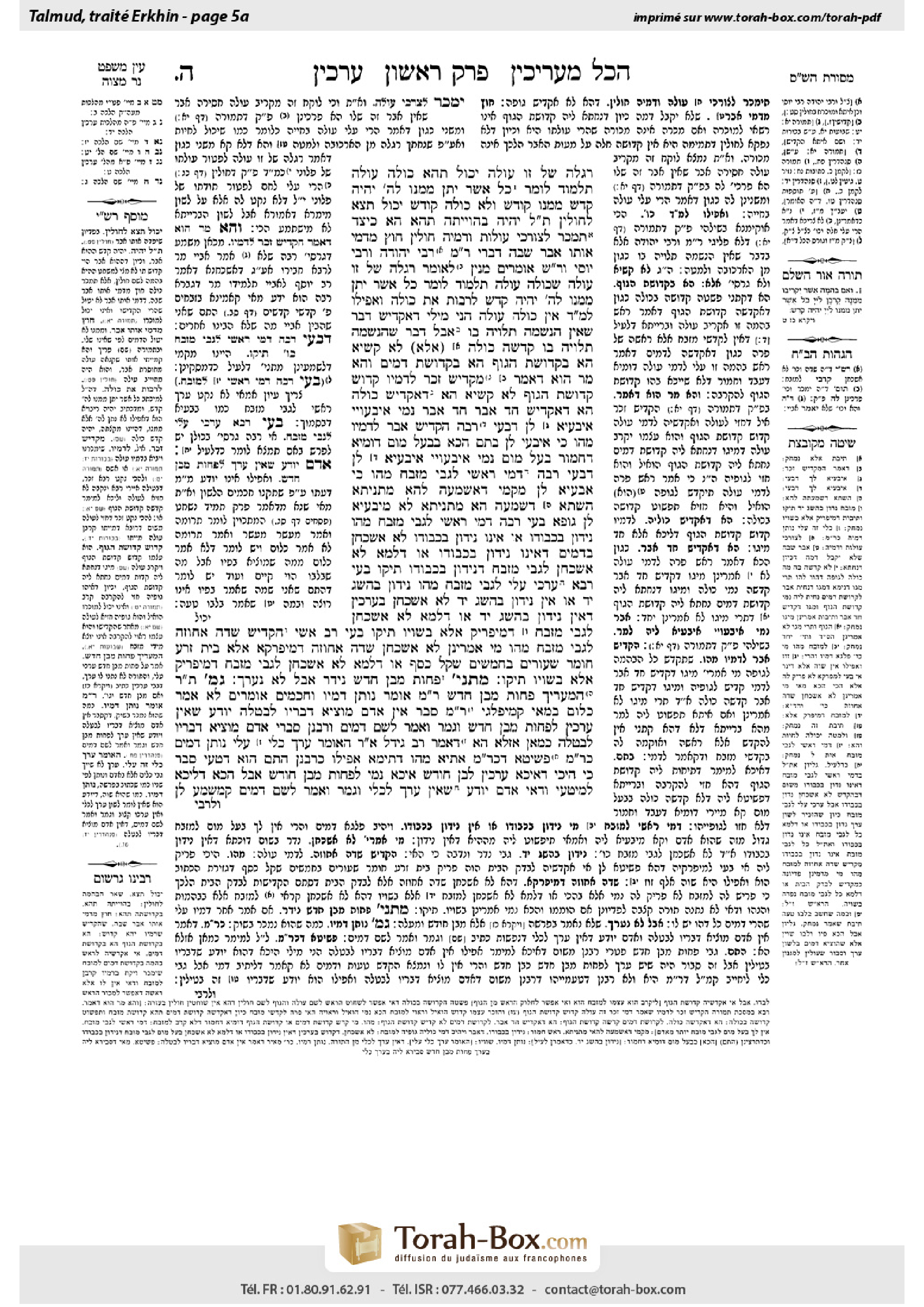
Scan : Torah-Box. Daf Study est un projet indépendant, sans affiliation ni approbation de Torah-Box ou de Sefaria.