Avoda Zara 67a en français · עבודה זרה ס״ז א
Traduction française du daf 67a du traité Avoda Zara (Avodah Zarah 67a en anglais), avec le texte araméen, l’anglais de Sefaria et le scan de la page, pour étudier le Daf Yomi.
Ouvrir dans le lecteur interactifLire le daf du jour
Traduction française de Avoda Zara 67a
Les traductions françaises de Daf Study sont générées par IA à partir de l’édition anglaise de Sefaria. Elles peuvent contenir des erreurs : vérifie toujours un passage avec le texte source.
Tout le monde s’accorde à dire que c’est interdit, puisque le pain a certainement absorbé l’odeur du vin. De plus, dans le cas d’un pain froid et d’un tonneau bouché, tout le monde s’accorde à dire que c’est permis. Le désaccord porte uniquement sur le cas d’un pain chaud et d’un tonneau bouché, ou sur celui d’un pain froid et d’un tonneau ouvert. Or mon cas, celui de la bonde, est lui aussi comparable à celui d’un pain chaud et d’un tonneau ouvert, où tout le monde s’accorde à dire que le pain est interdit.
§ Il est enseigné dans la Michna : Tel est le principe : tout ce qui tire profit du goût communiqué par un élément interdit, c’est-à-dire lorsque cet élément interdit lui confère un goût favorable, est interdit ; et tout ce qui ne tire pas profit du goût communiqué par un élément interdit est permis. C’est le cas, par exemple, du vinaigre interdit tombé sur des fèves fendues, car le goût que le vinaigre leur communique n’améliore pas celui des fèves. Rav Yehouda dit au nom de Chmouel : Telle est la halakha.
Et Rav Yehouda dit au nom de Chmouel : Les Sages n’ont enseigné cela que dans le cas où le vinaigre est tombé sur des fèves fendues chaudes, en détériorant leur goût. Mais si le vinaigre est tombé sur des fèves fendues froides, il en améliore le goût ; si on les a ensuite chauffées, le plat est comparable à un plat auquel un ingrédient ajouté a d’abord conféré un goût favorable, puis en a détérioré le goût, et il devient interdit, car le goût communiqué au départ était favorable.
De même, lorsque Ravin vint d’Eretz Israël en Babylonie, il rapporta que Rabba bar bar Ḥana dit au nom de Rabbi Yoḥanan : Les Sages n’ont enseigné cela que dans le cas où le vinaigre est tombé sur des fèves fendues chaudes. Mais si le vinaigre est tombé sur des fèves fendues froides et qu’on a ensuite chauffé le mélange, le plat est comparable à un plat auquel un ingrédient ajouté a d’abord conféré un goût favorable, puis en a détérioré le goût, et il devient interdit. De même, lorsque Rav Dimi arriva, il rapporta également cette règle au nom de Rabbi Yoḥanan et ajouta : À Tsippori, on préparait ce plat de fèves fendues au vinaigre les veilles de Chabbat, et on l’appelait « plat au cresson ».
§ Rech Lakich dit : Concernant le principe énoncé par les Sages selon lequel, si un aliment interdit communique à un aliment permis un goût qui détériore le mélange, celui-ci reste permis, le critère n’est pas qu’on puisse dire : « Ce plat manque de sel » ou « contient trop de sel », « manque d’épices » ou « contient trop d’épices », et que c’est pour cette raison que l’aliment interdit en a détérioré le goût. Il s’agit plutôt d’un plat auquel il ne manque rien, mais que l’on ne mangerait pas uniquement à cause de cette substance interdite qui y est tombée.
Et certains rapportent que Rech Lakich donne une interprétation indulgente de ce principe : concernant ce que les Sages ont dit — si un aliment interdit communique à un aliment permis un goût qui détériore le mélange, celui-ci reste permis —, on ne déclare pas l’aliment interdit au motif que son goût n’a pas réellement été détérioré par la substance interdite, parce que le plat manque de sel ou contient trop de sel, manque d’épices ou contient trop d’épices, et que c’est pour cette raison que la substance interdite en a détérioré le goût. Au contraire, puisque, dans tous les cas, la substance interdite en a maintenant détérioré le goût, le mélange est permis.
§ En outre, au sujet d’un aliment interdit mélangé à un aliment permis, Rabbi Abbahou dit au nom de Rabbi Yoḥanan : Dans tous les cas où le goût et la substance de l’aliment interdit sont perceptibles dans le mélange, celui-ci est interdit et celui qui le consomme reçoit la flagellation. La tradition fixe la mesure applicable à un tel cas : celui qui mange, dans le mélange, un volume d’olive de l’élément interdit en un temps égal à celui nécessaire pour manger un demi-pain est passible de flagellation pour avoir consommé l’aliment interdit.
Texte source et traduction anglaise
עבודה זרה ס״ז א · texte araméen et hébreu
דִּבְרֵי הַכֹּל אֲסוּרָה, בְּפַת צוֹנֶנֶת וְחָבִית מְגוּפָה — דִּבְרֵי הַכֹּל מוּתֶּרֶת. לֹא נֶחְלְקוּ אֶלָּא בְּפַת חַמָּה וְחָבִית מְגוּפָה, בְּפַת צוֹנֶנֶת וְחָבִית פְּתוּחָה. וְהָא דִּידִי נָמֵי כְּפַת חַמָּה וְחָבִית פְּתוּחָה דָּמֵי.
זֶה הַכְּלָל, כֹּל שֶׁבַּהֲנָאָתוֹ בְּנוֹתֵן טַעַם כּוּ׳. אָמַר רַב יְהוּדָה אָמַר שְׁמוּאֵל: הָכִי הִלְכְתָא.
וְאָמַר רַב יְהוּדָה אָמַר שְׁמוּאֵל: לֹא שָׁנוּ אֶלָּא שֶׁנָּפַל לְתוֹךְ גְּרִיסִין רוֹתְחִין, אֲבָל נָפַל לְתוֹךְ גְּרִיסִין צוֹנְנִין וְהִרְתִּיחָן, נַעֲשָׂה כְּמִי שֶׁהִשְׁבִּיחַ וּלְבַסּוֹף פָּגַם, וְאָסוּר.
וְכֵן כִּי אֲתָא רָבִין אָמַר רַבָּה בַּר בַּר חָנָה אָמַר רַבִּי יוֹחָנָן: לֹא שָׁנוּ אֶלָּא שֶׁנָּפַל לְתוֹךְ גְּרִיסִין רוֹתְחִין, אֲבָל נָפַל לְתוֹךְ גְּרִיסִין צוֹנְנִין וְהִרְתִּיחָן, נַעֲשָׂה כְּמִי שֶׁהִשְׁבִּיחַ וּלְבַסּוֹף פָּגַם, וְאָסוּר. וְכֵן כִּי אֲתָא רַב דִּימִי כּוּ׳. וְכָךְ הָיוּ עוֹשִׂין בְּעַרְבֵי שַׁבָּתוֹת בְּצִיפּוֹרִי, וְקוֹרְאִין אוֹתָם שַׁחֲלַיִים.
אָמַר רֵישׁ לָקִישׁ: נוֹתֵן טַעַם לִפְגָם שֶׁאָמְרוּ, לֹא שֶׁיֹּאמְרוּ: קְדֵירָה זוֹ חֲסֵירָה מֶלַח, יְתֵירָה מֶלַח, חֲסֵירָה תַּבְלִין, יְתֵירָה תַּבְלִין, אֶלָּא כֹּל שֶׁאֵין חֲסֵירָה כְּלוּם, וְאֵינָהּ נֶאֱכֶלֶת מִפְּנֵי זֶה.
וְאִיכָּא דְּאָמְרִי, אָמַר רֵישׁ לָקִישׁ: נוֹתֵן טַעַם לִפְגָם שֶׁאָמְרוּ, אֵין אוֹמְרִין: קְדֵירָה זוֹ חֲסֵירָה מֶלַח, יְתֵירָה מֶלַח, חֲסֵירָה תַּבְלִין, יְתֵירָה תַּבְלִין, אֶלָּא הַשְׁתָּא מִיהָא הָא פָּגְמָה.
אָמַר רַבִּי אֲבָהוּ אָמַר רַבִּי יוֹחָנָן: כֹּל שֶׁטַּעְמוֹ וּמַמָּשׁוֹ אָסוּר, לוֹקִין עָלָיו, וְזֶהוּ כְּזַיִת בִּכְדֵי אֲכִילַת פְּרָס.
Avodah Zarah 67a · traduction anglaise de Sefaria
everyone agrees that it is forbidden, as the bread certainly absorbed of the smell of the wine? Furthermore, in the case of a cool loaf of bread and a stoppered barrel, everyone agrees that it is permitted. They disagree only with regard to the case of a hot loaf of bread and a stoppered barrel, or in the case of a cool loaf of bread and an open barrel. And this case of mine, i.e., the case of the bunghole, is also comparable to the case of a hot loaf of bread and an open barrel, in which everyone agrees that the bread is forbidden.
§ It is stated in the mishna: This is the principle: Anything that benefits from a forbidden item imparting flavor to it, i.e., the forbidden item contributes a positive taste to it, is forbidden, and anything that does not benefit from a forbidden item imparting flavor to it is permitted, e.g., forbidden vinegar that fell onto split beans, as the flavor imparted by the vinegar does not enhance the taste of the beans. Rav Yehuda says that Shmuel says: This is the halakha.
And Rav Yehuda says that Shmuel says: The Sages taught this only with regard to a case where the vinegar fell into hot split beans, imparting flavor to their detriment. But if the vinegar fell into cold split beans, the vinegar enhances the flavor, and if one subsequently heated them, it becomes like a dish that some added ingredient first enhanced its flavor and ultimately detracted from it, and it is rendered forbidden, as the initial flavor that was imparted was beneficial.
And similarly, when Ravin came from Eretz Yisrael to Babylonia he reported that Rabba bar bar Ḥana says that Rabbi Yoḥanan says: The Sages taught this only with regard to the case where the vinegar fell into hot split beans. But if the vinegar fell into cold split beans and one subsequently heated the mixture, it becomes like a dish that some added ingredient first enhanced its flavor and ultimately detracted from it, and it is rendered forbidden. And similarly, when Rav Dimi came, he also reported this in the name of Rabbi Yoḥanan and added: And they would prepare this dish of split beans and vinegar on the eves of Shabbat in Tzippori, and they would call it cress dish.
§ Reish Lakish says: With regard to the principle that the Sages said, that if a forbidden food imparts flavor to a permitted food to the detriment of the mixture it remains permitted, the criterion is not that people would say: This dish is lacking in salt or is overabundant in salt, is lacking in spices or is overabundant in spices, and that is why its flavor was detracted by the forbidden food. Rather, it is referring to any dish that is not lacking in anything, but will not be eaten only because of this forbidden substance that fell into it.
And there are those who say that Reish Lakish states a lenient interpretation of the principle: With regard to that which Sages said that if a forbidden food imparts flavor to a permitted food to the detriment of the mixture, it remains permitted, one does not say that a certain food is forbidden because its flavor was not actually detracted by the forbidden substance, as this dish is lacking in salt or is overabundant in salt, is lacking in spices or is overabundant in spices, and it is for that reason that the forbidden substance detracted from its flavor. Rather, since now, in any event, the forbidden substance detracted from its flavor, it is permitted.
§ Furthermore, with regard to a forbidden food that became mixed with a permitted food, Rabbi Abbahu says that Rabbi Yoḥanan says: In any case where the flavor and substance of the forbidden food are perceptible in the mixture, the mixture is forbidden, and one is flogged for consuming it. And it is a tradition that this is the measure for such a case: One who eats an olive-bulk of the forbidden element in the mixture in the time it takes to eat a half-loaf of bread is liable for eating the forbidden food.
Texte de Sefaria : William Davidson Edition - Vocalized Aramaic (CC BY NC) ; William Davidson Edition - English (CC BY NC).
Scan de Avoda Zara 67a
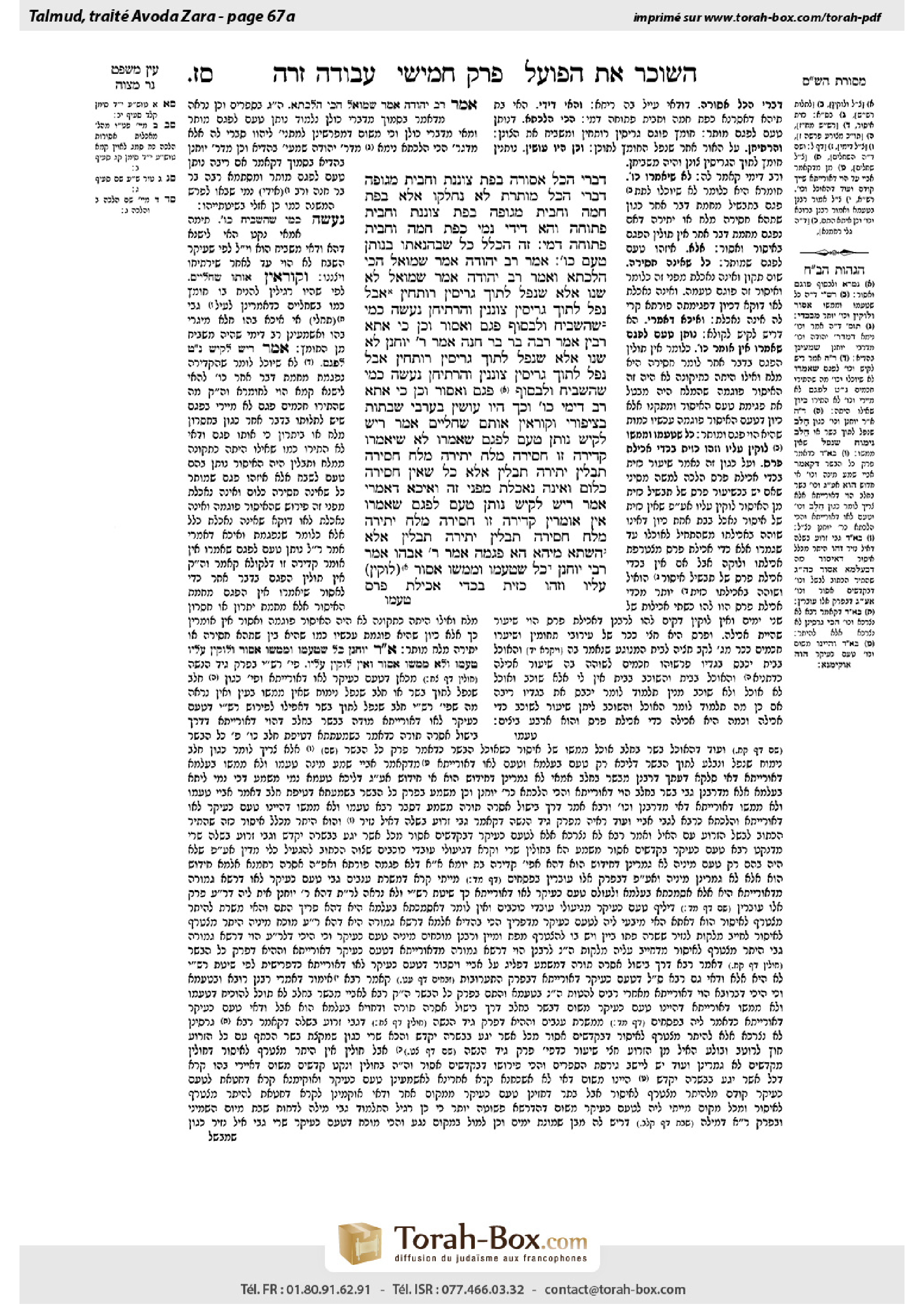
Scan : Torah-Box. Daf Study est un projet indépendant, sans affiliation ni approbation de Torah-Box ou de Sefaria.