Baba Batra 166b en français · בבא בתרא קס״ו ב
Traduction française du daf 166b du traité Baba Batra (Bava Batra 166b en anglais), avec le texte araméen, l’anglais de Sefaria et le scan de la page, pour étudier le Daf Yomi.
Ouvrir dans le lecteur interactifLire le daf du jour
Traduction française de Baba Batra 166b
Les traductions françaises de Daf Study sont générées par IA à partir de l’édition anglaise de Sefaria. Elles peuvent contenir des erreurs : vérifie toujours un passage avec le texte source.
La Michna conclut : Par conséquent, ce jour-là, le prix des nids tomba à un quart de dinar d’argent, car la demande de nids avait diminué. Il ressort clairement de la Michna que le terme dinarei désigne une valeur supérieure à celle du terme dinarin.
§ La Michna enseigne : Si le document indique en haut qu’une personne doit cent dinars et en bas deux cents dinars, ou s’il indique en haut deux cents dinars et en bas cent dinars, on retient dans tous les cas le montant inscrit en bas. Dès lors, pourquoi inscrire aussi ces informations dans la partie supérieure du document ? C’est une mesure de précaution : si une lettre est effacée dans la partie inférieure, rendant ainsi le texte illisible, l’information peut être retrouvée dans la partie supérieure. Les Sages ont enseigné dans une baraïta (Tossefta 11:4) : On peut retrouver, à partir du texte inscrit en haut, une information concernant ce qui est écrit en bas si une lettre manque dans le texte inférieur, mais pas si deux lettres manquent. Dans ce dernier cas, en cas de divergence entre les informations inscrites en haut et en bas, le document n’est pas valide.
Par exemple, si le nom d’une partie est écrit Ḥanan en bas et Ḥanani en haut, on peut déduire du nom Ḥanani inscrit en haut que cette partie s’appelle Ḥanani. De même, si le nom est écrit Anan en bas, on peut déduire du nom Anani inscrit en haut que cette partie s’appelle Anani.
La Guemara demande : En quoi le cas où deux lettres manquent diffère-t-il, pour que la baraïta enseigne que le nom écrit en bas ne peut pas être rectifié à partir du nom écrit en haut ? La Guemara propose : C’est par crainte qu’il puisse se trouver qu’un nom compte quatre lettres et que l’omission de deux lettres en représente la moitié ; les Sages ont donc étendu cette crainte à tous les cas où deux lettres manquent. La Guemara objecte : Dans ce cas, on pourrait en dire autant lorsqu’une seule lettre manque, car il pourrait se trouver qu’un nom compte deux lettres et que l’omission d’une lettre en représente la moitié.
La Guemara explique : En réalité, lorsque deux lettres manquent, le nom écrit en bas ne peut pas être rectifié à partir du nom écrit en haut pour la raison suivante : on craint qu’il puisse se trouver qu’un nom compte trois lettres et que l’omission de deux lettres en représente la majorité. Les Sages ont étendu cette crainte à tous les cas où deux lettres manquent.
La Guemara poursuit l’examen des divergences entre les informations inscrites en haut et en bas d’un document. Rav Pappa dit : Il m’est évident que si le document indique en haut qu’une personne doit un sefel, une sorte de coupe, et en bas un kefel, une sorte de vêtement, on retient dans tous les cas l’information inscrite en bas. Ici, il ne manque pas une lettre en bas : une lettre a été modifiée. Par conséquent, on ne rectifie pas l’information inscrite en bas à partir de celle qui figure en haut.
Rav Pappa soulève un dilemme : Que se passe-t-il si kefel est inscrit en haut et sefel en bas ? La différence entre les deux mots est que le premier commence par un kouf, tandis que le second commence par un samekh. La différence graphique entre ces deux lettres tient à un seul trait qui se prolonge vers le bas ; si ce prolongement est omis, le kouf devient un samekh. Rav Pappa se demande : Doit-on craindre qu’une mouche se soit posée sur le trait du kouf, en effaçant l’encre et en le transformant en samekh ? Ou ne doit-on pas craindre cette éventualité ? La Guemara conclut que le dilemme reste sans solution.
§ La Guemara rapporte : Dans un certain document, le montant dû était indiqué comme étant de six cents et un dinar, sans préciser à quelle dénomination correspondait la somme de six cents. Rav Sherevya soumit la question à Abaye : Le détenteur du document perçoit-il six cents istira et un dinar ? Istira est un autre nom du sela, qui vaut quatre dinars. Ou a-t-il peut-être droit à seulement six cents peroutot et un dinar, une perouta étant une petite fraction de dinar ? Abaye lui dit : Écarte la possibilité qu’il s’agisse de six cents peroutot, car les gens n’inscrivent pas de grandes quantités de peroutot dans un document ; ils les convertissent plutôt en unités de valeur supérieure.
Texte source et traduction anglaise
בבא בתרא קס״ו ב · texte araméen et hébreu
וְעָמְדוּ קִינִּין בּוֹ בַּיּוֹם בְּרִבְעָתַיִם.
כָּתוּב מִלְּמַעְלָה וְכוּ׳. תָּנוּ רַבָּנַן: יִלְמַד הַתַּחְתּוֹן מִן הָעֶלְיוֹן – בְּאוֹת אַחַת; אֲבָל לֹא בִּשְׁתֵּי אוֹתִיּוֹת –
כְּגוֹן ״חָנָן״ מֵ״חֲנָנִי״ וְ״עָנָן״ מֵ״עֲנָנִי״.
מַאי שְׁנָא שְׁתֵּי אוֹתִיּוֹת דְּלָא – דִּלְמָא מִיתְרְמֵי שֵׁם בֶּן אַרְבַּע אוֹתִיּוֹת, וְהָוֵה לֵיהּ פַּלְגֵיהּ דִּשְׁמָא; אִי הָכִי, אוֹת אַחַת נָמֵי – דִּלְמָא מִיתְרְמֵי שֵׁם בֶּן שְׁתֵּי אוֹתִיּוֹת, וְהָוֵה לֵיהּ פַּלְגֵיהּ דִּשְׁמָא!
אֶלָּא שְׁתֵּי אוֹתִיּוֹת הַיְינוּ טַעְמָא – דִּלְמָא מִיתְרְמֵי שֵׁם בֶּן שָׁלֹשׁ אוֹתִיּוֹת, וְהָוֵה לֵיהּ רוּבָּא דִשְׁמָא.
אָמַר רַב פָּפָּא: פְּשִׁיטָא לִי – ״סֵפֶל״ מִלְּמַעְלָה וְ״קֵפֶל״ מִלְּמַטָּה – הַכֹּל הוֹלֵךְ אַחַר הַתַּחְתּוֹן.
בָּעֵי רַב פָּפָּא: ״קֵפֶל״ מִלְּמַעְלָה וְ״סֵפֶל״ מִלְּמַטָּה, מַאי – מִי חָיְישִׁינַן לִזְבוּב, אוֹ לָא? תֵּיקוּ.
הָהוּא דַּהֲוָה כְּתִב בֵּיהּ: ״שֵׁית מְאָה וְזוּזָא״, שַׁלְחֵהּ רַב שֵׁרֵבְיָא קַמֵּיהּ דְּאַבָּיֵי: שֵׁית מְאָה אִיסְתֵּירֵי וְזוּזָא, אוֹ דִלְמָא שֵׁית מְאָה פְּרִיטֵי וְזוּזָא? אֲמַר לֵיהּ: דַּל פְּרִיטֵי, דְּלָא כָּתְבִי בִּשְׁטָרָא – דַּאֲסוֹכֵי מַסְכַּן לְהוּ,
Bava Batra 166b · traduction anglaise de Sefaria
The mishna concludes: And as a result, the price of the nests stood that day at one-quarter of a silver dinar, as the demand for nests decreased. It is clear in the mishna that the term dinarei indicates a higher value than the term dinarin.
§ The mishna teaches: If it is written in the document above that someone owes one hundred dinars, and below it is written two hundred dinars, or if above it is written two hundred and below one hundred, everything follows the bottom amount. If so, why does one write the information in the upper part of the document at all? It is a safety measure, so that if one letter is erased from the lower part of the document, thereby rendering it illegible, the information can be learned from the upper part of the document. The Sages taught in a baraita (Tosefta 11:4): Information concerning what is written below may be learned from what is written above if the lower text is missing one letter, but not if it is missing two letters. In that case, in the event of a discrepancy between information written above and information written below, the document is not valid.
For example, if the name of one party is written as Ḥanan below and Ḥanani above, it may be derived from the word Ḥanani written above that the party is named Ḥanani. And similarly, if a name is written Anan below, it may be learned from the name Anani written above that the party is named Anani.
The Gemara asks: What is different about two letters missing, that the baraita teaches that the name written below cannot be corrected from the name written above? The Gemara suggests: It is out of concern that perhaps it will occur by chance that there is a four-letter name, and the omission of two letters would be half of the name, and for this reason the Sages extended this concern to all cases where two letters are missing. The Gemara challenges: If so, the same could be said when one letter is missing as well, as perhaps it will occur by chance that there is a two-letter name, and the omission of one letter would be half of the name.
The Gemara explains: Rather, this is the reason that when two letters are missing the name written below cannot be corrected from the name written above: The concern is that perhaps it will occur by chance that there is a three-letter name, and the omission of two letters would be a majority of the name. The Sages applied this concern to all cases where two letters are missing.
The Gemara continues to discuss discrepancies between the information written above and below in a document. Rav Pappa said: It is obvious to me that if a document states above that one owes a sefel, a type of cup, and below it states kefel, a type of garment, everything is determined by the information written below. In this case there is not a missing letter at the bottom but an altered letter. Therefore, the information written below is not corrected from the information written above.
Rav Pappa raises a dilemma: What if it is stated kefel above and sefel below? The difference between the two words is that the former begins with kuf, whereas the latter begins with samekh. The orthographical difference between these two letters is a single stroke that extends downward, as the omission of the extension of this stroke would change kuf into samekh. Rav Pappa’s dilemma is: Are we concerned for the possibility that a fly landed on the stroke of the kuf, removing the ink and changing it into samekh? Or are we not concerned with this possibility? The Gemara comments: The dilemma shall stand unresolved.
§ The Gemara relates: There was a certain document in which it was written that the amount due was six hundred and a dinar, without specifying to which denomination the six hundred amount referred. Rav Sherevya sent this question before Abaye: Does the holder of the document collect six hundred istira and a dinar? Istira is another name for a sela, which equals four dinars. Or is he perhaps entitled to collect only six hundred perutot and a dinar, a peruta being a small fraction of a dinar? Abaye said to him: Remove the possibility of six hundred perutot, since people do not write large numbers of perutot in a document, as they instead combine them into larger denominations
Texte de Sefaria : William Davidson Edition - Vocalized Aramaic (CC BY NC) ; William Davidson Edition - English (CC BY NC).
Scan de Baba Batra 166b
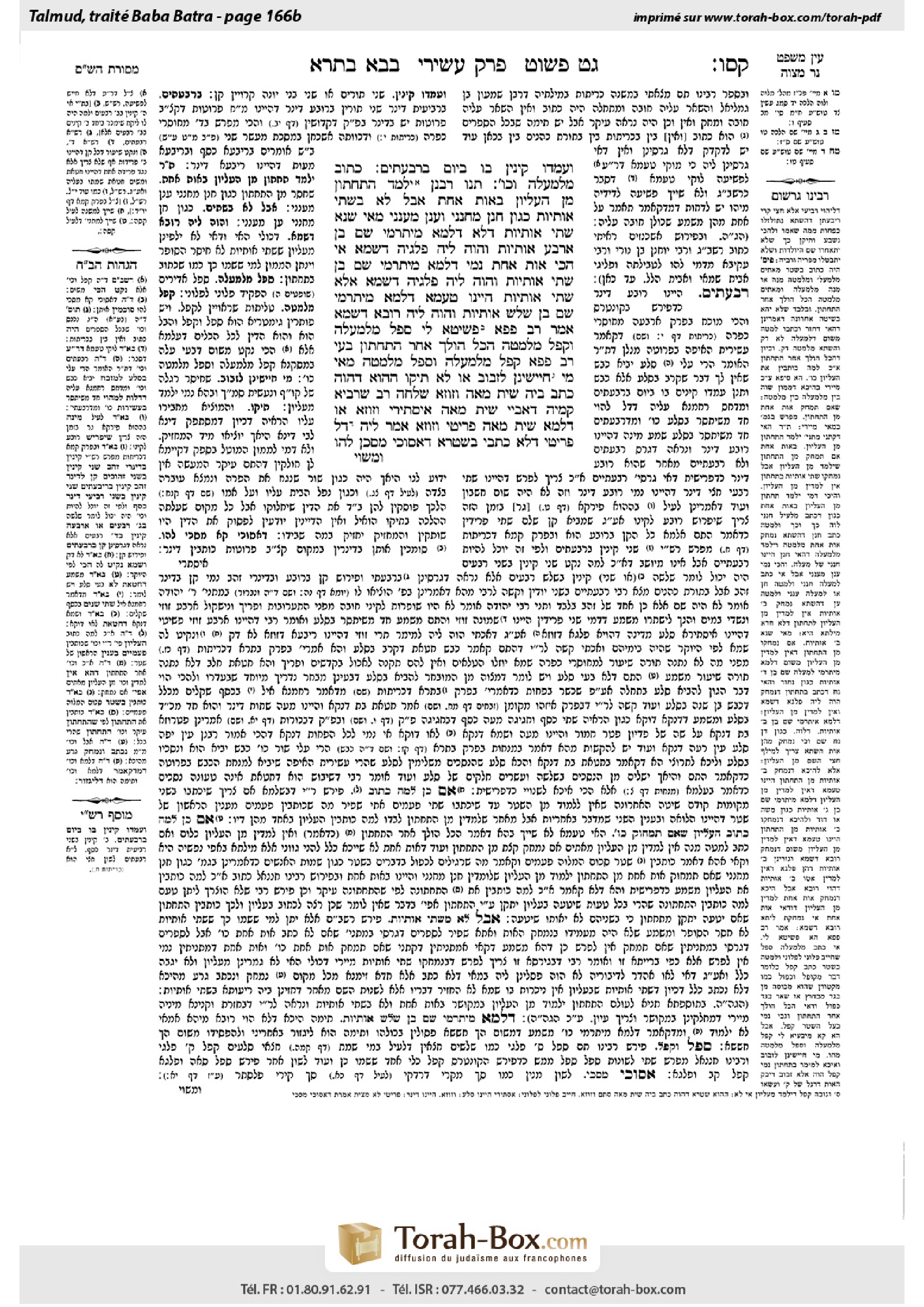
Scan : Torah-Box. Daf Study est un projet indépendant, sans affiliation ni approbation de Torah-Box ou de Sefaria.