Baba Batra 33b en français · בבא בתרא ל״ג ב
Traduction française du daf 33b du traité Baba Batra (Bava Batra 33b en anglais), avec le texte araméen, l’anglais de Sefaria et le scan de la page, pour étudier le Daf Yomi.
Ouvrir dans le lecteur interactifLire le daf du jour
Traduction française de Baba Batra 33b
Les traductions françaises de Daf Study sont générées par IA à partir de l’édition anglaise de Sefaria. Elles peuvent contenir des erreurs : vérifie toujours un passage avec le texte source.
car ils considèrent que, dès lors que l’autre parent a reconnu qu’il n’était pas un parent plus proche, il a reconnu qu’il n’avait jamais eu aucun droit sur les fruits de l’arbre. Par conséquent, selon ses propres aveux, il est tenu de rembourser Rav Idi bar Avin.
§ Un incident se produisit : deux personnes se disputaient la propriété d’un terrain. L’une dit : « Le terrain appartenait à mes ancêtres et j’en ai hérité », et l’autre dit : « Le terrain appartenait à mes ancêtres et j’en ai hérité. » L’une produit des témoins attestant que le terrain appartenait à ses ancêtres, tandis que l’autre produit des témoins attestant qu’elle a exploité le terrain et en a tiré profit pendant le nombre d’années nécessaire pour établir la présomption de propriété.
Rav Ḥisda dit : Celui qui est en possession du terrain est considéré comme crédible, selon le principe juridique suivant : si quelqu’un aurait été considéré comme crédible en avançant une certaine affirmation, mais en avance une autre qui aboutit au même résultat, il est crédible, car pourquoi mentirait-il en avançant cette affirmation ? S’il voulait mentir, il aurait pu lui dire : « Je te l’ai acheté et je l’ai exploité et en ai tiré profit pendant le nombre d’années nécessaire pour établir la présomption de propriété. » Abaye et Rava ne suivent pas l’opinion de Rav Ḥisda, car ils considèrent que le principe « Pourquoi mentirais-je ? » ne s’applique pas lorsqu’il y a des témoins qui contredisent l’affirmation avancée ; or, dans ce cas, des témoins attestent que le terrain appartenait aux ancêtres de l’autre prétendant.
Un homme dit à un autre : « Que fais-tu sur ce terrain qui m’appartient ? » Le détenteur lui répondit : « Je te l’ai acheté et je l’ai exploité et en ai tiré profit pendant le nombre d’années nécessaire pour établir la présomption de propriété. » Il alla ensuite produire des témoins attestant qu’il avait tiré profit du terrain pendant deux ans, mais il ne put produire de témoins pour une troisième année. Rav Naḥman dit : Le terrain revient à son propriétaire précédent, et le paiement des fruits consommés pendant ces deux années revient également à celui-ci. Puisque le détenteur n’a pas pu étayer sa revendication du terrain, on présume qu’il en a consommé les fruits illicitement.
Rav Zevid dit : Si, dès le début, lorsqu’il fut interrogé par l’autre homme, celui qui occupait le terrain avait déclaré : « Je suis entré sur le terrain pour consommer les fruits que j’avais achetés », il est considéré comme crédible. Rav Yehuda n’a-t-il pas dit : Celui qui tient une faucille et une corde [vetovelaya] et déclare : « Je vais cueillir [igderei] les dattes du dattier d’Untel, qui me l’a vendu », est considéré comme crédible quant à son droit de le faire ? Cela montre qu’une personne n’est pas assez effrontée pour cueillir les dattes d’un dattier qui ne lui appartient pas. De même ici, dans le cas évoqué par Rav Zevid, une personne n’est pas assez effrontée pour consommer des fruits qui ne lui appartiennent pas.
La Guemara demande : S’il en est ainsi, puisqu’on présume qu’il ne mentirait pas, pourquoi ne serait-il pas également considéré comme crédible au sujet du terrain ? La Guemara répond : Pour le terrain, nous lui disons : « Montre ton acte de vente, si tu l’as effectivement acheté. » La Guemara objecte : S’il en est ainsi, pour les fruits également, ne devrait-il être considéré comme crédible que s’il peut produire un document à l’appui de sa revendication ? La Guemara explique : Il n’est pas courant que les gens rédigent des documents pour établir le droit de consommer uniquement les fruits ; on peut donc prétendre avoir consommé les fruits sur la base d’un accord oral.
Un homme dit à un autre : « Que fais-tu sur ce terrain qui m’appartient ? » Le détenteur lui répondit : « Je te l’ai acheté et je l’ai exploité et en ai tiré profit pendant le nombre d’années nécessaire pour établir la présomption de propriété. » Il produisit alors un témoin qui attesta qu’il avait tiré profit du terrain pendant les trois années requises. Les rabbins qui étudiaient auprès d’Abaye estimaient qu’il était logique de dire que le principe appliqué dans ce cas était le même que dans l’affaire du morceau de métal coulé [naskha] jugée par Rabbi Abba.
La Guemara présente maintenant cette affaire : un homme arracha un morceau de métal coulé à un autre. Celui à qui on l’avait pris se présenta devant Rabbi Ami, tandis que Rabbi Abba siégeait devant lui, et produisit un témoin qui attesta qu’on le lui avait effectivement arraché. Celui qui l’avait arraché lui dit : « Oui, il est vrai que je l’ai arraché, mais je n’ai fait que reprendre ce qui m’appartenait. » Rabbi Ami dit :
Texte source et traduction anglaise
בבא בתרא ל״ג ב · texte araméen et hébreu
כֵּיוָן דְּאוֹדִי – אוֹדִי.
זֶה אוֹמֵר: ״שֶׁל אֲבוֹתַי״, וְזֶה אוֹמֵר: ״שֶׁל אֲבוֹתַי״; הַאי אַיְיתִי סָהֲדִי דַּאֲבָהָתֵיהּ הוּא, וְהַאי אַיְיתִי סָהֲדִי דַּאֲכַל שְׁנֵי חֲזָקָה –
אָמַר רַב חִסְדָּא: מָה לוֹ לְשַׁקֵּר? אִי בָּעֵי, אָמַר לֵיהּ: מִינָּךְ זְבֵינְתַּהּ וַאֲכַלְתִּיהָ שְׁנֵי חֲזָקָה. אַבָּיֵי וְרָבָא לָא סְבִירָא לְהוּ הָא דְּרַב חִסְדָּא – ״מָה לִי לְשַׁקֵּר״ בִּמְקוֹם עֵדִים – לָא אָמְרִינַן.
הָהוּא דַּאֲמַר לֵיהּ לְחַבְרֵיהּ: מַאי בָּעֵית בְּהַאי אַרְעָא? אֲמַר לֵיהּ: מִינָּךְ זְבַנִי, וַאֲכַלְתִּיהָ שְׁנֵי חֲזָקָה. אֲזַל אַיְיתִי סָהֲדִי דְּאַכְלַהּ תַּרְתֵּי שְׁנֵי. אָמַר רַב נַחְמָן: הָדְרָא אַרְעָא, וְהָדְרִי פֵּירֵי.
אָמַר רַב זְבִיד: אִם טָעַן וְאָמַר ״לְפֵירוֹת יָרַדְתִּי״ – נֶאֱמָן. לָאו מִי אָמַר רַב יְהוּדָה: הַאי מַאן דְּנָקֵיט מַגָּלָא וְתוּבַלְיָא, וְאָמַר: אֵיזִיל אֶיגְדְּרֵיהּ לְדִיקְלָא דִפְלָנְיָא, דְּזַבְּנֵיהּ נִיהֲלִי – מְהֵימַן? אַלְמָא לָא חֲצִיף אִינִישׁ דְּגָזַר דִּיקְלָא דְּלָאו דִּילֵיהּ; הָכָא נָמֵי, לָא חֲצִיף אִינִישׁ לְמֵיכַל פֵּירֵי דְּלָאו דִּילֵיהּ.
אִי הָכִי, אַרְעָא נָמֵי! אַרְעָא, אָמְרִינַן לֵיהּ: אַחְוִי שְׁטָרָךְ. אִי הָכִי, פֵּירֵי נָמֵי! שְׁטָרָא לְפֵירֵי לָא עָבְדִי אִינָשֵׁי.
הָהוּא דַּאֲמַר לְחַבְרֵיהּ: מַאי בָּעֵית בְּהַאי אַרְעָא? אֲמַר לֵיהּ: מִינָּךְ זְבַנִית, וַאֲכַלְתִּיהָ שְׁנֵי חֲזָקָה. אַיְיתִי חַד סָהֲדָא דְּאַכְלַהּ תְּלָת שְׁנֵי. סְבוּר רַבָּנַן קַמֵּיהּ דְּאַבָּיֵי לְמֵימַר: הַיְינוּ נְסָכָא דְּרַבִּי אַבָּא –
דְּהָהוּא גַּבְרָא דַּחֲטַף נְסָכָא מֵחַבְרֵיהּ. אֲתָא לְקַמֵּיהּ דְּרַבִּי אַמֵּי, הֲוָה יָתֵיב רַבִּי אַבָּא קַמֵּיהּ. אַיְיתִי חַד סָהֲדָא דְּמִיחְטָף חֲטַפָא מִינֵּיהּ. אֲמַר לֵיהּ: אִין, חֲטַפִי – וְדִידִי חֲטַפִי. אָמַר רַבִּי אַמֵּי:
Bava Batra 33b · traduction anglaise de Sefaria
as they hold that once it is so that the other relative admitted that he is not a closer relative, he admitted that he never had any right to the produce of the tree. Therefore, by his own admission, he is liable to reimburse Rav Idi bar Avin.
§ There was an incident where two people dispute the ownership of land. This one says: The land belonged to my ancestors and I inherited it from them, and that one says: The land belonged to my ancestors and I inherited it from them. This one brings witnesses that the land belonged to his ancestors, and that one brings witnesses that he worked and profited from the land for the years necessary for establishing the presumption of ownership.
Rav Ḥisda said: The one who is in possession of the land is deemed credible due to the legal principle that if one would have been deemed credible had he stated one claim but instead stated another claim that accomplishes the same result, he has credibility, because why would he lie and state this claim? If he wants to lie, he could have said to him: I purchased it from you and I worked and profited from it for the years necessary for establishing the presumption of ownership. Abaye and Rava do not hold in accordance with this opinion of Rav Ḥisda, because they hold that we do not say that the principle of: Why would I lie, applies in a case where there are witnesses contradicting the claim he is stating, and in this case, witnesses testify that it belonged to the ancestors of the other claimant.
There was a certain person who said to another: What do you want with this land of mine? The possessor said to him in response: I purchased it from you and I worked and profited from it for the years necessary for establishing the presumption of ownership. He then went and brought witnesses that he had profited from the land for two years, but he was unable to bring witnesses to testify about a third year. Rav Naḥman said: The land reverts back to the prior owner, and payment for the produce consumed during those two years reverts to the prior owner. Since the possessor was unable to substantiate his claim to the land, the assumption is that he consumed the produce unlawfully.
Rav Zevid said: If initially, when questioned by the other, the one occupying the land claimed and said: I entered the land to consume its produce that I had purchased, he is deemed credible. After all, didn’t Rav Yehuda say: This one who is holding a sickle and rope [vetovelaya] and says: I will go cull [igderei] the dates from the date tree of so-and-so who sold it to me, is deemed credible that he has the right to do so? Apparently, a person is not so brazen that he would cull the dates of a date tree that is not his. Here too, in the case discussed by Rav Zevid, a person is not so brazen as to consume produce that is not his.
The Gemara asks: If that is so, that the assumption is that he would not lie, let one be deemed credible with regard to the land as well. The Gemara answers: In terms of the land, we say to him: Show your bill of sale if you indeed purchased it. The Gemara challenges: If that is so, then in terms of the produce as well, let him be deemed credible only if he can produce documentation of his claim. The Gemara explains: It is not common for people to write documents to establish the right to consume produce alone, and one can therefore claim to have consumed the produce based on an oral agreement.
There was a certain person who said to another: What do you want with this land of mine? The possessor said to him in response: I purchased it from you and I worked and profited from it for the years necessary for establishing the presumption of ownership. He then brought one witness who testified that he profited from the land for the necessary three years. The Rabbis who were studying before Abaye maintained that it made sense to say that the principle in this case is the same as that in the case of the piece of cast metal [naskha] adjudicated by Rabbi Abba.
The Gemara now presents that case: As there was a certain man who snatched a piece of cast metal from another. The one from whom it was taken came before Rabbi Ami while Rabbi Abba was sitting before him, and he brought one witness who testified that it was, in fact, snatched from him. The one who snatched it said to him: Yes, it is true that I snatched it, but I merely snatched that which was mine. Rabbi Ami said:
Texte de Sefaria : William Davidson Edition - Vocalized Aramaic (CC BY NC) ; William Davidson Edition - English (CC BY NC).
Scan de Baba Batra 33b
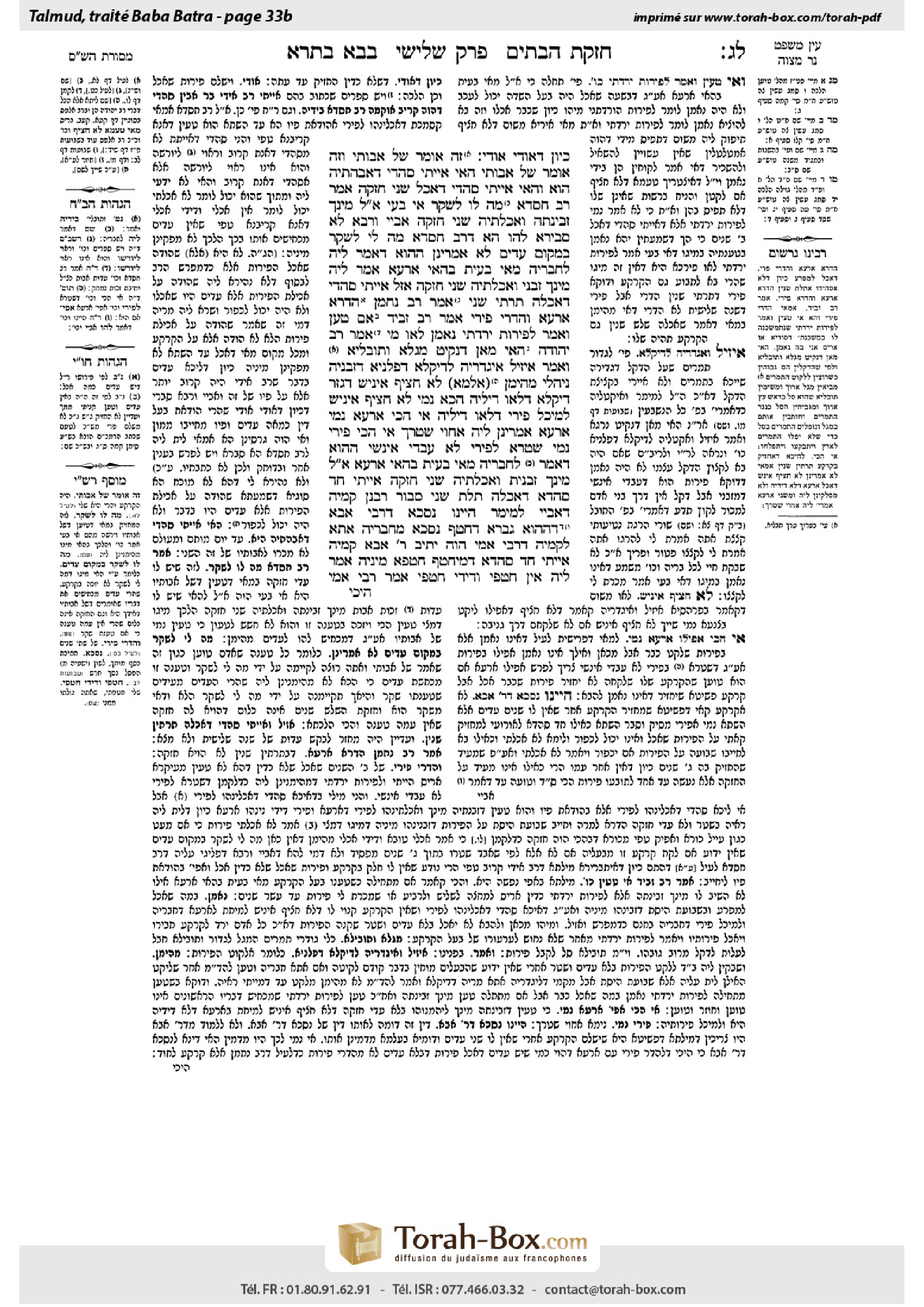
Scan : Torah-Box. Daf Study est un projet indépendant, sans affiliation ni approbation de Torah-Box ou de Sefaria.