Baba Batra 5b en français · בבא בתרא ה׳ ב
Traduction française du daf 5b du traité Baba Batra (Bava Batra 5b en anglais), avec le texte araméen, l’anglais de Sefaria et le scan de la page, pour étudier le Daf Yomi.
Ouvrir dans le lecteur interactifLire le daf du jour
Traduction française de Baba Batra 5b
Les traductions françaises de Daf Study sont générées par IA à partir de l’édition anglaise de Sefaria. Elles peuvent contenir des erreurs : vérifie toujours un passage avec le texte source.
afin qu’il ne me harcèle pas ensuite en me réclamant sans cesse l’argent.
La Guemara tente d’apporter une preuve à l’appui de l’opinion d’Abayé et de Rava à partir de ce que nous avons appris dans la Michna (5a) : si, après la construction du mur, l’un des voisins prétend l’avoir construit seul, sans que l’autre ait participé aux travaux, ce dernier est néanmoins présumé avoir versé sa part de l’argent, à moins que le premier ne prouve que l’autre n’a pas payé sa part.
La Guemara précise les circonstances : de quel cas s’agit-il ? Si l’on suppose qu’il lui a dit : « Je t’ai payé au moment où le paiement était exigible, une fois le mur achevé », il est évident qu’il est présumé avoir versé sa part. Ne s’agit-il pas plutôt du cas où il lui a dit : « Je t’ai payé avant l’échéance, alors que le mur était encore en construction » ? C’est à propos d’un tel cas que la Michna affirme qu’il est présumé avoir versé sa part. Apparemment, une personne est susceptible de rembourser sa dette avant l’échéance, conformément à l’opinion d’Abayé et de Rava. La Guemara rejette cette preuve : le cas présent est différent, car le paiement devient exigible à l’achèvement de chaque rangée. Il ne devient pas exigible uniquement lorsque l’ensemble du mur est achevé.
La Guemara propose en outre : « Viens et écoute » une preuve à l’appui de l’opinion de Reish Lakish, tirée de la suite de la Michna (5a) : le tribunal n’oblige pas le voisin réticent à contribuer à la construction du mur au-delà de quatre coudées. Mais si ce voisin a construit un autre mur près du mur qui avait été élevé au-delà de quatre coudées, afin de poser un toit au-dessus de la pièce ainsi créée, le tribunal lui impose de payer sa part pour l’ensemble du mur surélevé, bien qu’il n’y ait pas encore posé de toit. Si le constructeur du premier mur prétend ensuite qu’il n’a pas reçu le paiement de son voisin, celui-ci est présumé ne pas avoir versé sa part, à moins qu’il ne prouve avoir effectivement payé pour la construction du mur.
La Guemara précise les circonstances : de quel cas s’agit-il ? Si l’on suppose qu’il lui a dit : « Je t’ai payé au moment où le paiement était exigible, une fois le mur achevé », pourquoi ne serait-il pas cru ? Ne s’agit-il pas plutôt du cas où il lui a dit : « Je t’ai payé avant l’échéance », et où il n’est donc pas cru ? Apparemment, une personne n’est pas susceptible de rembourser sa dette avant l’échéance, conformément à l’opinion de Reish Lakish. La Guemara rejette cette preuve : le cas présent est différent, car le voisin réticent dit : « Qui sait si les Rabbins m’obligeront à payer pour ce mur ? » Dans un tel cas, il ne paie certainement pas avant que le paiement ne devienne exigible.
Rav Pappa et Rav Houna, fils de Rav Yehoshoua, ont agi dans un tel cas conformément à l’opinion d’Abayé et de Rava. Mar bar Rav Ashi a agi conformément à l’opinion de Reish Lakish. La Guemara conclut : la halakha suit l’opinion de Reish Lakish, selon laquelle celui qui affirme avoir remboursé un prêt avant son échéance n’est pas cru. Si le débiteur meurt, le tribunal recouvre le paiement même auprès de ses orphelins, sur la base de cette présomption. Et bien que le Maître ait dit que celui qui vient recouvrer une somme sur les biens d’orphelins ne peut le faire qu’après avoir prêté serment qu’il n’a pas déjà recouvré la dette auprès du défunt, ici, il peut recouvrer sans prêter serment, car il existe une présomption selon laquelle une personne n’est pas susceptible de rembourser sa dette avant l’échéance.
Une question fut soumise aux Sages : quelle est la halakha si le prêteur a fixé avec l’emprunteur une échéance pour le remboursement de la dette, qu’il lui a réclamé le paiement après cette échéance, et que l’emprunteur lui a dit : « Je t’ai déjà remboursé avant l’échéance » ? Disons-nous que, même lorsqu’une présomption joue contre la prétention de quelqu’un — comme dans ce cas, où il existe une présomption selon laquelle les gens ne remboursent pas leurs dettes avant l’échéance —, l’emprunteur peut invoquer : « Pourquoi mentirais-je ? » Si l’un des plaideurs pouvait avancer un argument plus favorable à sa cause que celui qu’il a effectivement avancé, on présume qu’il dit la vérité. Par conséquent, dans ce cas, si l’emprunteur avait voulu mentir, il aurait pu dire qu’il avait remboursé sa dette à l’échéance, et on l’aurait cru. Il devrait donc également être cru lorsqu’il affirme l’avoir remboursée avant l’échéance.
Texte source et traduction anglaise
בבא בתרא ה׳ ב · texte araméen et hébreu
כִּי הֵיכִי דְּלָא לִיטְרְדַן.
תְּנַן: – בְּחֶזְקַת שֶׁנָּתַן, עַד שֶׁיָּבִיא רְאָיָה שֶׁלֹּא נָתַן.
הֵיכִי דָמֵי? אִילֵימָא דַּאֲמַר לֵיהּ: ״פְּרַעְתִּיךָ בִּזְמַנִּי״, פְּשִׁיטָא בְּחֶזְקַת שֶׁנָּתַן! אֶלָּא לָאו דַּאֲמַר לֵיהּ: ״פְּרַעְתִּיךְ בְּתוֹךְ זְמַנִּי״? אַלְמָא עֲבִיד אִינִישׁ דְּפָרְעֵיהּ בְּתוֹךְ זִמְנֵיהּ! שָׁאנֵי הָכָא, דְּכׇל שָׂפָא וְשָׂפָא זִימְנֵיהּ הוּא.
תָּא שְׁמַע: בְּחֶזְקַת שֶׁלֹּא נָתַן, עַד שֶׁיָּבִיא רְאָיָה שֶׁנָּתַן.
הֵיכִי דָּמֵי? אִילֵימָא דַּאֲמַר לֵיהּ: ״פְּרַעְתִּיךָ בִּזְמַנִּי״, אַמַּאי לָא? אֶלָּא לָאו דַּאֲמַר לֵיהּ: ״פְּרַעְתִּיךְ בְּתוֹךְ זְמַנִּי״? אַלְמָא לָא עֲבִיד אִינִישׁ דְּפָרַע בְּגוֹ זִימְנֵיהּ! שָׁאנֵי הָכָא, דְּאָמַר: מִי יֵימַר דִּמְחַיְּיבוּ לִי רַבָּנַן.
רַב פָּפָּא וְרַב הוּנָא בְּרֵיהּ דְּרַב יְהוֹשֻׁעַ עָבְדִי כְּאַבַּיֵּי וְרָבָא. מָר בַּר רַב אָשֵׁי עָבֵד כְּרֵישׁ לָקִישׁ. וְהִלְכְתָא כְּרֵישׁ לָקִישׁ, וַאֲפִילּוּ מִיַּתְמֵי; וְאַף עַל גַּב דְּאָמַר מָר: הַבָּא לִיפָּרַע מִנִּכְסֵי יְתוֹמִים – לֹא יִפָּרַע אֶלָּא בִּשְׁבוּעָה; חֲזָקָה: לָא עֲבִיד אִינִישׁ דְּפָרַע בְּגוֹ זִימְנֵיהּ.
אִיבַּעְיָא לְהוּ: תְּבָעוֹ לְאַחַר זְמַן, וְאָמַר לוֹ: ״פְּרַעְתִּיךָ בְּתוֹךְ זְמַנִּי״, מַהוּ? מִי אָמְרִינַן: בִּמְקוֹם חֲזָקָה – אָמְרִינַן ״מַה לִּי לְשַׁקֵּר״;
Bava Batra 5b · traduction anglaise de Sefaria
so that he will not trouble me later by constantly demanding the money.
The Gemara attempts to bring a proof in support of the opinion of Abaye and Rava from what we learned in the mishna (5a): If after the wall was built one of the neighbors claims he alone constructed it and the other did not participate in its building, the latter is nevertheless presumed to have given his share of the money, unless the claimant brings proof that the other did not give his part.
The Gemara clarifies the matter: What are the circumstances of the case under discussion? If we say that he said to him: I paid you at the time when the payment became due, when the wall was completed, it is obvious that he is presumed to have given his part. Rather, is it not that he said to him: I paid you within the time before the payment became due, while the wall was still under construction? And with regard to such a case the mishna states that he is presumed to have given his share. Apparently, a person is apt to repay his debt within its time, in accordance with the opinion of Abaye and Rava. The Gemara rejects this proof: Here it is different, because the time to pay is upon the completion of each and every row. Payment does not become due specifically at the completion of the entire wall.
The Gemara further suggests: Come and hear a proof in support of the opinion of Reish Lakish from the continuation of the mishna (5a): The court does not obligate the reluctant neighbor to contribute to the building of the wall higher than four cubits. But if the reluctant neighbor built another wall close to the wall that had been built higher than four cubits, in order to set a roof over the room that was thereby created, the court imposes upon him the responsibility to pay his share for all of the rebuilt wall, even though he has not yet set a roof over it. If the builder of the first wall later claims he did not receive payment from his neighbor, the neighbor is presumed not to have given his share of the money, unless he brings proof that he did in fact give money for the building of the wall.
The Gemara clarifies the matter: What are the circumstances of the case under discussion? If we say that he said to him: I paid you at the time that the payment became due, when the wall was completed, why is he not deemed credible? Rather, is it not that he said to him: I paid you within the time before the payment became due, and therefore he is not deemed credible? Apparently, a person is not apt to repay his debt within its time, in accordance with the opinion of Reish Lakish. The Gemara rejects this proof: Here it is different, since the reluctant neighbor says: Who says that the Rabbis will obligate me to pay for this wall? In such a case he certainly does not pay before the payment becomes due.
Rav Pappa and Rav Huna, son of Rav Yehoshua, acted in such a case in accordance with the opinion of Abaye and Rava. Mar bar Rav Ashi acted in accordance with the opinion of Reish Lakish. The Gemara concludes: And the halakha is in accordance with the opinion of Reish Lakish that one is not deemed credible when he says that he repaid a loan before it became due. And if the debtor dies, the court collects payment even from his orphans based on this assumption. And even though the Master said that one who comes to collect money from the property of orphans cannot collect unless he first takes an oath that he did not already collect the debt from the deceased, here he can collect without taking an oath because there is a presumption that a person is not apt to repay his debt within its time.
A dilemma was raised before the Sages: What is the halakha if the lender stipulated a time with the borrower for repayment of the debt, and he demanded payment of the money after the time that the payment became due had passed, and the borrower said to him: I already repaid you within the time before the payment became due? Do we say that even where there is a presumption against someone’s claim, as in this case where there is a presumption that people do not pay their debts before they become due, we say that the borrower can claim: Why would I lie? If one of the litigants could have advanced a claim more advantageous to his cause than the one he actually did, the assumption is that he is telling the truth. Consequently, in this case had the borrower wished to lie, he could have said that he repaid his debt when it became due, and he would have been deemed credible. Therefore, when he claims that he repaid it before it came due he should also be deemed credible.
Texte de Sefaria : William Davidson Edition - Vocalized Aramaic (CC BY NC) ; William Davidson Edition - English (CC BY NC).
Scan de Baba Batra 5b
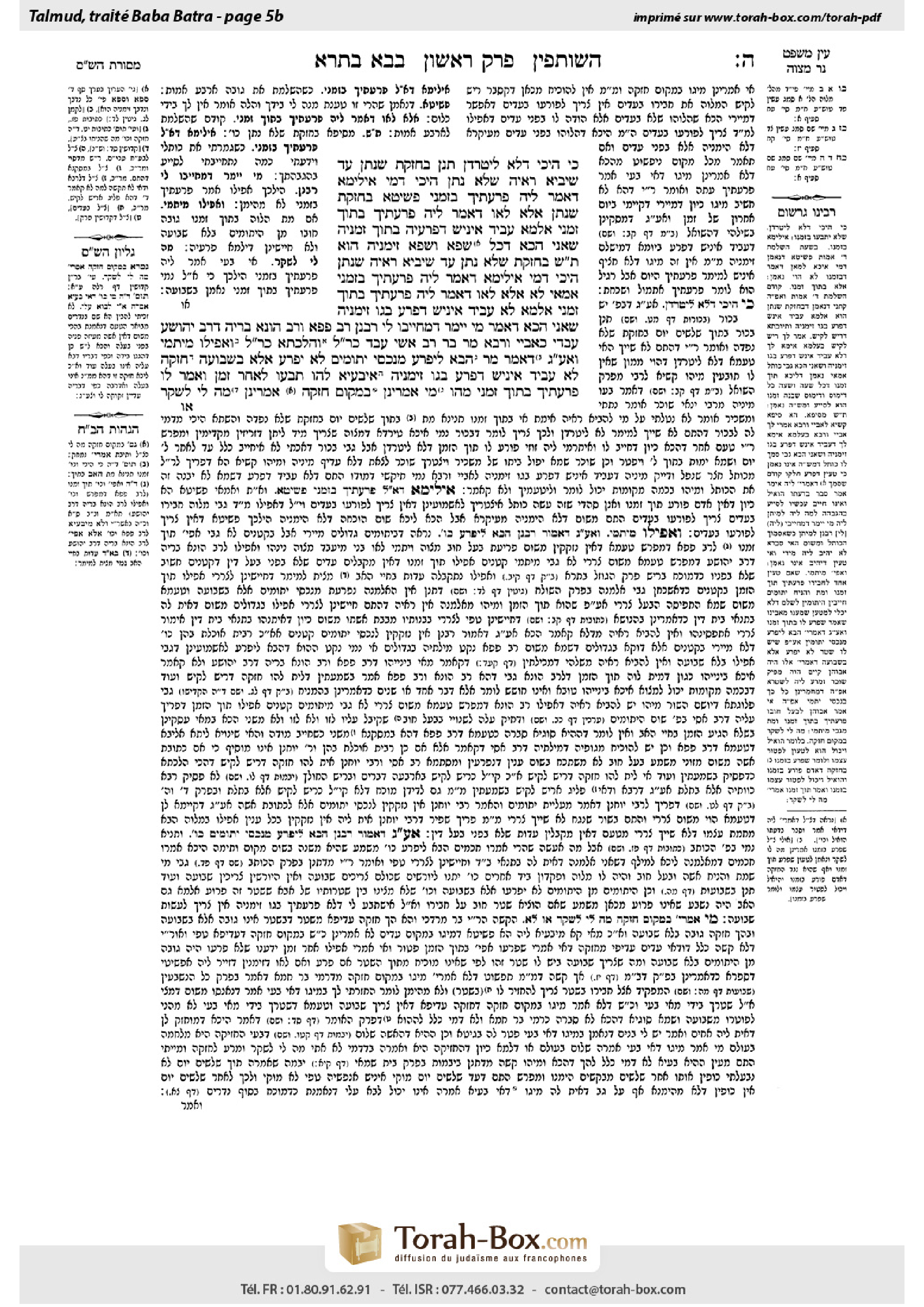
Scan : Torah-Box. Daf Study est un projet indépendant, sans affiliation ni approbation de Torah-Box ou de Sefaria.