Baba Batra 85a en français · בבא בתרא פ״ה א
Traduction française du daf 85a du traité Baba Batra (Bava Batra 85a en anglais), avec le texte araméen, l’anglais de Sefaria et le scan de la page, pour étudier le Daf Yomi.
Ouvrir dans le lecteur interactifLire le daf du jour
Traduction française de Baba Batra 85a
Les traductions françaises de Daf Study sont générées par IA à partir de l’édition anglaise de Sefaria. Elles peuvent contenir des erreurs : vérifie toujours un passage avec le texte source.
Les récipients d’une personne lui font acquérir tout objet qui y est déposé, quel que soit l’endroit où ils se trouvent, sauf dans le domaine public. Rabbi Yoḥanan et Rabbi Shimon ben Lakish disent tous deux : même dans le domaine public, les récipients d’une personne lui font acquérir les objets qui y sont déposés.
Rav Pappa dit : Ces amoraïm ne sont pas en désaccord. Ici, lorsque Rav et Shmuel affirment que le récipient d’une personne ne lui fait pas acquérir un objet, ils parlent d’un récipient placé dans le domaine public ; là, lorsque Rabbi Yoḥanan et Reish Lakish affirment que son récipient lui fait acquérir un objet, ils parlent d’un récipient situé dans une ruelle. Et pourquoi qualifient-ils une ruelle de domaine public ? Parce qu’une ruelle n’est pas un domaine privé.
La Guemara fait remarquer : Il est également raisonnable d’interpréter ainsi la déclaration de Rabbi Yoḥanan, puisque Rabbi Abbahu dit que Rabbi Yoḥanan dit : Les récipients d’une personne lui font acquérir des objets partout où elle a le droit de les laisser. On peut en déduire que, dans un endroit où elle a le droit de laisser ses récipients, ceux-ci lui font effectivement acquérir des objets ; mais dans un endroit où elle n’a pas le droit de les laisser, ils ne lui en font pas acquérir. Or, on a le droit de laisser ses récipients dans une ruelle, mais pas dans le domaine public. La Guemara conclut : Déduis de cette déclaration que, lorsque Rabbi Yoḥanan parlait du domaine public, il faisait référence à une ruelle.
La Guemara propose : Viens entendre une objection tirée d’une baraïta : il y a quatre cas concernant les vendeurs, c’est-à-dire quatre méthodes d’acquisition de marchandises. Lorsque le vendeur mesure la marchandise pour l’acheteur, tant que le récipient mesureur n’est pas rempli, la marchandise qui s’y trouve appartient encore au vendeur, qui peut changer d’avis et annuler la vente. Une fois le récipient mesureur rempli, la marchandise appartient à l’acheteur. Dans quel cas cette règle s’applique-t-elle ? Lorsque le vendeur mesure avec un récipient mesureur qui n’appartient ni à l’un ni à l’autre. Mais si le récipient mesureur appartient à l’un d’eux, l’acheteur acquiert les articles vendus un à un, au fur et à mesure qu’ils sont déposés dans le récipient.
Dans quel cas cette règle s’applique-t-elle ? Lorsque le vendeur mesure les articles dans le domaine public ou dans une cour qui n’appartient ni à l’un ni à l’autre. Mais si cela a lieu dans le domaine du vendeur, l’acheteur n’acquiert la marchandise qu’après avoir soulevé le récipient mesureur ou l’avoir déplacé hors du domaine du vendeur. Si elle se trouve dans le domaine de l’acheteur, celui-ci l’acquiert dès que le vendeur s’engage à la vendre. Si la marchandise se trouve dans le domaine de la personne à qui elle avait été confiée, l’acheteur ne l’acquiert qu’après que le dépositaire s’est engagé à désigner un emplacement où la marchandise sera entreposée pour l’acheteur, ou que l’acheteur a loué au dépositaire l’emplacement où se trouve la marchandise.
Quoi qu’il en soit, cette baraïta enseigne que, dans une transaction réalisée dans le domaine public ou dans une cour qui n’appartient ni à l’un ni à l’autre, si le récipient mesureur appartient à l’un d’eux, l’acheteur acquiert les articles vendus un à un, au fur et à mesure qu’ils sont déposés dans le récipient.
Texte source et traduction anglaise
בבא בתרא פ״ה א · texte araméen et hébreu
כִּלְיוֹ שֶׁל אָדָם קוֹנֶה לוֹ בְּכׇל מָקוֹם, חוּץ מֵרְשׁוּת הָרַבִּים. וְרַבִּי יוֹחָנָן וְרַבִּי שִׁמְעוֹן בֶּן לָקִישׁ דְּאָמְרִי תַּרְוַיְיהוּ: אֲפִילּוּ בִּרְשׁוּת הָרַבִּים.
אָמַר רַב פָּפָּא: לָא פְּלִיגִי; כָּאן בִּרְשׁוּת הָרַבִּים, כָּאן בְּסִימְטָא. וְאַמַּאי קָרוּ לַהּ רְשׁוּת הָרַבִּים? שֶׁאֵין רְשׁוּת הַיָּחִיד.
הָכִי נָמֵי מִסְתַּבְּרָא, דְּאָמַר רַבִּי אֲבָהוּ אָמַר רַבִּי יוֹחָנָן: כִּלְיוֹ שֶׁל אָדָם קוֹנֶה לוֹ בְּכׇל מָקוֹם שֶׁיֵּשׁ לוֹ רְשׁוּת לְהַנִּיחוֹ. יֵשׁ לוֹ רְשׁוּת – אִין, אֵין לוֹ רְשׁוּת – לָא. שְׁמַע מִינַּהּ.
תָּא שְׁמַע, אַרְבַּע מִדּוֹת בַּמּוֹכְרִין: עַד שֶׁלֹּא נִתְמַלְּאָה מִדָּה – לַמּוֹכֵר, מִשֶּׁנִּתְמַלְּאָה מִדָּה – לַלּוֹקֵחַ. בַּמֶּה דְּבָרִים אֲמוּרִים – בְּמִדָּה שֶׁאֵינָהּ שֶׁל שְׁנֵיהֶן, אֲבָל אִם הָיְתָה מִדָּה שֶׁל אֶחָד מֵהֶן – רִאשׁוֹן רִאשׁוֹן – קָנָה.
בַּמֶּה דְּבָרִים אֲמוּרִים – בִּרְשׁוּת הָרַבִּים וּבְחָצֵר שֶׁאֵינָהּ שֶׁל שְׁנֵיהֶן, אֲבָל בִּרְשׁוּת מוֹכֵר – לֹא קָנָה עַד שֶׁיַּגְבִּיהֶנָּה אוֹ עַד שֶׁיּוֹצִיאֶנָּה מֵרְשׁוּתוֹ. בִּרְשׁוּת לוֹקֵחַ – כֵּיוָן שֶׁקִּבֵּל עָלָיו מוֹכֵר, קָנָה לוֹקֵחַ. בִּרְשׁוּת הַלָּה הַמּוּפְקָדִים אֶצְלוֹ – לֹא קָנָה עַד שֶׁיְּקַבֵּל עָלָיו, אוֹ עַד שֶׁיִּשְׂכּוֹר אֶת מְקוֹמָן.
קָתָנֵי מִיהָא, בִּרְשׁוּת הָרַבִּים וּבְחָצֵר שֶׁאֵינָהּ שֶׁל שְׁנֵיהֶן;
Bava Batra 85a · traduction anglaise de Sefaria
A person’s vessels effect acquisition of any item placed inside them for him, in any place in which they are situated, except for the public domain. And Rabbi Yoḥanan and Rabbi Shimon ben Lakish both say: Even in the public domain, one’s vessels effect acquisition of items placed in them.
Rav Pappa said: These amora’im do not disagree: Here, when Rav and Shmuel state that one’s vessel does not effect acquisition for him, they are speaking of a vessel placed in the public domain; there, when Rabbi Yoḥanan and Reish Lakish state that his vessel effects acquisition on his behalf, they are referring to a vessel located in an alleyway. And why do they call an alleyway the public domain? The reason is that an alleyway is not a private domain.
The Gemara points out: So, too, it is reasonable to interpret Rabbi Yoḥanan’s statement in this manner, as Rabbi Abbahu says that Rabbi Yoḥanan says: A person’s vessels effect acquisition for him in any place where he has permission to keep them. It can be inferred from here: In a location where he has permission to keep them, yes, his vessels effect acquisition for him. But in a place where he does not have permission to keep his vessels, they do not effect acquisition for him, and one has permission to keep his vessels in an alleyway but not in the public domain. The Gemara affirms: Conclude from this statement that when Rabbi Yoḥanan referred to the public domain he meant an alleyway.
The Gemara suggests: Come and hear a difficulty from a baraita: There are four cases with regard to sellers, i.e., four methods through which merchandise is acquired. When the seller measures merchandise for the buyer, before the measuring vessel has been filled the merchandise in the vessel still belongs to the seller and he can change his mind and cancel the sale. Once the measuring vessel has been filled the merchandise belongs to the buyer. In what case is this statement said? It is said when the seller measures with a measuring vessel that does not belong to either of them. But if the measuring vessel belonged to one of them, the buyer acquires the items of sale one by one as they are placed in the measuring vessel.
In what case is this statement said? It is said when the seller measures the items in the public domain or in a courtyard that does not belong to either of them. But if it happens in the domain of the seller, the buyer does not acquire the merchandise until he lifts the measuring vessel or until he moves it out of the domain of the seller. If it is in the domain of the buyer, once the seller accepts upon himself to sell, the buyer acquires it. If the merchandise is located in the domain of this individual with whom it had been deposited, the buyer does not acquire it until the bailee accepts upon himself to designate a place where the merchandise is to be stored for the buyer, or until the buyer rents from the bailee the place where the merchandise is situated.
In any event, this baraita teaches with regard to a transaction in the public domain or in a courtyard that does not belong to either of them that if the measuring vessel belonged to one of them, the buyer acquires the items of sale one by one as they are placed in the vessel.
Texte de Sefaria : William Davidson Edition - Vocalized Aramaic (CC BY NC) ; William Davidson Edition - English (CC BY NC).
Scan de Baba Batra 85a
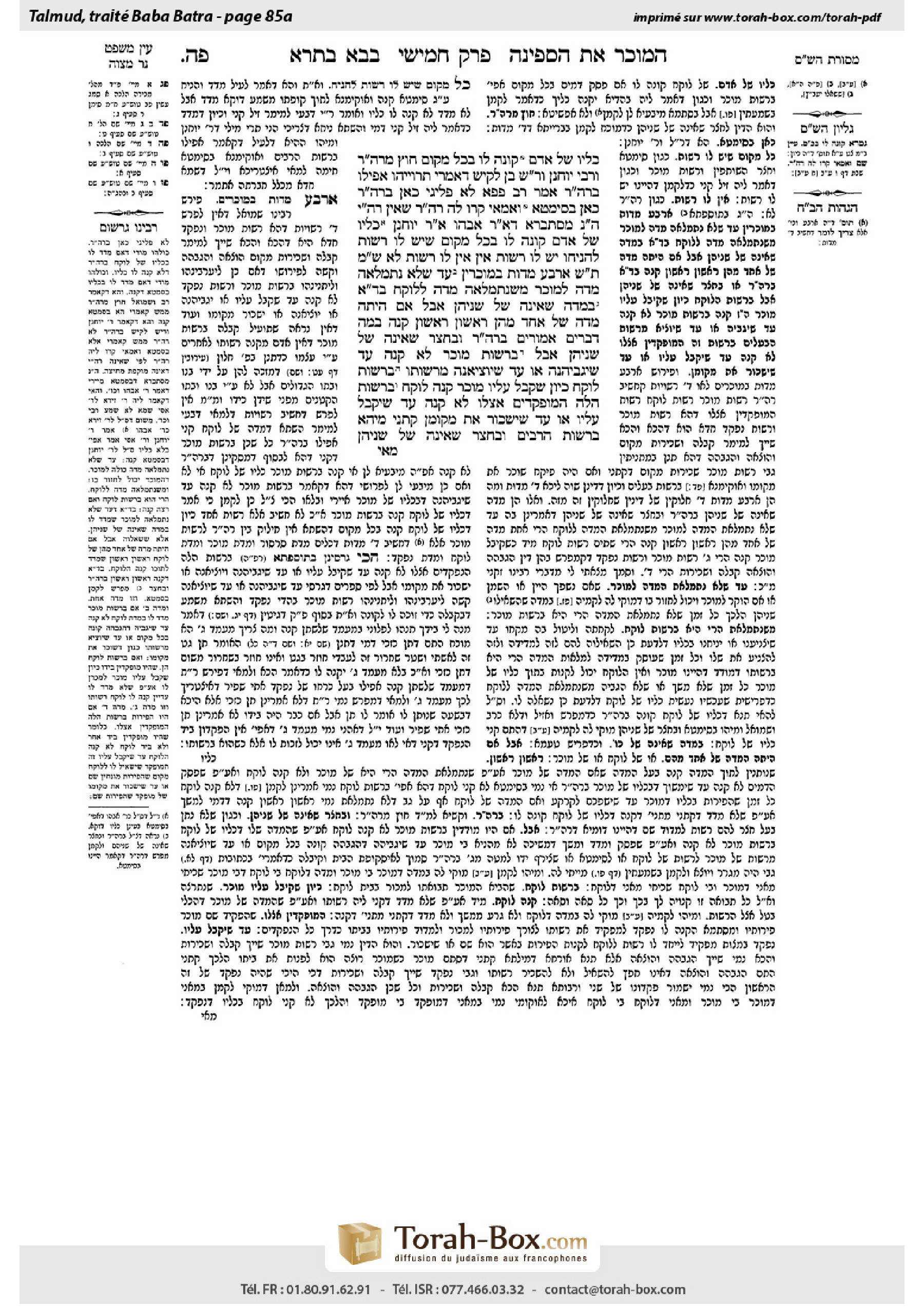
Scan : Torah-Box. Daf Study est un projet indépendant, sans affiliation ni approbation de Torah-Box ou de Sefaria.