Houlin 35b en français · חולין ל״ה ב
Traduction française du daf 35b du traité Houlin (Chullin 35b en anglais), avec le texte araméen, l’anglais de Sefaria et le scan de la page, pour étudier le Daf Yomi.
Ouvrir dans le lecteur interactifLire le daf du jour
Traduction française de Houlin 35b
Les traductions françaises de Daf Study sont générées par IA à partir de l’édition anglaise de Sefaria. Elles peuvent contenir des erreurs : vérifie toujours un passage avec le texte source.
De même, pour les vêtements, on craint que sa femme ne s’assoie dessus alors qu’elle est impure de l’impureté d’une femme menstruée. Mais, pour les produits, nous ne disons pas que, s’ils ont été préparés selon le degré de pureté de la terouma, ils rendent impurs les aliments consacrés. Rabbi Yitzḥak énonce également sa halakha à propos des produits.
Rabbi Yirmeya de Difti soulève une objection à l’opinion de Rabbi Yitzḥak : dit-on vraiment, à propos des produits, que, s’ils ont été préparés selon le degré de pureté de la terouma, ils rendent impurs les aliments consacrés ? N’avons-nous pas appris dans une Michna (Ḥagiga 24b) : Il n’est pas permis à un prêtre d’accepter du vin de terouma d’un am ha’aretz. Mais si un am ha’aretz dit au prêtre : « J’ai prélevé un quart de log de vin consacré et l’ai placé dans ce tonneau de vin de terouma », il est jugé digne de foi. Cela indique que la terouma ne rend pas impurs les aliments consacrés. Et si tu dis que, vis-à-vis des aliments consacrés, l’état de pureté de la terouma est considéré comme une impureté, que la terouma rende alors les aliments consacrés impurs !
Rabbi Yitzḥak dit à Rabbi Yirmeya de Difti : Dis-tu qu’il y a une objection à mon opinion fondée sur un cas d’impureté concernant des aliments — le vin de terouma et le vin consacré — réunis dans un même tonneau ? Le cas d’impureté concernant des aliments réunis est différent : puisque l’am ha’aretz est jugé digne de foi au sujet des aliments consacrés, il l’est également au sujet de la terouma.
Rav Huna bar Natan soulève, à partir d’une baraïta, une objection à l’opinion de Rabbi Yitzḥak concernant le fait de rendre les aliments consacrés impurs du quatrième degré : Des aliments profanes impurs du deuxième degré rendent impur par contact un liquide profane, qui prend le premier degré d’impureté, et disqualifient des aliments de terouma, c’est-à-dire que ces aliments sont impurs, mais ne transmettent pas l’impureté à d’autres aliments. Et des aliments profanes impurs du troisième degré rendent impur par contact un liquide consacré et disqualifient des aliments consacrés, dans le cas d’aliments profanes préparés selon le degré de pureté des aliments consacrés. Cela contredit l’opinion de Rabbi Yitzḥak, qui a dit que rien ne confère le quatrième degré d’impureté aux aliments consacrés, hormis les aliments consacrés eux-mêmes, mais pas les aliments profanes préparés selon le degré de pureté des aliments consacrés.
La Guemara répond que cette question fait l’objet d’une controverse entre les tannaïm, comme on l’enseigne dans une baraïta : Le statut halakhique des aliments profanes préparés selon le degré de pureté des aliments consacrés est celui des aliments profanes, et ils ne peuvent pas prendre le troisième degré d’impureté.
Rabbi Elazar, fils de Rabbi Tzadok, dit : Le statut halakhique des aliments profanes préparés selon le degré de pureté des aliments consacrés est celui de la terouma. En conséquence, une source primaire d’impureté peut rendre impurs deux éléments : l’aliment qu’elle touche prend le premier degré d’impureté, et l’aliment que celui-ci touche prend le deuxième degré d’impureté. Cet aliment peut ensuite en disqualifier un autre, qui prend le troisième degré d’impureté, mais ne rendra pas les aliments consacrés impurs du quatrième degré. Selon les deux opinions de cette baraïta, les aliments profanes préparés selon le degré de pureté des aliments consacrés ne disqualifient pas les aliments consacrés. Selon la Michna de Teharot, ils les disqualifient.
§ La Michna énonce (33a) : Dans le cas de celui qui abat un animal domestique, un animal sauvage ou un oiseau, sans qu’aucun sang ne s’écoule, Rabbi Shimon dit : L’abattage lui-même les a rendus susceptibles à l’impureté rituelle. Rav Asi a dit que, selon Rabbi Shimon, c’est l’abattage qui rend l’animal susceptible à l’impureté rituelle, et non le sang qui s’écoule pendant l’abattage.
La Guemara propose : Disons que la Michna appuie l’opinion de Rav Asi. Rabbi Shimon dit : « L’abattage lui-même les a rendus susceptibles à l’impureté rituelle. » La Guemara demande : Rabbi Shimon ne veut-il pas dire que c’est l’abattage, et non le sang issu de l’abattage, qui les rend susceptibles ? La Guemara répond : Non, peut-être Rabbi Shimon veut-il dire que l’animal peut être rendu susceptible à l’impureté rituelle aussi bien par le sang que par l’abattage.
La Guemara propose : Viens et entends une baraïta à l’appui de la déclaration de Rav Asi. Rabbi Shimon dit aux Sages : « Est-ce le sang qui rend l’animal susceptible à l’impureté rituelle ? N’est-ce pas l’abattage qui le rend susceptible ? » Cela indique que, selon Rabbi Shimon, c’est précisément l’abattage, et non le sang, qui rend la chair susceptible à l’impureté. La Guemara rejette cette preuve. Voici ce que Rabbi Shimon dit aux Sages : « Est-ce le sang seul qui rend l’animal susceptible à l’impureté rituelle ? L’abattage aussi le rend susceptible. »
La Guemara propose : Viens et entends une baraïta qui contredit la déclaration de Rav Asi. Rabbi Shimon dit : Le sang d’un animal mort de mort naturelle ne rend pas les aliments susceptibles à l’impureté rituelle. Ne peut-on pas en déduire que le sang de l’abattage rend les aliments susceptibles à l’impureté rituelle ? La Guemara rejette cette preuve. Non, déduis-en que le sang d’animaux mis à mort rend les aliments susceptibles à l’impureté rituelle. La Guemara demande : Mais, en ce qui concerne le sang de l’abattage, quelle est alors la halakha ? Ne rend-il donc pas les aliments susceptibles à l’impureté rituelle ?
Si tel est le cas, que Rabbi Shimon nous enseigne que le sang de l’abattage ne rend pas l’animal susceptible à l’impureté rituelle, et nous en conclurons à plus forte raison qu’il en va ainsi du sang d’un animal mort de mort naturelle. La Guemara répond : Il était nécessaire que Rabbi Shimon enseigne la halakha concernant le sang d’un animal mort de mort naturelle, car on aurait pu penser : Quelle différence y a-t-il entre le fait qu’un homme ait tué lui-même l’animal et le fait que l’ange de la mort l’ait tué ? Dans les deux cas, le sang devrait rendre l’animal susceptible à l’impureté rituelle. Rabbi Shimon nous enseigne donc que, contrairement au sang d’un animal mis à mort, le sang d’un animal mort de mort naturelle ne rend pas les aliments susceptibles à l’impureté rituelle ; on ne peut tirer aucune déduction concernant le sang de l’abattage.
La Guemara propose : Viens et entends une autre baraïta qui contredit la déclaration de Rav Asi. Rabbi Shimon dit : Le sang de la blessure d’un animal ne rend pas d’autres éléments susceptibles à l’impureté rituelle. Ne peut-on pas en déduire que le sang de l’abattage rend les aliments susceptibles à l’impureté rituelle ? La Guemara rejette cette preuve. Non, déduis-en que le sang d’animaux mis à mort rend les aliments susceptibles à l’impureté rituelle. La Guemara demande : Mais, en ce qui concerne le sang de l’abattage, quelle est la halakha ? Ne rend-il donc pas les aliments susceptibles à l’impureté rituelle ?
Si tel est le cas, que Rabbi Shimon nous enseigne que le sang de l’abattage ne rend pas l’animal susceptible à l’impureté rituelle, et nous en conclurons à plus forte raison qu’il en va ainsi du sang de sa blessure. La Guemara répond : Il était nécessaire que Rabbi Shimon enseigne la halakha concernant le sang de sa blessure, car on aurait pu penser : Quelle différence y a-t-il entre le fait qu’un homme ait tué l’animal tout entier et le fait qu’il n’en ait tué que la moitié, c’est-à-dire qu’il l’ait blessé ? Dans les deux cas, le sang devrait rendre l’animal susceptible à l’impureté rituelle. Rabbi Shimon enseigne donc que, contrairement au sang d’un animal mis à mort, le sang de la blessure d’un animal ne rend pas les aliments susceptibles à l’impureté rituelle ; on ne peut tirer aucune déduction concernant le sang de l’abattage.
La Guemara demande : Pourquoi le sang d’animaux mis à mort rend-il les aliments susceptibles à l’impureté rituelle ? Parce qu’il est écrit : « Voici un peuple qui se lève comme une lionne et se dresse comme un lion ; il ne se couchera pas avant d’avoir dévoré sa proie et bu le sang des victimes » (Nombres 23, 24). Le fait que le sang d’une victime — qui, dans le contexte du verset, désigne un animal mis à mort — soit mentionné en rapport avec le fait de boire indique qu’il s’agit d’un liquide qui rend les aliments susceptibles à l’impureté rituelle.
À propos du sang de l’abattage, il est également écrit : « Seulement, tu ne mangeras pas le sang ; tu le répandras sur la terre comme de l’eau » (Deutéronome 12, 16). La comparaison avec l’eau semble indiquer que le sang de l’abattage devrait lui aussi rendre les aliments susceptibles à l’impureté rituelle. La Guemara répond : Ce verset ne traite pas de la susceptibilité à l’impureté. Il vise à permettre de tirer profit du sang d’animaux consacrés devenus impropres.
Texte source et traduction anglaise
חולין ל״ה ב · texte araméen et hébreu
שֶׁמָּא תֵּשֵׁב עֲלֵיהֶן אִשְׁתּוֹ נִדָּה, אֲבָל בְּפֵירֵי לָא אָמְרִינַן. וְרַבִּי יִצְחָק בְּפֵירֵי נָמֵי אָמַר.
מֵתִיב רַבִּי יִרְמְיָה מִדִּיפְתִּי: וּמִי אָמְרִינַן בְּפֵירֵי? וְהָתְנַן: אִם אָמַר ״הִפְרַשְׁתִּי לְתוֹכָהּ רְבִיעִית קֹדֶשׁ״ – נֶאֱמָן, וְלָא קָא (מטמא) [מְטַמְּיָא] לֵיהּ תְּרוּמָה לְקֹדֶשׁ. וְאִי אָמְרַתְּ: טׇהֳרָתָהּ טוּמְאָה הִיא אֵצֶל הַקֹּדֶשׁ – תְּטַמֵּא תְּרוּמָה לְקֹדֶשׁ!
אֲמַר לֵיהּ: טוּמְאָה בְּחִבּוּרִין קָאָמְרַתְּ? טוּמְאָה בְּחִבּוּרִין שָׁאנֵי, דְּמִגּוֹ דִּמְהֵימַן אַקֹּדֶשׁ – מְהֵימַן נָמֵי אַתְּרוּמָה.
מֵתִיב רַב הוּנָא בַּר נָתָן: הַשֵּׁנִי שֶׁבַּחוּלִּין מְטַמֵּא מַשְׁקֵה חוּלִּין, וּפוֹסֵל אוֹכְלֵי תְרוּמָה, וְהַשְּׁלִישִׁי מְטַמֵּא מַשְׁקֵה קֹדֶשׁ, וּפוֹסֵל אוֹכְלֵי קֹדֶשׁ, בְּחוּלִּין שֶׁנַּעֲשׂוּ עַל טׇהֳרַת הַקֹּדֶשׁ.
תַּנָּאֵי הִיא, דְּתַנְיָא: חוּלִּין שֶׁנַּעֲשׂוּ עַל טׇהֳרַת קֹדֶשׁ – הֲרֵי הֵן כְּחוּלִּין.
רַבִּי אֶלְעָזָר בְּרַבִּי צָדוֹק אוֹמֵר: הֲרֵי הֵן כִּתְרוּמָה, לְטַמֵּא שְׁנַיִם, וְלִפְסוֹל אֶחָד.
רַבִּי שִׁמְעוֹן אוֹמֵר: הוּכְשְׁרוּ בִּשְׁחִיטָה. אָמַר רַב אַסִּי: אוֹמֵר הָיָה רַבִּי שִׁמְעוֹן, שְׁחִיטָתוֹ מַכְשֶׁרֶת וְלֹא דָּם.
לֵימָא מְסַיַּיע לֵיהּ, רַבִּי שִׁמְעוֹן אוֹמֵר: הוּכְשְׁרוּ בִּשְׁחִיטָה. מַאי לָאו בִּשְׁחִיטָה וְלָא בְּדָם? לָא, אַף בִּשְׁחִיטָה.
תָּא שְׁמַע: אָמַר לָהֶן רַבִּי שִׁמְעוֹן: וְכִי הַדָּם מַכְשִׁיר? וַהֲלֹא שְׁחִיטָה מַכְשֶׁרֶת! הָכִי קָאָמַר לָהֶן: וְכִי דָם בִּלְבַד מַכְשִׁיר? אַף שְׁחִיטָה נָמֵי מַכְשֶׁרֶת.
תָּא שְׁמַע: רַבִּי שִׁמְעוֹן אוֹמֵר: דַּם הַמֵּת אֵינוֹ מַכְשִׁיר. מַאי לָאו, הָא דַּם שְׁחִיטָה מַכְשִׁיר? לָא, הָא דַּם חֲלָלִים מַכְשִׁיר, אֲבָל דַּם שְׁחִיטָה מַאי – לָא מַכְשִׁיר?
לַישְׁמְעִינַן דַּם שְׁחִיטָה, וְכׇל שֶׁכֵּן דַּם הַמֵּת! דַּם הַמֵּת אִיצְטְרִיכָא לֵיהּ, סָלְקָא דַּעְתָּךְ אָמֵינָא: מָה לִי קַטְלֵיהּ אִיהוּ, מָה לִי קַטְלֵיהּ מַלְאַךְ הַמָּוֶת? קָא מַשְׁמַע לַן.
תָּא שְׁמַע: רַבִּי שִׁמְעוֹן אוֹמֵר: דַּם מַגֵּפָתוֹ אֵינוֹ מַכְשִׁיר. מַאי לָאו, הָא דַּם שְׁחִיטָה מַכְשִׁיר? לָא, הָא דַּם חֲלָלִים מַכְשִׁיר. אֲבָל דַּם שְׁחִיטָה מַאי, לָא מַכְשִׁיר?
לַשְׁמְעִינַן דַּם שְׁחִיטָה, וְכׇל שֶׁכֵּן דַּם מַגֵּפָתוֹ! דַּם מַגֵּפָתוֹ אִיצְטְרִיכָא לֵיהּ, סָלְקָא דַּעְתָּךְ אָמֵינָא: מָה לִי קַטְלֵיהּ כּוּלֵּהּ, מָה לִי קַטְלֵיהּ פַּלְגָא.
וּמַאי שְׁנָא דַּם חֲלָלִים דְּמַכְשַׁיר? דִּכְתִיב: ״וְדַם חֲלָלִים יִשְׁתֶּה״.
דַּם שְׁחִיטָה נָמֵי כְּתִיב: ״עַל הָאָרֶץ תִּשְׁפְּכֶנּוּ כַּמָּיִם״! הָהוּא לְמִישְׁרֵי דָּמָן דִּפְסוּלֵי הַמּוּקְדָּשִׁין בַּהֲנָאָה הוּא דַּאֲתָא.
Chullin 35b · traduction anglaise de Sefaria
as with regard to garments there is concern lest his wife sit upon them when she is impure with the impurity of a menstruating woman. But with regard to produce, we do not say that if it was prepared with the purity of teruma it renders sacrificial food impure, and Rabbi Yitzḥak states his halakha with regard to produce as well.
Rabbi Yirmeya of Difti raises an objection to the opinion of Rabbi Yitzḥak: And do we say with regard to produce that if it was prepared with the purity of teruma it renders sacrificial food impure? But didn’t we learn in a mishna (Ḥagiga 24b): It is not permitted for a priest to accept teruma wine from an am ha’aretz, but if an am ha’aretz says to the priest: I separated and placed into this barrel of teruma wine a quarter-log of sacrificial wine, he is deemed credible? And this indicates that teruma does not render the sacrificial food impure. And if you say with regard to teruma that its state of purity is impurity vis-à-vis sacrificial food, let the teruma render the sacrificial food impure.
Rabbi Yitzḥak said to Rabbi Yirmeya of Difti: Are you saying that there is an objection to my opinion based on the case of impurity in a case of food items, the teruma wine and the sacrificial wine, that are attached in one barrel? Impurity in a case of food items that are attached is different, as, since the am ha’aretz is deemed credible with regard to the sacrificial food, he is deemed credible with regard to the teruma as well.
Rav Huna bar Natan raises an objection from a baraita to the opinion of Rabbi Yitzḥak with regard to rendering sacrificial food impure with fourth-degree ritual impurity: Non-sacred food that is impure with second-degree impurity renders impure through contact a non-sacred liquid, which assumes first-degree impurity, and disqualifies teruma foods, in the sense that those foods are impure but do not transmit impurity to other food. And non-sacred food that is impure with third-degree impurity renders impure through contact a sacrificial liquid and disqualifies sacrificial foods, in the case of non-sacred food items that were prepared on the level of purity of sacrificial food. This contradicts the opinion of Rabbi Yitzḥak, who said that there is nothing that confers fourth-degree impurity in sacrificial food other than consecrated sacrificial food alone, but not non-sacred food prepared with the purity of sacrificial food.
The Gemara answers that this matter is a dispute between tanna’im, as it is taught in a baraita: The halakhic status of non-sacred food items that were prepared on the level of purity of sacrificial food is like that of non-sacred foods, and they are incapable of assuming third-degree impurity.
Rabbi Elazar, son of Rabbi Tzadok, says: The halakhic status of non-sacred food items that were prepared on the level of purity of sacrificial food is like that of teruma. Accordingly, a primary source of ritual impurity is able to render two items impure: The food item with which it comes into contact assumes first-degree impurity, and the food item with which that came into contact assumes second-degree impurity. And that item is able to disqualify one further item, which assumes third-degree impurity but will not render sacrificial food impure with fourth-degree impurity. According to both opinions in this baraita, non-sacred food prepared with the purity of sacrificial food does not disqualify sacrificial food. According to the mishna in Teharot, it does disqualify sacrificial food.
§ The mishna states (33a): In the case of one who slaughters a domesticated animal, an undomesticated animal, or a bird, and blood did not emerge from them, Rabbi Shimon says: They were rendered susceptible to ritual impurity by means of the slaughter itself. Rav Asi said that Rabbi Shimon would say: It is its slaughter that renders it susceptible to ritual impurity, and not the blood that emerges during the slaughter.
The Gemara suggests: Let us say that the mishna supports the opinion of Rav Asi. Rabbi Shimon says: They were rendered susceptible to ritual impurity by means of the slaughter itself. The Gemara asks: What, is it not that Rabbi Shimon is saying: By means of the slaughter and not by means of the blood from the slaughter? The Gemara answers: No, perhaps Rabbi Shimon is saying: The animal can be rendered susceptible to ritual impurity by means of blood and also by means of slaughter.
The Gemara suggests: Come and hear a baraita in support of Rav Asi’s statement. Rabbi Shimon said to the Rabbis: Is it blood that renders the animal susceptible to ritual impurity? But isn’t it slaughter that renders it susceptible? This indicates that Rabbi Shimon holds that it is specifically the slaughter and not the blood that renders the flesh susceptible to impurity. The Gemara rejects this proof. This is what Rabbi Shimon is saying to the Rabbis: Is it blood alone that renders the animal susceptible to ritual impurity? Slaughter too renders it susceptible.
The Gemara suggests: Come and hear a baraita contrary to Rav Asi’s statement. Rabbi Shimon says: Blood of the animal that is dead of natural causes does not render food items susceptible to ritual impurity. What, is it not that one may infer that blood of slaughter renders food items susceptible to ritual impurity? The Gemara rejects this proof. No, infer that blood of animals that are killed renders food items susceptible to ritual impurity. The Gemara asks: But with regard to blood of slaughter, what then is the halakha; that it does not render food items susceptible to ritual impurity?
If so, let Rabbi Shimon teach us that blood of slaughter does not render the animal susceptible to ritual impurity, and we will conclude that all the more so that is the halakha with regard to blood of the animal that is dead as a result of natural causes. The Gemara answers: It was necessary for Rabbi Shimon to teach the halakha of blood of the animal that is dead as a result of natural causes, as it could enter your mind to say: What difference is there to me if one killed the animal himself, and what difference is there to me if the animal was killed by the angel of death? In both cases the blood should render the animal susceptible to ritual impurity. Therefore, Rabbi Shimon teaches us that unlike blood of an animal that was killed, blood of an animal that is dead as a result of natural causes does not render food items susceptible to ritual impurity, and no inference may be drawn with regard to blood of slaughter.
The Gemara suggests: Come and hear another baraita contrary to Rav Asi’s statement. Rabbi Shimon says: Blood of the wound of an animal does not render other items susceptible to ritual impurity. What, is it not that one may infer that blood of slaughter renders food items susceptible to ritual impurity? The Gemara rejects this proof. No, infer that blood of animals that are killed renders food items susceptible to ritual impurity. The Gemara asks: But with regard to blood of slaughter, what is the halakha; that it does not render food items susceptible to ritual impurity?
If so, let Rabbi Shimon teach us that blood of slaughter does not render the animal susceptible to ritual impurity, and we will conclude that all the more so that is the halakha with regard to blood of its wound. The Gemara answers: It was necessary for Rabbi Shimon to teach blood of its wound, as it could enter your mind to say: What difference is there to me if one killed the entire animal, and what difference is there to me if one killed half of the animal, i.e., wounded it? In both cases the blood should render the animal susceptible to ritual impurity. Therefore, Rabbi Shimon teaches that unlike the blood of an animal that was killed, the blood from an animal’s wound does not render food items susceptible to ritual impurity, and no inference may be drawn with regard to blood of slaughter.
The Gemara asks: What is different with regard to blood of animals that are killed that they render food items susceptible to ritual impurity? It is due to the fact that it is written: “Behold, they are a people that rises up as a lioness, and as a lion he lifts himself up; he shall not lie down until he eats of the prey and drinks blood of carcasses” (Numbers 23:24). The fact that the blood of a carcass, which in the context of the verse is referring to an animal that was killed, is mentioned in the context of drinking, indicates that it is a liquid that renders food items susceptible to ritual impurity.
With regard to blood of slaughter it is also written: “Only, you shall not eat the blood; you shall pour it upon the earth as water” (Deuteronomy 12:16). The parallel to water ostensibly indicates that the blood of slaughter should also render food items susceptible to ritual impurity. The Gemara answers: That verse is not written with regard to susceptibility to impurity. The purpose for which it comes is to permit benefit from the blood of disqualified consecrated animals.
Texte de Sefaria : William Davidson Edition - Vocalized Aramaic (unknown) ; William Davidson Edition - English (CC BY NC).
Scan de Houlin 35b
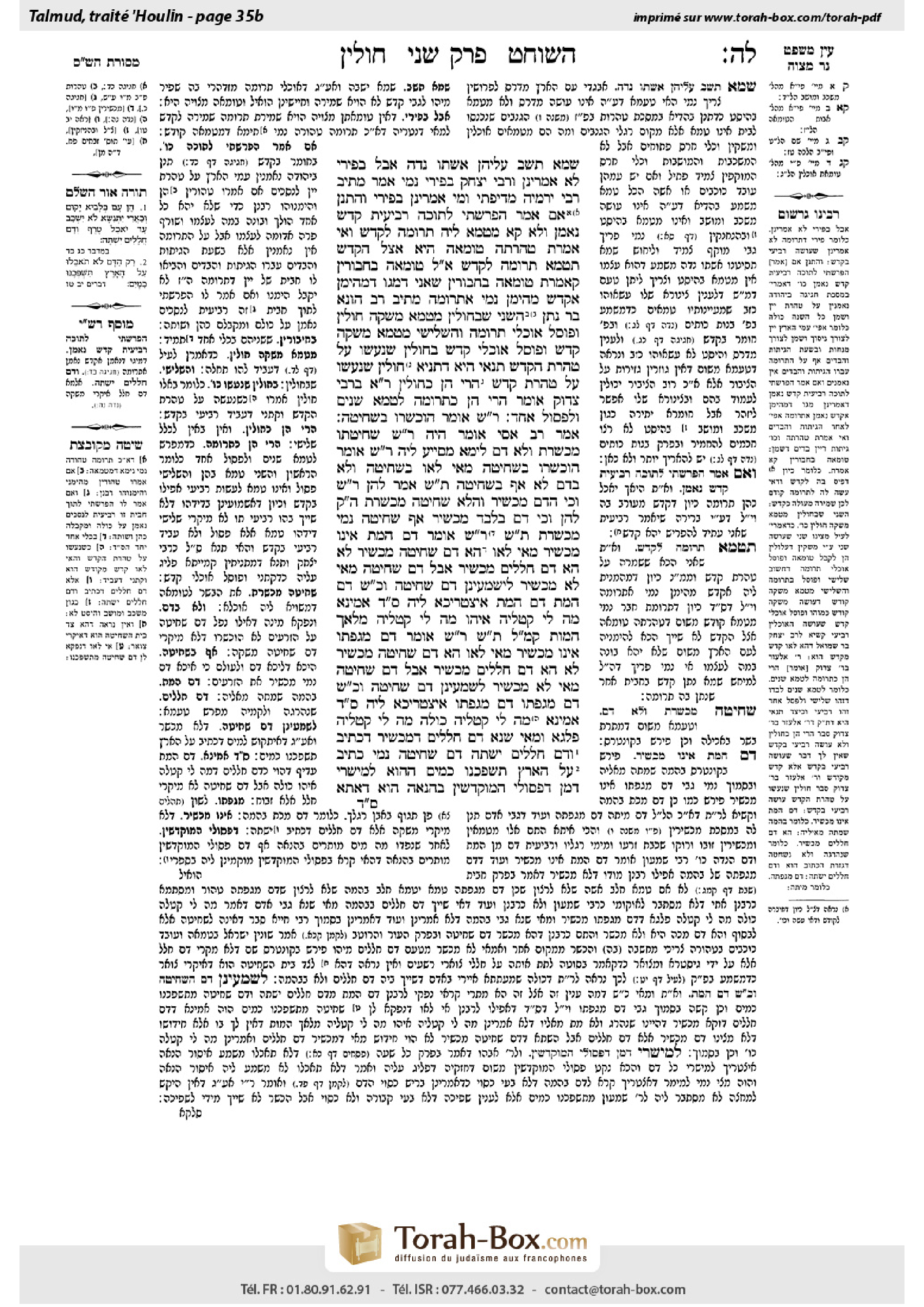
Scan : Torah-Box. Daf Study est un projet indépendant, sans affiliation ni approbation de Torah-Box ou de Sefaria.