Houlin 39b en français · חולין ל״ט ב
Traduction française du daf 39b du traité Houlin (Chullin 39b en anglais), avec le texte araméen, l’anglais de Sefaria et le scan de la page, pour étudier le Daf Yomi.
Ouvrir dans le lecteur interactifLire le daf du jour
Traduction française de Houlin 39b
Les traductions françaises de Daf Study sont générées par IA à partir de l’édition anglaise de Sefaria. Elles peuvent contenir des erreurs : vérifie toujours un passage avec le texte source.
Alors, dans un cas où l’intention invalide l’abattage d’animaux non consacrés lorsqu’ils sont abattus avec l’intention de servir une idole, et où seuls deux rites sacrificiels sont accomplis, l’abattage et l’aspersion du sang, n’est-il pas d’autant plus évident que tout dépend de la seule intention de celui qui abat l’animal ?
Une baraïta est enseignée conformément à l’opinion de Rabbi Yoḥanan : celui qui abat un animal afin d’asperger son sang pour une idole ou d’en brûler la graisse pour une idole fait de cet animal une offrande aux morts, c’est-à-dire aux idoles, et l’abattage n’est pas valide. Si quelqu’un abat l’animal, puis a l’intention d’asperger son sang ou d’en brûler la graisse pour une idole, tel fut l’incident de Césarée ; les Sages ne se sont prononcés sur l’animal ni pour l’interdire ni pour le permettre.
Rav Ḥisda explique la conduite des Sages : ils n’ont pas prononcé d’interdiction, par égard pour les Rabbins de la Michna, qui considèrent que l’intention non précisée d’un non-Juif — et, vraisemblablement, de même, celle d’un Juif idolâtre — n’est pas présumée viser le culte des idoles ; son abattage est donc valide. Les Sages n’ont pas non plus prononcé de permission, par égard pour Rabbi Eliezer, qui considère que l’intention non précisée d’un non-Juif — et, vraisemblablement, de même, celle d’un Juif idolâtre — est présumée viser le culte des idoles.
La Guemara demande : D’où tire-t-on cette conclusion ? Peut-être les Rabbins disent-ils que l’abattage est permis uniquement dans le cas de la Michna, parce que nous n’avons pas entendu explicitement que le non-Juif avait l’intention d’accomplir l’abattage pour une idole. Mais ici, dans le cas de la baraïta, où nous apprenons ensuite qu’il a l’intention d’asperger le sang ou de brûler les graisses pour une idole, peut-être sa déclaration ultérieure révèle-t-elle la nature de son intention initiale au moment de l’abattage.
Autre possibilité : peut-être, lorsque Rabbi Eliezer affirme dans la Michna qu’un abattage effectué pour le compte d’un non-Juif n’est pas valide, cela ne s’applique qu’à un animal appartenant à un non-Juif, puisque l’intention non précisée d’un non-Juif vise le culte des idoles. Mais, dans le cas de la baraïta, où l’animal appartient à un Juif, nous ne disons pas que sa déclaration ultérieure révèle la nature de son intention initiale.
Rav Sheizevi a plutôt dit que les Sages n’ont pas déclaré permis l’animal de la baraïta, par égard pour Rabban Shimon ben Gamliel, qui considère que les actes ultérieurs d’une personne révèlent la nature de son intention initiale. La Guemara demande : Quelle déclaration de Rabban Shimon ben Gamliel indique qu’il est de cet avis ?
Si l’on dit qu’il s’agit de la déclaration de Rabban Shimon ben Gamliel au sujet des actes de divorce, cela pose problème. En effet, nous avons appris dans une Michna (Gittin 66a) que si un mourant dit aux personnes présentes : « Écrivez un acte de divorce pour ma femme », elles doivent écrire l’acte de divorce et le remettre à sa femme. Bien que la remise ne soit pas comprise dans son ordre, telle est clairement son intention. Mais un homme en bonne santé qui dit : « Écrivez un acte de divorce pour ma femme », sans dire : « Remettez-le-lui », cherchait vraisemblablement à se moquer d’elle et non à désigner ses auditeurs comme mandataires chargés de le lui remettre.
La Michna poursuit : Il y eut un incident concernant un homme en bonne santé qui dit : « Écrivez un acte de divorce pour ma femme », puis monta sur le toit, en tomba et mourut. Rabban Shimon ben Gamliel dit : s’il est tombé de son propre chef, en se donnant la mort, l’acte de divorce est valide, car il est clair qu’il avait prévu sa mort, ce qui lui confère, selon la halakha, le statut d’un mourant. Mais si le vent l’a forcé à tomber et qu’il est mort, l’acte de divorce n’est pas valide, car il n’avait pas clairement l’intention de lui remettre l’acte de divorce.
Et nous avons discuté de la Michna : Le tanna a-t-il cité un incident pour contredire ce qui avait été énoncé auparavant dans la Michna ? Le tanna affirme sans réserve que lorsqu’un homme en bonne santé dit : « Écrivez un acte de divorce pour ma femme », l’acte de divorce n’est pas valide. Puis le tanna cite un incident indiquant que, dans certaines circonstances, lorsqu’un homme en bonne santé dit : « Écrivez un acte de divorce pour ma femme », l’acte de divorce est valide.
La Guemara répond : La Michna est incomplète, et voici ce qu’elle enseigne : un homme en bonne santé qui dit : « Écrivez un acte de divorce pour ma femme », sans dire : « Remettez-le-lui », cherchait vraisemblablement à se moquer d’elle. Mais si ses actes ultérieurs révèlent la nature de son intention initiale — à savoir qu’il veut lui donner l’acte de divorce parce qu’il est sur le point de mourir —, l’acte de divorce est valide. Et il y eut un incident concernant un homme en bonne santé qui dit : « Écrivez un acte de divorce pour ma femme », puis monta sur le toit, en tomba et mourut. Rabban Shimon ben Gamliel dit : s’il est tombé de son propre chef, l’acte de divorce est valide ; mais si le vent l’a forcé à tomber, l’acte de divorce n’est pas valide.
La Guemara explique pourquoi cela ne constitue pas une preuve : peut-être le cas cité là est-il différent, car le mari dit d’abord : « Écrivez un acte de divorce pour ma femme », ce qui indique qu’il avait initialement l’intention de tomber du toit. En revanche, dans le cas de l’abattage, rien n’indique quelle était son intention initiale.
Ravina a plutôt dit que les Sages n’ont pas déclaré permis l’animal dans l’incident de Césarée, par égard pour Rabban Shimon ben Gamliel, afin de ne pas contredire l’opinion citée ici, comme l’enseigne une baraïta : dans le cas d’un homme sur son lit de mort qui a rédigé un document transférant ses biens à d’autres, parmi lesquels se trouvaient des esclaves, si le bénéficiaire désigné dit : « Je ne veux pas prendre possession des esclaves », et que ce second maître des esclaves, le bénéficiaire désigné, est un prêtre, les esclaves peuvent consommer de la terouma, et sa protestation est ignorée. Rabban Shimon ben Gamliel dit : dès que le bénéficiaire désigné dit : « Je ne veux pas prendre possession des esclaves », les héritiers du propriétaire initial les ont déjà acquis.
Et nous avons discuté de la baraïta : selon le premier tanna, le bénéficiaire désigné acquiert-il les esclaves même s’il se tient là et proteste à grands cris qu’il ne veut pas en prendre possession ? Cela n’est pas raisonnable.
Rabba a dit — et certains disent que c’est Rabbi Yoḥanan qui l’a dit : si le bénéficiaire proteste dès le départ, au moment où le propriétaire lui fait don des esclaves, tous s’accordent à dire qu’il ne les acquiert pas. S’il garde le silence à ce moment-là et ne proteste que plus tard, tous s’accordent à dire qu’il acquiert les esclaves.
Le désaccord porte sur le cas où le propriétaire lui a transféré la propriété des esclaves par l’intermédiaire d’une autre personne : à ce moment-là, le bénéficiaire a gardé le silence, puis, lorsqu’il a effectivement reçu les esclaves, il a protesté à grands cris. Le premier tanna considère que, puisqu’il a d’abord gardé le silence, il a acquis les esclaves, et que ses protestations ultérieures indiquent qu’il revient sur son acceptation initiale du don. Ce revirement est sans effet, car une acquisition ne peut être annulée de cette manière.
Rabban Shimon ben Gamliel, lui, considère que les actes ultérieurs d’une personne révèlent la nature de son intention initiale. Il n’a jamais voulu des esclaves et a toujours eu l’intention d’éviter d’en prendre possession. S’il n’a pas protesté au début, c’est parce qu’il s’est dit : « Puisqu’ils ne sont pas encore en ma possession, pourquoi protesterais-je ? »
§ La Guemara reprend la discussion du désaccord dans la Michna, où Rabbi Yosei affirme que lorsqu’un Juif abat un animal pour le compte d’un non-Juif, même si l’on sait que le non-Juif a l’intention de le faire pour le culte des idoles, l’abattage est valide, car seule compte l’intention de celui qui abat. Rav Yehuda dit au nom de Shmuel : la halakha est conforme à l’opinion de Rabbi Yosei.
La Guemara rapporte : des Arabes vinrent à Tzikuneya et donnèrent des béliers à des bouchers juifs. Les Arabes leur dirent : « Le sang et la graisse sont pour nous, afin de les utiliser dans le culte de nos idoles, et la peau et la viande sont pour vous. » Rav Tuvi bar Rav Mattana envoya une question à Rav Yosef : dans un cas comme celui-ci, quelle est la halakha ? Rav Yosef lui fit répondre : voici ce que Rav Yehuda a dit au nom de Shmuel : la halakha est conforme à l’opinion de Rabbi Yosei ; c’est l’intention de celui qui abat, et non celle du propriétaire, qui détermine si l’abattage est valide.
Rav Aḥa, fils de Rav Avya, dit à Rav Ashi : selon l’opinion de Rabbi Eliezer dans la Michna, si un Juif abat un animal pour le compte d’un non-Juif, l’abattage n’est pas valide. Quelle est la halakha si le non-Juif a donné un dinar à un boucher juif pour acheter une petite quantité de viande ? Cette petite quantité invalide-t-elle tout l’abattage ? Rav Ashi lui dit : nous examinons la situation. Si ce non-Juif est un homme violent et que le Juif ne peut repousser son offre en lui disant de reprendre son argent, l’animal entier est interdit, car l’abattage a été effectué en partie pour le compte du non-Juif. Si le non-Juif n’est pas violent, le Juif peut lui dire : « Va provoquer une collision entre ta tête et une montagne, car je n’abattrai pas d’animal pour ton compte. »
MICHNA : Dans le cas de celui qui abat un animal pour les montagnes, c’est-à-dire afin de les adorer, pour les collines, les mers, les rivières ou les étendues sauvages, son abattage n’est pas valide.
Texte source et traduction anglaise
חולין ל״ט ב · texte araméen et hébreu
מְקוֹם שֶׁאֵין מַחְשָׁבָה פּוֹסֶלֶת בְּחוּלִּין אֶלָּא בִּשְׁתֵּי עֲבוֹדוֹת – אֵינוֹ דִּין שֶׁלֹּא יְהֵא הַכֹּל הוֹלֵךְ אֶלָּא אַחַר הַשּׁוֹחֵט.
תַּנְיָא כְּוָותֵיהּ דְּרַבִּי יוֹחָנָן: הַשּׁוֹחֵט אֶת הַבְּהֵמָה לִזְרוֹק דָּמָהּ לַעֲבוֹדָה זָרָה וּלְהַקְטִיר חֶלְבָּהּ לַעֲבוֹדָה זָרָה – הֲרֵי אֵלּוּ זִבְחֵי מֵתִים. שְׁחָטָהּ וְאַחַר כָּךְ חִישֵּׁב עָלֶיהָ – זֶה הָיָה מַעֲשֶׂה בְּקֵיסָרִי, וְלֹא אָמְרוּ בָּהּ לֹא אִיסּוּר וְלֹא הֶיתֵּר.
אָמַר רַב חִסְדָּא: לֹא אָמְרוּ בָּהּ אִיסּוּר – מִשּׁוּם כְּבוֹדָן דְּרַבָּנַן. לֹא הֶיתֵּר – מִשּׁוּם כְּבוֹדוֹ דְרַבִּי אֱלִיעֶזֶר.
מִמַּאי? דִּלְמָא עַד כָּאן לָא קָאָמְרִי רַבָּנַן הָתָם, אֶלָּא דְּלָא שְׁמַעְנֵאּ דְּחַשֵּׁיב, אֲבָל הָכָא דִּשְׁמַעְנֵאּ דְּחַשֵּׁיב – הוֹכִיחַ סוֹפוֹ עַל תְּחִלָּתוֹ!
אִי נָמֵי, עַד כָּאן לָא קָאָמַר רַבִּי אֱלִיעֶזֶר הָתָם אֶלָּא גַּבֵּי נׇכְרִי, דִּסְתָם מַחְשֶׁבֶת נׇכְרִי לַעֲבוֹדָה זָרָה, אֲבָל יִשְׂרָאֵל – הוֹכִיחַ סוֹפוֹ עַל תְּחִלָּתוֹ לָא אָמְרִינַן.
אֶלָּא אָמַר רַב שֵׁיזְבִי: לֹא אָמְרוּ בָּהּ הֶיתֵּר מִשּׁוּם כְּבוֹדוֹ דְּרַבָּן שִׁמְעוֹן בֶּן גַּמְלִיאֵל, הֵי רַבָּן שִׁמְעוֹן בֶּן גַּמְלִיאֵל?
אִילֵּימָא רַבָּן שִׁמְעוֹן בֶּן גַּמְלִיאֵל דְּגִיטִּין, דִּתְנַן: הַבָּרִיא שֶׁאָמַר ״כִּתְבוּ גֵּט לְאִשְׁתִּי״ – רָצָה לְשַׂחֵק בָּהּ.
וּמַעֲשֶׂה בְּבָרִיא שֶׁאָמַר ״כִּתְבוּ גֵּט לְאִשְׁתִּי״, וְעָלָה לַגָּג וְנָפַל וָמֵת. אָמַר רַבָּן שִׁמְעוֹן בֶּן גַּמְלִיאֵל: אִם מֵעַצְמוֹ נָפַל, הֲרֵי זֶה גֵּט, וְאִם הָרוּחַ דָּחַתּוּ, אֵינוֹ גֵּט.
וְהָוֵינַן בַּהּ: מַעֲשֶׂה לִסְתּוֹר?
חַסּוֹרֵי מִיחַסְּרָא וְהָכִי קָתָנֵי: אִם הוֹכִיחַ סוֹפוֹ עַל תְּחִלָּתוֹ – הֲרֵי זֶה גֵּט, וּמַעֲשֶׂה נָמֵי בְּבָרִיא שֶׁאָמַר ״כִּתְבוּ גֵּט לְאִשְׁתִּי״, וְעָלָה לַגָּג וְנָפַל וָמֵת. אָמַר רַבָּן שִׁמְעוֹן בֶּן גַּמְלִיאֵל: אִם מֵעַצְמוֹ נָפַל – הֲרֵי זֶה גֵּט, וְאִם הָרוּחַ דָּחַתּוּ – אֵינוֹ גֵּט.
וְדִלְמָא שָׁאנֵי הָתָם, דְּקָאָמַר ״כִּתְבוּ״.
אֶלָּא אָמַר רָבִינָא: מִשּׁוּם כְּבוֹדוֹ דְּרַבָּן שִׁמְעוֹן בֶּן גַּמְלִיאֵל דְּהָכָא, דְּתַנְיָא: הַכּוֹתֵב נְכָסָיו לַאֲחֵרִים, וְהָיוּ בָּהֶן עֲבָדִים, וְאָמַר הַלָּה ״אִי אֶפְשִׁי בָּהֶן״, אִם הָיָה רַבּוֹ שֵׁנִי כֹּהֵן – הֲרֵי אֵלּוּ אוֹכְלִין בִּתְרוּמָה. רַבָּן שִׁמְעוֹן בֶּן גַּמְלִיאֵל אוֹמֵר: כֵּיוָן שֶׁאָמַר הַלָּה ״אִי אֶפְשִׁי בָּהֶן״ – כְּבָר זָכוּ בָּהֶן יוֹרְשִׁין.
וְהָוֵינַן בַּהּ: לְתַנָּא קַמָּא, אֲפִילּוּ עוֹמֵד וְצוֹוֵחַ?
אֲמַר רַבָּה, וְאִיתֵּימָא רַבִּי יוֹחָנָן: בְּצוֹוֵחַ מֵעִיקָּרָא – דְּכוּלֵּי עָלְמָא לָא פְּלִיגִי דְּלָא קָנָה, בְּשׁוֹתֵק וּבַסּוֹף צוֹוֵחַ – דְּכוּלֵּי עָלְמָא לָא פְּלִיגִי דִּקְנָה.
כִּי פְּלִיגִי – שֶׁזִּיכָּה לוֹ עַל יְדֵי אַחֵר, וְשָׁתַק וּלְבַסּוֹף צָוַוח; תַּנָּא קַמָּא סָבַר: מִדִּשְׁתֵיק – קְנָנְהוּ, וְהַאי דְּקָא צָוַוח – מִיהְדָּר קָא הָדַר בֵּיהּ.
וְרַבָּן שִׁמְעוֹן בֶּן גַּמְלִיאֵל סָבַר: הוֹכִיחַ סוֹפוֹ עַל תְּחִילָּתוֹ, וְהָא דְּלָא צְוַוח מֵעִיקָּרָא, סָבַר: כִּי לָא אָתֵי לִידִי אַמַּאי אֶצְוַוח.
אָמַר רַב יְהוּדָה אָמַר שְׁמוּאֵל: הֲלָכָה כְּרַבִּי יוֹסֵי.
הָנְהוּ טַיָּיעֵי דַּאֲתוֹ לְצִיקוֹנְיָא, יְהוּב דִּיכְרֵי לְטַבָּחֵי יִשְׂרָאֵל, אֲמַרוּ לְהוּ: דְּמָא וְתַרְבָּא לְדִידַן, מַשְׁכָּא וּבִישְׂרָא לְדִידְכוּ. שַׁלְחַהּ רַב טוֹבִי בַּר רַב מַתְנָה לְקַמֵּיהּ דְּרַב יוֹסֵף: כִּי הַאי גַּוְונָא מַאי? שְׁלַח לֵיהּ: הָכִי אָמַר רַב יְהוּדָה אָמַר שְׁמוּאֵל: הֲלָכָה כְּרַבִּי יוֹסֵי.
אֲמַר לֵיהּ רַב אַחָא בְּרֵיהּ דְּרַב אַוְיָא לְרַב אָשֵׁי: לְרַבִּי אֱלִיעֶזֶר, יְהֵיב לֵיהּ זוּזָא לְטַבָּח יִשְׂרָאֵל, מַאי? אֲמַר לֵיהּ: חָזֵינַן, אִי אִינִישׁ אַלָּמָא הוּא דְּלָא מָצֵי מְדַחֵי לֵיהּ – אָסוּר, וְאִי לָא – אָמַר לֵיהּ: ״רֵישָׁיךָ וְהַר״.
מַתְנִי׳ הַשּׁוֹחֵט לְשֵׁם הָרִים, לְשֵׁם גְּבָעוֹת, לְשֵׁם יַמִּים, לְשֵׁם נְהָרוֹת, לְשֵׁם מִדְבָּרוֹת – שְׁחִיטָתוֹ פְּסוּלָה.
Chullin 39b · traduction anglaise de Sefaria
then in a place where intent invalidates the slaughter in non-sacred animals slaughtered with intent for idol worship during performance of only two sacrificial rites, slaughter and sprinkling the blood, is it not right that everything should follow only the intent of the one who slaughters the animal?
It is taught in a baraita in accordance with the opinion of Rabbi Yoḥanan: With regard to one who slaughters an animal in order to sprinkle its blood for idol worship or to burn its fat for idol worship, the status of these animals is that of offerings to the dead, i.e., to idols, and the slaughter is not valid. If one slaughtered the animal and thereafter intended in its regard to sprinkle its blood or burn its fats for idol worship, that was the incident in Caesarea, and the Sages did not say anything with regard to the animal, neither prohibition nor permission.
Rav Ḥisda says in explanation of the conduct of the Sages that they did not say prohibition, due to the honor of the Rabbis in the mishna, who hold that the unspecified intent of a gentile, and presumably likewise of a Jew who worships idols, is not presumed to be directed to idol worship, and therefore his slaughter is valid. Nor did the Sages say permission, due to the honor of Rabbi Eliezer, who holds that the unspecified intent of a gentile, and presumably likewise of a Jew who worships idols, is presumed to be directed to idol worship.
The Gemara asks: From where is that conclusion drawn? Perhaps the Rabbis say that the slaughter is permitted only there in the mishna, because we did not hear explicitly that the gentile intends the slaughter for idol worship. But here in the case in the baraita, where we hear thereafter that he intends to sprinkle the blood or burn the fats for idol worship, perhaps his ultimate statement proves the nature of his original intent while performing the slaughter.
Alternatively, perhaps when Rabbi Eliezer states there in the mishna that slaughter performed on behalf of a gentile is not valid, this applies only with regard to an animal that is owned by a gentile, as the unspecified intent of a gentile is directed to idol worship. But in the case in the baraita where the animal belongs to a Jew, we do not say that his ultimate statement proves the nature of his original intent.
Rather, Rav Sheizevi said that the Sages did not state permission with regard to the animal in the baraita due to the honor of Rabban Shimon ben Gamliel, who holds that one’s ultimate actions prove the nature of his original intent. The Gemara asks: Which statement of Rabban Shimon ben Gamliel indicates that this is his opinion?
If we say that the reference is to the statement of Rabban Shimon ben Gamliel with regard to bills of divorce, this is difficult. As we learned in a mishna (Gittin 66a) that if a dying man said to the people present: Write a bill of divorce for my wife, those people should write and deliver the bill of divorce to his wife. Although the delivery was not included in his command, that is clearly his intent. But a healthy man who says: Write a bill of divorce for my wife, but did not say: Deliver it to her, presumably sought to mock her and not to designate his listeners as agents of delivery.
The mishna continues: And there was an incident involving a healthy man who said: Write a bill of divorce for my wife, and then ascended to the roof and fell, and died. Rabban Shimon ben Gamliel says: If he fell at his own initiative, taking his own life, it is a valid bill of divorce, as it is clear that he anticipated his death, thereby rendering his halakhic status like that of a dying man. But if the wind forced him to fall and he died, it is not a valid bill of divorce, as there was no clear intent to give her the bill of divorce.
And we discussed the mishna: Did the tanna cite an incident to contradict that which was stated previously in the mishna? The tanna states unequivocally that when a healthy man says: Write a bill of divorce for my wife, the bill of divorce is not valid. The tanna then cites an incident indicating that under certain circumstances, when a healthy man says: Write a bill of divorce for my wife, the bill of divorce is valid.
The Gemara answers: The mishna is incomplete and this is what it is teaching: The healthy man who says: Write a bill of divorce for my wife, but did not say: Deliver it to her, presumably sought to mock her. But if his ultimate actions prove the nature of his initial intent, that he seeks to give the bill of divorce because he is about to die, it is a valid bill of divorce. And there was an incident involving a healthy man who said: Write a bill of divorce for my wife, and then ascended to the roof and fell, and died. Rabban Shimon ben Gamliel said: If he fell at his own initiative, it is a valid bill of divorce, but if the wind forced him to fall, it is not a valid bill of divorce.
The Gemara explains why this is not a proof: But perhaps the case cited there is different, as the husband initially says: Write a bill of divorce for my wife, indicating that he originally intended to fall from the roof. By contrast, in the case of slaughter, there is no indication of his original intent.
Rather, Ravina said that the Sages did not state permission in the incident in Caesarea with regard to the animal due to the honor of Rabban Shimon ben Gamliel, to avoid contradicting the opinion that is cited here, as it is taught in a baraita: In a case of a person on his deathbed who wrote a document transferring his property to others, and there were slaves among his property, and that intended recipient says: I do not want to assume ownership of the slaves, if their second master, the intended recipient, was a priest, these slaves may partake of teruma, and his protest is ignored. Rabban Shimon ben Gamliel says: Once that intended recipient says: I do not want to assume ownership of the slaves, heirs of the original owner already acquired them.
And we discussed the baraita: And according to the first tanna, does the intended recipient acquire the slaves even if he stands and shouts in protest that he does not want to assume ownership of the slaves? That is not reasonable.
Rabba said, and some say it was Rabbi Yoḥanan who said: In a case where he shouts in protest at the outset, while the owner is giving him the gift, everyone agrees that he did not acquire the slaves. In a case where he was silent at that moment and ultimately shouted his protest at a later opportunity, everyone agrees that he acquired the slaves.
When they disagree it is in a case where the owner transferred ownership of the slaves to him through another person, and at that point the recipient was silent, and ultimately, when he actually received the slaves, he shouted in protest. The first tanna holds: Since he was initially silent, he acquired the slaves, and the fact that he is ultimately shouting indicates that he is retracting his initial acceptance of the gift. That retraction is ineffective, as acquisitions cannot be nullified in that manner.
And Rabban Shimon ben Gamliel holds: His ultimate actions prove the nature of his original intent. He never wanted the slaves and always intended to avoid assuming ownership of them. And the fact that he did not shout initially is because he thought: As the situation is that they did not yet enter my possession, why would I shout?
§ The Gemara resumes discussion of the dispute in the mishna where Rabbi Yosei says that when a Jew slaughters an animal on behalf of a gentile, even if it is known that the intent of the gentile is for idol worship, the slaughter is valid, as it is only the intent of the slaughterer that is relevant. Rav Yehuda says that Shmuel says: The halakha is in accordance with the opinion of Rabbi Yosei.
The Gemara relates: There were these Arabs who came to Tzikuneya, and they gave rams to Jewish slaughterers. The Arabs said to them: The blood and the fat are for us, for use in our idol worship, and the hide and the flesh are for you. Rav Tuvi bar Rav Mattana sent a question to be asked before Rav Yosef: In a case like this, what is the halakha? Rav Yosef sent to him: This is what Rav Yehuda said that Shmuel said: The halakha is in accordance with the opinion of Rabbi Yosei, and it is the intent of the slaughterer and not the intent of the owner that determines the validity of the slaughter.
Rav Aḥa, son of Rav Avya, said to Rav Ashi: According to the opinion of Rabbi Eliezer in the mishna, that if a Jew slaughters an animal on behalf of a gentile the slaughter is not valid, if the gentile gave a dinar to a Jewish slaughterer in order to purchase a small amount of the meat, what is the halakha? Does that small amount invalidate the entire slaughter? Rav Ashi said to him: We examine the situation. If this gentile is a violent man, and the Jew is unable to repudiate his offer and tell him to take his money, the entire animal is forbidden, because the slaughter was partially on behalf of the gentile. And if the gentile is not violent, the Jew can say to him: Go and arrange a collision between your head and a mountain, as I will not slaughter an animal on your behalf.
MISHNA: In the case of one who slaughters an animal for the sake of, i.e., to worship, mountains, for the sake of hills, for the sake of seas, for the sake of rivers, or for the sake of wildernesses, his slaughter is not valid.
Texte de Sefaria : William Davidson Edition - Vocalized Aramaic (unknown) ; William Davidson Edition - English (CC BY NC).
Scan de Houlin 39b
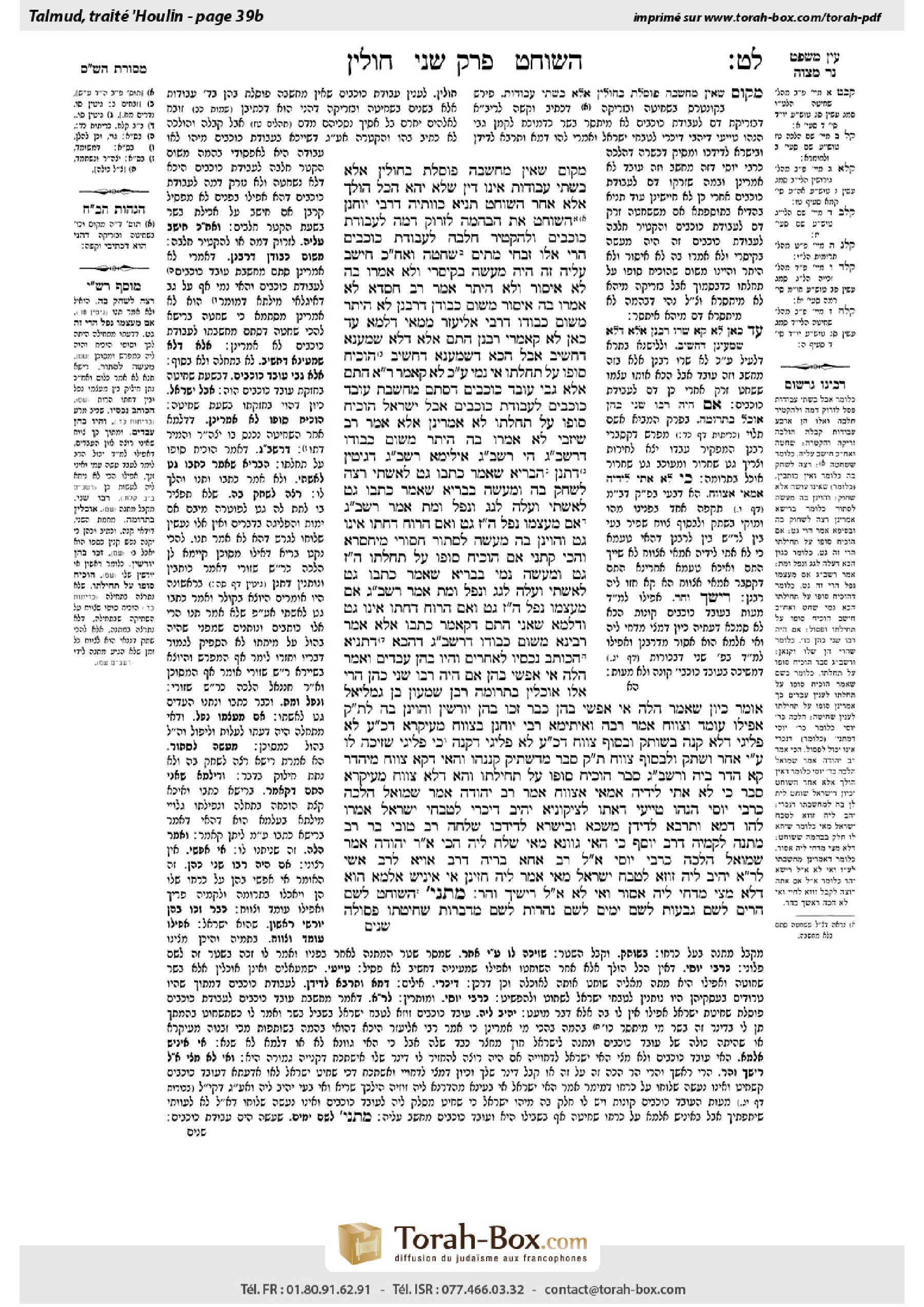
Scan : Torah-Box. Daf Study est un projet indépendant, sans affiliation ni approbation de Torah-Box ou de Sefaria.