Houlin 3a en français · חולין ג׳ א
Traduction française du daf 3a du traité Houlin (Chullin 3a en anglais), avec le texte araméen, l’anglais de Sefaria et le scan de la page, pour étudier le Daf Yomi.
Ouvrir dans le lecteur interactifLire le daf du jour
Traduction française de Houlin 3a
Les traductions françaises de Daf Study sont générées par IA à partir de l’édition anglaise de Sefaria. Elles peuvent contenir des erreurs : vérifie toujours un passage avec le texte source.
On déduit du rapprochement entre « égorgé » et « épée » que, selon la halakha, une épée ou tout autre ustensile métallique qui entre en contact avec un cadavre a le même statut que le cadavre lui-même. De même, si un ustensile métallique entre en contact avec une personne impure du fait d’un cadavre, il acquiert le statut de cette personne. Par conséquent, puisque cette personne est une source primaire d’impureté rituelle, qu’elle rende le couteau impur, qui deviendra lui aussi une source primaire d’impureté ; le couteau pourra alors rendre la chair impure.
Il s’agit plutôt d’un cas où la personne est devenue impure du fait d’un animal rampant ; puisqu’elle a le statut d’une personne atteinte d’une impureté de premier degré et ne rend pas les ustensiles impurs, le couteau reste rituellement pur. Et si tu préfères, dis plutôt qu’en réalité, elle est devenue impure du fait d’un cadavre, et qu’il s’agit d’un cas où l’on a examiné la tige d’un roseau, un ustensile plat en bois qui ne peut pas devenir rituellement impur, afin de s’assurer qu’elle était parfaitement lisse et sans entailles, puis qu’on a égorgé avec elle. Car il est enseigné dans une baraïta : On peut égorger un animal avec n’importe quel objet tranchant, que ce soit du silex, des éclats de verre ou une tige de roseau.
§ Abayé dit, pour résoudre la contradiction apparente dans la Michna, que voici ce qu’elle enseigne : Tout le monde peut égorger, même un Samaritain. Dans quel cas cette affirmation s’applique-t-elle ? Lorsque un Juif se tient auprès de lui et veille à ce qu’il égorge correctement ; mais si le Juif ne fait que sortir et entrer, sans être constamment présent, le Samaritain ne peut pas égorger l’animal.
Et si le Samaritain a égorgé l’animal sans surveillance, le Juif prélève sur l’animal égorgé un volume de viande équivalant à une olive et le donne au Samaritain à manger. Si le Samaritain le mange, le Juif est autorisé à manger de la viande de l’animal que le Samaritain a égorgé. Puisque les Samaritains sont scrupuleux au sujet de la viande qu’ils consomment et ne mangent que celle d’un animal égorgé conformément aux règles, le Juif peut en manger. Mais si le Samaritain ne mange pas la viande, on peut craindre que l’animal n’ait pas été égorgé correctement, et il est interdit de manger de la viande de l’animal que le Samaritain a égorgé.
Et il est enseigné : Cette règle s’applique à tout le monde, à l’exception d’un sourd-muet, d’un déficient intellectuel et d’un mineur : même s’ils n’ont égorgé que des animaux non consacrés, leur égorgement n’est pas valide, même a posteriori. Les Sages ont déclaré leur égorgement invalide de crainte que les personnes de ces catégories n’interrompent l’égorgement, n’appuient sur le couteau pendant l’égorgement ou ne dissimulent le couteau sous la trachée ou l’œsophage en procédant à un égorgement inversé.
La Guemara demande : Si c’est ainsi, à quel cas de la Michna renvoie la clause suivante : « Et si l’un d’entre eux a égorgé un animal et que d’autres le voient et le surveillent, son égorgement est valide » ? Si nous disons qu’elle renvoie au cas d’un sourd-muet, d’un déficient intellectuel et d’un mineur, puisque cette clause suit immédiatement la règle qui les concerne, le tanna aurait dû formuler ainsi : « Et s’ils ont égorgé », plutôt que : « Et si l’un d’entre eux a égorgé ».
Il s’agit peut-être plutôt du cas d’un Samaritain qui égorge. La Guemara rejette cette possibilité : Mais n’as-tu pas dit dans ce cas que, lorsqu’un Juif se tient auprès de lui, un Samaritain peut égorger même a priori ? La Guemara reconnaît que, selon cette explication de la Michna, sa formulation — « Et si l’un d’entre eux a égorgé » — pose une difficulté.
Rava dit : Dans un cas où un Juif sort et entre, n’est-il pas permis au Samaritain d’égorger l’animal a priori ? Mais n’avons-nous pas appris dans une Michna (Avoda Zara 69a) : « Si quelqu’un laisse un non-Juif dans sa boutique, où se trouve du vin, et qu’un Juif sort et entre, le vin est permis » ? De même que, dans ce cas, la présence intermittente du Juif suffit à empêcher le non-Juif de toucher au vin, elle devrait également suffire dans le cas d’un Samaritain qui égorge un animal. La Guemara rejette cette preuve : Dans le cas de la boutique, le tanna enseigne-t-il : « On laisse un non-Juif » a priori ? Le tanna enseigne : « Celui qui a laissé », après coup. Par conséquent, ce passage ne prouve pas que la présence intermittente du Juif suffit à autoriser a priori l’égorgement par un Samaritain.
On peut plutôt apporter une preuve de la Michna ici (Avoda Zara 61a) : lorsque des tonneaux de vin appartenant à un Juif sont en possession d’un non-Juif et qu’un Juif a été chargé de les surveiller, le surveillant n’a pas besoin de rester assis en permanence à les surveiller pour s’assurer que le non-Juif ne touche pas au vin ; même s’il sort et entre, le vin est permis. Cette Michna indique clairement que le fait de sortir et d’entrer suffit, même a priori.
Rava dit plutôt, pour résoudre la contradiction apparente d’une manière semblable à la solution proposée par Abayé, que voici ce que la Michna enseigne : Tout le monde peut égorger, même un Samaritain. Dans quel cas cette affirmation s’applique-t-elle ? Lorsque un Juif sort et entre ; mais si le Juif ne sort pas et n’entre pas, et qu’il arrive pour constater que le Samaritain a égorgé l’animal, le Juif prélève sur l’animal égorgé un volume de viande équivalant à une olive et le donne au Samaritain à manger. Si le Samaritain le mange, le Juif est autorisé à manger de la viande de l’animal que le Samaritain a égorgé. Mais si le Samaritain ne mange pas la viande, il est interdit de manger de la viande de l’animal que le Samaritain a égorgé.
Et il est enseigné : Cette règle s’applique à tout le monde, à l’exception d’un sourd-muet, d’un déficient intellectuel et d’un mineur, dont l’égorgement n’est pas valide, même a posteriori. Les Sages ont déclaré leur égorgement invalide de crainte que les personnes de ces catégories n’interrompent l’égorgement, n’appuient sur le couteau pendant l’égorgement ou ne dissimulent le couteau sous la trachée ou l’œsophage en procédant à un égorgement inversé. La Guemara demande : Si c’est ainsi, à quel cas de la Michna renvoie la clause suivante : « Et si l’un d’entre eux a égorgé un animal et que d’autres le voient et le surveillent, son égorgement est valide » ? Si nous disons qu’elle renvoie au cas d’un sourd-muet, d’un déficient intellectuel et d’un mineur, puisque cette clause suit immédiatement la règle qui les concerne, le tanna aurait dû formuler ainsi : « Et s’ils ont égorgé », plutôt que : « Et si l’un d’entre eux a égorgé ».
Il s’agit peut-être plutôt du cas d’un Samaritain qui égorge. La Guemara rejette cette possibilité : Mais n’as-tu pas dit que, si un Juif est présent, alors même s’il sort et entre sans être constamment présent, un Samaritain peut égorger a priori ? La Guemara reconnaît que, selon cette explication de la Michna, sa formulation — « Et si l’un d’entre eux a égorgé » — pose une difficulté.
§ Rav Achi dit, pour résoudre la contradiction apparente dans la Michna, que voici ce qu’elle enseigne : Tout le monde peut égorger, même un Juif transgresseur [meshummad]. La Guemara demande : De quel genre de transgresseur s’agit-il ? La Guemara répond : Il s’agit de celui dont la transgression consiste à manger des carcasses d’animaux non égorgés pour satisfaire son appétit, c’est-à-dire par commodité. Et la décision de la Michna est conforme à l’enseignement de Rava, car Rava dit : Dans le cas d’un Juif transgresseur dont la transgression consiste à manger des carcasses d’animaux non égorgés pour satisfaire son appétit, s’il souhaite égorger un animal,
Texte source et traduction anglaise
חולין ג׳ א · texte araméen et hébreu
חֶרֶב הֲרֵי הוּא כֶּחָלָל, אַב הַטּוּמְאָה הוּא, לְטַמְּיֵיהּ לְסַכִּין, וַאֲזַל סַכִּין וְטַמִּיתֵיהּ לְבָשָׂר!
אֶלָּא דְּאִיטַּמִּי בְּשֶׁרֶץ, וְאִי בָּעֵית אֵימָא: לְעוֹלָם דְּאִיטַּמִּי בְּמֵת, וּכְגוֹן שֶׁבָּדַק קְרוּמִית שֶׁל קָנֶה וְשָׁחַט בָּהּ, דְּתַנְיָא: בַּכֹּל שׁוֹחֲטִים, בֵּין בְּצוֹר בֵּין בִּזְכוּכִית בֵּין בִּקְרוּמִית שֶׁל קָנֶה.
אַבָּיֵי אָמַר: הָכִי קָתָנֵי – הַכֹּל שׁוֹחֲטִין, וַאֲפִילּוּ כּוּתִי. בַּמֶּה דְּבָרִים אֲמוּרִים? כְּשֶׁיִּשְׂרָאֵל עוֹמֵד עַל גַּבָּיו, אֲבָל יוֹצֵא וְנִכְנָס – לֹא יִשְׁחוֹט.
וְאִם שָׁחַט, חוֹתֵךְ כְּזַיִת בָּשָׂר וְנוֹתֵן לוֹ. אֲכָלוֹ – מוּתָּר לֶאֱכוֹל מִשְּׁחִיטָתוֹ, לֹא אֲכָלוֹ – אָסוּר לֶאֱכוֹל מִשְּׁחִיטָתוֹ.
חוּץ מֵחֵרֵשׁ שׁוֹטֶה וְקָטָן, דַּאֲפִילּוּ דִּיעֲבַד נָמֵי לָא, שֶׁמָּא יִשְׁהוּ, שֶׁמָּא יִדְרְסוּ, וְשֶׁמָּא יַחֲלִידוּ.
וְכוּלָּן שֶׁשָּׁחֲטוּ, אַהֵיָיא? אִילֵּימָא אַחֵרֵשׁ שׁוֹטֶה וְקָטָן – עֲלַהּ קָאֵי, ״וְאִם שָׁחֲטוּ״ מִבְּעֵי לֵיהּ!
אֶלָּא, אַכּוּתִי – הָא אָמְרַתְּ: כְּשֶׁיִּשְׂרָאֵל עוֹמֵד עַל גַּבָּיו שָׁחֵיט אֲפִילּוּ לְכַתְּחִלָּה! קַשְׁיָא.
אָמַר רָבָא: וְיוֹצֵא וְנִכְנָס, לְכַתְּחִלָּה לָא? וְהָתְנַן: הַמַּנִּיחַ נָכְרִי בַּחֲנוּתוֹ וְיִשְׂרָאֵל יוֹצֵא וְנִכְנָס – מוּתָּר! הָתָם מִי קָתָנֵי ״מַנִּיחַ״? ״הַמַּנִּיחַ״ קָתָנֵי, דִּיעֲבַד.
אֶלָּא מֵהָכָא: אֵין הַשּׁוֹמֵר צָרִיךְ לִהְיוֹת יוֹשֵׁב וּמְשַׁמֵּר, אֶלָּא אַף עַל פִּי שֶׁיּוֹצֵא וְנִכְנָס – מוּתָּר.
אֶלָּא אָמַר רָבָא, הָכִי קָתָנֵי: הַכֹּל שׁוֹחֲטִין, וַאֲפִילּוּ כּוּתִי. בַּמֶּה דְּבָרִים אֲמוּרִים? כְּשֶׁיִּשְׂרָאֵל יוֹצֵא וְנִכְנָס, אֲבָל בָּא וּמְצָאוֹ שֶׁשָּׁחַט – חוֹתֵךְ כַּזַּיִת בָּשָׂר וְנוֹתֵן לוֹ, אֲכָלוֹ – מוּתָּר לֶאֱכוֹל מִשְּׁחִיטָתוֹ, לֹא אֲכָלוֹ – אָסוּר לֶאֱכוֹל מִשְּׁחִיטָתוֹ.
חוּץ מֵחֵרֵשׁ שׁוֹטֶה וְקָטָן, דַּאֲפִילּוּ דִּיעֲבַד נָמֵי לָא, שֶׁמָּא יִשְׁהוּ, וְשֶׁמָּא יִדְרְסוּ, וְשֶׁמָּא יַחֲלִידוּ. וְכוּלָּן שֶׁשָּׁחֲטוּ – אַהֵיָיא? אִילֵּימָא אַחֵרֵשׁ שׁוֹטֶה וְקָטָן – עֲלַהּ קָאֵי, ״וְאִם שָׁחֲטוּ״ מִבְּעֵי לֵיהּ!
אֶלָּא אַכּוּתִי? הָא אָמְרַתְּ: אֲפִילּוּ יוֹצֵא וְנִכְנָס שָׁחֵיט לְכַתְּחִלָּה! קַשְׁיָא.
רַב אָשֵׁי אָמַר: הָכִי קָתָנֵי – הַכֹּל שׁוֹחֲטִין, וַאֲפִילּוּ יִשְׂרָאֵל מְשׁוּמָּד. מְשׁוּמָּד לְמַאי? לֶאֱכוֹל נְבֵילוֹת לְתֵיאָבוֹן, וְכִדְרָבָא, דְּאָמַר רָבָא: יִשְׂרָאֵל מְשׁוּמָּד אוֹכֵל נְבֵילוֹת לְתֵיאָבוֹן
Chullin 3a · traduction anglaise de Sefaria
It is derived from the juxtaposition of “slain” to “sword” that the halakhic status of a sword or any other metal vessel that comes into contact with a corpse is like that of a corpse itself. Similarly, if a metal utensil comes in contact with a person impure with impurity imparted by a corpse, it assumes his status. Therefore, since the impure person is a primary source of ritual impurity, let him render the knife impure, rendering it as well a primary source of impurity, and the knife then goes and renders the flesh impure.
Rather, it is a case where the person became impure with impurity imparted by a creeping animal; as he assumes first-degree ritual impurity status and does not render vessels impure, the knife remains ritually pure. And if you wish, say instead that actually he became impure with impurity imparted by a corpse, and it is a case where one examined the stalk of a reed, which is a flat wooden vessel that does not become ritually impure, to ensure that it is perfectly smooth with no nicks, and slaughtered with it, as it is taught in a baraita: One may slaughter an animal with any sharp object, whether with a flint, or with glass shards, or with the stalk of a reed.
§ Abaye said in resolution of the apparent contradiction in the mishna that this is what the mishna is teaching: Everyone slaughters, and even a Samaritan. In what case is this statement said? It is said in a case where a Jew is standing over him and ensuring that he slaughters properly; but if the Jew merely exits and enters and does not have a constant presence, the Samaritan may not slaughter the animal.
And if the Samaritan slaughtered the animal without supervision, the Jew cuts an olive-bulk of meat from the slaughtered animal and gives it to the Samaritan to eat. If the Samaritan ate it, it is permitted for the Jew to eat meat from what the Samaritan slaughtered. Since Samaritans are meticulous with regard to the meat that they eat and eat meat only from an animal that was slaughtered properly, the Jew may partake of the meat. But if the Samaritan did not eat the meat, there is concern that the animal was not slaughtered properly, and it is prohibited to eat from what the Samaritan slaughtered.
And it teaches: This is the halakha with regard to all people except for a deaf-mute, an imbecile, and a minor, who, even if they slaughtered only non-sacred animals, their slaughter is not valid even after the fact. The reason the Sages deemed such slaughter not valid is lest people in these categories interrupt the slaughter, lest they press the knife in the course of slaughter, and lest they conceal the knife beneath the windpipe or the gullet in the course of an inverted slaughter.
The Gemara asks: If so, with regard to the clause in the mishna that follows: And any of them who slaughtered an animal and others see and supervise them, their slaughter is valid, to which case in the mishna is it referring? If we say that the reference is to the case of a deaf-mute, an imbecile, and a minor, since that is the halakha to which it stands adjacent, the tanna should have formulated the phrase: And if they slaughtered, instead of: And any of them who slaughtered.
Rather, perhaps the reference is to the case of a Samaritan who slaughters. The Gemara rejects that possibility. But didn’t you say in that case: When a Jew is standing over him, a Samaritan may slaughter even ab initio? The Gemara concedes that the formulation of the mishna: And any of them who slaughtered, is difficult according to this explanation of the mishna.
Rava said: And in a case where a Jew exits and enters, is it not permitted for the Samaritan to slaughter the animal ab initio? But didn’t we learn in a mishna (Avoda Zara 69a): In the case of one who leaves a gentile in his store in which there is wine, and a Jew exits and enters, the wine is permitted? Just as there, the sporadic presence of the Jew is sufficient to ensure that the gentile will refrain from touching the wine, it should be sufficient in the case of a Samaritan who slaughters an animal as well. The Gemara rejects that proof. There, in the case of the store, does the tanna teach: One leaves a gentile ab initio? The tanna teaches: One who leaves, after the fact. Consequently, there is no proof from there that the Jew’s sporadic presence is sufficient to permit slaughter by a Samaritan ab initio.
Rather, proof can be cited from the mishna here (Avoda Zara 61a): In a case where barrels of wine belonging to a Jew are in the possession of a gentile, and a Jew was tasked with supervising those barrels, the supervisor need not be continuously sitting and supervising to ensure that the gentile does not touch the wine; rather, even if the supervisor exits and enters, the wine is permitted. This mishna clearly indicates that exiting and entering is sufficient even ab initio.
Rather, Rava said in resolution of the apparent contradiction similar to the resolution proposed by Abaye, that this is what the mishna is teaching: Everyone slaughters, and even a Samaritan. In what case is this statement said? It is said in a case where a Jew exits and enters; but if the Jew does not exit and enter and instead came and found that the Samaritan slaughtered the animal, the Jew cuts an olive-bulk of meat from the slaughtered animal and gives it to the Samaritan to eat. If the Samaritan ate it, it is permitted for the Jew to eat meat from what the Samaritan slaughtered. But if the Samaritan did not eat the meat, it is prohibited to eat from what the Samaritan slaughtered.
And it teaches: This is the halakha with regard to all people except for a deaf-mute, an imbecile, and a minor, whose slaughter is not valid even after the fact. The reason the Sages deemed such slaughter not valid is lest people in these categories interrupt the slaughter, lest they press the knife in the course of slaughter, and lest they conceal the knife beneath the windpipe or the gullet in the course of an inverted slaughter. The Gemara asks: If so, with regard to the clause in the mishna that follows: And any of them who slaughtered an animal and others see and supervise them, their slaughter is valid, to which case in the mishna is this referring? If we say that the reference is to the case of a deaf-mute, an imbecile, and a minor, since that is the halakha to which it stands adjacent, the tanna should have formulated the phrase: And if they slaughtered, instead of: And any of them who slaughtered.
Rather, perhaps the reference is to the case of a Samaritan who slaughters. The Gemara rejects that possibility. But didn’t you say that if a Jew is present, then even if he exits and enters and does not have a constant presence, a Samaritan may slaughter even ab initio? The Gemara concedes that the formulation of the mishna: And any of them who slaughtered, is difficult according to this explanation of the mishna.
§ Rav Ashi said in resolution of the apparent contradiction in the mishna that this is what the mishna is teaching: Everyone slaughters, and even a Jewish transgressor [meshummad]. The Gemara asks: A transgressor of what sort? The Gemara answers: It is one whose transgression is to eat unslaughtered animal carcasses to satisfy his appetite, i.e., for his convenience. And the ruling of the mishna is in accordance with the statement of Rava, as Rava says: In the case of a Jewish transgressor whose transgression is that he eats unslaughtered animal carcasses to satisfy his appetite, if he seeks to slaughter an animal,
Texte de Sefaria : William Davidson Edition - Vocalized Aramaic (unknown) ; William Davidson Edition - English (CC BY NC).
Scan de Houlin 3a
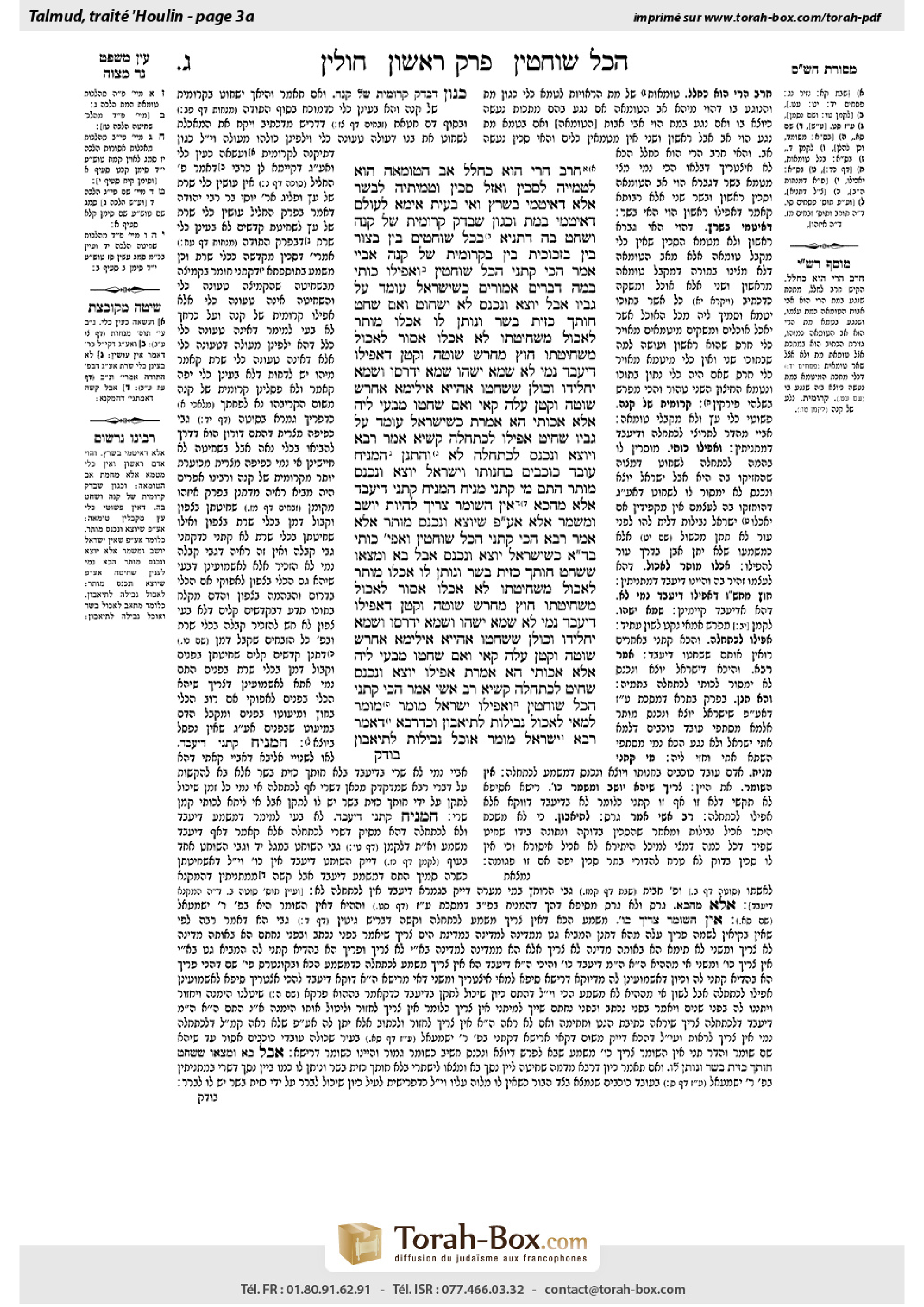
Scan : Torah-Box. Daf Study est un projet indépendant, sans affiliation ni approbation de Torah-Box ou de Sefaria.