Guittin 72b en français · גיטין ע״ב ב
Traduction française du daf 72b du traité Guittin (Gittin 72b en anglais), avec le texte araméen, l’anglais de Sefaria et le scan de la page, pour étudier le Daf Yomi.
Ouvrir dans le lecteur interactifLire le daf du jour
Traduction française de Guittin 72b
Les traductions françaises de Daf Study sont générées par IA à partir de l’édition anglaise de Sefaria. Elles peuvent contenir des erreurs : vérifie toujours un passage avec le texte source.
si Rabbi Yosei affirme que la date inscrite sur un document détermine le moment où il prend effet, même lorsque le mari a énoncé une condition verbale en le remettant, ou s’il n’applique pas son principe dans un tel cas.
La Guemara demande : Mais Rav Huna a-t-il des doutes à ce sujet ? N’avons-nous pas appris dans une Michna (76b) : Si un homme dit à sa femme : « Voici ton acte de divorce, à condition que je ne revienne pas ici d’ici la fin des douze mois », et qu’il meurt avant l’expiration des douze mois, l’acte de divorce n’est pas valide, car il ne prend effet qu’à la fin des douze mois, donc après la mort du mari ? Par conséquent, si son mari n’a pas d’enfants, elle est liée par le lien de lévirat. Or, il est enseigné à propos de cette Michna : Nos Rabbins sont en désaccord et l’ont autorisée à se remarier, car ils estiment qu’il n’y a pas de lien de lévirat dans ce cas.
Et nous disons : Qui représente l’opinion désignée par l’expression « nos Rabbins » ? Rav Yehuda dit au nom de Shmuel : Il s’agit du tribunal qui a autorisé la consommation d’huile fabriquée par des non-Juifs, et ses membres suivent l’opinion de Rabbi Yosei, qui dit que la date inscrite sur un document détermine le moment où il prend effet. Il apparaît donc que, selon Rabbi Yosei, ce principe s’applique même lorsque le mari a énoncé verbalement une condition concernant l’acte de divorce.
Il faut plutôt dire ceci : Rav Huna ne sait pas si la halakha suit l’opinion de Rabbi Yosei lorsque le mari ajoute une condition verbale en remettant le document, ou si, dans un tel cas, la halakha ne suit pas son opinion.
La Guemara demande : Mais Rav Huna a-t-il des doutes à ce sujet ? Rava n’a-t-il pas dit : Si un homme dit à sa femme : « Voici ton acte de divorce si je meurs » ou « Voici ton acte de divorce quand je serai mort », l’acte de divorce est valide. S’il lui dit : « Quand je mourrai » ou « Après ma mort », l’acte de divorce n’est pas valide.
La Guemara précise : Dans quelles circonstances ? Si l’on suppose qu’il lui a dit : « Voici ton acte de divorce à partir d’aujourd’hui si je meurs », et que la déclaration de Rava suit l’opinion des Rabbins, qui est l’opinion anonyme de la Michna, était-il nécessaire qu’un amora comme Rava énonce cette halakha ? N’avons-nous pas appris explicitement dans la Michna que, s’il a dit : « Voici ton acte de divorce à partir d’aujourd’hui si je meurs », l’acte de divorce est valide ? Mais ne s’agit-il pas plutôt d’un cas où il n’a pas dit « à partir d’aujourd’hui » en remettant l’acte de divorce, et où la déclaration de Rava suit l’opinion de Rabbi Yosei ? Déduis-en que la halakha suit l’opinion de Rabbi Yosei.
La Guemara répond : Pour Rava, il est évident que la halakha suit l’opinion de Rabbi Yosei même lorsque le mari ajoute une condition verbale. En revanche, Rav Huna ne sait pas si telle est ou non la halakha.
Et si tu le souhaites, dis plutôt : En réalité, la déclaration de Rava porte sur un cas où il lui a dit : « Voici ton acte de divorce à partir d’aujourd’hui », et elle suit l’opinion des Rabbins. Rava devait énoncer sa décision afin d’enseigner la halakha concernant ces expressions qui ne figurent pas dans la Michna : premièrement, dire « quand je serai mort » est considéré comme équivalant à dire « si je meurs » ; deuxièmement, dire « quand je mourrai » est considéré comme équivalant à dire « après ma mort ».
§ Certains enseignent cette déclaration de Rav Huna à propos de la dernière partie de la Michna, qui dit que si le mari a déclaré : « Voici ton acte de divorce après ma mort », l’acte de divorce n’est pas valide et c’est comme s’il n’avait rien dit. Rav Huna dit : Selon l’opinion de Rabbi Yosei, elle doit néanmoins accomplir la ḥalitsa, car on ne sait pas si l’acte de divorce prend effet à partir du jour où il a été remis, puisque la date a été indiquée verbalement.
La Guemara conteste cette version de la déclaration de Rav Huna : Cela va de soi. Puisque, dans la dernière partie de la Michna, il est enseigné que, dans un cas où le mari a explicitement dit « à partir d’aujourd’hui », elle doit accomplir la ḥalitsa selon l’opinion des Rabbins, parce qu’il y a une incertitude quant au moment où l’acte de divorce prend effet, il va de soi que, dans la première partie aussi, lorsqu’il n’a pas ajouté « à partir d’aujourd’hui », elle doit accomplir la ḥalitsa selon l’opinion de Rabbi Yosei, en raison de cette incertitude. Le désaccord entre Rabbi Yosei et les Rabbins porte uniquement sur la nécessité pour le mari d’ajouter les mots « à partir d’aujourd’hui ».
La Guemara répond : Sa déclaration est nécessaire, de peur que tu ne dises que, sur ce point, Rabbi Yosei est d’accord avec Rabbi Yehuda HaNasi, qui dit que l’acte de divorce est valide et que l’épouse n’a même pas à accomplir la ḥalitsa. Rav Huna nous enseigne donc que Rabbi Yehuda HaNasi n’est pas d’accord avec Rabbi Yosei, et que Rabbi Yosei n’est pas d’accord avec Rabbi Yehuda HaNasi. Chacun a une opinion qui lui est propre, quoique similaire à celle de l’autre.
La Guemara explique : Rabbi Yehuda HaNasi ne partage pas l’opinion de Rabbi Yosei, comme l’enseigne une baraïta : Si le mari a dit : « Voici ton acte de divorce à partir d’aujourd’hui et après ma mort », Rabbi Yehuda HaNasi dit : « Un tel cas constitue un acte de divorce valide », et l’épouse n’a pas besoin d’accomplir la ḥalitsa. En soulignant les mots « un tel cas », Rabbi Yehuda HaNasi entend exclure l’opinion de Rabbi Yosei, pour qui la question est incertaine. De même, Rabbi Yosei ne partage pas l’opinion de Rabbi Yehuda HaNasi, comme l’enseigne une Michna : Rabbi Yosei dit : « Un tel cas constitue un acte de divorce valide », excluant ainsi l’opinion de Rabbi Yehuda HaNasi.
La Guemara cite la baraïta et la Michna qui illustrent le désaccord entre Rabbi Yehuda HaNasi et Rabbi Yosei. Quelle est l’opinion de Rabbi Yehuda HaNasi ? Comme il est enseigné dans une baraïta : Si un mari dit à sa femme : « Voici ton acte de divorce à partir d’aujourd’hui et après ma mort », il y a une incertitude quant à savoir s’il s’agit ou non d’un acte de divorce, et l’épouse doit accomplir la ḥalitsa. Telle est l’opinion des Rabbins. Rabbi Yehuda HaNasi s’y oppose et dit : « Un tel cas constitue un acte de divorce valide », sans aucune incertitude, et l’épouse n’a pas besoin d’accomplir la ḥalitsa.
Quelle est l’opinion de Rabbi Yosei ? Comme nous l’avons appris dans une Michna (76b) : Si quelqu’un dit : « Écrivez et remettez un acte de divorce à ma femme si je ne suis pas revenu d’ici la fin des douze mois », et que le tribunal rédige l’acte de divorce pendant les douze mois et le remet à l’épouse après leur expiration, l’acte de divorce n’est pas valide. Rabbi Yosei s’y oppose et dit : « Un tel cas constitue un acte de divorce valide. »
§ La Michna enseigne : Si un homme dit à sa femme : « Voici ton acte de divorce à partir d’aujourd’hui si je meurs de cette maladie », qu’il guérit, se lève et marche sur la place du marché, puis retombe malade et meurt, il faut déterminer s’il est mort de la première maladie ; dans ce cas, l’acte de divorce est valide. Mais s’il n’est pas mort de cette maladie, l’acte de divorce n’est pas valide.
Rav Huna dit : Pour un homme sur son lit de mort, les règles relatives à son acte de divorce sont les mêmes que celles qui régissent son don. Les Sages ont institué que lorsqu’un homme sur son lit de mort fait un don, aucun acte formel d’acquisition n’est requis. De même que, pour son don, s’il se lève et guérit de sa maladie, le don qu’il a fait sur son lit de mort est révoqué, car il ne l’a accordé que parce qu’il pensait être sur le point de mourir, de même, s’il se lève et guérit de sa maladie, l’acte de divorce est révoqué et annulé : il ne l’a remis à sa femme que parce qu’il pensait être sur le point de mourir et voulait la dispenser du lien de lévirat.
Rav Huna poursuit : De même que, dans le cas de son acte de divorce, bien qu’il n’ait pas exprimé explicitement toute son intention, dès lors qu’il a dit : « Écrivez l’acte de divorce », ses paroles sont interprétées comme signifiant que le tribunal doit remettre l’acte de divorce à sa femme, même s’il n’a pas dit : « Remettez l’acte de divorce à ma femme », ce qu’un homme en bonne santé devrait préciser, de même en va-t-il pour son don. Dès lors qu’il a dit : « Faites le don », les bénéficiaires n’ont pas besoin de l’acquérir auprès de lui — ce qui est nécessaire pour qu’un don fait par une personne en bonne santé devienne définitif — car, puisqu’il est mourant, la halakha tient compte de son intention sans exiger toutes les formalités juridiques habituelles.
La Guemara objecte : Nous avons appris dans la Michna : Si un homme dit : « Voici ton acte de divorce à partir d’aujourd’hui si je meurs de cette maladie », qu’il guérit, se lève et marche sur la place du marché, puis retombe malade et meurt, le tribunal doit déterminer les circonstances. S’il est mort à cause de la première maladie, l’acte de divorce est valide ; sinon, il ne l’est pas. Or, si tu dis que l’acte de divorce est révoqué dès qu’il se lève et guérit de sa maladie, pourquoi faut-il procéder à cette détermination ? Il s’est levé de son lit de malade ; l’acte de divorce aurait donc dû être automatiquement annulé.
Mar, fils de Rav Yosef, dit au nom de Rava : Cela concerne un cas où, au lieu de guérir complètement, il est passé immédiatement d’une maladie à une autre ; il faut déterminer s’il est mort de la première maladie ou de la seconde.
La Guemara objecte : Mais n’est-il pas enseigné dans la Michna qu’il s’est levé de sa maladie, ce qui indique qu’il a complètement guéri ? La Guemara répond : Non, cela signifie qu’il s’est remis de cette maladie, mais qu’il est tombé malade d’une autre. La Guemara objecte : Mais n’est-il pas également enseigné dans la Michna qu’il a marché sur la place du marché ? La Guemara répond : Cela signifie qu’il marchait en s’appuyant sur son bâton, c’est-à-dire qu’il n’avait pas complètement guéri, mais qu’il pouvait marcher uniquement avec de l’aide.
Texte source et traduction anglaise
גיטין ע״ב ב · texte araméen et hébreu
אִי אָמַר רַבִּי יוֹסֵי בְּעַל פֶּה, אִי לָא אָמַר.
וּמִי מְסַפְּקָא לֵיהּ?! וְהָתְנַן: ״הֲרֵי זֶה גִּיטִּיךְ אִם לֹא בָּאתִי מִכָּאן וְעַד שְׁנֵים עָשָׂר חֹדֶשׁ״, וּמֵת בְּתוֹךְ שְׁנֵים עָשָׂר חֹדֶשׁ – אֵינוֹ גֵּט. וְתָנֵי עֲלַהּ: רַבּוֹתֵינוּ הִתִּירוּהָ לְהִינָּשֵׁא.
וְאָמְרִינַן: מַאן רַבּוֹתֵינוּ? אָמַר רַב יְהוּדָה אָמַר שְׁמוּאֵל: בֵּי דִינָא דִּשְׁרוֹ מִישְׁחָא; וְסָבְרִי לַהּ כְּרַבִּי יוֹסֵי, דְּאָמַר: זְמַנּוֹ שֶׁל שְׁטָר מוֹכִיחַ עָלָיו.
אֶלָּא מְסַפְּקָא לֵיהּ אִי הֲלָכָה כְּרַבִּי יוֹסֵי בְּעַל פֶּה, אוֹ אֵין הֲלָכָה.
וּמִי מְסַפְּקָא לֵיהּ?! וְהָאָמַר רָבָא: ״הֲרֵי זֶה גִּיטִּיךְ אִם מַתִּי״ וְ״שֶׁאֲנִי מֵת״ – הֲרֵי זֶה גֵּט. ״כְּשֶׁאָמוּת״ וּ״לְאַחַר מִיתָה״ – אֵין זֶה גֵּט.
הֵיכִי דָּמֵי? אִילֵימָא דְּאָמַר לַהּ ״מֵהַיּוֹם״, וְרַבָּנַן; צְרִיכָא לְמֵימַר?! וְהָתְנַן: ״מֵהַיּוֹם אִם מַתִּי״ – הֲרֵי זֶה גֵּט! וְאֶלָּא לָאו דְּלָא אָמַר לַהּ ״מֵהַיּוֹם״, וְרַבִּי יוֹסֵי? שְׁמַע מִינַּהּ הֲלָכָה כְּרַבִּי יוֹסֵי!
לְרָבָא פְּשִׁיטָא לֵיהּ, לְרַב הוּנָא מְסַפְּקָא לֵיהּ.
וְאִיבָּעֵית אֵימָא: לְעוֹלָם דַּאֲמַר לַהּ ״מֵהַיּוֹם״ – וְרַבָּנַן, וְהָנֵי לִישָּׁנֵי אִיצְטְרִיכִי לֵיהּ: ״שֶׁאֲנִי מֵת״ – כְּ״אִם מַתִּי״ דָּמֵי; ״כְּשֶׁאָמוּת״ – כִּ״לְאַחַר מִיתָה״ דָּמֵי.
וְאִיכָּא דְּמַתְנֵי לַהּ אַסֵּיפָא: ״זֶה גִּיטִּיךְ לְאַחַר מִיתָה״ – לֹא אָמַר כְּלוּם. אָמַר רַב הוּנָא: וּלְדִבְרֵי רַבִּי יוֹסֵי, חוֹלֶצֶת.
פְּשִׁיטָא, מִדְּסֵיפָא – לְרַבָּנַן חוֹלֶצֶת, רֵישָׁא נָמֵי – לְרַבִּי יוֹסֵי חוֹלֶצֶת!
מַהוּ דְּתֵימָא, רַבִּי יוֹסֵי בְּהָא כְּרַבִּי סְבִירָא לֵיהּ – דְּאָמַר: גִּיטָּא מְעַלְּיָא הָוֵי, וַחֲלִיצָה נָמֵי לָא תִּיבְעֵי; קָא מַשְׁמַע לַן דְּלָא רַבִּי סָבַר לַהּ כְּרַבִּי יוֹסֵי, וְלָא רַבִּי יוֹסֵי סָבַר לַהּ כְּרַבִּי.
רַבִּי לָא סָבַר לַהּ כְּרַבִּי יוֹסֵי – דְּקָתָנֵי: ״כָּזֶה – גֵּט״, לְמַעוֹטֵי דְּרַבִּי יוֹסֵי; וְרַבִּי יוֹסֵי לָא סָבַר לַהּ כְּרַבִּי – דְּקָתָנֵי: ״כָּזֶה – גֵּט״, לְמַעוֹטֵי דְּרַבִּי.
רַבִּי מַאי הִיא? דְּתַנְיָא: ״מֵהַיּוֹם וּלְאַחַר מִיתָה״ – גֵּט וְאֵינוֹ גֵּט, דִּבְרֵי חֲכָמִים; רַבִּי אוֹמֵר: כָּזֶה – גֵּט.
רַבִּי יוֹסֵי מַאי הִיא? דִּתְנַן: ״כִּתְבוּ וּתְנוּ גֵּט לְאִשְׁתִּי, אִם לֹא בָּאתִי מִיכָּן וְעַד שְׁנֵים עָשָׂר חֹדֶשׁ״, כְּתָבוּהוּ בְּתוֹךְ שְׁנֵים עָשָׂר חֹדֶשׁ וּנְתָנוּהוּ לְאַחַר שְׁנֵים עָשָׂר חֹדֶשׁ – אֵינוֹ גֵּט; רַבִּי יוֹסֵי אוֹמֵר: כָּזֶה – גֵּט.
״זֶה גִּיטִּיךְ מֵהַיּוֹם, אִם מַתִּי מֵחוֹלִי זֶה״, וְעָמַד וְהָלַךְ בַּשּׁוּק כּוּ׳.
אָמַר רַב הוּנָא: גִּיטּוֹ כְּמַתְּנָתוֹ; מָה מַתְּנָתוֹ, אִם עָמַד – חוֹזֵר; אַף גִּיטּוֹ, אִם עָמַד – חוֹזֵר.
וּמָה גִּיטּוֹ – אַף עַל גַּב דְּלָא פָּרֵישׁ, כֵּיוָן דְּאָמַר ״כְּתוֹבוּ״ – אַף עַל גַּב דְּלָא אָמַר ״תְּנוּ״; אַף מַתְּנָתוֹ, כֵּיוָן דְּאָמַר ״תְּנוּ״ – אַף עַל גַּב דְּלָא קְנוֹ מִינֵּיהּ.
תְּנַן: ״זֶה גִּיטִּיךְ מֵהַיּוֹם, אִם מַתִּי מֵחוֹלִי זֶה״, וְעָמַד וְהָלַךְ בַּשּׁוּק, וְחָלָה וָמֵת; אוֹמְדִים אוֹתוֹ – אִם מֵחֲמַת חוֹלִי הָרִאשׁוֹן מֵת, הֲרֵי זֶה גֵּט; אִם לָאו, אֵינוֹ גֵּט. וְאִי אָמְרַתְּ ״אִם עָמַד – חוֹזֵר״, לְמָה לִי אוּמְדָּנָא? הֲרֵי עָמַד!
אָמַר מָר בְּרֵיהּ דְּרַב יוֹסֵף מִשְּׁמֵיהּ דְּרָבָא: שֶׁנִּיתַּק מֵחוֹלִי לְחוֹלִי.
וְהָא ״עָמַד״ קָתָנֵי! עָמַד מֵחוֹלִי זֶה, וְנָפַל לְחוֹלִי אַחֵר. וְהָא ״הָלַךְ בַּשּׁוּק״ קָתָנֵי! הָלַךְ עַל מִשְׁעַנְתּוֹ;
Gittin 72b · traduction anglaise de Sefaria
if Rabbi Yosei says that the date on which a document is written proves when it takes effect even when the husband stated a verbal condition as he handed it over, or if Rabbi Yosei does not say his principle in such a case.
The Gemara asks: But is Rav Huna uncertain with regard to this matter? But didn’t we learn in a mishna (76b): If one says to his wife: This is hereby your bill of divorce if I have not come back here from now until the conclusion of twelve months, and he died within twelve months, then it is not a valid bill of divorce because the bill of divorce does not take effect until the end of twelve months, which is after the husband’s death? As a result, she is bound by a levirate bond if her husband has no children. And it is taught with regard to that mishna: Our Rabbis disagree, and they rendered it permitted for her to marry, because they are of the opinion that there is no levirate bond in this case.
And we say: Who represents the opinion cited as our Rabbis? Rav Yehuda says that Shmuel says: It is the court that permitted the consumption of oil manufactured by gentiles, and they hold in accordance with the opinion of Rabbi Yosei, who says: The date written in a document proves when it takes effect. Evidently, according to Rabbi Yosei this principle applies even when the husband made a verbal condition with regard to the bill of divorce.
Rather, it is necessary to say as follows: Rav Huna is uncertain if the halakha is in accordance with the opinion of Rabbi Yosei when the husband adds a verbal condition when giving the document, or if the halakha is not in accordance with Rabbi Yosei’s opinion in such a case.
The Gemara asks: But is Rav Huna uncertain with regard to this matter? But didn’t Rava say: If one says to his wife: This is hereby your bill of divorce if I die, or: “This is your bill of divorce when I am dead, then this is a valid bill of divorce? If he said to her: When I die, or: After my death, then this is not a valid bill of divorce.
The Gemara clarifies: What are the circumstances? If we say that he said to her: This is your bill of divorce from today if I die, and Rava’s statement is in accordance with opinion of the Rabbis, which is the unattributed opinion of the mishna, is it necessary that this halakha be said by Rava, an amora? But didn’t we learn explicitly in the mishna that if he said: This is your bill of divorce from today if I die, then it is a valid bill of divorce? But rather, is it not speaking about a case where he did not say the term: From today, when he gave the bill of divorce, and Rava’s statement is in accordance with the opinion of Rabbi Yosei? Conclude from it that the halakha is in accordance with the opinion of Rabbi Yosei.
The Gemara answers: It is obvious to Rava that the halakha is in accordance with the opinion of Rabbi Yosei even when the husband added a verbal condition. But according to Rav Huna, it is uncertain whether or not this is the halakha.
And if you wish, say instead: Actually, Rava’s statement is referring to a case where he said to her: This is your bill of divorce from today, and it is in accordance with opinion of the Rabbis. And it was necessary for Rava to state his ruling to teach the halakha of these expressions not stated in the mishna: First, the husband saying: When I am dead, is considered to be like the expression: If I die. Second, the husband saying: When I die, is considered to be like the expression: After my death.
§ And there are those who teach this statement of Rav Huna with regard to the latter clause of the mishna, which states that if the husband said: This is your bill of divorce after my death, then the bill of divorce is invalid and it is as though he said nothing. Rav Huna says: But according to the statement of Rabbi Yosei she must nevertheless perform ḥalitza, as it is uncertain if the bill of divorce takes effect from the day the bill of divorce was given when the date is supplied verbally.
The Gemara questions this version of Rav Huna’s statement: This is obvious. Since it was taught in the latter clause of the mishna, in a case where he explicitly stated: From today, that according to the opinion of the Rabbis she must perform ḥalitza due to the uncertainty as to when the bill of divorce takes effect, in the first clause as well, when he did not add: From today, it is obvious that according to the opinion of Rabbi Yosei she must perform ḥalitza due to the uncertainty. The dispute between Rabbi Yosei and the Rabbis concerns only whether the husband needs to add the term: From today.
The Gemara answers: His statement is necessary, lest you say that with regard to this, Rabbi Yosei holds in accordance with the opinion of Rabbi Yehuda HaNasi, who says: It is a proper bill of divorce, and she is not even required to perform ḥalitza. Therefore, Rav Huna teaches us that Rabbi Yehuda HaNasi does not hold in accordance with the opinion of Rabbi Yosei and Rabbi Yosei does not hold in accordance with the opinion of Rabbi Yehuda HaNasi. Each has a unique, albeit similar, opinion.
The Gemara explains: Rabbi Yehuda HaNasi does not hold in accordance with the opinion of Rabbi Yosei, as it teaches in a baraita: If the husband said: This is your bill of divorce from today and after my death, Rabbi Yehuda HaNasi says: A case like this is a valid bill of divorce and there is no need for the wife to perform ḥalitza. By emphasizing the term: Like this, Rabbi Yehuda HaNasi intends to exclude the opinion of Rabbi Yosei, who is uncertain with regard to the matter. And similarly, Rabbi Yosei did not hold in accordance with the opinion of Rabbi Yehuda HaNasi, as it teaches in a mishna: Rabbi Yosei says: A case like this is a valid bill of divorce, to exclude the opinion of Rabbi Yehuda HaNasi.
The Gemara cites the baraita and mishna that demonstrate the difference of opinion between Rabbi Yehuda HaNasi and Rabbi Yosei. What is the opinion of Rabbi Yehuda HaNasi? As it is taught in a baraita: If a husband says to his wife: This is your bill of divorce from today and after my death, then there is uncertainty whether it is a bill of divorce or whether it is not a bill of divorce, and the wife must perform ḥalitza. This is the statement of the Rabbis. Rabbi Yehuda HaNasi disagrees and says: A case like this is a valid bill of divorce without any uncertainty, and there is no need for the wife to perform ḥalitza.
What is the opinion of Rabbi Yosei? As we learned in a mishna (76b): If one says: Write and give a bill of divorce to my wife if I have not come from now until the conclusion of twelve months, and the court wrote the bill of divorce within twelve months and gave it to the wife after twelve months, it is not a valid bill of divorce. Rabbi Yosei disagrees and says: A case like this is a valid bill of divorce.
§ The mishna teaches: If one says to his wife: This is your bill of divorce from today if I die from this illness, and he recovered, and he arose and walked in the market and became ill again and died, then it must be assessed whether he died from the first illness and it is therefore a valid bill of divorce. But if he did not die from this illness then it is not a valid bill of divorce.
Rav Huna said: With regard to a person on his deathbed, the halakhot of his bill of divorce are the same as the halakhot of his gift. The Sages instituted that when a person on his deathbed gives a gift, no formal act of acquisition is required. Just as with regard to his gift, if he arose and was cured from his illness the gift he granted while on his deathbed is retracted, as he gave it only based on the assumption that he was about to die, so too, with regard to his bill of divorce, if he arose and was cured from his illness, the bill of divorce is retracted and nullified, as he gave his wife her bill of divorce only because he thought he was about to die and he wanted to exempt her from a levirate bond.
Rav Huna continues: And just as in the case of his bill of divorce, where, even though he did not explicitly say his full intention, once he said: Write the bill of divorce, his statement is interpreted to mean that the court should give the bill of divorce to his wife even though he did not say: Give the bill of divorce to my wife, which a healthy man would need to state, so too, this is the halakha with regard to his gift. Once he said: Give the gift, then even though the recipients did not acquire it from him, which finalizes a gift from a healthy person, because he is dying the halakha takes into account his intention without all the necessary legal requirements.
The Gemara challenges: We learned in the mishna: If a man said: This is your bill of divorce from today if I die from this illness, and he recovered, and he arose and walked in the market, but then became ill again and died, the court assesses him. If he died because of the first illness then this is a valid bill of divorce, but if not then it is not a valid bill of divorce. And if you say that if he arose and was cured of his illness the bill of divorce is retracted, then why do I need assessment at all? He arose from his sickbed, so the bill of divorce should automatically be nullified.
Mar, son of Rav Yosef, says in the name of Rava: This is referring to a case where, instead of recovering completely, he proceeded from one illness immediately to another illness, and the assessment is to ascertain whether he died from the first illness or from the second one.
The Gemara challenges: But isn’t it taught in the mishna: He arose from his illness, which indicates that he was completely cured? The Gemara answers: No, it means that he arose from this illness but fell into another illness. The Gemara challenges: But isn’t it also taught in the mishna: He walked in the market? The Gemara answers: This means that he walked with his staff for support, meaning that he was not fully recovered from his illness but was able to walk only with assistance.
Texte de Sefaria : William Davidson Edition - Vocalized Aramaic (CC BY NC) ; William Davidson Edition - English (CC BY NC).
Scan de Guittin 72b
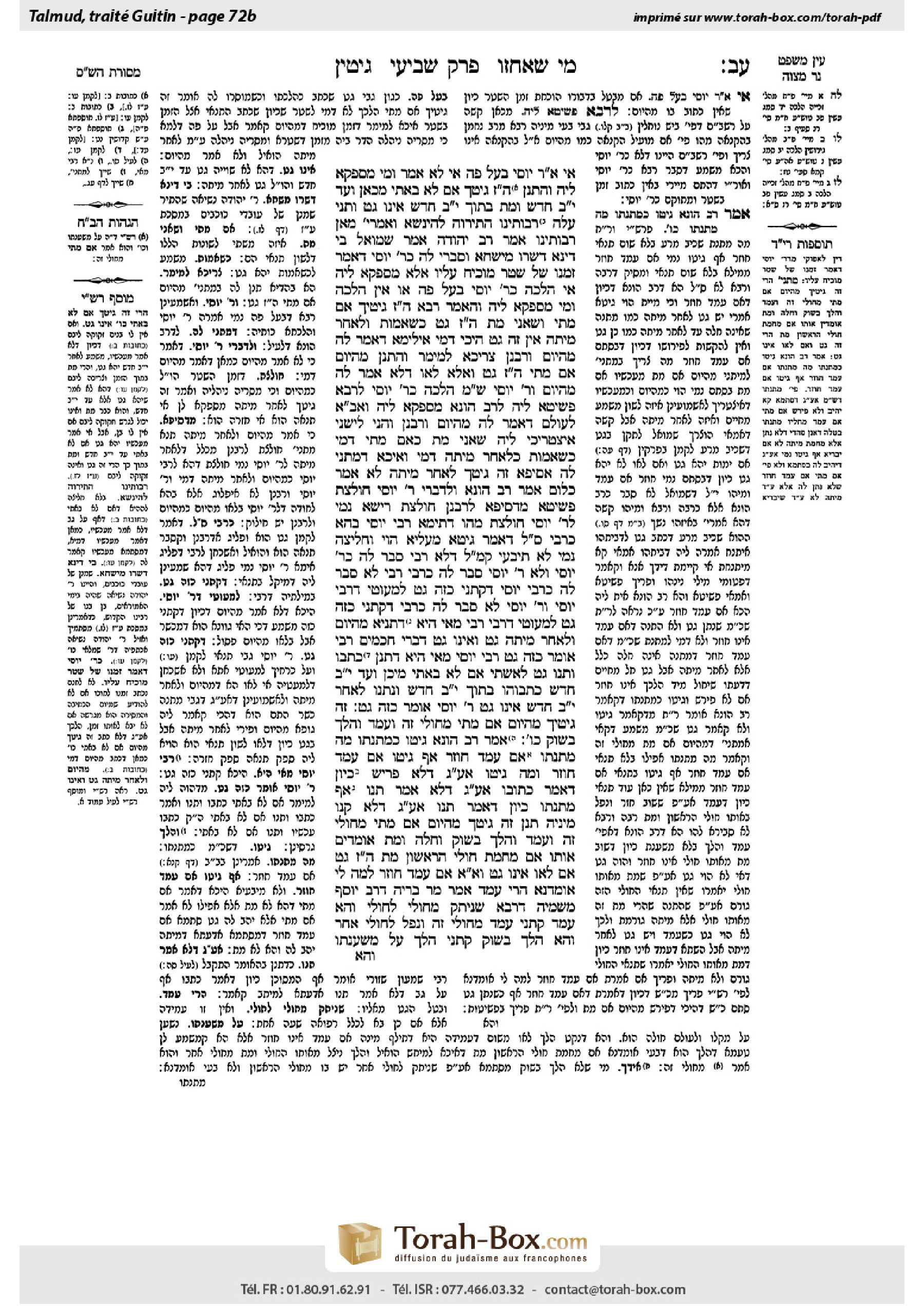
Scan : Torah-Box. Daf Study est un projet indépendant, sans affiliation ni approbation de Torah-Box ou de Sefaria.